Paid social for a fashion brand means running Facebook, Instagram and TikTok ads as one connected system — a product catalogue feeding dynamic ads, scroll-native creative built for each platform, and increasingly automated targeting on top. For apparel and footwear, three things decide whether it works: the catalogue, because it powers retargeting and shopping ads and fashion catalogues carry variants most brands set up badly; the creative, because now that targeting is largely automated the ad itself is the main lever you still control; and returns-aware measurement, because a category that returns roughly a fifth of its units online makes platform-reported ROAS look better than the business feels.
TL;DR
- The catalogue is the engine. Meta's Advantage+ catalog ads (and TikTok's shopping formats) run off your product feed — variants, sizes, colours and availability decide what gets shown and retargeted. A messy fashion catalogue caps everything downstream.
- Targeting is largely automated now — creative is the lever. Meta's automated solutions passed a $60bn annualised run-rate by late 2025; manual audience-building is no longer where the edge is. The edge moved to creative volume and quality.
- Build for the platform, not across it. A Reel is not a repurposed YouTube cut, and a TikTok is not a polished brand film. Native, mobile-first, sound-on creative with a hook in the first seconds outperforms reformatted assets.
- TikTok is discovery and demand creation for fashion; Meta is the conversion workhorse. Run them for different jobs and measure them differently.
- Signal quality decides automation quality. The Conversions API and clean event data feed the algorithms; without them, Advantage+ and Smart+ optimise on noise.
- Returns make platform ROAS a flattering number. At ~24% online apparel return rates, feed net-of-returns value back to the platforms and judge campaigns on incremental, returns-adjusted results — not last-click ROAS.
Why paid social is different for fashion
Fashion is the category paid social was almost built for — and the one most likely to flatter you with numbers that don't survive contact with the P&L. Four differences shape everything below.
It's visual and impulsive at the top, considered at the bottom. A coat can be discovered, desired and bought in a single scroll — or browsed five times across two weeks before converting. That means the same brand needs demand-creation creative (stop the scroll) and demand-capture mechanics (retarget the browse) running together.
It's catalogue-driven. Unlike a single-SKU DTC product, a fashion brand lives or dies on how its catalogue is structured — variants, sizes, colours, availability. Dynamic and shopping ads read that catalogue directly, so a sloppy product feed quietly caps performance no creative can rescue.
It's return-heavy. Online apparel returns run near 24% and footwear higher, mostly on fit. A campaign optimising to gross purchase value will happily scale the styles that come back most. Returns aren't a finance footnote here; they're a targeting input.
And it's now automation-first. The platforms have automated most of the targeting that used to be the specialist's craft. That doesn't make the specialist redundant — it moves the work to the inputs the automation can't generate itself: the catalogue, the creative, and the signal quality feeding the models.
A quick glossary
- Catalog / Advantage+ catalog ads — Meta ads that pull products from your catalogue and show the right items to the right person automatically (formerly "dynamic product ads"); the backbone of fashion retargeting and prospecting.
- Advantage+ sales campaign — Meta's automated shopping campaign (formerly Advantage+ Shopping), which automates audience and placement and leans on creative and the catalogue.
- Spark Ads — TikTok ads built from organic posts (your own or a creator's), keeping native look and social proof.
- Smart+ — TikTok's automated campaign type, its closest equivalent to Advantage+.
- Collection ad / Instant Experience — a Meta format pairing a hero video/image with a tap-through product grid — a mini storefront in-feed.
- Conversions API (CAPI) — server-side event sharing that sends conversions to Meta directly, hardening the signal against browser and tracking loss.
- Conversion Lift — a platform test measuring the incremental conversions a campaign actually caused versus a holdout, rather than what it claims.
The catalogue is the engine
Before any creative decision, get the catalogue right — because Advantage+ catalog ads, collection ads and TikTok's shopping formats all render straight from it. For fashion that means more than uploading products: variants grouped correctly so one garment shows its colours and sizes as one product, accurate availability so you're not advertising sold-out lines, clean colour and size naming that matches the product page, and editorial imagery rather than flat studio shots. Most of the retargeting value in fashion — showing someone the exact coat they browsed, or the rest of the look — depends entirely on that structure being clean.

The catalogue is also what makes browse-abandonment retargeting work, which matters disproportionately in fashion's high-browse, lower-convert pattern. The same catalog setup that powers prospecting powers the "you left this in your bag" sequence — and the recent changes to how Meta retrieves and ranks ads (its Andromeda layer) mean the system can match a far larger creative-and-catalogue pool to each person, rewarding brands that feed it more clean variety. The feed sets the ceiling; creative and budget operate underneath it.
Meta: Advantage+, catalog, and the automation shift
Meta has moved decisively toward automation, and the numbers behind that are not small: the company's end-to-end automated solutions passed a $60 billion annualised run-rate by Q3 2025, and Advantage+ Shopping alone crossed a $20bn run-rate, up about 70% year over year, the prior quarter. Meta reports figures like a $4.52 average ROAS and 22% higher returns for AI-driven targeting — treat those as the platform's own numbers and validate against your business, but the direction is unambiguous: hand-built audiences are no longer the edge.
For a fashion brand the practical setup is an Advantage+ sales campaign leaning on the catalogue, with the existing-customer budget cap set so you're not just re-buying loyal shoppers, plus catalog ads for retargeting the browse. What you actually control in that setup is creative. Meta's formats reward different jobs: Reels ads for native demand creation, carousel for showing a range or a look, and collection ads for turning a hero asset into a tap-through storefront. Advantage+ creative enhancements and AI-assisted variations let you generate volume — and volume is the point, because an automated system needs many creative options to find the winners.
The honest version of "Meta strategy for fashion" in 2026 is therefore less about audiences and more about a creative engine: enough distinct, platform-native concepts, fed in fast enough, with clean catalogue and signal underneath, that the automation has good material to optimise. Our own benchmark for what that looks like in practice is 500+ creative tests a month across the accounts we run — not because volume is a vanity number, but because automated buying turns creative into the primary variable.
TikTok: discovery, Spark Ads and shopping
TikTok plays a different role in a fashion stack. It is where discovery and cultural relevance happen — where a brand reaches people who weren't searching for it — so judging it purely on last-click conversions will always make it look weaker than it is. Its job is mostly demand creation; measure it on reach, engagement and the lift it drives in branded search and site visits, not only on in-platform purchases.
The formats that matter for fashion: In-Feed ads as the native baseline, Spark Ads that turn strong organic posts (yours or a creator's) into paid reach while keeping the native look and social proof, Video Shopping Ads that link products from a catalogue, and Smart+, TikTok's automation layer, as the equivalent of Advantage+. TikTok Shop adds in-app checkout where it's available, collapsing discovery and purchase into one surface. The creative rule is stricter than on Meta: TikTok punishes anything that looks like an ad. Native, sound-on, fast-hook video — ideally creator-style — is the only thing that travels. A polished brand film reformatted to vertical will underperform a rougher, native-feeling cut almost every time. Our guides to TikTok ads and Spark Ads cover the mechanics.
Instagram: where shopping and discovery meet
Instagram sits inside the Meta stack but earns its own note for fashion, because it's where product and aspiration overlap most. Reels ads carry the same demand-creation job as on TikTok; Stories ads suit time-bound drops and sales moments; and shopping tags plus the shop surface let discovery turn into a product view without leaving the app. For a visual category, Instagram is often where the brand's best-performing creative and its catalogue do their most natural work together — which is exactly why the catalogue hygiene above matters here most.
Creative is the lever — build it for fashion
Since the platforms automate targeting, the creative is where a fashion brand wins or loses. A few principles that hold across Meta and TikTok:

- Mobile-first and motion-first. Fabric in motion, fit on a real body, the garment doing something — static studio packshots underperform video for apparel almost everywhere except the catalogue grid.
- Hook in the first beat. The first second on TikTok and the first frame on Reels decide whether the rest is seen.
- UGC and creator-style for the top, brand-grade for the bottom. Native, authentic-feeling content earns discovery; cleaner brand creative converts the people already considering you. Run both.
- Variety over polish. Automated buying needs many angles — product, lifestyle, social proof, offer-free desire — to find what each audience responds to. One perfect ad is fewer shots on goal than ten good ones.
- Show the range. Carousel and collection formats let a fashion brand show a look or a category, not just one SKU — which suits how people actually shop fashion.
Targeting and measurement that survive returns
With targeting automated, two inputs decide how well the automation performs — and both are easy to neglect.
The first is signal quality. Advantage+ and Smart+ are only as good as the events you feed them. The Conversions API and clean, server-side measurement harden the signal against tracking loss, and feeding net-of-returns value rather than gross purchase value stops the system scaling your highest-return styles. On a category returning a fifth of its units, that single change reshapes what the algorithm learns to chase.
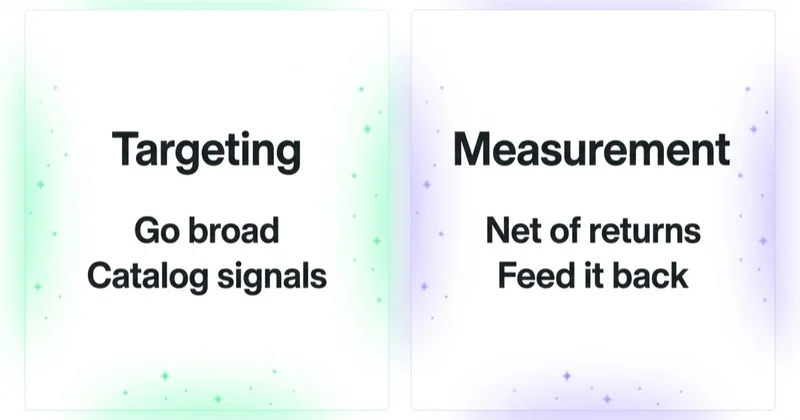
The second is measurement that isn't last-click. Platform-reported ROAS can overstate contribution because each platform attributes results inside its own rules and windows — and on fashion, returns widen the gap further. Use incrementality tests and platform Conversion Lift to measure what a campaign actually caused, account for the long consideration window with view-through where appropriate, and report blended, returns-adjusted results against the order book. The point is to connect platform signals to the business so budget lands where it actually delivers.
How we approach this at Space Ads
We run daily audits across 25+ client accounts and analyse roughly 14 million data points a month through Space Ads OS, and several of those are fashion and footwear brands. On paid social, the work is less about finding a hidden audience and more about feeding automation better inputs: catalogue, creative, event quality and returns-adjusted value.
Creative volume, not audience tinkering, moves the needle now. Once targeting is automated, the accounts that improve are the ones feeding the system enough distinct, platform-native concepts to find winners — which is why our cadence runs to 500+ creative tests a month rather than a handful of "hero" ads polished to death.
The catalogue is the quiet constraint. Before we scale Meta or TikTok, we check variant structure, availability, imagery and whether the catalogue supports the way people actually browse a fashion range. Public work for Philipp Plein, Plein Sport and ZAXY shows the same principle across premium fashion and footwear: the social campaign performs better when feed, analytics and ecommerce reality are run together.
Headline ROAS and real ROAS diverge once returns are in. We reconcile platform-reported conversions against GA4, ecommerce data and the order book, then judge paid social on incremental, returns-adjusted contribution rather than a screenshot from one platform. For the channel-by-channel version for premium fashion and footwear, that's what our fashion & footwear paid media practice is built around.
A build order for paid social on a fashion brand
- Fix the catalogue and signal first. Variant grouping, sizes, availability, imagery; install the Conversions API and feed net-of-returns value before scaling spend.
- Stand up the conversion workhorse. Advantage+ sales campaign on Meta leaning on the catalogue, with catalog ads for browse-abandonment retargeting and the existing-customer cap set deliberately.
- Build the creative engine. Many platform-native concepts per month — Reels, carousel, collection on Meta; native, hook-first video on TikTok — not a few polished assets.
- Run TikTok for what it's good at. Discovery and demand creation via In-Feed and Spark Ads, measured on lift and branded-search, not last-click.
- Measure honestly. Incrementality and Conversion Lift, blended and returns-adjusted ROAS against the order book; reallocate by contribution, not platform-claimed return.
Stop doing / do instead
| Stop doing | Do instead |
|---|---|
| Hand-building audiences as the main lever | Feed automated buying many platform-native creatives |
| Reusing one polished asset everywhere | Build for each platform; many angles over one "hero" |
| Optimising to gross purchase value | Feed net-of-returns value via the catalogue and CAPI |
| Judging TikTok on last-click ROAS | Measure it on reach, lift and branded-search |
| Trusting platform-reported ROAS | Reconcile against the order book; use Conversion Lift |
| Treating the catalogue as setup-once | Keep variants, availability and imagery clean continuously |
Common mistakes
- Audience obsession in an automated era — spending the hours on audience splits the platform now does itself, instead of on creative and signal.
- A weak catalogue — bad variant grouping and stale availability cap dynamic and shopping ads before any budget helps.
- Ad-shaped TikToks — repurposed brand films that the platform and the audience both reject.
- Gross-value optimisation — scaling the styles that get returned most because the value signal ignores returns.
- Last-click verdicts on TikTok — cutting a demand-creation channel because it doesn't close the sale it started.
- Neglected signal — running Advantage+ and Smart+ on noisy events and blaming the algorithm.
FAQ
Do Facebook and Instagram ads work for clothing brands?
Yes — Meta is usually the conversion workhorse of a fashion brand's paid social, because its catalog ads and Advantage+ sales campaigns turn a product feed into highly relevant prospecting and retargeting. The performance depends on three things: a clean catalogue (variants, sizes, availability), enough platform-native creative for the automation to optimise, and signal quality through the Conversions API. Audience targeting is largely automated now, so creative and catalogue are where you win.
How are TikTok ads different for fashion brands?
TikTok is a discovery and demand-creation channel first, not a last-click conversion channel. It reaches people who weren't searching for your brand, so it's measured better on reach, engagement and branded-search lift than on in-platform purchases. Creative rules are stricter than Meta's: native, sound-on, hook-first video — often Spark Ads built from organic or creator posts — works, while reformatted brand films underperform.
What's the best ad format for fashion on Meta?
It depends on the job. Reels ads drive native demand creation, carousel ads show a range or a full look, collection ads turn a hero asset into a tap-through storefront, and catalog ads handle retargeting the exact products someone browsed. Most fashion brands run a mix, with the catalogue underneath all of them — and feed the automated campaign many creative variations rather than relying on one.
Should a fashion brand use Advantage+?
For most, yes — Meta's automation now drives a large and growing share of its ad revenue, and manual audience-building is rarely the edge anymore. The work shifts to inputs the automation can't make itself: a clean catalogue, net-of-returns value signals through the Conversions API, the existing-customer budget cap set so you're acquiring rather than re-buying, and a steady stream of platform-native creative.
How do returns affect Facebook and TikTok ads for fashion?
Significantly. With online apparel returns near 24%, optimising to gross purchase value rewards the styles that get returned most. Feed net-of-returns value back to the platforms so the algorithms learn real contribution, and report blended, returns-adjusted ROAS rather than platform-reported numbers — otherwise a campaign can look profitable while losing money on returns.
How do you measure paid social when fashion purchases take weeks?
Don't rely on last-click. Use platform Conversion Lift and independent incrementality tests to measure what a campaign actually caused, account for the long consideration window with view-through where it's justified, and reconcile platform numbers against GA4 and the order book. The goal is to connect platform-reported results to real, returns-adjusted business revenue.
In short
- Paid social for fashion is one system: a clean catalogue, platform-native creative, and automated targeting on top.
- Targeting is automated now — creative volume and catalogue quality are the levers you still control.
- Meta is the conversion workhorse; TikTok is discovery and demand creation; build and measure them for different jobs.
- Signal quality (Conversions API) and net-of-returns value decide how well the automation performs.
- Returns make platform ROAS flattering — measure incremental, returns-adjusted results against the order book.
Sources and further reading
- Meta — Advantage+ shopping ads
- Meta for Developers — Conversions API
- Meta — Q3 2025 investor materials
- TikTok for Business — Solutions and ad formats
- TikTok for Business — Spark Ads
Continue learning
- Luxury fashion marketing: how premium brands build desire (not discounts)
- Google Ads for fashion e-commerce: Search, Shopping, Performance Max & Demand Gen
- Meta Advantage+: what it is and how it works after the changes
- Meta Andromeda: what it is and how to adapt your Meta Ads in 2026
- TikTok ads: how to start and run campaigns
- What is a product feed and how to use it
Continue reading
How to Market a Fashion Brand in 2026: A Complete Strategy for Premium Labels
This article turns broad fashion marketing advice into board-level choices: which growth you refuse to buy with markdowns, how to avoid harvesting-only media plans, what product data must be trusted, and how to separate real demand from platform attribution.
How to Market a Footwear Brand: Sizing, Drops, Returns and Paid Media
Footwear marketing needs more than generic fashion advice. This guide explains how to use sizing data, product feeds, fit content, returns-aware measurement, drops, paid media and retention to sell shoes profitably.
Google Ads for Fashion E-commerce: Capturing and Creating Demand with Search, Shopping, Performance Max & Demand Gen
This guide treats Google Ads for fashion as a merchandising and economics problem first. It covers the feed rules, Performance Max controls, Demand Gen use cases and return-adjusted conversion values that decide whether Search and Shopping scale profitably.