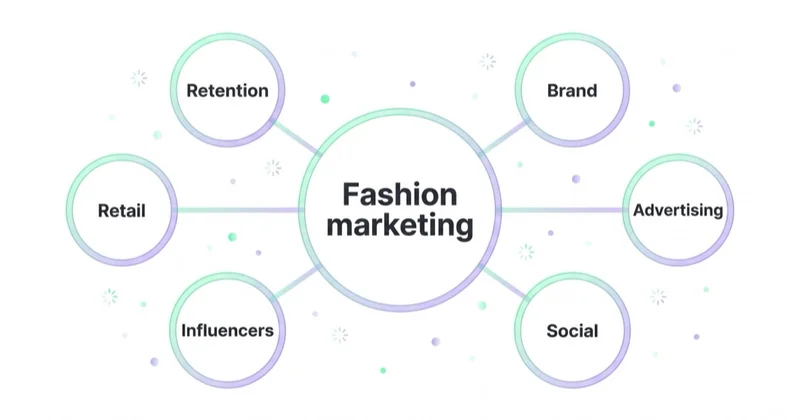
Fashion marketing is the discipline of creating demand for apparel, footwear and accessories, converting that demand into fulfilled sales and building customer and brand value over time. It connects positioning, product and price architecture, creative, social media, creators, paid advertising, ecommerce merchandising, retail, PR, CRM and commercial measurement.
The important point is that fashion marketing is not just "running ads for clothes." Fashion is bought through identity, aspiration, fit, styling, social proof and timing. A person may discover a brand on TikTok, save a look on Instagram, search the brand later, compare sizing, wait for payday, visit a store, return one size and buy again in a different category months later. The marketing system has to account for that full journey.
This guide is the map of the discipline. For the board-level strategy of growing a premium fashion label without relying on discounts, go deeper in how to market a fashion brand. For the paid-media execution layer, see how to advertise a clothing brand.
TL;DR
- Fashion marketing is a connected system. Brand, social, creators, paid media, ecommerce, retail and retention work together; they should not be planned as isolated channels.
- Fashion is desire-led and visually discovered. People often see the product before they search for it, so demand creation matters as much as demand capture.
- The 2026 market rewards sharper value. Consumers are more selective, growth is harder, AI is changing product discovery, and brands need clearer reasons to buy.
- Product data is now marketing infrastructure. Feeds, categories, variants, size, color, availability, images and returns data shape Shopping, social commerce, AI shopping and onsite conversion.
- Creators and social supply paid-media hypotheses. Organic response can help shortlist products, hooks and styling contexts, but paid performance still requires a fair test.
- Returns, markdowns and stock change the economics. ROAS based on gross placed-order revenue can scale the wrong products. Reporting needs fulfilled net sales, contribution, new-customer quality and mature repeat cohorts.
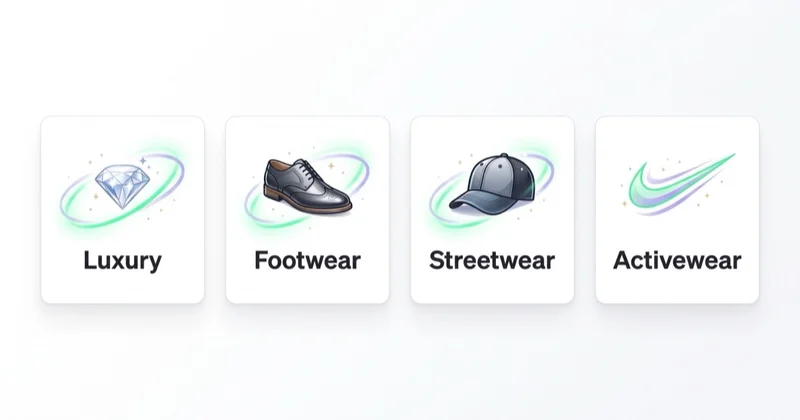
- Segments need different playbooks. Luxury, footwear, streetwear, activewear, beauty-adjacent fashion and mass-market apparel do not grow the same way.
What is fashion marketing?
Fashion marketing is the set of decisions and activities that make a fashion offer relevant, distinctive, discoverable and commercially viable. It covers the strategic work of deciding whom the brand serves, what value it represents and how the assortment earns its price, plus the operational work of getting products seen, evaluated, bought, delivered, kept and purchased again.
The discipline usually includes:
- brand positioning and visual identity;
- campaign concepts, creative direction and storytelling;
- organic social media and community;
- influencer and creator programs;
- PR, editorial, collaborations and cultural moments;
- paid media across Google, Meta, TikTok, Pinterest, YouTube and other platforms;
- ecommerce merchandising, product feeds and landing pages;
- retail, wholesale and marketplace presence;
- CRM, loyalty, email, SMS and customer retention;
- analytics, attribution, incrementality and margin measurement.
A useful operating model does not give each department a separate version of performance. Social provides creative and community signals. Paid media records attributed demand under its own measurement rules. Ecommerce data shows which products are fulfilled, kept and repurchased. CRM shows cohort behavior. Merchandising contributes stock, sell-through and markdown context. Finance reconciles revenue and contribution. The team can then make one decision while preserving the limitations of every data source.
Build the fashion marketing strategy before the channel plan
A channel calendar is not a strategy. Before assigning budget, answer seven connected questions:
- Commercial objective: is the priority profitable new-customer growth, full-price sell-through, entry into a market, repeat purchase or clearing a defined inventory position?
- Priority customer and occasion: who is the offer for, what job or identity does it serve and what triggers the purchase now?
- Positioning and evidence: why this brand at this price, and which product, service or cultural proof supports that claim?
- Assortment role: which items recruit customers, express the brand, create margin, drive repeat buying or complete a look?
- Constraints: what do stock by size, production lead times, fulfillment, creative capacity, cash and return risk allow?
- Channel job: which routes create discovery, support evaluation, capture intent, convert existing customers or build retail demand?
- Decision system: what evidence releases more budget, pauses a product or changes the creative and merchandising plan?
This prevents a common failure: marketing scales demand for a product whose profitable sizes are unavailable, whose return rate is already high or whose replenishment lead time is too long. The plan should use variant-level inventory and mature order economics, not only a top-line revenue target.
The product and price architecture
Every item does not need the same acquisition target. Map products into roles such as:
| Product role | Marketing implication |
|---|---|
| Brand icon | Protect recognizability and availability; use it to explain the brand |
| New-customer entry | Judge downstream cohort quality, not first-order volume alone |
| Margin driver | Scale only while full-price demand and stock depth remain healthy |
| Outfit or basket builder | Measure attach rate and contribution across the order |
| Repeat or replenishment item | Connect acquisition with lifecycle timing and retention |
| Seasonal or drop product | Plan release, scarcity and exit rules before launch |
Discounting should be a deliberate pricing and inventory decision. If promotions become the default acquisition proposition, platform performance may improve while full-price demand, gross margin and customer expectations deteriorate.
Why fashion marketing is different
Fashion has several traits that change the marketing playbook.
It is identity-led. A product is not only evaluated on function. It signals taste, status, community, body confidence, lifestyle and belonging.
It is visual and social. A dress, sneaker, jacket or bag often becomes desirable because it is seen on a person, in motion, in context. Search frequently happens after social discovery.
It is catalog-heavy. Marketing performance depends on variants, sizes, colors, images, availability, pricing, sale status and product taxonomy. A weak feed can hold back every paid channel.
It has high return risk. Sizing, fit, material expectations and occasion buying all affect profitability. A campaign that looks strong on gross revenue can be weak after returns and exchanges.
It is seasonal and culturally timed. Drops, collections, weather, holidays, festivals, sports, travel, back-to-school, Black Friday and sale periods all affect demand.
It can create repeat value. A first purchase may lead to buying across categories and seasons, but that possibility is not guaranteed. Use mature, realized cohorts by first product, discount status, market and acquisition source before increasing an allowable CAC on the basis of forecast lifetime value.
The 2026 context for fashion marketers
Fashion marketing in 2026 is being shaped by cautious demand, uneven consumer confidence, supply and tariff exposure, faster platform automation and new shopping interfaces. Industry forecasts are scenarios rather than facts for an individual brand; the response should be based on its own market, stock, price position and customer evidence.
That creates several practical implications:
- The value proposition must be sharper. Consumers are asking whether quality, design, service and brand meaning justify the price.
- Efficiency cannot mean performance-only. Cutting brand and creative investment may protect short-term ROAS while weakening future demand.
- AI shopping adds another discovery surface. Google introduced limited Merchant Center reporting for organic visibility in AI Mode and AI Overviews in 2026, while direct agentic checkout remains available only to selected merchants and markets. Product data quality matters now; broad adoption should not be assumed.
- Resale and circularity can affect perception. The importance varies by segment, market and customer. Avoid using vague environmental language as a substitute for measurable product facts.
- Retention is more important. When new-customer acquisition is expensive, repeat purchase, replenishment, loyalty and community become strategic, not only CRM tactics.
For marketers, the response is not to chase every trend. It is to build a clearer system: sharper positioning, better product data, stronger creative signals, a healthier brand-performance balance and measurement that reflects real economics.
The main disciplines of fashion marketing
| Discipline | Its job | What good looks like |
|---|---|---|
| Brand strategy | Define why the brand should exist and who it is for | Clear positioning, price logic, audience and point of view |
| Creative and campaigns | Make the brand desirable and recognizable | Consistent concepts, strong visuals, native formats |
| Organic social | Build relevance, service the community and learn | Retention, saves, qualified comments, product questions and content learning |
| Influencer marketing | Add creator context and credible product demonstration | Creator fit, rights, disclosure, fulfilled outcomes and paid-test utility |
| PR and collaborations | Build cultural credibility | Editorial fit, tastemaker adoption, launch moments |
| Paid media | Capture demand and test incremental reach | Search, Shopping, Meta, TikTok, YouTube and Pinterest by assigned role |
| Ecommerce | Convert interest into orders | Product pages, size guidance, feed quality, checkout and returns |
| Retention | Grow repeat purchase and LTV | Segmentation, lifecycle flows, drops, loyalty and customer quality |
| Analytics | Support decisions without hiding uncertainty | Fulfilled net sales, contribution, incrementality, cohorts and data quality |
The connections are where most of the value is created. A creator try-on can become a TikTok Spark Ad. A PR moment can lift branded search. A high-return product can be excluded from aggressive scaling. A customer cohort can reveal which first orders lead to profitable repeat behavior.
Channel roles in fashion marketing
Fashion channels should be planned by job, not by platform preference.
| Channel | Primary role | Best use | Main measurement |
|---|---|---|---|
| Shopfront, aspiration and customer context | Visual identity, product styling, creators and releases | Retention, saves, product actions and tested lift | |
| TikTok | Discovery and creative learning | Native video, creators, hooks and product storytelling | Watch quality, shares, qualified visits and tested lift |
| Visual planning and inspiration | Occasion, seasonal, home/lifestyle-adjacent fashion | Saves, outbound clicks, assisted conversions | |
| Google Search | Demand capture | Brand, category and problem-aware searches | Search terms, conversion value, new customer quality |
| Google Shopping / PMax | Product demand capture | Feed-led commerce across eligible inventory | Fulfilled value, contribution and product-level performance |
| Meta Ads | Prospecting, retargeting and catalog delivery | Creative testing, product sets and creator amplification | New-customer contribution and incremental evidence |
| YouTube | Brand and product education | Launches, founder story, collection world, proof | Reach, view quality, search lift, assisted demand |
| Email / SMS | Retention and drop conversion | Newness, replenishment, back-in-stock, VIP access | Repeat rate, revenue per subscriber, margin |
| Retail / wholesale | Trust and physical experience | Fit, service, discovery, local demand | Sell-through, repeat rate, omnichannel behavior |
This is why comparing every channel on last-click ROAS is misleading. TikTok may precede a Google search, and email may convert someone acquired earlier, but an observed sequence does not prove which contact caused the order. Assign leading and commercial measures to each role, then use controlled tests, blended trends and finance reconciliation to make budget decisions.
Fashion advertising inside the wider marketing system
Fashion advertising is the paid layer of fashion marketing. It usually has two jobs:
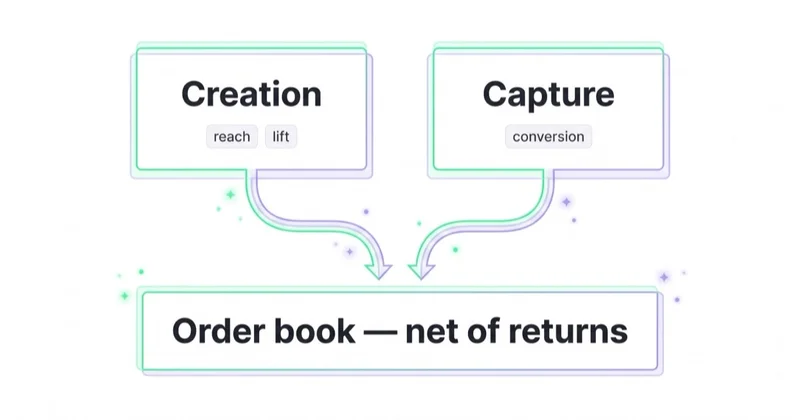
- Capture existing demand. Brand search, Shopping, retargeting, category search and product remarketing.
- Create new demand. Prospecting on Meta, TikTok, YouTube, Pinterest, creators and video.
The mistake is funding only the capture layer because it looks cleaner in attribution. That can work for a short period, especially if the brand already has demand, but it eventually runs into a ceiling. The market stops growing because the brand is no longer creating enough new desire.
A stronger paid plan uses organic and creator work as one source of creative hypotheses. Social response can reveal product questions, styling contexts and possible hooks. Paid media then tests authorized assets under comparable conditions and scales only after a defined commercial signal. This is the logic behind fashion influencer marketing, social media marketing for fashion brands and Facebook, Instagram and TikTok ads for fashion brands.
Product data as marketing infrastructure
Fashion marketing increasingly depends on product data quality. The feed is not a back-office file. It is the source that platforms use to understand, match, rank, recommend and advertise products.
Important data points include:
- product title and product type;
- brand, category and collection;
- size, color, material, pattern and gender where relevant;
- images and video assets;
- price, sale price and margin tier;
- availability and variant-level stock;
- return rate and exchange rate;
- product reviews and fit feedback;
- shipping, return policy and delivery promise.
This matters across Google Shopping, Performance Max, Meta catalog ads, TikTok Shop where available, marketplaces and AI-assisted discovery. In May 2026, Google added the variant_option attribute so merchants can explicitly identify properties that define a variant. For apparel, size and color still need their dedicated attributes, each variant needs its own item, and related variants should share an item_group_id. Product structured data should agree with Merchant Center values for price, currency, availability, condition and other supported fields.
Feed optimization is not only about approval, but not every commercial variable belongs in a public feed. Customer-facing product facts—identity, variants, price, stock, materials, images, shipping and returns—must be accurate. Internal labels and campaign structures can then reflect margin tier, season, stock depth, return risk and merchandising priority without exposing confidential unit economics.
AI search and LLM visibility for fashion
AI-assisted search adds conversational routes to fashion discovery: recommendations, comparisons, outfit ideas, sizing guidance and occasion-based questions. In 2026, Google's AI performance insights report is still a limited US pilot in Merchant Center, with other markets announced for later expansion. Treat its share-of-voice and journey classifications as platform diagnostics, not audited market share.
Fashion brands should prepare by strengthening:
- clear category pages for use cases and occasions;
- product pages with material, fit, care and sizing detail;
- comparison content where it helps the user choose;
- brand pages that explain positioning, values, origin and product logic;
- reviews and customer language;
- internal links between guides, categories and products;
- structured data that matches visible page content;
- crawlable, text-based explanations rather than image-only storytelling.
This is not a separate technical discipline from good SEO and product content. Google does not require a special “AI schema.” Use supported Product and Offer structured data that matches the visible page, keep important information crawlable, and build original pages that genuinely help a buyer choose. Visibility in any generative answer remains selective and cannot be guaranteed.
Measurement: how to avoid misleading ROAS
Fashion marketing is easy to misread because platform attribution is optimistic and returns are commercially important. A Meta or Google report may show strong gross conversion value while the business sees weak contribution after returns, discounts, fees and product cost.
A better measurement model includes:
| Layer | What to measure |
|---|---|
| Revenue quality | placed, fulfilled and kept revenue; returns, cancellations and discounts |
| Contribution | kept revenue less product, fulfillment, payment, creator, affiliate and media costs under a documented definition |
| Customer quality | new-customer rate, realized repeat purchase and mature cohort contribution |
| Demand creation | branded search and direct traffic as diagnostics; controlled lift where feasible |
| Product performance | SKU-level margin, stock, return rate, sell-through |
| Channel role | discovery, consideration, capture, retention |
| Incrementality | geo tests, holdouts, conversion lift or MMM where scale allows |
The goal is not to reject platform data. It is to use each source for the decision it can support. Platform reports help diagnose delivery and optimize within that platform. The order system establishes fulfilled and returned revenue. Finance defines contribution. CRM identifies customers and cohorts. Experiments estimate incrementality. Budget decisions should reconcile these views without adding overlapping attributed revenue together.
The minimum fashion trading view
At product group, market and acquisition-source level, review:
- spend and creator or affiliate cost;
- placed, cancelled, fulfilled and returned orders;
- full-price versus discounted revenue;
- contribution under a finance-approved definition;
- new-customer rate and first-product mix;
- stock cover and size availability;
- mature repeat behavior by cohort;
- platform-attributed outcomes alongside controlled or blended evidence.
A strong campaign can still be a poor trading decision if it empties only the easy sizes, accelerates returns or creates demand that cannot be replenished. Marketing, merchandising and finance should therefore share a weekly decision rhythm during launches and peak periods.
Fashion marketing by segment
Different fashion segments need different playbooks.
- Luxury and premium fashion requires price integrity, scarcity, clienteling, editorial context and carefully controlled performance pressure.
- Footwear depends heavily on sizing, comfort, returns, drop logic, fit education and product feed precision.
- Streetwear and sneakers run on community, scarcity, culture, drops, collaborations and resale signals.
- Activewear and athleisure combine performance proof, lifestyle identity, community and repeat purchase.
- Mass-market apparel needs operational excellence: feed depth, price architecture, creative volume, retail media, promo discipline and retention.
- Premium contemporary brands often win by elevating product quality, storytelling and service without drifting into luxury pricing that the brand cannot justify.
The common thread is that positioning and economics decide the channel mix. A luxury playbook applied to mass apparel can underinvest in conversion. A discount-led mass playbook applied to premium fashion can damage the brand.
How Space Ads approaches fashion marketing
Our standard approach treats fashion marketing as one connected commercial system: brand demand, merchandising, paid media, creative, product data, ecommerce UX, analytics and retention need the same commercial definitions. The audit begins with positioning, product roles, stock, contribution, data quality and decision ownership before changing channel tactics.
Then each channel receives a job and guardrails. Creators and organic social generate context and creative hypotheses. Paid social tests selected assets. Google captures search and product demand. CRM supports service and repeat purchase. Reporting connects the activity with fulfilled net sales, contribution, stock, returns and mature cohorts. More budget is released when the marginal evidence and operating capacity justify it—not because one platform reports a high historical ROAS.
For brands that already spend but cannot see where growth is leaking, a marketing audit can identify whether the blocker is strategy, feed quality, tracking, creative, channel mix, landing pages, returns or retention. For fashion and footwear specifically, this connects with fashion and footwear paid media, Google Ads, Meta Ads and TikTok Ads.
Common mistakes in fashion marketing
| Mistake | Why it hurts | Better approach |
|---|---|---|
| Treating marketing as ads only | The brand stops creating future demand | Connect brand, social, creators, paid and retention |
| Comparing all channels on last-click ROAS | Demand creation gets undervalued | Measure each channel by its role |
| Optimizing to gross revenue | Returns and margin get ignored | Use net revenue and contribution metrics |
| Ignoring product feed quality | Platforms cannot match or scale products properly | Treat product data as marketing infrastructure |
| Scaling without size-level stock | Demand concentrates on unavailable or unprofitable variants | Join marketing decisions with stock cover and replenishment |
| Copying a segment playbook | Luxury, streetwear, footwear and activewear behave differently | Start from positioning and economics |
| Overusing discounts | Customers learn to wait and margin erodes | Use price architecture, value proof and retention |
| Separating creators from paid | Rights and learning are lost between teams | Test suitable authorized creator assets in paid media |
FAQ
What is fashion marketing?
Fashion marketing is the discipline of building demand for apparel, footwear and accessories and converting that demand into profitable sales. It includes brand strategy, social media, influencer marketing, PR, paid advertising, ecommerce, retail, CRM and measurement.
What makes fashion marketing different from regular marketing?
Fashion is highly visual, identity-led, seasonal and catalog-heavy. Products are often discovered socially before they are searched for, and profitability is affected by sizing, returns, stock, margin and repeat purchase. That makes brand-building, creative, product data and net measurement especially important.
What are the main fashion marketing channels?
The main channels are Instagram, TikTok, Pinterest, Google Search, Google Shopping, Meta Ads, YouTube, creators, PR, email, SMS, retail and marketplaces. Each channel has a different role, so the best strategy assigns jobs instead of comparing everything on one attribution metric.
What is the difference between fashion marketing and fashion advertising?
Fashion advertising is the paid media layer: buying reach, traffic and sales through platforms such as Google, Meta, TikTok, Pinterest and YouTube. Fashion marketing is broader. It also includes positioning, creative, social, influencers, PR, ecommerce, retail, retention and analytics.
How should fashion marketing be measured?
Fashion marketing should be measured against fulfilled net sales, a documented contribution definition, returns, full-price sell-through, new customers, stock position and mature repeat cohorts. Branded search and assisted conversions can diagnose demand paths; experiments provide stronger incrementality evidence. Platform ROAS is useful for in-platform optimization but is not a complete budget metric.
How does AI change fashion marketing?
AI changes both operations and discovery. It can support governed workflows for product data, service, creative variants and analysis, while shoppers can encounter products in conversational results. In 2026, Google's Merchant Center AI visibility report and agentic checkout remain limited by account and market. Brands should invest in accurate product data and useful crawlable content without assuming guaranteed inclusion.
Key takeaways
- Fashion marketing is the connected discipline of creating desire and converting it into profitable sales.
- The strongest systems connect brand, social, creators, paid media, ecommerce, retail and retention.
- In 2026, product and variant data, stock, value perception, retention and new shopping surfaces require joint marketing and merchandising decisions.
- Fashion performance must be measured on fulfilled, returns-adjusted contribution and mature cohorts—not only platform-reported gross ROAS.
- Segment context matters: luxury, footwear, streetwear, activewear and mass apparel need different growth systems.
Sources and further reading
- McKinsey and The Business of Fashion - The State of Fashion 2026
- Google Merchant Center Help - Size, variants and the 2026 variant option update
- Google Merchant Center Help - Supported structured data attributes
- Google Merchant Center Help - AI performance insights
- Meta - Advantage+ sales campaigns
- Google Search Central - Creating helpful, reliable, people-first content
Continue learning
Continue reading
Fashion PR in 2026: What It Is and How It Works With Performance Marketing
Fashion PR builds credibility, desire and cultural relevance through earned attention: editorial coverage, events, gifting, stylists, creators and digital PR. This guide explains how PR should connect with performance marketing so demand is captured, not wasted.
Social Media Marketing for Fashion Brands: Organic, Creators, Commerce and Paid
Social media marketing for fashion brands works when organic content, creators, social commerce and paid amplification operate as one system. This guide explains platform roles, content pillars, creator rights, catalogue hygiene, measurement and how to turn attention into profitable demand.

How to Market a Fashion Brand in 2026: A Complete Strategy for Premium Labels
This article turns broad fashion marketing advice into board-level choices: which growth you refuse to buy with markdowns, how to avoid harvesting-only media plans, what product data must be trusted, and how to separate real demand from platform attribution.