Google Ads vs Facebook Ads is not a choice between a universally “better” and “worse” platform. It is a decision about where a specific audience can be reached, what the campaign should accomplish and which customer outcome the business can measure. Google Search remains powerful for expressed intent. Meta Ads across Facebook and Instagram remains powerful for visual discovery and repeated exposure. Both platforms, however, now span more of the journey than that simple distinction suggests.
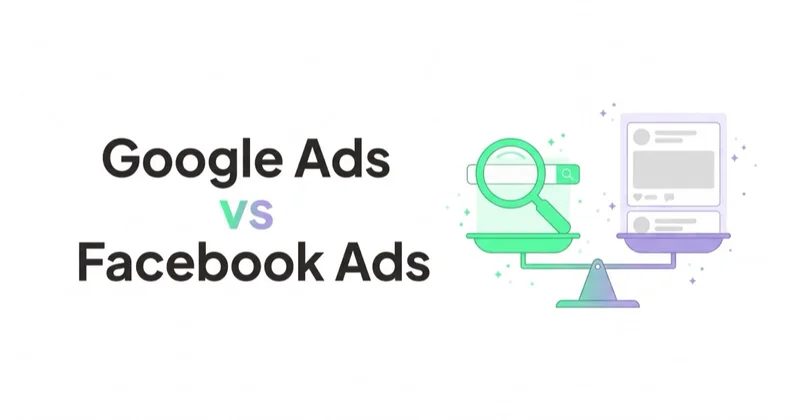
Google also offers visual, non-search inventory through YouTube, Demand Gen and Performance Max. Meta can generate purchases, qualified leads and calls directly. The useful comparison is therefore Search vs feed, intent capture vs demand creation, or product feed vs creative-led discovery at campaign level—not Google vs Meta as fixed funnel stages.
For a mature paid media strategy, the better question is not "Google Ads or Facebook Ads?" It is: which channel should start, what job should each channel perform, and how should the business measure the combined funnel without double-counting conversions?
TL;DR
- Start with the customer and campaign job. Search captures expressed intent; visual and feed placements can create discovery on either platform.
- Google Search is usually strongest for existing demand. It can reach category, product, comparison, problem and local-service queries at the moment they are expressed.
- Meta is usually strongest for creative-led discovery. Facebook and Instagram can demonstrate a product, test propositions, build reach and drive direct response.
- Neither platform is universally cheaper. Google often works around CPC, while Meta often starts from CPM, but the decision should be based on valuable conversion cost and customer value.
- The first channel depends on evidence, not a rule. Consider addressable demand, creative strength, gross or contribution margin, sales cycle and the volume needed to learn.
- Do not split a small test budget automatically. One well-defined channel hypothesis is often more informative than two underfunded campaigns.
- Platform attribution can mislead. The same buyer may see a Meta ad, search the brand on Google and buy after a Search click.
- Modern delivery is highly automated. Durable inputs are accurate conversion values, clean feeds, strong creative, relevant landing pages and privacy-aware first-party measurement.
The fundamental difference: intent vs discovery
Google Search works closest to active, stated intent. A person types a query such as “emergency plumber near me,” “running shoes for flat feet,” “CRM for a small business” or “black leather tote bag.” Search and Shopping can connect the advertiser with that request, provided the keyword or product match, geography, eligibility and offer are right.
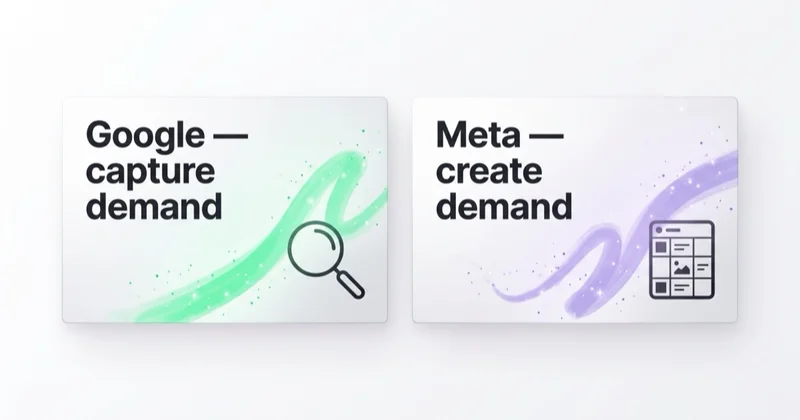
Facebook and Instagram ads usually appear while the person is scrolling Feed, Reels or Stories rather than searching for the advertiser's category. The creative has to earn attention and make relevance understandable quickly. Product-market fit, proposition, proof and landing-page continuity therefore matter at least as much as audience settings.
In simplified terms:
- Google Search is a major demand-capture environment.
- Meta is a major creative-led discovery environment.
- Remarketing in both channels brings back people who already interacted with the brand.
That distinction is directional, not absolute. In June 2026, Google began offering eligible advertisers migration of Display campaigns into Demand Gen, expanding a visual campaign type across YouTube, Discover, Gmail, Maps and the Google Display Network. Performance Max can serve across Search, Shopping, YouTube, Display and other Google inventory. Meta's Advantage+ Sales campaigns automate audience, placement, budget and creative decisions toward sales. Compare the campaign architecture and its assigned role, not outdated platform stereotypes.
Google Ads vs Facebook Ads at a glance
| Area | Google Ads | Facebook Ads / Meta Ads |
|---|---|---|
| Main environments | Search, Shopping, YouTube, Discover, Gmail, Maps and Display inventory | Facebook, Instagram, Messenger and eligible partner inventory |
| Clearest advantage | Query and product intent in Search and Shopping | Creative-led discovery in Feed, Reels and Stories |
| Typical campaign jobs | capture search, sell products, generate demand, remarket, drive local actions | create reach, demonstrate products, generate sales or leads, remarket |
| Main scaling constraint | eligible demand, auction competition, feed and conversion-signal quality | creative supply, audience size, offer strength and conversion-signal quality |
| Operational diagnostics | search terms, impression share, feed issues, assets, conversion lag and values | creative breakdowns, frequency, CPM, landing-page progression and event quality |
| Data inputs | tags, consent state, enhanced conversions, CRM outcomes and product feed | Pixel, Conversions API, CRM or offline outcomes and catalog |
| Core risk | paying for existing or low-value intent without separating its role | attributing view-through or retargeted demand as wholly incremental |
When Google Ads is the better first choice
Google Ads is usually the better first channel when demand already exists in search. This applies to services, products that people compare before buying, urgent needs, local searches and categories where users start research by typing a query.
Examples:
- local services such as plumbers, dentists, clinics, law firms, repair services and contractors;
- e-commerce products searched by model, brand, material, category or problem;
- B2B software and services where buyers search for integrations, alternatives, pricing or suppliers;
- higher-value products that require research;
- brand and non-brand Search campaigns with clear intent;
- queries including "price," "reviews," "near me," "book," "agency," "best," "alternative" or "buy."
When a small budget must test an existing-demand hypothesis, tightly scoped Search or Shopping can produce clearer query or product feedback than broad prospecting. That does not guarantee profitable volume: expensive auctions, weak landing pages, low margins and poor lead handling can make high intent unviable.
The limitation is equally clear: Search cannot capture queries that do not exist. Once the profitable share of eligible demand is reached, additional growth may require category education, brand building, product development, partnerships, creators, PR, content or broader paid inventory—not simply higher Search bids.
When Facebook Ads / Meta Ads is the better first choice
Meta can be the stronger first test when the product needs to be demonstrated before people know what to search, or when a visual proposition carries more information than a short query. This is common in fashion, beauty, interiors, food, apps and emerging categories, but the product still needs sufficient economics and a credible path from attention to action.
Examples:
- fashion, beauty, jewelry, interiors, food, DTC and giftable products;
- new or unfamiliar products with low search volume;
- brands that need awareness, trust and preference before search demand exists;
- categories where video, before/after, social proof or styling changes perception;
- remarketing to people who viewed products, added to cart, watched videos or engaged on Instagram;
- testing hooks, offers, objections and creative angles before scaling.
Meta also helps compare hooks, formats and objections across relevant audiences. A new fashion label can show material, fit, styling and collection context before it has meaningful brand search. Some buyers may purchase directly; others may return through organic search, paid brand search, direct navigation or email.
The limitation is that the ad usually interrupts another activity. Weak creative, an unclear value proposition, a disconnected landing page or repeated exposure without novelty can waste spend quickly. As delivery becomes more automated, the account needs a controlled creative pipeline and reliable value signals—not constant manual audience fragmentation.
Cost: CPC vs CPM is not enough
Comparing CPC on Google with CPM on Meta answers two different questions. Advertisers ultimately buy auction outcomes through campaign-specific bidding systems; the visible billing or diagnostic metric does not establish business efficiency.
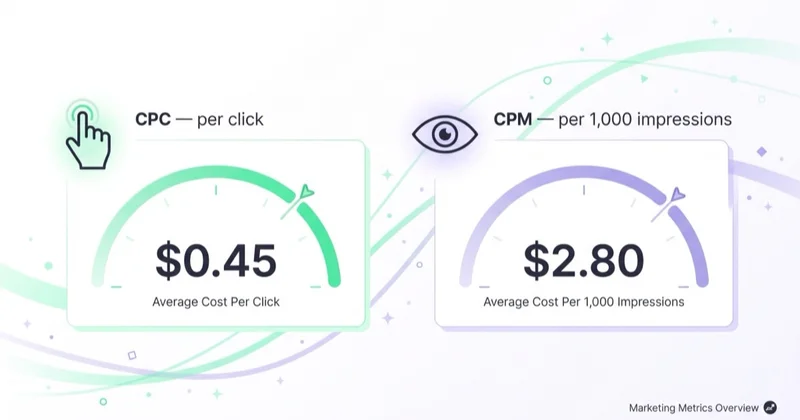
Google Search is commonly diagnosed with CPC, search terms, impression share and conversion value. Ad Rank considers factors including the bid, ad and landing-page quality, auction competitiveness, search context and expected impact of assets. A high CPC can still be viable when the click produces strong contribution; a low CPC can be wasteful when the query is irrelevant.
Meta is commonly diagnosed through CPM, click and landing-page rates, conversion cost, frequency and creative-level performance. Cheap reach is not automatically valuable reach. Evaluate whether eligible users progress and whether attributed customers create value after returns, cancellations, incentives and fulfillment.
The right cost questions are:
- How much does an incremental or at least qualified outcome cost?
- What is the outcome worth after cost of goods, discounts, returns, fulfillment or sales qualification?
- Is the channel creating demand, closing demand or recovering a user?
- Does platform-reported performance match store, CRM or finance data?
- Is the channel acquiring a new customer, supporting an existing journey or reclaiming demand that would have returned anyway?
For detailed cost context, see how much Google Ads costs and how much Facebook ads cost.
What to choose by business type
| Business type | Better starting point | Why |
|---|---|---|
| Local service with existing demand | Google Ads | Users actively search for providers near them |
| E-commerce with searched products | Shopping/Search test; add Meta where visual discovery is credible | Query and feed demand can be validated before broadening reach |
| New fashion, beauty or DTC brand | Meta or Google Demand Gen; protect emerging search demand | Creative can establish the product while Search captures later intent |
| B2B with a long buying cycle | High-intent Search plus selective paid social | Judge qualified pipeline and account progression, not form volume |
| Innovative product category | Demonstration-led media, content and partnerships | Users may not know the category language yet |
| Brand with strong search demand | Both, measured separately | Google captures brand demand; Meta may help create it |
| Marketplace or retailer | Both with feed discipline | Google/Shopping and Meta catalog need clean product data |
Treat this table as a starting hypothesis. A replacement part may fit Shopping and Search; a visually distinctive collection may fit Meta or Demand Gen; an urgent local service may fit Search. Validate with real demand, geographic coverage, margins, lead handling and creative capacity.
Measurement: why platform dashboards disagree
Google Ads and Meta Ads report conversions using their own attribution models, windows and rules. It is normal for both platforms to claim influence over the same sale or lead.
Example: a user sees an Instagram ad, visits the site, leaves, searches the brand on Google two days later, clicks a Search ad and purchases. Meta may report contribution because it created the initial touch. Google may report the final click. Both views can be useful inside each platform, but adding them together can overstate reality.
A stronger measurement approach:
- Define the business ledger: ecommerce backend, CRM, booking system and finance data.
- Use stable lead or transaction IDs and deduplicate browser/server events.
- Separate brand from non-brand Search and new from existing customers where the data supports it.
- Pass realized values or qualified stages back to the platforms when lawful and technically appropriate.
- Track contribution, cancellation or return rate, close rate and time lag—not only ROAS.
- Compare blended outcomes before and after meaningful changes, accounting for seasonality and promotions.
- Use lift or geographic experiments when the account is eligible and the test has enough statistical power.
- Reconcile platform views with GA4, CRM and finance reporting.
Meta's Conversions API and Google's enhanced conversions can improve event connectivity; neither overrides consent requirements or proves causality. Google explicitly distinguishes standard attributed conversions from Conversion Lift's incremental conversions. Keep those concepts separate in reporting.
When to run both channels
Both platforms make sense when each has a distinct, testable job and the business can fund enough eligible exposure and outcomes to make a decision. “Being everywhere” is not a strategy.
A common setup:
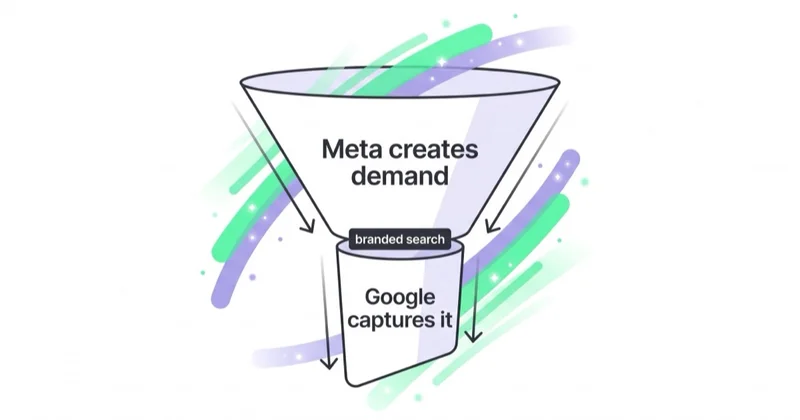
- Meta tests and scales visual propositions among eligible audiences.
- Google Search and Shopping capture query and product demand.
- Google Demand Gen or YouTube may also create reach, so their role must not duplicate Meta by accident.
- Remarketing in both channels supports return visits.
- Store, CRM or finance data defines the real result.
- Budget is split by role, not only by which platform claimed more conversions.
With a small budget, splitting too early often produces inconclusive data. Start with the hypothesis that carries the strongest evidence: existing high-value search intent, or a demonstrable proposition for a reachable audience. Add the second platform when measurement works, operations can handle the response and the new test answers a question the first channel cannot.
Decision framework
Ask these questions before choosing the first channel:
| Question | If yes | If no |
|---|---|---|
| Do people already search for the product or service? | Start with Google | Consider Meta, video or content first |
| Can visual demonstration change understanding or desire? | Test Meta or Google visual inventory | Prioritize intent-led formats |
| Is the purchase urgent or local? | Google Search is usually priority | Meta can support awareness and retargeting |
| Is the category new or unfamiliar? | Demand creation is needed | Demand capture may work immediately |
| Is the brand already searched? | Separate brand capture and test incrementality | Build demand through the most credible routes |
| Can the team produce meaningfully different creative? | Discovery campaigns have material to test | Build creative before broad social or video spend |
| Is downstream value reliable? | Automated delivery can learn from a useful signal | Fix CRM, feed and event quality before scaling |
| Can the business fulfill additional demand? | Set a bounded test and response SLA | Repair capacity before buying more leads or orders |
How Space Ads approaches Google Ads vs Facebook Ads
At Space Ads, we start by assigning a commercial role to each campaign rather than letting two platforms compete for attribution credit. That may mean Search captures non-brand intent, Shopping matches products, Meta tests visual propositions and a separate campaign supports existing demand. The allocation changes by category, market and buying cycle.
Then we map platform events to the business outcome. Brand and non-brand Search are reported separately. Ecommerce decisions consider contribution, returns and new-customer quality; lead generation considers qualification, acceptance, close rate and realized revenue. Where volume and eligibility allow, controlled tests help distinguish attributed demand from incremental demand.
This approach connects Google Ads, Meta Ads, PPC strategy, marketing reporting and performance marketing. A marketing audit is often the fastest way to identify whether the current split is underfunding demand creation, over-crediting branded Search or scaling campaigns on weak conversion data.
Common mistakes
| Mistake | Why it hurts | Better approach |
|---|---|---|
| Asking only which platform is cheaper | CPC and CPM do not show customer value | Compare valuable conversion cost and channel role |
| Judging both on last click | Demand creation gets undervalued | Measure each channel by job |
| Mixing brand and non-brand Search | Google performance can look inflated | Split reporting and budget logic |
| Assuming Google only captures and Meta only creates demand | Both now span multiple environments | Assign roles at campaign level |
| Sending every lead back as equal | Delivery optimizes toward low-quality volume | Return qualified stages and values where appropriate |
| Running Meta without creative testing | Fatigue rises and learning stalls | Build a repeatable creative pipeline |
| Adding dashboard conversions together | One sale can be claimed twice | Reconcile stable IDs against business records |
| Treating attributed ROAS as incrementality | Attribution allocates credit; it does not create a control group | Use lift or geo experiments when feasible |
| Sending personal data without governance | Creates legal, security and trust risk | Apply consent, minimization, access and retention rules |
FAQ
Is Google Ads or Facebook Ads better?
Neither is universally better. Google Search is usually stronger for expressed intent, while Meta is often stronger for feed-based discovery and visual demonstration. Google also has discovery inventory and Meta can drive direct response, so compare the campaign job, economics and data quality.
Which is cheaper, Google Ads or Facebook Ads?
There is no reliable answer based on CPC or CPM. Compare cost per qualified or incremental outcome and its contribution after returns, discounts, fulfillment or lead quality. A cheap impression or click can still be expensive growth.
Should a small business start with Google Ads or Facebook Ads?
If valuable search demand exists, a tightly scoped Google Search or Shopping test is often the clearest starting point. If the proposition must be demonstrated visually and the audience is reachable, Meta may be the better test. Start with one decision-quality hypothesis rather than splitting a small budget by default.
Can Google Ads and Facebook Ads work together?
Yes. For example, Meta may introduce a product while Google captures later category or brand searches. Google Demand Gen may also overlap with Meta's discovery role. Define the job of each campaign, deduplicate outcomes and measure the combined business result.
Which platform is better for e-commerce?
Both can be valuable. Shopping and Search can capture product intent; Meta can demonstrate the product and scale creative propositions; Performance Max and Demand Gen can work across broader Google inventory. The balance depends on searchability, visual differentiation, margin, returns, feed quality and creative capacity.
Does Facebook Ads influence Google Ads results?
It can. A Meta campaign can increase brand awareness and make users search for the brand or product later. In that case, Google Ads may record the final click even though Meta helped create the demand. This is why branded search lift and full-funnel measurement matter.
Which platform converts better?
There is no platform-wide answer. Conversion rate changes with audience, query, placement, offer, attribution window and conversion definition. Compare like-for-like qualified outcomes, then use experiments where feasible to estimate incremental contribution.
Key takeaways
- Google Search has a clear advantage in expressed intent; Meta has a clear advantage in feed-based, creative-led discovery.
- Both platforms now cover several funnel stages, so assign jobs at campaign—not platform—level.
- Choose the first test from demand evidence, economics, creative strength, operational capacity and measurement quality.
- Judge cost by qualified and realized business value, not CPC, CPM or platform ROAS alone.
- Deduplicate outcomes, separate brand demand and use incrementality tests when feasible.
Sources and further reading
- Google Ads Help - Your guide to Google Ads
- Google Ads Help - About Ad Rank
- Google Ads Help - About Demand Gen campaigns
- Google Ads Help - About Conversion Lift
- Meta for Business - Advantage+ Sales campaigns
- Meta Business Help - About Conversions API
Continue learning
Continue reading
PPC vs SEO: What to Choose, How to Measure and When to Combine Both
PPC vs SEO is not a channel popularity contest. PPC buys controlled demand now; SEO builds durable organic visibility. This guide shows how to choose and combine them using margin, LTV, payback period, intent, measurement quality and AI search risk.
What is PPC — The Ultimate Guide to Pay-Per-Click Advertising
PPC is performance advertising bought through auction-based platforms, but the real goal is not cheaper clicks. It is profitable demand, clean measurement and better business outcomes.
How to Choose a Performance Marketing Agency
Choose a performance marketing agency with a defined brief, evidence-based scorecard and clear commercial safeguards. This guide covers team evaluation, measurement, account access, fees, contracts and handover.