Gym and fitness studio marketing should not be judged by the cheapest form submission. A campaign can generate free-pass leads, trial bookings, direct messages and calls, but the business result appears only when those people show up, start a paid membership and stay long enough for the acquisition cost to make sense. The practical job is to connect local search demand, Meta creative, a clear trial offer, fast follow-up, a useful first visit and CRM feedback into one member acquisition system.
That distinction matters because fitness is easy to optimize badly. A low-friction offer can fill a spreadsheet with people who want a free workout and never return. A narrow Google Search campaign can produce fewer leads but better local intent. A beautiful Instagram campaign can build interest but still fail if the studio does not confirm bookings quickly. The right question is not "How many leads did the ads generate?" It is "How many joined members did each channel create, and what happened after the first month?"
TL;DR
- Gym and fitness studio marketing starts with member economics. Lead cost matters, but cost per joined member and retention decide profitability.
- Google captures local intent. Search campaigns, location targeting and a strong Google Business Profile help reach people already looking for a gym, pilates studio, yoga class or personal training nearby.
- Meta creates demand through proof and an entry offer. Facebook and Instagram work best when creative shows the real facility, trainers, classes and a low-friction first step.
- The trial offer needs quality filters. A free week, first class or intro session should include booking, confirmation and a clear path to membership.
- Seasonality should be prepared before demand peaks. January, pre-summer and September perform better when tracking, creative and operations are ready in advance.
- Offline feedback is essential. Events such as
trial_booked,trial_attended,membership_startedandretained_90dshould shape reporting and bidding.
Why Fitness Marketing Is Different
Fitness is local, recurring and experience-led. Those three traits change the campaign design.
First, most prospects do not buy a membership purely from an ad. The ad lowers the barrier to a first action: a trial class, intro workout, consultation, tour, personal training assessment or no-commitment pass. The sale often happens after the person sees the space, meets staff and understands the routine.
Second, the value is recurring. A member can pay monthly dues, buy personal training, attend paid classes, refer friends and stay for months. That makes lifetime value more important than the first payment. A campaign with a higher lead cost can still be better when it brings people who attend, join and remain active.
Third, demand is seasonal. New Year health goals, pre-summer motivation and post-vacation routine changes often create acquisition windows. The mistake is treating those windows as last-minute promotion periods. A studio needs working tracking, a tested offer, lead handling and onboarding before demand rises.
Fourth, fitness messaging needs care. Ads should avoid shame, exaggerated transformation claims and pressure around body image. Stronger positioning usually comes from confidence, community, coaching, convenience, beginner support, class variety and a realistic first step.
The Fitness Acquisition Funnel
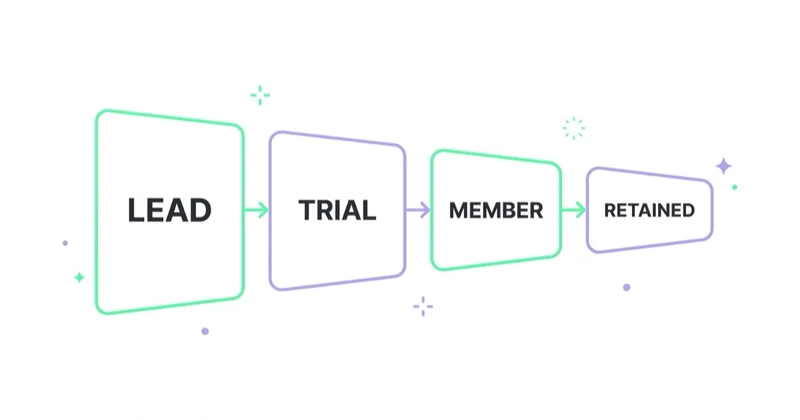
A gym funnel has more steps than a form submission. Reporting should reflect that.
| Stage | What to Measure | Why It Matters |
|---|---|---|
| Lead or booking | Form, call, message, trial reservation | Shows the cost of entering the funnel |
| Confirmed appointment | Contact rate, booked slot, reminder sent | Separates curiosity from intent |
| Trial attendance | Show-up rate by channel and offer | Reveals lead quality and follow-up quality |
| Membership start | Paid membership or paid package | Main acquisition metric |
| Retention | 30-, 60- and 90-day activity | Shows whether acquisition quality holds |
| Member value | Dues, upsells, referrals, churn | Sets the acceptable acquisition cost |
This structure changes optimization. If one campaign produces leads at $20 and only 5 percent become members, the cost per member is $400. If another campaign produces leads at $50 and 25 percent become members, the cost per member is $200. The second campaign looks worse in the ad platform but is twice as strong for the business.
The same logic applies to facilities with different economics. A budget gym may need high volume and low friction. A boutique pilates studio may accept fewer leads because membership value, class packages or private sessions are higher. A personal training studio may need qualification before a consultation. Campaigns should reflect those differences instead of using one generic "free pass" message for every model.
Google Ads for Gyms and Studios
Google is strongest when demand already exists. Typical searches include "gym near me," "fitness studio [city]," "pilates [neighborhood]," "yoga classes near me," "personal trainer [city]" and branded searches for a specific facility. The visitor is usually comparing location, price, opening hours, reviews, class schedule and the confidence to take a first step.
A practical Google setup for fitness usually includes:
- Brand search: protect searches for the facility name, especially when competitors advertise locally.
- Non-brand local search: gym, fitness studio, pilates, yoga, CrossFit-style training, personal training and class-specific terms by city or neighborhood.
- Location targeting: target the real catchment area, not the whole country or an oversized city region.
- Location assets and calls: make it easy to open maps, call the front desk or ask about a first visit.
- Search term control: exclude job seekers, free equipment queries, online-only workout searches and unrelated classes.
- Landing pages by intent: send pilates searches to pilates content, personal training searches to trainers and consultations, not one generic homepage.
Google's own location targeting documentation notes that advertisers can target countries, regions, cities, radius areas and location groups, but also warns that geographic targeting is based on signals and is not perfectly accurate. For a local gym, this means campaign settings should be reviewed against actual lead locations and membership data, not left on autopilot.
Google Business Profile is also part of the acquisition system. Local rankings are influenced by relevance, distance and prominence, while the profile gives prospects fast access to hours, reviews, photos, directions and calls. Paid search and local SEO should therefore use the same facts: address, category, opening hours, class information and current photos.
Meta Ads for Gym and Fitness Studio Marketing
Meta is usually less about capturing existing search intent and more about creating motivation. Facebook and Instagram can show the facility, trainers, atmosphere, classes and trial offer to people near the location before they search on Google.

Strong Meta creative for fitness is usually specific:
- real footage from the facility, not generic stock training images;
- short class clips that show pace, equipment, group size and trainer involvement;
- beginner-friendly messaging that reduces first-visit anxiety;
- clear trial mechanics such as "book an intro session" or "reserve a first class";
- member stories or testimonials that avoid exaggerated transformation promises;
- separate angles for beginners, commuters, parents, strength training, group classes, personal training and premium studio experiences.
Meta lead forms can reduce friction, especially on mobile. They need more qualification than a basic name-and-phone form. A fitness form can ask for preferred time, goal, class interest, training experience or preferred contact method. A landing page is better when the decision needs more context: timetable, pricing, coach bios, parking, facilities, FAQ and pictures of the space.
The important operational rule is speed. A free-pass lead that waits two days for a reply often becomes a no-show. Confirmation by SMS, email or phone, followed by a reminder before the visit and a message after the trial, usually matters as much as the ad itself.
Trial Offers Without Low-Quality Volume
The trial offer is often the campaign's entry point, but free access alone is not a strategy. A weak offer attracts people with low intent; a strong offer creates a first step that is easy to take and still connected to membership.
Useful fitness offers include:
- first group class;
- beginner intro workout;
- consultation with a trainer;
- seven-day trial with booked onboarding;
- small-group trial session;
- body composition or movement assessment, where appropriate and compliant;
- short challenge with a defined start date;
- trial package credited toward membership after joining.
Each offer should define the next step. What happens after the form? Does the person choose a time? Who confirms the visit? What should they bring? What happens after the trial? Which membership or package is the natural continuation?
The offer should also include a quality filter. A preferred time slot, training goal, class type or contact preference can reduce junk leads and help staff prepare a better first conversation. The filter should be light enough to keep conversion friction reasonable, but specific enough to separate serious prospects from random submissions.
Landing Page and Follow-Up
The page or form should answer the questions that create hesitation before a first visit:
- exact location, map, parking and public transport;
- opening hours and class schedule;
- membership options or clear price guidance;
- what happens during the first visit;
- whether beginners are welcome;
- photos of the gym floor, studios, changing rooms and entrance;
- coach or instructor profiles;
- reviews and local proof;
- safety, access and cancellation details;
- fast booking, call and message options;
- privacy and marketing consent language.
The follow-up sequence should be designed before the campaign scales. A simple model is enough at the start:
- immediate confirmation after the form or booking;
- reminder before the scheduled visit;
- staff task if the person does not respond;
- post-trial message with the recommended membership path;
- win-back sequence for no-shows and expired trials.
Without that process, the ad account can look healthy while the business loses most of the value between lead and visit.
Measurement: Members, Not Forms
The minimum measurement stack should track forms, calls and bookings. A better stack tracks the full path:
| Event | Description | Use in Optimization |
|---|---|---|
lead_submitted |
Form, message, phone lead or booking request | Early volume signal |
trial_booked |
A specific visit or class is scheduled | Better intent signal |
trial_attended |
The prospect showed up | Lead quality and operations signal |
membership_started |
Paid membership or package begins | Primary acquisition goal |
retained_30d / retained_90d |
Member stays active after joining | Quality and LTV signal |
For Google Ads, offline conversion imports and enhanced conversions for leads help connect ad clicks with later CRM outcomes. That is especially important when the valuable event happens at the front desk or inside a membership system, not on the website. For Meta, Pixel, Conversions API and CRM integrations can support the same principle: send the platform a better signal than a low-quality lead form alone.
The reporting view should include channel, campaign, offer, location, source, lead status, trial attendance, member start and early retention. When the ad platform and CRM disagree, CRM outcomes should have more weight in budget decisions.
Seasonality: January Is Not the Whole Plan
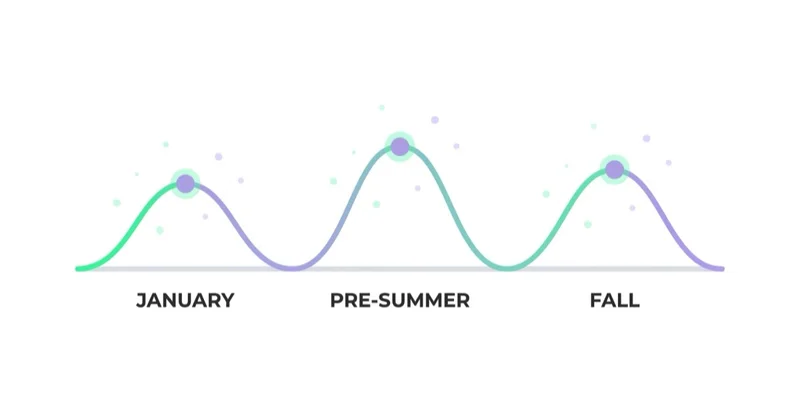
Fitness demand is calendar-sensitive. January gets attention because resolutions often involve exercise, health and weight management. Industry reporting also points to a January lift in new memberships. But a profitable fitness marketing calendar should not depend on one promotion.
| Period | Campaign Role | What to Prepare |
|---|---|---|
| December | Build audiences, test offers, prepare January | Tracking, landing pages, creative, staffing, reminders |
| January | Capture peak interest and first visits | Search coverage, Meta offers, fast follow-up, onboarding |
| February-March | Convert and retain January trials | Membership offers, beginner paths, no-show recovery |
| May-June | Pre-summer demand | Short programs, classes, personal training packages |
| September | Return to routine after holidays | Reactivation, referrals, local search, schedule-led ads |
| Quiet months | Improve retention and data | CRM, referrals, content, reviews, creative testing |
The operational lesson is simple: campaigns should go into peak demand with a working system. If the offer, tracking and staff follow-up are still being built after demand rises, the strongest period is partly wasted.
Segment by Facility Type
"Gym marketing" covers very different businesses. The channel mix, offer and qualification logic should change by model.
| Facility Type | Acquisition Logic | Strong Messaging Angle |
|---|---|---|
| Budget gym | High volume, low barrier | Price, convenience, opening hours, equipment |
| Local independent gym | Balanced volume and community | Coaching, atmosphere, location, classes |
| Boutique studio | Lower volume, higher value | Experience, instructor quality, small groups |
| Pilates, yoga or specialist studio | Class-led demand | Method, schedule, levels, instructor trust |
| Personal training studio | Low volume, high intent | Assessment, plan, expertise, accountability |
| Multi-location chain | Brand plus local execution | Consistent offer, local pages, location-level reporting |
A budget gym can often lead with convenience and membership simplicity. A boutique studio needs to show the quality of the experience. A personal training business should qualify heavily enough to avoid consultations with poor fit. One generic campaign structure rarely serves all of these models.
Common Mistakes
| Mistake | Better Approach |
|---|---|
| Optimizing only for cost per lead | Optimize for cost per joined and retained member |
| Running a free-pass offer with no follow-up | Add booking, confirmation, reminders and post-trial sales steps |
| Sending all traffic to the homepage | Use intent-specific pages for classes, locations and trials |
| Launching seasonal campaigns too late | Prepare tracking, creative and operations before demand peaks |
| Using generic fitness stock images | Show the real facility, people, coaches and class environment |
| Ignoring Google Business Profile | Keep categories, hours, photos, reviews and local facts accurate |
| Treating all studios the same | Segment by facility type, value, offer and sales process |
How Space Ads Approaches Fitness Campaigns
Across 25+ client accounts audited daily and roughly 14 million monthly data points analyzed through Space Ads OS, the recurring fitness problem is not traffic volume. It is signal quality. Accounts often have plenty of leads but weak visibility into which leads became members, which channels produced no-shows and which campaigns attracted people who stayed.
The Space Ads approach starts with member economics: membership value, upsells, margin, capacity, retention and acceptable cost per acquisition. Then the account is organized around four layers: Google for local intent, Meta for demand creation and trial offers, landing pages and CRM for conversion, and offline feedback for member-level optimization.
For an existing account, a marketing audit can show whether media spend is buying real members or only cheap forms. Ongoing channel execution usually sits across Google Ads, Meta Ads and broader performance marketing.
30-Day Action Plan
- Days 1-3: define economics and offer. Set the acceptable cost per joined member, average membership value, capacity limits and trial structure.
- Days 4-7: fix measurement. Track forms, calls, bookings, trial attendance, membership starts and early retention.
- Days 8-12: improve the landing path. Add location, schedule, first-visit details, photos, reviews, pricing context and direct booking.
- Days 13-18: launch local Google Search. Separate brand, local non-brand and class-specific intent. Review search terms quickly.
- Days 19-24: launch Meta creative tests. Test real facility footage, trainer-led clips, beginner messages, class offers and remarketing.
- Days 25-30: review quality. Compare lead cost, contact rate, attendance, membership starts and early retention before scaling spend.
FAQ
What is the best marketing strategy for a gym?
The strongest strategy combines local Google demand capture, Meta demand creation, a clear trial offer, fast follow-up and CRM feedback. The business should measure cost per joined member and retention, not only form submissions or trial requests.
Should gyms use Google Ads or Meta Ads?
Both channels can work, but they do different jobs. Google captures people actively searching for a gym, studio or class nearby. Meta reaches local audiences with creative, proof and a first-step offer before they search. Smaller facilities can start with the channel that best matches current demand and operational capacity, then add the second once tracking is reliable.
What kind of offer works for fitness ads?
The best offer is a low-friction first step with a clear booking and next action. Examples include a first class, intro session, seven-day trial, trainer consultation or small-group trial. The offer should avoid attracting only free-pass seekers by adding a light quality filter and confirmed appointment.
How should a gym measure marketing ROI?
Gym ROI should be measured through the full path from lead to retained member. Useful metrics include lead cost, contact rate, trial booking rate, attendance rate, cost per membership start, 30- or 90-day retention and member value.
When should fitness studios increase ad spend?
Spend should rise before predictable demand peaks, especially January, pre-summer and September. Scaling is only useful when tracking, landing pages, offer handling and staff follow-up are already working. Otherwise, more budget simply creates more unconverted interest.
Are lead forms or landing pages better for gym campaigns?
Lead forms reduce friction and can work for simple trial offers. Landing pages are stronger when prospects need schedule, pricing, class detail, trainer information, location proof and a clearer first-visit explanation. Many accounts use both and compare downstream quality, not only lead cost.
In Short
- Gym and fitness studio marketing should optimize for joined and retained members.
- Google captures local intent; Meta creates demand with creative and a first-step offer.
- Trial offers need booking, confirmation, follow-up and a path to membership.
- January matters, but profitable acquisition comes from a year-round system.
- Offline conversion feedback helps ad platforms learn which leads become real members.
Sources
- Google Ads Help - Target ads to geographic locations
- Google Business Profile Help - Improve local ranking on Google
- Google Ads Help - About offline conversion imports
- Google Ads Help - About enhanced conversions for leads
- Meta for Developers - Conversions API
- Health & Fitness Association / Big Rapids News - Fitness among top 2025 resolutions
Continue Learning
Continue reading

Language School Marketing: Two Businesses, One Building
Language schools often combine consumer enrolment and corporate training. Market them as separate buying journeys, then connect campaigns to attendance, enrolment, group contribution and continuation.

Driving School Marketing: Selling Instructor Hours, Not Courses
A practical system for growing a driving school around real instructor capacity: local demand, transparent lesson offers, compliant proof, responsive booking and completed-pupil value.

Bike Shop Marketing: The Workshop Pays the Rent
A practical marketing system for bike retailers and workshops: model capacity and contribution, capture local service demand, promote in-stock bikes, and turn first visits into lasting customer relationships.