Content marketing in B2B is the disciplined creation and distribution of material that helps a buying group make a better decision. It can explain a problem, compare approaches, show evidence, reduce implementation risk and help internal stakeholders reach agreement. Articles are only one format; useful content also includes decision tools, service pages, research, case studies, product documentation and sales material.
The common mistake is treating content as either a traffic factory or a library of sales brochures. A page can rank and still attract no suitable buyers. A case study can help a deal without generating the first visit. The strategy therefore needs a commercial job, credible evidence, distribution and measurement for each asset—without claiming that every opportunity which touched a page was caused by it.
TL;DR
- Content should improve a buying decision, not merely increase page views. Define the question, audience, evidence and next useful action before writing.
- Map people and decisions, not only a linear funnel. A finance approver, technical evaluator and day-to-day user may enter research at different points.
- SEO and sales enablement can share one evidence base. Public discovery pages and private deal material may use the same facts, with different detail and access.
- One article cannot serve every intent. B2B teams need clusters: problem guides, comparison pages, case studies, FAQs, service pages and methodology content.
- There is no guaranteed “LLM citation” format. Clear, original, well-supported content helps users and can be discoverable, but tables, FAQ or schema do not buy citations.
- Sales feedback should shape the roadmap. Repeated objections, lost reasons and demo questions are content topics.
- Assisted and influenced metrics need caveats. They show contact with content, not incremental impact. Combine them with cohorts, sales evidence and experiments where feasible.
What content marketing in B2B should do
B2B content commonly has five jobs:
- Create category understanding.
- Capture existing research demand.
- Reduce buyer risk.
- Help stakeholders evaluate, approve and implement a decision.
- Help customers adopt, retain or expand where that is part of the growth model.
That means a content plan cannot come only from keyword volume. It should also use recorded and consented research where appropriate, sales questions, CRM loss reasons, support themes, implementation risks, product evidence, customer interviews and the language buyers use. Keyword data shows expressed search demand; it does not reveal every internal question in a buying process.
For the acquisition layer, see B2B lead generation and customer acquisition strategy.
B2B content vs B2C content
| Area | B2B content | B2C content |
|---|---|---|
| Buyer | may involve users, evaluators, approvers and procurement | may involve an individual or household |
| Decision cycle | can involve higher organisational risk and formal approval | can be shorter, but not always simple |
| Content role | educate, justify, compare, reduce risk | inspire, inform, convert, retain |
| Proof | case studies, methodology, ROI, security, process | reviews, product visuals, price, delivery |
| Measurement | pipeline, opportunities, assisted sales | revenue, conversion rate, repeat purchase |
B2B and B2C are not opposites: both involve emotion, trust and practical constraints. The useful distinction is the decision being supported. For a complex B2B purchase, content should address cost, alternatives, evidence, implementation, security or compliance, ownership and when the solution is not a fit.
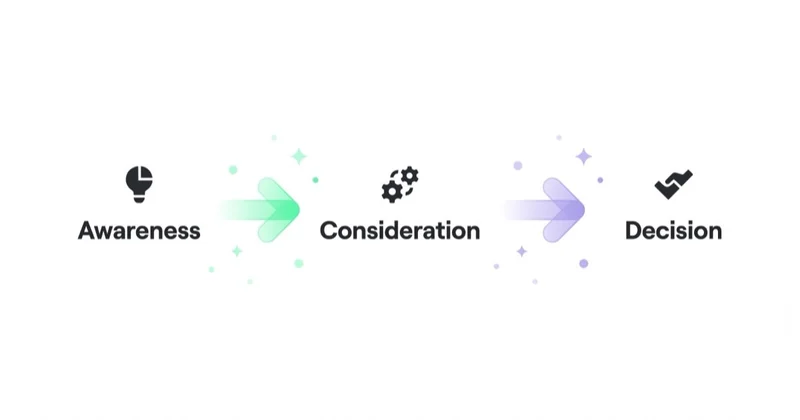
Map content to decisions and stakeholders
| Decision context | Main question | Useful content |
|---|---|---|
| Problem diagnosis | What is happening, how material is it and why? | diagnostic guides, original data, benchmarks with methodology |
| Solution exploration | What options exist? | frameworks, comparison guides, how-to articles |
| Vendor evaluation | Who can solve this under our constraints? | case studies, methodology, service pages, security and delivery evidence |
| Internal approval | How do we justify and govern this? | assumption-based business cases, risk notes, implementation plan |
| Post-contact | What happens next? | process docs, onboarding pages, FAQ, checklists |
| Retention / expansion | How do we get more value? | playbooks, advanced guides, reporting, education |
This is a planning aid, not a claim that buyers move in a neat sequence. A technical evaluator may begin with implementation details while an executive begins with risk and economics. Build routes between related questions and allow a reader to reach proof, limitations and the relevant next step without following a prescribed funnel.
Content types that support sales pipeline
Problem guides
Problem guides explain symptoms, plausible causes, diagnostic steps and the limits of the advice. For example, “why paid media leads are not converting to sales” should distinguish traffic quality, qualification, sales response, attribution and product-market fit instead of blaming one channel.
Comparison pages
Comparison pages help buyers choose between methods, tools or vendors. State the comparison criteria, disclose commercial interest and explain who each option suits. If competitors are named, verify claims from primary sources, review them regularly and do not use their trademarks or data misleadingly.
Case studies
Case studies show what happened in a particular context. They need customer permission, a defined period and metric, the baseline, material interventions and limitations. Separate measured results from estimates and do not imply that one customer's outcome is typical or guaranteed. An anonymised case study should still contain enough operational detail to be useful without exposing confidential information.
Methodology pages
Methodology pages explain how the company works: inputs, responsibilities, quality controls, decision gates, deliverables and exclusions. Specificity reduces uncertainty; invented proprietary names do not.
FAQ and objection pages
FAQ content supports sales when it answers repeated questions about cost, timing, data access, responsibility, expected outcomes and limitations. Write it because users need the answer, not because an FAQ block guarantees a rich result. Google stopped showing FAQ rich results from May 7, 2026, according to its Search Console data notes.
Service pages
Service pages should be the source of truth for what the company offers, who it fits, what is included, what the process requires and what happens next. Supporting articles should not contradict them or compete for the same intent.
Original research and decision tools
Original data, calculators, templates and diagnostic tools can be more valuable than another summary article—but only when the method is visible. Publish sample, dates, exclusions, definitions, funding or commercial interest, and enough detail for a reader to assess the conclusion. A calculator should show its assumptions and never present a forecast as a guaranteed return.
SEO and generative search: one useful source, several discovery surfaces
Buyers can research through conventional results, Google's generative features and assistants such as ChatGPT or Perplexity. The same person may use several of them. That changes how journeys are observed, but not the need to publish accurate, accessible and distinctive material.
- "how to improve lead quality from Google Ads";
- "what should a marketing dashboard track";
- "AEO vs GEO vs LLM SEO";
- "how to choose a performance marketing agency";
- "why is sales rejecting marketing leads";
- "how to measure paid media pipeline".
Google's current guidance says that appearing in its generative Search features uses the same foundational SEO practices; there are no extra technical requirements, special schema or AI text files required. The practical priorities are:
- make the page crawlable, indexable and internally linked;
- answer the actual question in language the target reader understands;
- add first-hand experience, original evidence or expert analysis that a summary of other pages cannot provide;
- identify the responsible author or organisation and the review method where it matters;
- cite primary sources close to factual claims and keep them current;
- use headings, prose, tables or steps only when they improve comprehension;
- ensure important facts also exist as accessible text, not only in images or video; and
- keep structured data consistent with visible content when a supported type genuinely applies.
A TL;DR, definition, table or FAQ may make a page easier for people and machines to interpret, but none guarantees selection or citation. llms.txt, unsupported schema and “AI keyword density” should not replace crawlability, useful evidence or sound information architecture.
Google's new Generative AI performance report in Search Console provides AI Overview and AI Mode impressions to a subset of properties during rollout. It currently reports impressions rather than a complete lead or citation journey, and aggregation can make chart and page totals differ. Use it as one visibility signal, not as proof of pipeline. Other assistants have their own crawlers, controls and attribution limitations.
For AI visibility, see AI SEO, LLM SEO and Generative Engine Optimization.
The B2B content cluster model
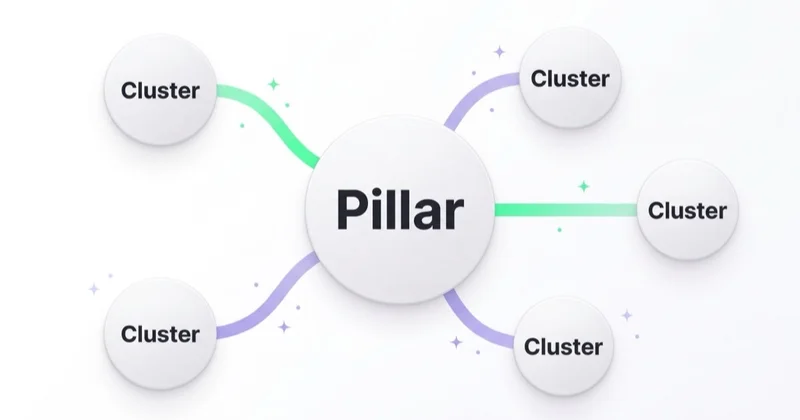
A cluster is useful when each page serves a distinct decision or intent. It becomes waste when a pillar and several thin articles repeat the same answer.
| Cluster element | Example |
|---|---|
| Pillar | B2B lead generation guide |
| Problem article | Why paid leads are low quality |
| Comparison article | Demand generation vs lead generation |
| Process article | How to import CRM outcomes into Google Ads |
| Service page | Marketing audit |
| Proof | Success story or methodology page |
| Nurture article | Lead nurturing guide |
| Dashboard article | What growth teams should track |
Before creating a supporting page, decide whether the reader needs a separate canonical resource or a stronger section in an existing one. Map intent, entity, owner and internal links. Consolidate near-duplicates and redirect retired URLs where appropriate. The goal is a coherent evidence base, not a target number of articles.
Sales feedback as content research
Some of the best B2B content topics come from sales, customer success and delivery rather than keyword tools.
Useful inputs:
- discovery-call questions;
- proposal objections;
- lost-deal reasons;
- CRM notes;
- competitor mentions;
- implementation concerns;
- procurement questions;
- security or data questions;
- finance objections;
- onboarding problems.
If a question appears every week, decide whether the answer should be public, gated for a legitimate reason or kept inside the deal team. Security questionnaires, customer-specific economics, personal data and confidential implementation details do not belong in a public article. Use aggregated themes from calls and CRM notes, respect recording and privacy requirements, and obtain customer approval before publishing identifiable detail.
Record the exact claim the asset must support and who can verify it. A subject-matter expert should be responsible for technical accuracy; marketing should be responsible for clarity and distribution; legal, security or compliance review should be risk-based rather than added ceremonially to every draft.
Content distribution in B2B
Publishing is not distribution. A B2B article can be excellent and still underperform if it is never placed in front of the right people.
Useful distribution paths:
- organic search;
- LinkedIn posts from founders or experts;
- permission-based newsletter sequences;
- sales follow-up;
- retargeting audiences;
- webinar follow-up;
- partner newsletters;
- customer onboarding;
- proposal links;
- internal sales knowledge base;
- relevant communities or expert participation where promotion is allowed.
Distribution should match the asset and the reader's permission. A comparison guide may work in sales follow-up. A short diagnostic can be adapted for an expert's LinkedIn post. A technical implementation guide may be discovered through search. A case study may support proposals and lawful retargeting. Repurpose the underlying insight for the format instead of pasting the same copy everywhere.
Assign an owner and distribution plan before writing. If nobody knows where the intended reader will encounter the asset or what question it should answer, the topic is not ready.
The B2B content brief
A strong B2B content brief should define more than a keyword.
| Brief field | Why it matters |
|---|---|
| Primary intent | Keeps the article focused |
| Decision context | Decides depth and next useful action |
| Target reader | Prevents generic copy |
| Sales objection | Connects content to pipeline |
| Evidence required | Supports material claims and buyer trust |
| Internal links | Connects the cluster |
| External sources | Builds trust |
| Commercial next step | Prevents dead-end traffic |
| Repeated questions | Ensures the asset answers genuine buyer needs |
| Update trigger | Keeps content current |
| Distribution and owner | Ensures the asset reaches the intended reader |
| Claim reviewer | Makes technical accountability explicit |
| Measurement caveat | Prevents an assisted touch from becoming a causal claim |
Replace “proof needed” with named evidence: customer data with permission, product documentation, an expert's first-hand process, a regulator, an academic paper or an explicitly labelled estimate. E-E-A-T is Google's way of discussing signals used to assess helpfulness and trust—not a numeric score that a page earns by adding an author box.
Sales enablement workflow
Content supports pipeline when sales actually uses it. That requires a simple workflow.
- Marketing publishes or updates an asset.
- Sales receives a short note: who the asset is for, when to send it and which objection it answers.
- The CRM or sales enablement tool stores the asset by use case.
- Sales records when an asset answered a material question, without turning optional admin into busywork.
- Marketing reviews usage, buyer feedback and opportunity context, while keeping “used in a deal” separate from “caused the deal.”
This does not need to be complex. Even a simple shared library organized by problem, stage and industry can improve consistency. The main point is that content should not sit only in the blog archive. It should be part of the sales conversation.
What not to write
Some B2B topics look attractive in keyword tools but do not support the business.
Avoid topics that:
- attract students or job seekers instead of buyers;
- are too broad for the company to credibly own;
- compete with a stronger existing page;
- answer a question with no commercial path;
- require proof the company does not have;
- promise outcomes that cannot be supported;
- belong on a service page rather than a blog post;
- chase a competitor's brand without a fair comparison angle;
- reproduce copyrighted research, screenshots or customer material without permission;
- publish AI-generated claims or citations that a responsible expert has not verified;
- expose confidential deal, employee, security or customer information.
The question is not "can this topic get traffic?" The better question is "would the right buyer trust the company more after reading it?"
Content maintenance should be trigger-based
B2B content should be maintained like an asset, but a fixed quarterly rewrite for every page wastes time and can introduce errors. Prioritise by commercial importance, factual volatility, visibility, user harm if wrong and evidence of decay. A legal or platform guide may require an immediate review after a change; a sound evergreen framework may not.
Refresh work should check:
- whether the answer is still accurate;
- whether sources are still current;
- whether internal links point to the best next step;
- whether new sales objections appeared;
- whether current search results and buyer language reveal an unanswered question;
- whether the page still matches the intended query and decision context;
- whether several pages now compete for the same task;
- whether examples, statistics, screenshots and calls to action remain true.
Keep the original publication date unless editorial policy says otherwise, and use an updated date only when a meaningful revision has actually occurred. Do not change dates merely to signal freshness. Consolidating or retiring weak pages is often more valuable than adding another article to a crowded cluster.
How Space Ads approaches this
We structure B2B content as part of the acquisition, sales and customer system. We map what buyers search before contact, what each stakeholder asks during evaluation, what blocks approval and what evidence they need. Then we decide whether the best answer is a public article, service-page section, case study, tool, FAQ, product documentation or private sales asset.
For a performance marketing topic, the useful next step might be another diagnostic resource, a marketing audit, Google Ads, Meta Ads or Fractional CMO—depending on the reader's problem. Measurement combines discovery, qualified behaviour, sales use and opportunity context. We do not treat a content touch or platform attribution as proof that the page created the deal.
B2B content by business model
| Business model | Content priority |
|---|---|
| SaaS | use cases, integrations, comparisons, onboarding, activation |
| B2B services | methodology, proof, pricing factors, process, objections |
| Agencies | audits, channel guides, case studies, reporting, AI search |
| Manufacturing / distribution | product application, compliance, procurement, quote paths |
| High-ticket consulting | point of view, proof, executive education, decision frameworks |
| Local B2B services | service area, reviews, process, industry pages |
This prevents content from becoming too generic. A SaaS buyer needs different evidence than a CFO buying consulting or an operations manager choosing a contractor.
Measuring B2B content
Content measurement should combine leading and lagging indicators.
| Metric | What it shows |
|---|---|
| Organic clicks and impressions | Search visibility |
| Non-brand queries | Category reach |
| Assisted conversions | Whether content appeared on measured paths to contact |
| Relevant next-step use | Whether readers choose a useful deeper resource or action |
| Qualified leads | Whether traffic matches the buyer |
| Pipeline influence | Whether known opportunities touched content, under a stated rule |
| Sales usage | Whether reps send or reference the asset |
| Generative-search impressions | Visibility in supported Google features where the report is available |
| Prompt answer sample | Directional presence and message accuracy for a controlled question set |
| Branded search trend | A possible demand signal influenced by many activities |
Not every asset should be judged by last-click conversion, and not every touch deserves revenue credit. A comparison may answer a decisive objection; a case study may help internal approval; a definition page may reach researchers who never enter the market. Define success from the asset's job and decision horizon.
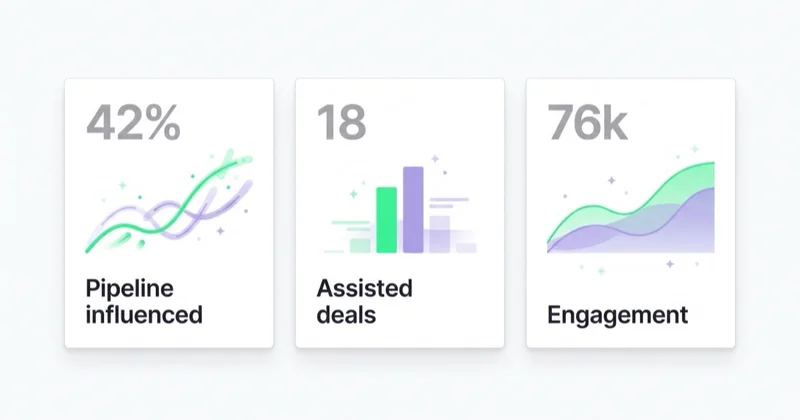
“Influenced pipeline” is descriptive, not causal. It can rise simply because high-intent opportunities view more pages. Document the lookback window, identity matching, whether sales-sent links count and how duplicate opportunities are handled. Use exposed versus unexposed account cohorts, regional tests or release holdouts where volume and ethics permit. When no causal design is feasible, combine the attribution report with sales interviews and label the conclusion as an inference.
AI visibility is also easy to overstate. A manual prompt check varies with model, location, account, wording and time. Keep a fixed, versioned question set, record date and environment, and evaluate whether the answer represents the brand accurately—not only whether the name appears. Google's dedicated generative AI report is currently rolling out to a subset of properties and reports impressions for AI Overviews and AI Mode; it is not a universal cross-LLM citation tracker.
Common mistakes
| Mistake | Why it hurts | Better approach |
|---|---|---|
| Publishing only top-of-funnel posts | Misses commercial and sales-stage questions | Build full-funnel clusters |
| Chasing traffic with weak-fit topics | Attracts readers who will never buy | Filter by ICP and buyer problem |
| No internal links to service pages | Content has no commercial path | Link naturally to relevant offers |
| Ignoring sales objections | Content misses real decision blockers | Use CRM and sales calls as research |
| Publishing generic AI summaries | Adds no first-hand or decision value | Add original evidence, expert method and limitations |
| Treating influence as revenue caused | Inflates content's apparent return | Report touch rules and add experiments or qualitative evidence |
| Refreshing by arbitrary calendar alone | Wastes effort or misses urgent changes | Prioritise by value, volatility, decay and risk |
| Adding FAQ or unsupported schema for AI | Confuses formatting with substance | Use supported markup and structure for users |
30-day B2B content plan
Week 1: map questions
Collect questions from sales, Search Console, keyword research, CRM themes, consented customer research and delivery teams. Group them by stakeholder and decision; verify whether public competitor material adds a legitimate comparison question rather than copying its roadmap.
Week 2: build the cluster
Audit what already exists. Choose one important decision area, then consolidate weak overlaps and commission only the supporting pages or assets that have a distinct job. There is no required number of cluster pages.
Week 3: publish and link
Create the first asset with verified claims, suitable structure, primary sources, internal routes and an accountable reviewer. Give sales a short note on who it is for, when it is useful and what it cannot prove.
Week 4: measure and iterate
Confirm distribution and instrumentation, then establish a baseline. One week of results will rarely show pipeline impact in B2B. Set the review date from search indexing, promotion and sales-cycle reality; use early feedback to fix clarity, not to manufacture a return claim.
FAQ
What is content marketing in B2B?
Content marketing in B2B is the creation and distribution of useful, credible material that helps business stakeholders diagnose a problem, evaluate options, approve a decision, implement it or get more value afterward. It includes public discovery content and private sales or customer assets.
How is B2B content marketing different from SEO?
SEO is one distribution and discovery layer. B2B content marketing is broader: it includes sales enablement, lead nurturing, proof, internal approval, customer education and AI search visibility.
What content supports B2B sales pipeline?
Useful pipeline content includes problem guides, comparison pages, service pages, case studies, methodology pages, pricing-factor guides, FAQ, executive summaries and implementation checklists.
How should B2B content be measured?
Measure each asset against its job. Useful evidence can include organic visibility, qualified behaviour, sales use, opportunity context, customer adoption and controlled tests. Assisted and influenced metrics show association, not causation; AI answer samples are directional and should be versioned.
Should B2B content be gated?
Gate an asset when access control serves a legitimate purpose or the exchange is genuinely worthwhile—not merely to increase lead count. Public material is easier to discover and share. A gated tool, dataset or working session may justify contact details when the value, privacy notice, follow-up and consent choices are clear. Do not treat every download as buying intent.
How often should B2B content be updated?
Review content when its claims, product, platform, law, evidence or buyer need changes, and periodically according to commercial value and risk. A high-stakes operational guide may need faster review than an evergreen framework. Change an updated date only after a meaningful revision.
Key takeaways
Content marketing in B2B should make important decisions easier. The strongest system connects real buyer questions with original evidence, expert review, search discovery, responsible distribution and useful sales or customer follow-up.
The goal is not to publish more or attach every deal to a content touch. It is to maintain a coherent knowledge base that makes the company easier to find, evaluate, implement and trust—and to measure its role without pretending correlation is causation.
Sources and further reading
- Google Search Central - Creating helpful, reliable, people-first content
- Google Search Central - Official guide to generative AI features in Google Search
- Google Search Console Help - Generative AI performance report
- Google Search Console Help - Search performance common tasks and limitations
- Google Search Console Help - Data anomalies and the end of FAQ rich results
- Google Search Central - Using Search Console and Google Analytics data for SEO
- Google Analytics Help - About events
Continue learning
Continue reading

Lead Nurturing: How to Convert More Leads Without Increasing Your Ad Budget
Lead nurturing turns existing leads into better sales conversations through segmentation, useful follow-up, CRM triggers, email, retargeting and sales timing. It improves pipeline without relying only on more ad spend.

B2B Lead Generation: How to Build a Predictable Pipeline From Paid Media and SEO
A predictable B2B pipeline is built from agreed stage definitions, cohort conversion rates and closed-loop feedback—not form volume. Learn how paid media, SEO, landing pages, CRM data and sales follow-up work as one measurable system.

Google Ads vs SEO: Paid vs Organic on Google, and How to Use Both
Google Ads vs SEO is a decision about speed, control, cost and durability on the Google results page. This guide explains when to pay for clicks, when to build organic visibility, how to test brand bidding and how to connect paid and organic data.