
LinkedIn Ads do not have a fixed cost per click, lead or thousand impressions. Ads enter an auction against other advertisers targeting similar member accounts and formats. LinkedIn says the price is influenced by the target audience, bidding strategy, objective and ad relevance.
That means a universal “average LinkedIn CPC” is not a reliable budget. A campaign aimed at finance directors in one country can face a different auction from a campaign aimed at engineers across several markets. The better planning question is: what cost per qualified opportunity can the business afford, and what click, lead and qualification rates would make that possible?
Use Campaign Manager's audience estimate and bid suggestions for the current market, then build conservative and central scenarios through to pipeline. Replace those estimates with actual qualified-lead and opportunity data as soon as the campaign produces enough evidence.
TL;DR
- LinkedIn uses an online auction; there is no set or guaranteed CPC, CPM, CPV, cost per send or cost per result.
- The optimisation goal and bidding strategy determine the chargeable event. Maximum delivery and cost cap are currently charged by impressions; manual bidding may charge by clicks, impressions, video views or sends depending on the setup.
- Current LinkedIn budget documentation does not publish one universal $10 daily / $100 lifetime minimum. The interface shows applicable limits; lifetime minimum depends on campaign/ad-set duration.
- Daily spend can be up to 50% higher than the entered daily budget on a given day, subject to LinkedIn's weekly or scheduled-period caps.
- Do not judge viability from CPC alone. Model cost per qualified lead, opportunity, pipeline value and customer, including sales conversion and margin.
- Audience precision can justify a high media price when it materially improves reach among valuable accounts and roles. Excessive narrowing can reduce learning and exhaust a small audience.
- LinkedIn says relevant, engaging ads can pay less in the auction. The former exportable Ad Set Quality Score was discontinued, so use actual CTR, engagement and downstream quality rather than searching for that score.
- Qualified-lead optimisation can use CRM Sync or Conversions API data. LinkedIn recommends one source to prevent duplication and at least five qualified leads within two weeks to accelerate learning.
What you actually pay for
LinkedIn's objective, optimisation goal, format and bid strategy determine the chargeable event.
| Charging unit | What triggers spend | Where it may appear |
|---|---|---|
| CPM | One thousand impressions | Maximum delivery, cost cap and some manual-bid setups |
| CPC | An eligible click | Supported manual-bid objectives/formats |
| CPV | A qualifying video view | Supported video/manual configurations |
| CPS | A delivered message send | Supported Sponsored Messaging/manual configurations |
The platform can report CPC or cost per lead even when billing occurs on CPM. Distinguish:
- charging method: how spend accrues;
- optimisation goal: what delivery tries to maximise;
- reporting KPI: spend divided by the result being analysed.
A maximum-delivery lead campaign can be charged on impressions while the team reports cost per lead and cost per qualified lead.
How the LinkedIn auction sets cost
When an eligible member account visits a placement, campaigns targeting that audience compete. LinkedIn names four main cost factors.
Target audience
Advertisers compete with others trying to reach the same member accounts. Popular combinations of location, industry, function, seniority, skills or company lists can require a more competitive bid or produce higher effective costs.
“Senior decision-makers are always the most expensive” is plausible but not a universal pricing law. The actual auction depends on who else targets that population, the format and available supply. Campaign Manager's current bid suggestion is more useful than a generic benchmark.
Bidding strategy
LinkedIn currently offers maximum delivery, cost cap and manual bidding, subject to objective and format eligibility.
- Maximum delivery uses automated bidding to seek the most key results while using the budget. It is charged on CPM and enters a learning phase when a new ad set launches.
- Cost cap lets the advertiser set an average cost-per-result benchmark. It is also charged on CPM; delivery may be limited if the cap is too restrictive.
- Manual bidding sets the amount offered for the chargeable result and can use CPC, CPM, CPV or CPS depending on configuration.
Cost cap is not a hard ceiling on every individual outcome. LinkedIn describes it as an average benchmark the system tries to stay under.
Objective and optimisation goal
The chosen objective controls available formats, optimisation goals and bidding strategies. Optimising for reach, landing-page clicks, leads, qualified leads or conversions changes who the system seeks and what counts as success.
Choosing a cheaper upstream event can reduce the reported cost while moving the campaign away from business value. A click-optimised campaign should not be expected to find the same users as a qualified-lead programme.
Ad relevance
LinkedIn says its auction rewards relevant, engaging ads and that relevance incorporates signals such as CTR, comments, likes and shares. More relevant ads can pay a lower price.
The old exportable Ad Set Quality Score was discontinued in August 2024. Relevance still matters in the auction, but advertisers should not claim access to a current numeric quality score that LinkedIn no longer reports. Monitor engagement alongside qualified outcomes: clickbait may lift CTR and lower apparent CPC while worsening pipeline.
Why generic CPC and CPM benchmarks are weak
A published cross-account average usually mixes:
- countries and currencies;
- seniority and function;
- narrow account lists and broad prospecting;
- objectives and chargeable events;
- brand awareness and lead generation;
- single-image, document, video and message formats;
- strong and weak creative;
- mature accounts and new learning phases;
- different reporting dates and auction conditions.
Even a genuine average may be irrelevant to the campaign being planned. It can anchor bids too low to deliver or normalise costs that the business cannot afford.
Use three sources in order:
- Campaign Manager estimates and bid suggestions for the exact audience, objective, placement and current auction.
- The account's historical results for comparable markets, formats and audiences.
- Commercial back-solving from qualified opportunity and customer economics.
External ranges can be a sense check only when their scope, date, sample and methodology are transparent.
Current LinkedIn budget rules
LinkedIn lets budgets sit at campaign level, ad-set level or both, depending on whether Dynamic Group Budget/budget optimisation is enabled.
Budget types include:
- daily budget;
- lifetime budget;
- daily plus lifetime budget where supported.
There is no one documented global minimum
LinkedIn's current help page says a lifetime budget must meet a minimum based on campaign or ad-set duration and that the interface displays an error when it is too low. It does not state a universal $10 daily and $100 lifetime rule.
Minimums and supported options can change by currency, objective, account and interface version. Use the current Campaign Manager validation for the actual setup.
Daily budget is an average, not a hard daily ceiling
LinkedIn currently says actual daily spend can be up to 50% above the entered daily budget:
- for continuous schedules, weekly spend will not exceed seven times the daily budget;
- for a fixed schedule, total spend will not exceed daily budget × scheduled days;
- with a lifetime cap, total spend will not exceed that lifetime amount.
For example, a £100 daily budget can spend up to £150 on a high-opportunity day, while the relevant weekly or scheduled total remains capped according to the documented pacing rule. Finance and reporting teams should plan for daily variation.
Back-solve the affordable LinkedIn Ads cost
Start with the economics of an opportunity rather than the click.
Step 1: estimate contribution per new customer
Use expected gross or contribution profit over the period the business is willing to fund—not headline contract value. Account for fulfilment, service, sales and retention assumptions.
Step 2: set the allowable acquisition cost
Decide how much of expected contribution can fund marketing and sales while meeting payback and cash requirements.
Step 3: translate acquisition cost into opportunity cost
If 25% of qualified opportunities become customers:
allowable cost per qualified opportunity = allowable customer acquisition cost × 25%
With an allowable customer acquisition cost of £8,000, the opportunity ceiling is £2,000.
Step 4: translate opportunity cost into lead cost
If 20% of leads become qualified opportunities:
allowable cost per lead = £2,000 × 20% = £400
Step 5: translate lead cost into click cost
If 5% of landing-page clicks become valid leads:
allowable CPC = £400 × 5% = £20
These are hypothetical calculations, not LinkedIn benchmarks. They show why a £12 click can be commercially attractive for one company and impossible for another.
Include total acquisition cost
Media is not the only input. Add:
- agency or internal management;
- creative and video production;
- landing pages and forms;
- data/CRM integration;
- sales-development time;
- software and enrichment;
- discounts or event costs where relevant.
Evaluate fully loaded cost per opportunity and customer, not media-only CPL.
Build a LinkedIn test budget
A useful test budget must generate enough observations for the decision. Starting from an arbitrary monthly number often produces impressions but no qualified pipeline.
Method 1: click-to-lead planning
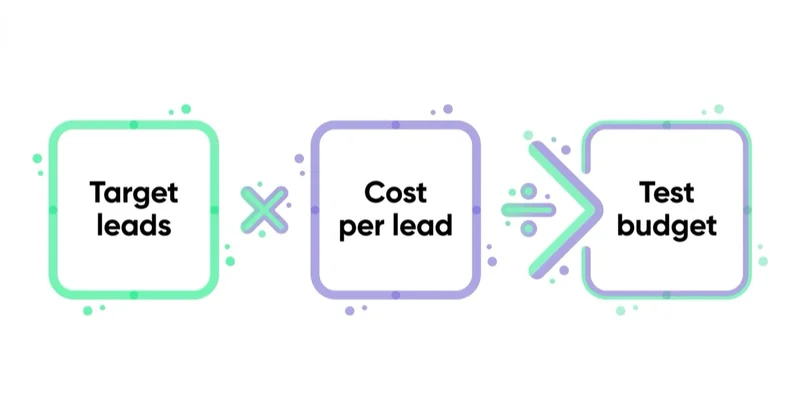
Suppose the current Campaign Manager setup suggests a planning CPC range of £8–£14. If the landing-page conversion assumption is 4%, one lead requires roughly 25 clicks:
- media per lead at £8 CPC: about £200;
- media per lead at £14 CPC: about £350.
If the team needs 20 leads to observe initial qualification patterns, the scenario requires roughly £4,000–£7,000 in media. This still may be too small to estimate customer acquisition if the sales cycle is long or few leads qualify.
Method 2: CPM and reach planning
For awareness or account penetration, use the audience estimate, suggested CPM and desired reach/frequency. If the target list contains 20,000 matched members, do not multiply population by an assumed frequency and call it guaranteed reach; auction eligibility and member activity mean only a share may be reachable during the period.
Plan scenarios for:
- unique reach in the target group;
- average frequency;
- impressions and CPM;
- engagement or site-visit rate;
- target-account activity;
- downstream influenced opportunities.
Method 3: qualified-lead learning
LinkedIn's qualified-lead optimisation currently recommends sending five or more qualified leads within two weeks to accelerate the learning phase. Use the historical lead-to-qualified rate to estimate how many initial leads and how much budget that may require.
If the expected budget cannot produce that signal, start with another supported optimisation goal, consolidate audiences or accept that the platform cannot learn from qualified outcomes yet. Do not lower the definition of “qualified” merely to satisfy the algorithm.
Audience size, precision and cost
LinkedIn requires at least 300 member accounts in an ad-set audience. This is a technical floor, not a recommendation that 300 people are enough for a scalable campaign.
Very narrow audiences can create:
- limited delivery;
- high frequency;
- faster creative fatigue;
- weak test power;
- difficulty supplying enough conversion events;
- sensitivity to one employer or job-title classification error.
Broad audiences can waste reach if the proposition is irrelevant. Find the widest population that still shares the business problem and can be addressed with the same message and offer.
Avoid title-only targeting
Job titles are inconsistent across companies. Combine available attributes thoughtfully—function, seniority, skills, industry, company size or matched company lists—then review the audience estimate. Avoid layering every criterion with AND logic simply to create a visually “precise” persona.
Account-based audiences
Company-list targeting can make LinkedIn valuable when the objective is account penetration. LinkedIn requires matched audiences to contain at least 300 member accounts to activate and recommends larger source lists for match reliability. In the EEA and Switzerland, matched audience size may be limited by member preferences.
Measure account engagement and pipeline coverage, not just individual form submissions. A campaign can influence several people in a buying group before one opportunity appears.
Creative cost is part of media efficiency
The auction rewards relevance, and a finite professional audience sees repeated assets quickly. Budget for enough concepts to test meaningful messages, not only colour changes.
Useful B2B angles include:
- a costly operational problem;
- a specific change in regulation or market behaviour;
- proof from a comparable company or role;
- a diagnostic, calculator or benchmark with a clear methodology;
- an expert point of view that helps the buyer decide;
- a direct product demonstration tied to the job.
Track creative against qualified outcomes. A document ad can generate inexpensive engagement from students or competitors without producing pipeline. A less-clicked case study may attract the right accounts.
Refresh based on frequency, reach, fatigue and message learning—not an arbitrary weekly schedule. When costs rise, diagnose audience saturation, auction change, offer fit, placement, landing-page conversion and lead quality before blaming creative alone.
Lead Gen Forms versus landing pages
LinkedIn Lead Gen Forms reduce friction because profile information can pre-fill fields. A website landing page offers more room for explanation and can capture first-party behaviour outside the form.
Compare them using:
- form completion;
- valid contact and company fit;
- qualified-lead rate;
- sales acceptance and meeting attendance;
- opportunity and pipeline value;
- consent and follow-up requirements;
- fully loaded cost.
A lower Lead Gen Form CPL is not a win if the CRM fills with people who did not understand the commitment. A higher website CPL can be worthwhile when the page qualifies intent. Test the full funnel.
Measurement through to qualified pipeline
Insight Tag and website conversion tracking
The Insight Tag supports website conversion tracking, retargeting and audience insights. LinkedIn states it should not be installed on pages that collect or contain sensitive data; legal and technical teams should review placement.
Use our LinkedIn Insight Tag guide for implementation and consent checks.
Conversions API and CRM Sync
LinkedIn's Conversions API can send online and offline outcomes. CRM Sync can also provide qualified-lead data through Business Manager. For qualified-lead optimisation, LinkedIn recommends choosing one source—CAPI or CRM Sync—to prevent duplicated events and inflated cost-per-conversion reporting.
Define qualified status before activation. Send it promptly and consistently; LinkedIn currently requires qualified lead data within 30 days for optimisation and recommends at least five qualified leads in a two-week period to accelerate learning.
Pipeline metrics
At minimum, calculate by audience, offer and creative:
- valid lead rate;
- cost per valid and qualified lead;
- sales-accepted lead rate;
- cost per opportunity;
- pipeline value and contribution-weighted pipeline;
- win rate and customer acquisition cost;
- time from exposure to stage progression.
Keep LinkedIn's attributed pipeline separate from causal proof. Multi-touch journeys can be claimed by several systems. Use matched-market, holdout or other incrementality methods where spend and audience design support them.
When LinkedIn's premium can make sense
LinkedIn is a strong candidate when:
- professional identity is essential to finding the audience;
- specific accounts, industries, roles or seniorities have materially different value;
- deal contribution can support the expected acquisition cost;
- the sales and CRM process can return lead quality;
- creative can address a professional problem credibly;
- the buyer journey benefits from repeated education across a group.
It may be a poor fit when:
- the audience is broad consumer demand with no professional distinction;
- transaction contribution is low;
- the same high-intent users can be captured more efficiently in Search;
- the matched audience is too small or weakly matched;
- the offer is generic and cannot justify interruption;
- no one can connect leads to qualified pipeline;
- the budget is too low to support learning or a meaningful test.
The strategic role and campaign options are covered in LinkedIn Ads for B2B.
Common cost mistakes
| Avoid | Do instead |
|---|---|
| Planning from a generic $5–$15 CPC range | Use current in-account suggestions and business-specific economics |
| Quoting a universal $10 daily minimum | Use Campaign Manager's current minimum and schedule rules |
| Treating daily budget as a hard daily cap | Plan for up to 50% daily overdelivery within documented total caps |
| Comparing LinkedIn and Meta CPC directly | Compare qualified opportunity and customer contribution |
| Assuming narrower targeting is always better | Balance relevance, reach, frequency and conversion volume |
| Optimising for cheap leads | Return qualified and pipeline outcomes through a deduplicated source |
| Treating engagement as pipeline | Review account fit, qualification and sales progression |
| Ignoring creative and sales costs | Calculate fully loaded acquisition cost |
| Using a cost cap as a per-result guarantee | Treat it as an average benchmark that can restrict delivery |
How Space Ads plans LinkedIn Ads budgets
We begin with target-account and buying-role definitions, expected contribution, sales-stage conversion and allowable acquisition cost. Campaign Manager then provides current audience and auction inputs; we model conservative and central scenarios from impression or click through qualified opportunity.
The initial test consolidates enough budget and audience to produce interpretable evidence. Creative is built around business problems and proof, while measurement connects the Insight Tag or Lead Gen Forms with one controlled source of CRM/CAPI outcomes.
Reporting separates media efficiency, lead quality, pipeline attribution and incremental evidence. If the expected volume cannot answer the question within the available budget, we say so before launch rather than presenting a low daily minimum as a viable plan.
FAQ
How much do LinkedIn Ads cost?
There is no fixed rate. Cost comes from an auction and depends on the target audience, bid strategy, objective, optimisation goal, format and relevance. Use current Campaign Manager estimates for the exact setup and evaluate them against cost per qualified opportunity and customer.
What is the minimum LinkedIn Ads budget?
LinkedIn's current budget page does not publish one universal daily minimum. Lifetime budgets must exceed a minimum based on duration, which Campaign Manager displays. Minimums and available budget types can vary, so verify them in the account at setup.
Can LinkedIn spend more than the daily budget?
Yes. LinkedIn currently states daily spend can be up to 50% above the entered amount on a given day. Continuous campaigns remain capped at seven times the daily budget per Monday–Sunday week, while fixed schedules and lifetime budgets use their documented total caps.
Why can LinkedIn Ads be expensive?
Advertisers compete for professional audiences defined by roles, skills, industries and companies. Scarce, desirable audiences and competitive formats can increase auction price. The cost can still be efficient when that precision improves qualified pipeline and the deal economics support it.
Which bidding strategy should I use?
Maximum delivery suits advertisers prioritising volume and full budget use; cost cap provides an average cost benchmark but can reduce delivery; manual bidding provides direct bid control. Eligibility depends on objective and format. Test against the business outcome rather than choosing solely for a lower reported CPC.
Is LinkedIn Ads worth it for B2B?
It can be when professional identity or account targeting is valuable, deal contribution is sufficient and measurement reaches qualified pipeline. It is not automatically appropriate for every B2B company, especially with low deal value, a tiny audience or weak CRM feedback.
What is a good LinkedIn Ads CPC?
A “good” CPC is one that can produce qualified opportunities and customers within the business's allowable acquisition cost. Back-solve it from lead conversion and qualification rates. A low CPC from the wrong audience is worse than a high CPC that produces profitable pipeline.
How large should a LinkedIn Ads test budget be?
Large enough to observe the outcome that determines the decision. Estimate it from current CPC/CPM suggestions, click-to-lead rate, lead-to-qualified rate and required sample. If the campaign needs qualified-lead optimisation, account for LinkedIn's recommendation of at least five qualified leads within two weeks to accelerate learning.
Should I use the Insight Tag or Conversions API?
They can complement each other for online measurement, with appropriate deduplication. For qualified-lead optimisation, LinkedIn recommends selecting one qualified-lead event source—CAPI or CRM Sync—to avoid duplicate reporting. Apply consent, privacy and sensitive-data restrictions.
Key takeaways
- LinkedIn pricing is auction-based; use the actual audience and account rather than generic CPC tables.
- Understand the difference between charging unit, optimisation goal and reporting KPI.
- Current budget rules allow daily variation and do not document one universal $10 minimum.
- Back-solve affordable CPC and CPL from qualified opportunity and customer economics.
- Budget a test for enough downstream signal, not merely the platform minimum.
- Balance professional precision with audience size, frequency and learning.
- Return one deduplicated source of qualified outcomes and evaluate fully loaded pipeline cost.
Learn more about our LinkedIn Ads and lead generation work.
Sources and further reading
- LinkedIn advertising cost and pricing — LinkedIn Help
- Campaign and ad-set bidding strategies — LinkedIn Help
- Campaign and ad-set budgets — LinkedIn Help
- Targeting options and audience minimum — LinkedIn Help
- Qualified-lead optimisation goal — LinkedIn Help
- LinkedIn Conversions API — LinkedIn Help
- LinkedIn Insight Tag — LinkedIn Help
Continue reading
Pinterest Performance+: What You Gain and What You Give Up
Pinterest Performance+ simplifies setup, bidding, targeting and creative, but some controls change materially — especially in catalogue Sales campaigns. Learn what is automated, what remains yours and how to test it fairly.
Social Media Management Cost: What Drives the Price
Social media management can mean scheduling client-supplied posts or running strategy, production, publishing and community care. This guide gives practical budget ranges and shows how to compare proposals on the work and outcomes included.
Video Ads: What You Are Actually Buying on Each Platform
A YouTube view, a Meta ThruPlay and a TikTok focused view are different events. Learn how to compare video delivery, attention, outcomes and creative without letting platform labels mislead you.


































