LinkedIn Ads lets advertisers build audiences from professional attributes such as job function, seniority, company, industry and skills, as well as eligible company or contact lists and engagement data. This can help a B2B team reach several members of a buying group before, during or after active category research. It is not the only way to reach professional audiences, and executives also use search, publishers, events, communities and other channels. The business case depends on audience match, auction cost, deal economics, creative, sales follow-up and incremental pipeline — not on an assumption that every decision-maker is scrolling LinkedIn.
TL;DR
- LinkedIn combines professional, company and behavioural signals. Search captures expressed queries; LinkedIn can reach defined roles and accounts whether or not they are currently searching.
- Give each campaign a job. Demand creation, account penetration, event response, retargeting and lead capture require different creative and evaluation.
- Do not assume the cost premium. Compare actual cost per target-account reach, qualified opportunity, incremental pipeline and payback with realistic alternatives.
- Feed a lawful, well-defined quality signal. Qualified-lead optimisation can use Conversions API or CRM Sync data, subject to members' preferences; prevent duplicates and map qualification consistently.
- Targeting is a discipline of restraint. Over-narrow audiences starve delivery; the usual mistake is layering too many filters, not too few.
- Current audience products matter. LinkedIn discontinued new lookalike audiences in February 2024; use predictive audiences or deliberate audience expansion where appropriate.
- Sponsored Messaging is consent-limited in the EU. Since October 2024, eligible Message and Conversation Ads can reach EU members who opted in.
- Matched Audiences need sufficient matches. An ad set requires at least 300 member accounts, and the mandatory location facet can reduce the usable audience further.
Why LinkedIn is a different kind of paid channel
Search advertising can respond to an expressed query. Social, video, publishing and programmatic channels use other contextual, behavioural or audience signals. LinkedIn's distinctive input is self-reported and inferred professional information combined with company and engagement data.
In a considered B2B purchase, the person conducting research may differ from the economic buyer, technical evaluator, procurement owner or end user. Search can still reach several of them, but it only captures queries that occur and are commercially addressable. A LinkedIn plan can add coverage against roles or named accounts that the team considers material.
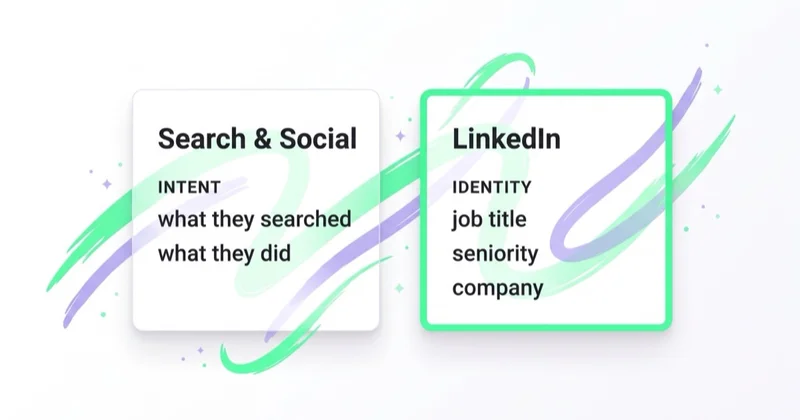
LinkedIn audience attributes can approximate the buying group, but profile data can be incomplete, stale or inconsistent, and a job title does not prove purchasing authority or current need. Treat targeting as a testable hypothesis. Validate delivery through Campaign Manager demographics, company-level reporting, CRM match and sales feedback rather than assuming the selected filters equal the intended audience.
Auction costs vary by market, audience, format, objective, competition and period. A high CPC can still be economical; a low CPC can still buy irrelevant attention. Compare fully loaded acquisition cost and contribution, but also recognise the sales-cycle delay and uncertainty. Platform-attributed pipeline is an operational view, not proof that the ad caused the opportunity.
Who actually clicks: the decision-maker reach
The strategic case is often buying-group coverage, not simply more form fills. Define the accounts and roles the campaign needs to reach, why they matter in the purchase, and what evidence would show progress. Do not claim that another channel cannot reach them without testing the overlap.
For example, a team can target finance functions with specified seniorities at software companies of a given size, or apply role filters to a matched company list. Delivery will be to member accounts that LinkedIn matches to those criteria, subject to platform rules and members' preferences — not an exact list of verified decision-makers. Use different messages for economic, technical and operational concerns, then assess whether the intended companies and downstream opportunities actually appear.
This changes what “working” means. A coverage campaign may not be expected to generate immediate leads; a Lead Gen Form campaign should still be accountable for qualification and follow-up. Define the primary decision metric, observation window and stop rule before launch rather than excusing weak results as invisible influence.
When LinkedIn Ads makes sense — and when it doesn't
LinkedIn is not a universal channel. It fits a specific shape of business.
| Signal | LinkedIn Ads is a strong fit | LinkedIn Ads is a weak fit |
|---|---|---|
| Deal size / ACV | Mid-to-high; a customer is worth thousands or more | Low-ticket, high-volume, thin margin |
| Buyer | A definable role or seniority you can name | Broad consumer or undefined audience |
| Sales motion | Considered, multi-stakeholder, sales-assisted | Impulse or pure self-serve at low price |
| Target list | You can list the companies or roles that matter | "Anyone who might buy" |
| Payback and cash | Sales-cycle economics can support the measured delay | Cash model requires rapid, directly observed payback |
| Content | You have a point of view worth publishing | Only product-feature ads |
A low-ACV self-service product may struggle to recover targeted-media costs, but there is no universal ACV cutoff. Model audience size, conversion, contribution, sales cost and payback with a range, then test against alternative channels. LinkedIn may also support partnerships, events or expansion in ways a lead-only model misses.
For a fuller comparison of how the paid channels divide the work in B2B, see SaaS paid acquisition on Google and Meta, which covers the pipeline-measurement side in depth.
Targeting: how to actually reach decision-makers
LinkedIn's targeting is its product. The main building blocks:
- Company attributes — name, industry, size, and growth rate. Company name targeting is the foundation of account-based marketing.
- Job attributes — job title, job function, seniority, and years of experience. Function plus seniority is usually more durable than job title, because titles are inconsistent across companies.
- Member attributes — declared skills, groups, education and interests.
- Matched Audiences — your own first-party data: contact lists (by email), company lists (for ABM), and retargeting from website visits (via the Insight Tag), video views, event responses, Lead Gen Form opens and Company Page engagement.
- Predictive audiences — built from one eligible source type such as a Lead Gen Form, list, conversion or retargeting audience. LinkedIn combines the source with its AI to predict similar actions. New lookalike audiences have been discontinued since February 2024.
The glossary you need first
- Matched Audiences — audiences built from your own data (contact emails, target-company lists, or website retargeting) rather than LinkedIn's native attributes.
- Insight Tag — LinkedIn's website tag that enables retargeting, conversion tracking and audience demographics.
- Conversions API (CAPI) — a server connection for eligible online or offline conversion data. When used with the Insight Tag, event IDs and matching fields must support deduplication.
- Lead Gen Form — an in-platform form pre-filled with the member's profile data, so they convert without leaving LinkedIn.
- Thought Leader Ad — a sponsored version of an organic post from an individual member (often an executive or employee), not the company page.
- Audience expansion and automated audience options — tools that can broaden delivery using platform signals. Availability and behaviour depend on the ad-set setup; use them only when that trade-off matches the test.
The restraint problem
Stacking seniority, title, skills, group and interests can shrink the audience and make results hard to interpret. LinkedIn requires at least 300 matched member accounts for an ad set, but the minimum is not a recommendation. The useful size depends on geography, budget, objective and available demand; LinkedIn guidance for some use cases recommends much larger audiences.
Start with the fewest attributes needed to represent the hypothesis, then create separate ad sets when you need to learn whether a role, industry or account tier behaves differently. Review every expansion and network setting in the current setup rather than applying a universal on/off rule. Exclusions and company lists also depend on match quality, member preferences and minimum audience thresholds.
Ad formats and the job each one does
LinkedIn's formats are not interchangeable. Match the format to the job in the funnel.
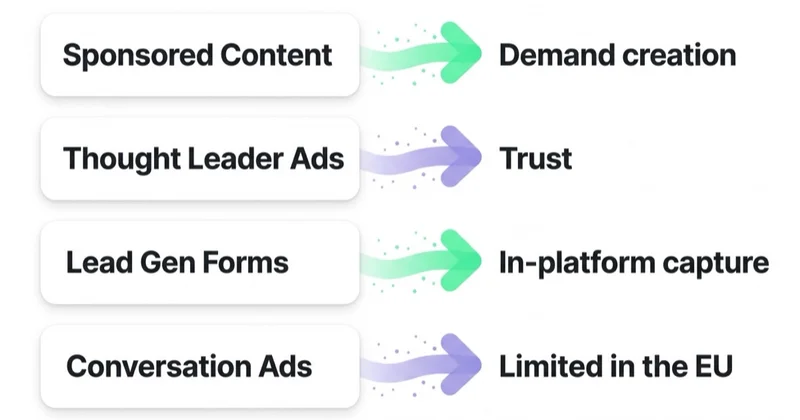
| Format | Primary job | Notes |
|---|---|---|
| Single image / video (Sponsored Content) | Demand creation, retargeting | The workhorse; put the point of view here |
| Document ads | Education, lead capture | High engagement; a gated document can capture leads in-feed |
| Carousel | Sequential proof or steps | Useful for multi-point arguments |
| Thought Leader Ads | Distribute an eligible member's perspective | Test the speaker, post and audience; the format does not create credibility by itself |
| Lead Gen Forms | In-platform lead capture | Pre-filled; high completion but watch lead quality |
| Conversation / Message Ads | Sponsored inbox experience | In the EU, delivery is limited to members who opted in; check current eligibility and law |
| Text / Dynamic (Spotlight, Follower) | Supporting reach or follower objectives | Desktop placement and eligibility vary; evaluate actual delivery and cost |
Thought Leader Ads let an advertiser sponsor an eligible member post, but performance depends on the argument, speaker, audience and objective; test them against appropriate alternatives. For Sponsored Messaging in the EU, LinkedIn supports Message and Conversation Ads only for members who agreed to see native ads in their inbox. Forecast reach from the platform rather than assuming EU delivery is either fully available or prohibited.
Bidding, budget and the cost reality
LinkedIn delivery is auction-based, and available bid strategies, objectives and minimums can change. Plan from the business event and current Campaign Manager forecast rather than a universal CPC benchmark. Compare the channel with credible alternatives on target-account reach, qualified opportunity economics and incremental lift where measurable.
Plan budgets by intent, not by copying a Meta plan:
- Testing a new audience or offer — enough budget and time to reach a pre-defined evidence threshold, concentrated enough to interpret the result.
- Always-on ABM — steady, sustained presence against a defined account list, measured on account engagement and pipeline, not weekly leads.
- Demand capture — retargeting eligible engaged accounts and website visitors; validate rather than assume lower cost or higher conversion.
Where you use LinkedIn's lead optimisation, prefer optimising toward qualified outcomes over raw form fills once you have enough conversion volume, so the system learns to find people who become pipeline rather than people who fill forms.
Measurement: judge it on pipeline, not last click
Last-click gives the final eligible interaction credit and can miss earlier LinkedIn exposure. Multi-touch or platform attribution can show a broader path, but still does not establish causality. The measurement plan should connect delivery to qualified business outcomes and reserve causal language for valid experiments.
A defensible LinkedIn measurement setup:
- Install the Insight Tag and define conversions that matter (demo, qualified lead, pipeline creation), not just page views.
- Connect Conversions API or CRM Sync where appropriate and map a consistently defined qualified-lead event. LinkedIn recommends choosing one qualified-lead event source to prevent duplication.
- Report several views without conflating them — platform-attributed conversions, CRM-sourced or influenced pipeline, account progression and self-reported discovery each use different rules and have different limitations.
- Use the buying-cycle length honestly. If deals take three months, judging a campaign after three weeks measures noise.
- For material budgets, assess an experiment. LinkedIn Conversion Lift or a valid geo/account design can estimate incremental effects when eligibility, sample size, assignment, contamination and outcome volume support it. This is the same logic behind incrementality testing.
The pattern to internalise: LinkedIn should be reported next to closed revenue and CAC, in the same view as every other channel. A single source of truth for that is a marketing dashboard the leadership team actually reads.
Creative that works on decision-makers
Generic promises give a busy B2B buyer little reason to stop. A more useful creative hypothesis is to make the problem, operational consequence, relevant metric and evidence concrete. The message still needs testing: seniority alone does not determine what a person will read or how they will respond.
Useful hypotheses to test:
- Name the problem precisely, in the buyer's language, before naming the product.
- Lead with a point of view, not a feature list — a claim the reader can agree or disagree with.
- Use proof — a customer outcome, a benchmark, a concrete number — over adjectives.
- Test a credible expert voice through Thought Leader Ads when the named person's expertise and permissions fit the message.
- Give the buying group different assets — the economic buyer needs a cost-and-risk case; the technical evaluator needs detail. B2B buying is not linear, so the creative cannot be.
Account-based marketing: LinkedIn's home turf
LinkedIn can support ABM by applying professional attributes to a matched company list and reporting company-level engagement. Match rates, the 300-member minimum, member preferences and role coverage limit precision, so coordinate ads with CRM, sales and organic activity. A workable structure:
- Tier the accounts — a small strategic tier gets bespoke creative and higher budget; a broader tier gets programmatic always-on.
- Sequence by stage — problem-framing content to cold accounts, proof and comparison to engaged ones, direct offers to sales-ready ones.
- Align with sales — the same account list drives ads and outbound, so a rep's call lands after the buyer has already seen the argument.
- Exclude the wrong people — current customers, open opportunities and off-ICP roles waste an expensive impression.
Budget by company size
The right LinkedIn plan changes with company stage:
| Stage | Sensible LinkedIn role | Watch out for |
|---|---|---|
| Early / seed | Validate whether a sufficiently large matched audience and deal model support a focused test | Forcing a tiny named list below delivery thresholds |
| Growth / mid | Layered ABM tiers plus demand creation; Lead Gen Forms with CRM feedback | Judging on CPL before the CRM loop is connected |
| Enterprise | Always-on ABM across the buying group; brand plus pipeline reporting | Attribution disputes hiding real influence |
From Lead Gen Form to revenue: close the CRM loop
A Lead Gen Form can reduce friction by pre-filling profile data, but a cheaper form completion is not automatically better pipeline. The CRM payload should preserve the identifiers available from the form or integration, submission time, form version and relevant permission or consent records. Downstream events should use the company's actual lifecycle definitions, values and disqualification reasons; do not send fields to LinkedIn simply because they exist in the CRM.
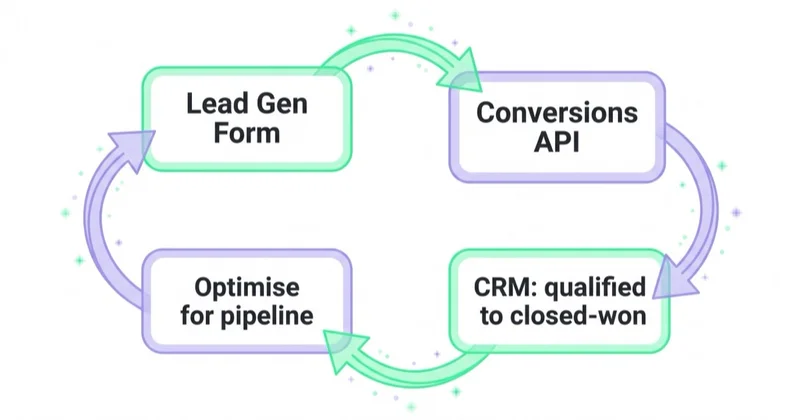
LinkedIn supports hidden form fields, including dynamic IDs and names for the account, campaign, ad set and ad. This can preserve source detail without duplicating every form. The CRM still needs identity deduplication, routing ownership and a response-time SLA. Decision reporting should include cost per qualified opportunity, sourced and influenced pipeline under explicit rules, CAC, contribution and payback. CPL can remain a diagnostic, not the final success measure.
For account-based targeting, begin with the company list and then layer job function, seniority, or skills. Combining too many facets can shrink delivery below a useful level. LinkedIn requires at least 300 matched member accounts for an ad set to run, and the mandatory location facet can reduce the final audience further. A small named-account program may therefore need broader role logic, several buying personas, or a coordinated organic and outbound layer rather than more targeting filters.
How Space Ads approaches LinkedIn Ads
Our starting point is the buying group, target-account universe, commercial event and evidence threshold. We then check whether the addressable LinkedIn audience is large enough, whether profile attributes approximate the intended roles, and whether the deal economics support a test.
We connect the Insight Tag and an appropriate server or CRM source with deduplication, privacy review and stable qualification definitions. Demand creation, account coverage, retargeting and lead capture receive separate decisions and windows. Reporting places attributed platform outcomes beside CRM pipeline, contribution and experimental evidence without blending them into false precision. That is the operating core of performance marketing. A fractional CMO can own positioning and cross-channel allocation; the channel offer is on the LinkedIn Ads service page.
An illustrative gated rollout
| Gate | Work | Evidence required before progressing |
|---|---|---|
| Measurement ready | Define the commercial event, install and validate tracking, deduplicate events, review privacy and build lists | Test events reconcile across Campaign Manager and CRM |
| Audience viable | Check match rate, 300-member minimum, location effect, forecast and expected economics | Addressable audience and maximum test exposure are credible |
| Initial test | Launch one clear audience-message hypothesis with controls and a decision window | Delivery, target-company mix and early quality pass the agreed threshold |
| Quality feedback | Add qualified-lead data through one selected source and test additional formats or retargeting selectively | Stable qualification mapping and sufficient signal for optimisation |
| Scale or stop | Review contribution, pipeline maturity, capacity and incremental evidence where feasible | A documented decision to scale, revise or stop |
Stop doing / Do instead
| Stop doing | Do instead |
|---|---|
| Judging LinkedIn on cost per lead | Judge it on qualified pipeline, CAC and influence |
| Stacking five targeting filters | Lead with one fit filter; keep the audience deliverable |
| Optimising to raw form fills | Optimise to qualified outcomes once volume allows |
| Assuming an ad format creates credibility | Test expert-led and brand creative against the same objective |
| Relying on last-click attribution | Add CRM-stage feedback, assisted pipeline and holdouts |
| Treating Sponsored Messaging as banned or unrestricted in the EU | Forecast the opted-in audience and check current eligibility and law |
| Forcing LinkedIn into an uneconomic acquisition model | Model contribution and payback; test only when the exposure is supportable |
FAQ
What are LinkedIn Ads?
LinkedIn Ads are paid placements delivered through LinkedIn Campaign Manager that let advertisers reach members by professional attributes — job title, seniority, function, company, industry and skills — as well as by their own contact and account lists. They are used mainly for B2B demand creation, account-based marketing and lead generation.
Are LinkedIn Ads more expensive than Google or Meta?
They are not always more expensive. Auction cost varies by audience, market, objective, format and competition, while CPC comparisons ignore lead quality and sales value. Evaluate cost per target-account reach, qualified opportunity, incremental pipeline and payback against realistic alternatives.
How do you target decision-makers on LinkedIn?
Start with the professional attributes most likely to represent the buying role, such as function, seniority, skills or a named account list, then inspect forecast size and actual company mix. Job titles can be inconsistent, but no single facet is universally more reliable. Use the smallest set of filters that expresses the hypothesis without preventing useful delivery, and let the message help qualify the audience.
Should I use LinkedIn Lead Gen Forms?
Lead Gen Forms produce high completion rates because they are pre-filled, but that convenience can attract low-intent leads. Use them, but send the resulting CRM stages back through the Conversions API and optimise toward qualified leads rather than raw form completions.
How should I measure LinkedIn Ads for B2B?
Connect delivery to consistently defined CRM outcomes and report platform-attributed, sourced, influenced and experimental views separately. Respect conversion delay and cohort maturity. Use Conversions API or CRM Sync with deduplication and privacy controls, and consider a valid lift or holdout design for material budgets.
Is LinkedIn good for account-based marketing?
It can be. Company lists and professional attributes support buying-group coverage, while company-level reporting can inform sales coordination. Precision is limited by match rates, member preferences, profile data and the 300-member minimum. Test it alongside sales, organic and other account channels.
Can I run LinkedIn Message or Conversation Ads in Europe?
LinkedIn has supported EU targeting for Message and Conversation Ads since mid-October 2024, but only EU members who agreed to see Sponsored Messaging can receive them. Forecast the eligible audience in Campaign Manager and review current platform requirements and applicable law.
What budget do I need to start with LinkedIn Ads?
There is no universal starting budget. Build it from the reachable audience, forecast cost, sales-cycle length, baseline conversion, minimum detectable effect or decision threshold, and maximum acceptable exposure. Concentrate the first test enough to answer one clear question.
Key takeaways
- LinkedIn combines professional attributes, company lists and engagement signals; targeting remains a hypothesis to validate.
- Give demand creation, account coverage, retargeting and lead capture separate goals and evidence windows.
- New lookalike audiences are discontinued; use current predictive or expansion options deliberately.
- Qualified-lead optimisation can use Conversions API or CRM Sync, with one selected source, stable definitions and deduplication.
- Measure actual auction economics and qualified outcomes, and use valid experiments before claiming incremental pipeline.
Sources and further reading
- LinkedIn Marketing Solutions — Ad formats overview
- LinkedIn Ads Help — Targeting options and Matched Audiences
- LinkedIn Ads Help — Matched Audience minimum size and troubleshooting
- LinkedIn Ads Help — Creating Lead Gen Forms
- LinkedIn Ads Help — Hidden fields and dynamic form identifiers
- LinkedIn Ads Help — Conversion optimization and Conversion Lift testing
- LinkedIn Ads Help — Lookalike Audiences discontinuation and Predictive Audiences
- LinkedIn Ads Help — Sponsored Messaging availability in the European Union
- LinkedIn Ads Help — Conversions API and qualified lead events
- LinkedIn Ads Help — Qualified Leads optimization and event-source selection
Continue learning
- SaaS paid acquisition: Google and Meta for pipeline, CAC and payback
- Demand generation vs lead generation in B2B
- The marketing dashboard growth teams should track across ads, SEO and sales
- Incrementality testing: geo experiments across Meta and Google
- LinkedIn Ads, run as a pipeline channel
- Fractional CMO: senior marketing ownership across the whole mix
Continue reading
Pinterest Ads in 2026: When Visual Discovery Beats Search and Social
Pinterest Ads combine visual feeds, saves, keyword targeting and catalogues. Learn how to test channel fit, validate Performance+ and Conversions API, and separate attribution from incremental value.
Social Media Advertising Tools That Run Campaigns (Not Just Schedule Posts)
A scheduler will not tell a team where the next budget increase should go. This guide defines the paid-social stack around spend governance, creative evidence, pacing, approvals and AI-assisted changes, then shows when it belongs beside native platform panels.
Static vs Video Ads: Which Converts, and When to Use Each
Static and video ads can both sell. The useful question is which format communicates a specific idea in a specific placement at an acceptable total cost. This guide shows how to choose and test them fairly.