Influencer marketing cost is not one creator rate. A programme can include strategy, creator research, production, publication to the creator's audience, usage rights, paid-media permissions, exclusivity, product and travel, management, amplification and measurement. Two proposals with the same number of posts can therefore buy very different commercial assets.
The contract turns those assets into something the brand can actually use. Measurement then determines whether the work generated profitable incremental demand, useful paid creative, valuable reach—or only attractive engagement.
TL;DR
- Start with the business role: awareness, qualified reach, content production, launch demand, sales or long-term advocacy.
- Separate creator work, organic distribution, content licence, account/content ad permissions, exclusivity and expenses.
- Do not assume a post fee includes the right to edit, publish on brand channels, use in ads or run from the creator's identity.
- Select creators on audience relevance, content credibility, brand safety, delivery quality and commercial evidence—not follower count alone.
- Contract deliverables, disclosure, claims, usage, music/third-party rights, approvals, cancellation, reporting and payment.
- Use links, codes and surveys as attribution inputs, not proof of incrementality.
- Calculate ROI from incremental contribution after all programme and media costs, not attributed revenue divided only by creator fees.
- Treat Meta Partnership Ads and TikTok Spark Ads as platform permission workflows that must align with contractual rights.
What are you paying for?
Strategy and creator selection
This can include audience research, shortlisting, outreach, negotiation, due diligence, briefing and programme design. It is real work even when a creator ultimately declines.
Content production
The production fee covers the creator's time and agreed output: concept, script, shooting, editing, voiceover, captions, raw footage, cut-downs and revisions. Specify which of these are included.
A creator can be valuable as a content producer even when their audience is not required. Conversely, a strong distribution partner may not produce an asset suitable for paid media without additional versions.
Organic distribution
Publication to the creator's audience buys access to that audience under the platform's delivery conditions. The fee may depend on format, expected reach, audience fit, posting schedule and number of channels.
The brand is not buying a guaranteed number of organic impressions unless the agreement expressly includes a make-good or delivery commitment—and even then, define how it is measured.
Usage rights
A content licence should state:
- exact assets and versions;
- brand-owned channels and media;
- organic and paid use;
- territories;
- duration and start date;
- editing, cropping, translation and derivative rights;
- website, email, retailer, marketplace and out-of-home use if needed;
- whether raw files are included;
- renewal and removal process.
“All social usage” is not precise enough. The creator may also have used music, footage, people or locations whose permissions do not extend to brand advertising. Creator permission alone cannot grant rights they do not hold.
Paid-media identity permissions
On Meta, partnership ads can run with creator and brand identities subject to eligibility and permission settings. Meta provides content-level and account-level permission workflows. On TikTok, Spark Ads can use a creator's organic post with authorisation; current tools allow authorisation periods to be configured, and account-linking workflows also exist.
These platform permissions are sometimes called “whitelisting”, but the term can hide important differences. The agreement and in-platform authorisation should both cover:
- advertiser/ad account;
- eligible content;
- permitted objective and markets;
- dates;
- whether the brand can create ads-only/new versions;
- comment and community responsibility;
- renewal/revocation;
- what happens when the relationship ends.
Platform access does not replace a contractual content licence, and a contract does not automatically create platform access.
Exclusivity
Exclusivity compensates the creator for work they cannot accept. Define the competitive set, products, geography, media and time. “No work with competitors” is likely too broad for both pricing and enforcement.
Separate pre-publication, campaign and post-campaign periods. A narrow seven-day category restriction may meet the need better than a six-month ban across an entire industry.
Product, travel and production expenses
Include shipping, samples, props, location, crew, travel, platform fees, taxes and creator-management commission where applicable. A gifted product is something of value and may create disclosure obligations; it is not automatically payment for a guaranteed post.
Programme management and paid amplification
Budget for contracts, approvals, asset management, compliance checks, reporting, edits and media spend. A creator programme designed to generate paid creative needs a media-testing budget; an organic advocacy programme may not.
What drives influencer marketing rates?
There is no reliable universal rate card based only on follower tier. The same creator may quote differently for a one-time Story, a technically complex video, a six-month licence or category exclusivity.
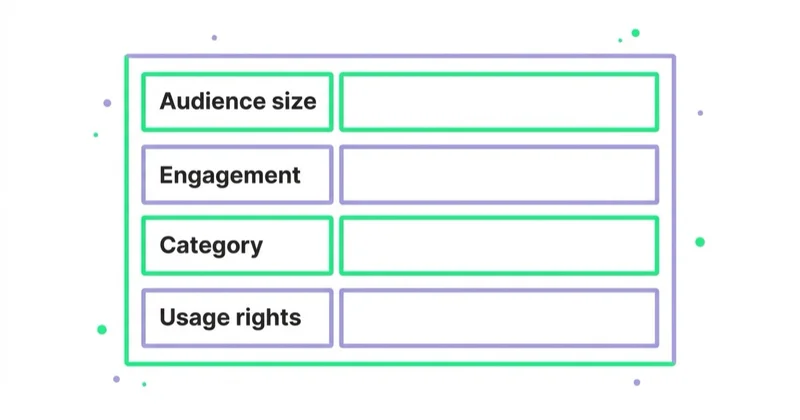
| Cost driver | Questions to ask |
|---|---|
| Audience fit | How much of the reachable audience matches the market, age, need and geography? |
| Expected delivery | What are recent median views/reach for comparable posts, not only the best example? |
| Production complexity | How many concepts, scenes, locations, products, edits and formats? |
| Publication | Which accounts, formats, dates and retention period? |
| Licence | Where, how, for how long and with what editing rights? |
| Paid-media permission | Which platform workflow, content and authorisation period? |
| Exclusivity | Which named competitors/category, market and time? |
| Approval/compliance | How many rounds, what review and which claim restrictions? |
| Urgency | Does the timetable require rush work or reserved availability? |
| Creator demand | What other commercial work must be declined? |
Follower count is useful context but a weak buying metric on its own. Request recent distribution by format, audience geography/demography where available, sponsored-content examples and performance definitions. Watch for sudden audience growth, implausible geographic mix, repetitive comments and large gaps between reported following and recent delivery.
Do not demand personal audience data beyond what is necessary. Handle screenshots, platform exports and any customer-level data under appropriate privacy and confidentiality controls.
Creator selection scorecard
Use a structured scorecard before negotiating price.
| Area | Example weight | Evidence |
|---|---|---|
| Audience relevance | 25% | Platform audience data and content/community review |
| Creative fit | 20% | Ability to explain or demonstrate the product credibly |
| Delivery consistency | 15% | Median recent performance by comparable format |
| Brand and compliance fit | 15% | Disclosure history, claims, safety and category suitability |
| Commercial evidence | 10% | Link/code data, brand references or paid-ad results with definitions |
| Production reliability | 10% | Brief response, deadlines, file quality and revision process |
| Cost and rights | 5% | Total value of deliverables, licence and permissions |
Weights should change by objective. For a pure UGC production brief, audience reach may have little importance. For a credibility launch, topic authority and community trust may dominate.
Common pricing models
Fixed fee
A set fee for defined deliverables, publication and any included rights. Predictable, but only comparable when the scope is itemised.
Cost per deliverable or production day
Useful when buying a content batch or uncertain production scope. Define what makes a deliverable accepted and how reshoots are handled.
Fee plus performance commission
Combines guaranteed compensation with commission on tracked sales, leads or another result. Specify attribution window, returns, cancellations, coupon leakage, tax, payment schedule and reporting access.
Affiliate/performance only
Appropriate for some publisher or ambassador relationships, but not automatically cheaper or better aligned. It transfers attribution, conversion and stock risk to the creator, which can change the partners willing to participate. It may also reward sales that would have happened anyway.
Gifting or sampling
Useful for evaluation and product experience when the creator is free to decline and no guaranteed coverage is implied. Any post, licence or approval right should be separately agreed. Disclosure and platform rules still apply.
Retainer or ambassador agreement
Supports repeated exposure, product learning and an evolving content library. Define minimum output, category conflicts, review points and exit terms so the arrangement does not become an expensive automatic renewal.
Influencer contract checklist
This checklist identifies commercial issues; it is not legal advice. Use counsel familiar with the relevant jurisdictions, platform terms and category.
Parties, services and timetable
- correct legal parties and representatives;
- deliverables, format, length, language and platform;
- organic publication date/time and minimum live period;
- draft, feedback, reshoot and final deadlines;
- brand inputs and late-approval consequences;
- acceptance criteria and make-good conditions.
Creative control and authentic opinion
The brief can require accurate product information, prohibited claims and mandatory disclosure. It should not require the creator to describe an experience they did not have or state an opinion they do not hold.
Define which facts need approval and how much editorial independence remains. Include a process for discovering a genuine product problem before publication.
Advertising claims
The brand should supply substantiated claim boundaries. Health, financial, environmental, comparative, performance and children's advertising may require additional review.
Under the US FTC Endorsement Guides, endorsements must reflect honest experience and advertisers can face liability for false or unsubstantiated statements made through endorsements. Training, monitoring and correction should be operational responsibilities, not merely boilerplate.
Disclosure
State the markets, formats and required labels/tools, then verify the live post. Requirements vary.
- The FTC advises that a material connection—including free or discounted products—should be disclosed clearly with the endorsement itself.
- UK CMA guidance says brands should take responsibility for ensuring paid endorsements are labelled and should check relevant content.
- ASA/CAP guidance generally expects a prominent, upfront “Ad” label for influencer advertising; a brand tag or discount code is not enough by itself.
Platform paid-partnership tools can help but may not satisfy every context or market alone. Disclosure must remain noticeable in video, captions, Stories, reposts and edited versions.
Intellectual property and third-party rights
Cover ownership/licence, creator name and likeness, music, fonts, footage, trademarks, other people, locations, releases and generative-AI use where relevant. Identify who clears rights for paid advertising and who bears the cost of replacement.
Paid usage and platform permission
Separate:
- the legal right to use the content;
- the right to use the creator's identity;
- technical authorisation in Meta/TikTok/another platform;
- the media budget and ad-account responsibility.
Track expiry in the campaign calendar. Do not promise automatic renewal without price, consent and availability terms.
Exclusivity and conflicts
Name the product/category and competitor definition. Address existing commitments, organic mentions, retailer relationships and the creator's own products. Keep duration proportionate.
Reporting and audit
Specify the screenshots or exports, metrics, deadline and definitions. If affiliate commission applies, define the creator's access to sales and adjustment data.
Payment, cancellation and morality/brand-safety terms
Set currency, tax, payment milestones, agent commission, kill fee, postponement, product recall, force majeure, non-delivery and breach remedy. A morality clause should be specific, mutual where appropriate and reviewed by counsel—not an unrestricted right to cancel after work is complete.
Data protection and confidentiality
Address embargoes, unreleased products, customer information, tracking and deletion. Creators should not receive customer-level purchase data merely to prove commission when aggregated reporting can serve the purpose.
How to calculate influencer marketing ROI
Use one consistent cost and value definition.
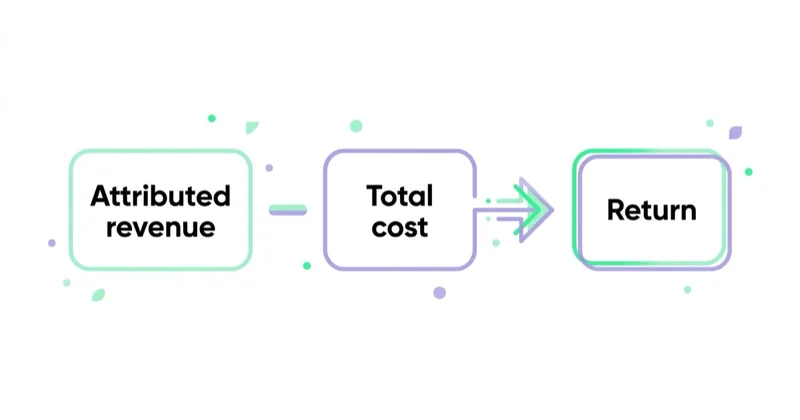
total programme cost = creator fees + rights + management + product/expenses + production support + paid media + measurement + incremental internal cost
incremental contribution = incremental net revenue − cost of goods/services − fulfilment − returns/refunds − variable sales/service cost
influencer ROI = (incremental contribution − total programme cost) ÷ total programme cost
Revenue ROAS and ROI are not interchangeable. If the programme reports $200,000 in attributed revenue against $50,000 in creator fees while ignoring product cost, media and management, the result is neither full ROAS nor profit ROI.
Illustrative example
Assume:
- creator production and distribution: $30,000;
- usage rights and platform permissions: $8,000;
- management, products and editing: $7,000;
- paid amplification: $25,000;
- total cost: $70,000.
A controlled analysis estimates $190,000 in incremental net revenue. If incremental contribution after product, fulfilment and returns is $95,000:
ROI = ($95,000 − $70,000) ÷ $70,000 = 35.7%
This is a hypothetical illustration, not a benchmark. If $190,000 is only code-attributed revenue rather than estimated incrementality, label it accordingly and do not use the same conclusion.
Measurement: from attribution to incrementality
Delivery and creative diagnostics
- reach, impressions and frequency;
- video completion or watch time;
- saves, shares and meaningful comments;
- audience geography/demography where available;
- hook and message performance in paid media;
- cost per usable asset.
These show delivery and resonance. They do not prove revenue.
Direct-response attribution
- creator/campaign UTMs;
- unique landing pages;
- affiliate links and codes;
- tracked leads or purchases;
- new-customer and contribution data;
- platform-attributed conversions for amplified ads.
Codes undercount buyers who do not use them and can overcount when codes leak to coupon sites. Links lose cross-device and delayed journeys. Platform attribution includes its own windows and modelling. Use these inputs for optimisation, not as a single unquestioned truth.
Self-reported attribution
A post-purchase survey can capture word of mouth and impressions that tracking misses. Keep answer options stable, allow open text and analyse response rate. Memory and response bias mean survey totals are not exact causal estimates.
Directional demand signals
Brand search, direct traffic, social profile activity and organic mentions can move during creator activity. They are useful diagnostics but are confounded by PR, seasonality, other media and existing trends. “Branded search increased” does not prove the creator caused all of it.
Incremental methods
Depending on scale and feasibility:
- randomised audience/platform conversion-lift studies;
- geographic holdouts or matched-market tests;
- staggered launch designs;
- creator-level holdouts where assignment is controllable;
- marketing-mix modelling for sustained, material programmes;
- triangulation of experiments, attribution and surveys.
No single method is always available or sufficient. A geo test needs enough independent markets and stable treatment; a platform lift test answers within that platform's observable environment; MMM is sensitive to data volume and assumptions. Pre-register the hypothesis, budget and decision rule before results are known.
Read our guide to incrementality testing.
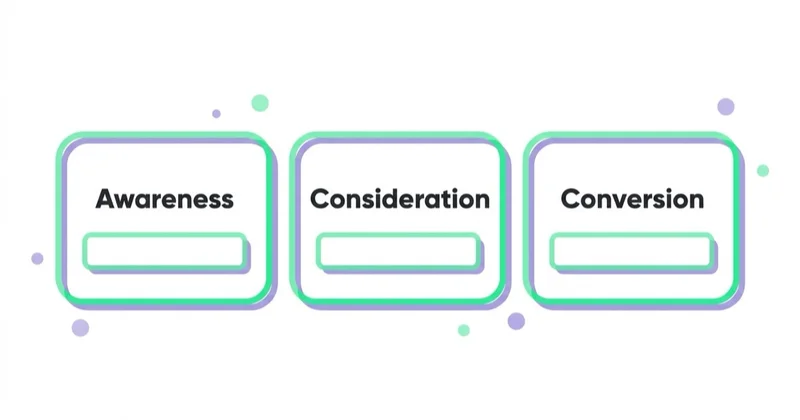
Organic creator content versus paid amplification
These are related but different media products.
Organic distribution can provide
- access to an established community;
- context from the creator's regular content;
- comments and audience feedback;
- a credible product demonstration;
- demand beyond the brand's current targeting.
Paid amplification can provide
- controlled budget and objective;
- broader or defined delivery;
- creative comparison in a media system;
- frequency and placement management;
- conversion optimisation and paid reporting.
Do not assume every successful organic post will be a successful ad, or vice versa. An organic story may depend on creator context; a direct paid hook may feel too commercial to followers.
Create a rights ladder:
- initial organic post/production;
- short paid test permission for selected assets;
- extension for proven winners;
- broader channels/markets only when the business case exists.
This avoids buying expensive perpetual rights for untested work while preventing a successful asset from stopping unexpectedly. Negotiate extension mechanics upfront without assuming the creator must renew.
Budget planning by objective
Content engine
Prioritise production volume, raw footage, versions, editing rights and paid testing. Organic audience size may receive a lower weight.
Brand or product launch
Prioritise credible category voices, coordinated timing, high-quality distribution, PR/retail integration and reach measurement. Reserve capacity for follow-up content after the first exposure.
Direct response
Prioritise audience-product fit, clear offer, link/code setup, landing-page continuity, new-customer economics and sufficient paid amplification. Avoid selecting only on historical code sales without knowing discount, attribution and audience overlap.
Ambassador programme
Prioritise authentic long-term fit, repeated product experience, content consistency, category conflicts and review milestones. Avoid locking into a long agreement before a pilot demonstrates working chemistry.
Operational workflow
- Define outcome and economics. Audience, value event, allowable cost and measurement method.
- Create the brief and claim matrix. Required messages, evidence, prohibited claims, disclosure and creative freedom.
- Research and verify creators. Audience, content, safety, sponsored history and delivery.
- Request itemised proposals. Production, publication, licence, paid permission, exclusivity and expenses.
- Contract before production. Include acceptance, rights, disclosures, data, payment and cancellation.
- Onboard product and evidence. Give enough time for genuine use where an endorsement relies on experience.
- Review facts and compliance. Do not rewrite the creator's opinion into a scripted testimonial.
- Validate links, permissions and landing pages. Test before publication.
- Monitor live delivery. Capture disclosure, post URL, metrics, claims and comment risks.
- Test amplification selectively. Extend rights and media only on evidence.
- Report attribution and incrementality separately. Include all costs and contribution.
- Archive rights and expiries. Remove or renew assets on time.
Space Ads approach
Space Ads designs creator programmes around the role each creator and asset must play. We separate organic distribution from content production and paid-media use, then align creator selection, rights, platform permissions and amplification with one commercial measurement plan.
Reporting distinguishes delivery, attributed response and incremental evidence. Paid creative is evaluated against contribution and customer quality, while disclosure and claim verification are checked as operational deliverables. Where the available scale cannot support a causal test, we state the limitation and triangulate the strongest available signals.
FAQ
How much does influencer marketing cost?
There is no dependable universal rate by follower count. Cost depends on audience fit, expected delivery, production, number of posts, licence, paid-ad permissions, exclusivity, market, urgency and management. Compare itemised total programme cost against the outcome and evidence required.
What should an influencer contract include?
Define deliverables, publication, approvals, honest experience, substantiated claims, disclosure, IP and third-party rights, paid usage, platform permissions, exclusivity, reporting, data, payment, cancellation and breach. Use market-specific legal advice.
What is influencer whitelisting?
It is an industry term for permission to run ads using a creator's identity or content. Current platform names include Meta Partnership Ads and TikTok Spark Ads. Technical authorisation and contractual rights are separate, so establish both.
How long should usage rights last?
Long enough for the intended test or deployment, not an arbitrary 30, 90 or 180 days. A staged licence can be efficient: initial test, priced extension for winners, then broader use if justified. Include precise start/end dates and removal obligations.
How do you measure influencer ROI?
Calculate incremental contribution after product, fulfilment and returns, subtract all creator, rights, management, media and measurement costs, then divide by total cost. Use links, codes and surveys for attribution and add lift tests, geo experiments or modelling where feasible.
Is engagement rate a valid KPI?
It is a delivery/creative diagnostic when defined consistently. It does not prove commercial impact. Examine the quality of interactions, audience, reach basis and downstream behaviour.
Is affiliate-only payment a good idea?
It can suit some creator, publisher and ambassador relationships. Define commission, attribution, returns and code leakage. It transfers risk to the partner and may not buy production quality, guaranteed publication or usage rights.
Do gifted products need disclosure?
Often yes. The FTC treats free or discounted products as a material connection requiring clear disclosure in relevant US-facing endorsements, and UK guidance also covers incentives and gifts. Apply the rules of every market reached and the platform's policy.
Key takeaways
- Itemise production, distribution, licence, platform permissions, exclusivity, expenses and media.
- Match creator selection to the programme's real objective.
- Contract both content rights and technical ad permissions.
- Supply claim evidence and verify clear disclosure after publication.
- Use codes, links and surveys as imperfect attribution inputs.
- Calculate ROI from incremental contribution and total programme cost.
- Buy longer or broader rights after evidence, with extension terms agreed in advance.
- Keep a rights ledger so successful ads do not run outside permission.
See how Space Ads approaches influencer marketing and creator-led ad production.
Sources and further reading
- FTC Endorsement Guides: questions and answers
- Disclosure guidance for social media influencers — FTC
- Social media endorsements: guidance for brands — UK CMA
- Recognising influencer advertising — ASA/CAP
- Partnership Ads on Facebook and Instagram — Meta Help
- Spark Ads — TikTok Ads Manager Help
- UGC ads: how to brief, source and run creator content
Continue reading
How Much Do LinkedIn Ads Cost?
LinkedIn Ads have no fixed CPC or CPM. Cost is set by the audience auction, objective, bidding and relevance. Use this framework to model an affordable CPL, opportunity cost and test budget.
Pinterest Performance+: What You Gain and What You Give Up
Pinterest Performance+ simplifies setup, bidding, targeting and creative, but some controls change materially — especially in catalogue Sales campaigns. Learn what is automated, what remains yours and how to test it fairly.
Social Media Management Cost: What Drives the Price
Social media management can mean scheduling client-supplied posts or running strategy, production, publishing and community care. This guide gives practical budget ranges and shows how to compare proposals on the work and outcomes included.