Video marketing uses video content to build awareness, educate audiences, generate leads, sell products, support recruitment, improve onboarding, answer customer questions and retain customers. It is not limited to paid video ads. It includes Reels, Stories, YouTube videos, Shorts, TikTok, webinars, product videos, tutorials, case studies, livestreams, creator content and short videos used in paid campaigns.
Video works because it can show context, motion, emotion and proof faster than text or static images. It can demonstrate a product, explain a service, make a brand feel more human and help users understand what happens after they buy or enquire.
The key is strategy. Video is not automatically effective because it moves. It needs a clear goal, a strong opening, channel-specific format, captions, useful creative and a measurement model that matches the funnel stage.
TL;DR
- Video marketing is worth using when it helps explain, demonstrate, build trust or improve memory.
- The goal determines the format: awareness, education, lead generation, sales, onboarding or retention.
- Short vertical video works well in social feeds, but longer video still matters for education, B2B, webinars and complex products.
- A strong hook, clear structure, captions and native formatting are more important than expensive production.
- Meta, TikTok, YouTube and Demand Gen need different creative adaptations.
- AI can speed up scripts, edits, captions and variants, but should not replace product truth or brand judgement.
- Product videos are only one type of video marketing.
- Measurement should match the objective: reach, watch time, retention, leads, sales, assisted conversions or customer activation.
What is video marketing?
Video marketing is the planned use of video to support a business objective.
It can be used for:
- brand awareness;
- product education;
- demand generation;
- lead generation;
- ecommerce sales;
- social proof;
- recruitment;
- customer onboarding;
- product support;
- community building;
- event promotion;
- retention.
The same company may need several video types at the same time. A brand film can build trust, a product demo can support sales, a webinar can generate leads and a short vertical clip can test a message in paid social.
When is video marketing worth it?
Video is useful when the audience needs to see or hear something to understand it.
Good use cases:
- showing a product in use;
- explaining a service;
- building trust through people and proof;
- demonstrating before-and-after results where truthful and allowed;
- teaching a process;
- answering common questions;
- showing customer stories;
- comparing options;
- reducing sales objections;
- improving onboarding;
- making a brand more memorable.
Video is less useful when it is created only because a competitor uses video. A weak video with no idea, no structure and no distribution plan is just an expensive file.
Video marketing vs product video
Product video is one part of video marketing.
| Area | Product video | Video marketing |
|---|---|---|
| Main focus | Specific product or product category | Broader business communication |
| Typical goal | Reduce purchase uncertainty | Awareness, education, sales, trust, retention |
| Main placement | Product pages, ads, listings | Social, YouTube, site, email, webinars, ads |
| Best for | Demonstration, scale, detail | Story, proof, explanation, demand generation |
For ecommerce details, see product videos.
Main types of video marketing
| Type | Goal | Example |
|---|---|---|
| Short social video | Attention and reach | Reels, TikTok, Shorts |
| Product demo | Purchase confidence | Show how the product works |
| Explainer video | Education | Explain a service or process |
| Webinar | Lead generation | Teach a topic and qualify interest |
| Case study | Trust | Show a customer story or result |
| UGC-style video | Authenticity | Creator or customer-style message |
| Founder video | Credibility | Explain mission, point of view or offer |
| Tutorial | Support and SEO | Show how to use, install or maintain |
| Video ad | Paid distribution | Campaign creative for Meta, TikTok or YouTube |
| Onboarding video | Activation | Help new customers get value faster |
The best format depends on the objective and channel.
Start with the goal
Before producing video, define the job.
Questions:
- Is the goal reach, trust, lead generation, sales or retention?
- Who should watch the video?
- What should be remembered?
- What action should happen next?
- Which channel will distribute it?
- Will the video be organic, paid or both?
- Does it need a landing page?
- What metric will decide whether it worked?
A video made for awareness should not be judged only by direct purchases. A video made for sales should not be judged only by views.
For brand-stage planning, see brand awareness campaign.
Video brief template
Before production, define:
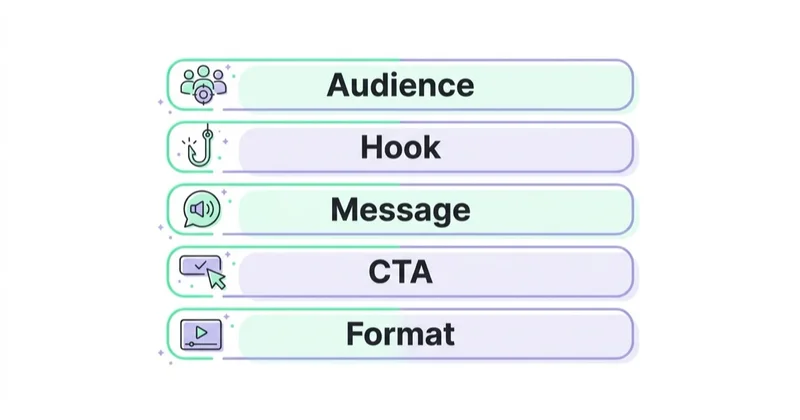
- target audience;
- funnel stage;
- one main message;
- product, service or topic;
- proof available;
- objection to answer;
- distribution channel;
- format and aspect ratio;
- desired length range;
- opening hook;
- CTA;
- landing page or next step;
- metric that decides success;
- required legal, brand or product claims.
This brief prevents the most common video problem: producing a visually acceptable asset that has no clear job. If the goal is lead generation, the video needs a next step and a landing page. If the goal is education, it needs enough substance to be saved, shared or watched. If the goal is paid social, it needs early context and placement-specific cuts.
The structure of an effective video
A practical structure:
- Hook: show the reason to keep watching.
- Context: make the problem or situation clear.
- Value: show the product, idea, proof or explanation.
- Detail: answer the main objection or question.
- Next step: tell the viewer what to do or remember.
The opening matters because social and video platforms are fast environments. The first seconds should show the subject, problem or promise. Avoid long logo animations unless the media format and audience justify them.
Video creative principles
Strong video usually has:
- one main idea;
- clear visual focus;
- early brand or product cue;
- native format for the channel;
- captions;
- strong thumbnail or first frame;
- clear audio when needed;
- useful pacing;
- human presence where trust matters;
- proof or demonstration;
- simple CTA.
Expensive production does not guarantee clarity. A simple expert explanation or creator-style demo can outperform a polished video if it answers the question better.
Video marketing in Meta Ads
Meta video can support awareness, engagement, remarketing and sales.
Useful formats:
- Reels video;
- Stories video;
- Feed video;
- creator-style UGC;
- product demo;
- customer proof;
- founder explanation;
- before-and-after where compliant;
- short offer video;
- retargeting video.
In Meta Ads, creative variety matters. Do not only resize one video. Test different hooks, angles, formats and levels of production.
Practical checks:
- Does the video work without sound?
- Is the first frame clear?
- Is the format vertical where placement needs it?
- Does the brand or product appear early enough?
- Is the message understandable in a few seconds?
- Does the landing page continue the promise?
For creative and account diagnosis, see Facebook Ads audit.
Video marketing on TikTok
TikTok is a discovery and entertainment environment. Ads that feel too much like traditional ads can struggle if they ignore platform behaviour.

TikTok creative should usually:
- use vertical 9:16 format;
- open quickly;
- feel native to the feed;
- use a clear hook;
- show the product or idea clearly;
- use captions or text overlays;
- adapt to trends only when relevant;
- avoid overproduced corporate language;
- refresh creative regularly.
The goal is not to copy every trend. The goal is to communicate in a format that users understand on the platform.
Official TikTok guidance for performance ads emphasises strong early hooks and creative analysis through video insights.
Video marketing on YouTube and Google
YouTube supports both short and long video strategies.
Useful formats:
- skippable in-stream ads;
- non-skippable ads;
- bumper ads;
- Shorts;
- long-form educational videos;
- product demos;
- tutorials;
- testimonials;
- webinars or webinar clips;
- Demand Gen video creative.
Google's ABCD framework for effective video ads focuses on Attention, Branding, Connection and Direction. In practice, this means the video should earn attention, make the brand identifiable, connect with the audience and guide the next action.
For campaigns across YouTube, Shorts, Discover and Gmail, see Demand Gen campaigns.
Video in B2B and services
Video is not only for ecommerce and consumer brands.
B2B video can support:
- complex service explanation;
- expert point of view;
- webinar funnels;
- product demos;
- case studies;
- sales enablement;
- onboarding;
- recruitment;
- conference follow-up;
- thought leadership.
The format can be longer when the audience has real intent. A buyer evaluating a complex service may watch a 20-minute webinar if it answers a serious problem.
B2B video content library
| Funnel role | Video format | Example |
|---|---|---|
| Awareness | short expert point of view | "Why lead quality drops after scaling Google Ads" |
| Education | tutorial or explainer | "How offline conversion imports improve bidding signals" |
| Consideration | case study or process walkthrough | "What happens during a PPC audit" |
| Sales enablement | objection answer | "When Performance Max should not get more budget" |
| Retention | onboarding or training | "How to read the monthly reporting dashboard" |
B2B video should make expertise visible. The best videos often show how the team thinks, diagnoses problems and reduces risk, rather than simply stating that the company is experienced.
Video in ecommerce
In ecommerce, video can support:
- product pages;
- product ads;
- creator reviews;
- shoppable content;
- abandoned cart flows;
- launch campaigns;
- how-to content;
- comparison content;
- post-purchase support;
- product education.
Start with products that have:
- high traffic;
- high margin;
- high return rates;
- many pre-purchase questions;
- complex use;
- important scale or fit;
- strong paid media potential.
For visual merchandising, connect video with product photography.
AI in video marketing
AI can make video production faster, but it does not remove the need for strategy.
Useful AI applications:
- script drafts;
- hook variations;
- caption generation;
- translation;
- repurposing long videos into short clips;
- resizing for placements;
- storyboards;
- voiceover drafts;
- background cleanup;
- generating simple variants;
- creative analysis.
Risks:
- generic scripts;
- unrealistic product scenes;
- inconsistent brand voice;
- incorrect claims;
- low-trust avatars;
- legal or policy issues;
- too much volume without learning;
- visuals that misrepresent the offer.
AI should increase useful creative output, not flood channels with weak variations.
Repurposing video without losing quality
One strong recording can become several assets, but each version should be adapted.
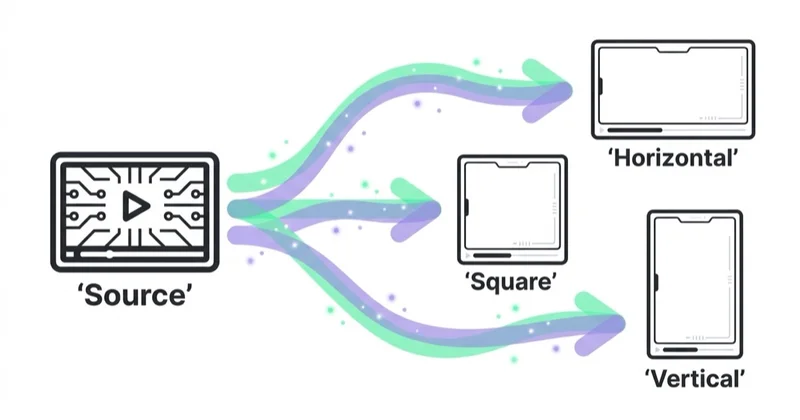
Example:
- full webinar for YouTube or lead nurture;
- 60-second expert clip for LinkedIn or YouTube Shorts;
- 15-second hook-led version for Reels or TikTok;
- product or proof snippet for Meta Ads;
- quote graphic or transcript for a blog post;
- FAQ clip for the website;
- email embed or thumbnail linking to the video.
Repurposing should not mean exporting the same file everywhere. Vertical platforms need vertical framing. Search-led YouTube content needs a clear title and thumbnail. Paid social needs a faster hook and stronger CTA. Website embeds need performance optimisation.
How to measure video marketing
Match metrics to the goal.
Awareness metrics
- reach;
- frequency;
- video views;
- completed views;
- brand lift;
- ad recall;
- branded search;
- direct traffic.
Engagement metrics
- watch time;
- retention curve;
- shares;
- saves;
- comments;
- profile visits;
- click-through rate.
Lead and sales metrics
- leads;
- qualified leads;
- cost per lead;
- purchases;
- conversion rate;
- ROAS;
- assisted conversions;
- remarketing audience growth.
Customer success metrics
- onboarding completion;
- support ticket reduction;
- tutorial views;
- feature adoption;
- repeat purchase.
One video can influence several metrics, but the primary metric should be chosen before launch.
Video QA checklist
Before publishing or launching ads, check:
- the first seconds make the topic clear;
- captions are accurate;
- the video works without sound where needed;
- the product or brand appears early enough for the channel;
- text overlays are readable on mobile;
- important elements stay inside safe zones;
- the CTA matches the landing page;
- claims are supportable;
- music and creator permissions are clear;
- aspect ratio fits the placement;
- file size and embed method do not hurt page speed;
- tracking and UTMs are ready for campaign use.
This QA step is especially important when the same concept is adapted into several versions. A strong YouTube cut can become a weak Reels ad if the crop hides the product or the first seconds depend on context that was removed.
30-day video marketing plan
Days 1-5: Strategy
Define goals, audience, funnel stage, channels and measurement.
Days 6-10: Creative concepts
Write hooks, scripts, visual references and format requirements for each platform.
Days 11-15: Production
Create a mix of simple videos, creator-style content, demos and one or two higher-quality assets where useful.
Days 16-20: Editing and adaptation
Create vertical, square and horizontal cuts. Add captions, thumbnails and CTA variants.
Days 21-25: Launch
Publish organic content and launch paid tests with clear naming and UTMs.
Days 26-30: Learn and iterate
Review retention, watch time, CTR, comments, leads, sales and creative themes. Produce the next batch based on evidence.
How we approach this at Space Ads
Video is no longer a "nice extra"; it's the default format almost everywhere — YouTube beside Search, social, TikTok — and the platforms reward it more every year. The question isn't whether to make video, it's how to make enough of it to test. So we plan for volume and reuse: one session yields several cuts and formats, built for sound-off vertical viewing, and we judge each by the role it plays (often upper funnel) rather than last-click cost. Brands that struggle with video treat it as one expensive flagship film a quarter. The ones that win treat it as a steady stream of testable assets. It was never about a single perfect spot; it's about how fast you learn what actually holds attention.
Common mistakes
| Mistake | Impact | Better approach |
|---|---|---|
| No goal | Weak message and weak measurement | Define the video job first |
| One video for every channel | Poor native fit | Adapt format and pacing |
| No captions | Sound-off users miss the point | Add captions and text overlays |
| Long intro | Viewers leave early | Start with the product, problem or hook |
| Overproduction only | Low testing volume | Mix polished and simple formats |
| Too many AI variants | Noise without insight | Create meaningful concept tests |
| Measuring awareness by ROAS | Wrong conclusion | Use funnel-matched metrics |
| Ignoring landing page | Clicks do not convert | Continue the same promise after click |
FAQ
Is video marketing worth it?
Yes, when video helps explain, demonstrate, build trust or make the brand more memorable. It is not worth it when produced without a goal or distribution plan.
Is video marketing only for large brands?
No. Small businesses can start with simple demos, expert answers, customer stories, behind-the-scenes content and short social videos.
How long should a marketing video be?
Length depends on goal and channel. Short social videos should get to the point quickly. Webinars, tutorials and B2B explainers can be longer when the audience has intent.
Does video help sales?
It can help sales when it reduces uncertainty, demonstrates value, builds trust or improves remarketing. The effect should be measured with funnel-appropriate metrics.
Should video be vertical?
Vertical video is important for Reels, Stories, TikTok and Shorts. Horizontal video still matters for YouTube, webinars and website embeds.
Can AI replace video production?
AI can support production, editing and scaling variations. It should not replace strategy, product truth, brand judgement or legal review.
What is the biggest video marketing mistake?
The biggest mistake is making a video with no clear job. Every video should have an audience, message, channel, next step and measurement plan.
Can one video be used across all channels?
The core idea can be reused, but the asset should usually be adapted for each channel. Cropping, pacing, captions, CTA and first frame often need changes.
What should be produced first?
Start with videos that answer high-value questions, support best-selling products, explain complex services or can be reused in paid campaigns and sales conversations.
Conclusion
Video marketing is valuable when it has a clear role in the funnel. It can build awareness, explain complex offers, support sales, reduce customer uncertainty and improve retention. The winning factor is not production cost alone. It is fit: goal, channel, hook, message, proof, captions, CTA and measurement.
Use video where motion, people, context or demonstration improve understanding. Start with practical assets, measure what they actually change and build a repeatable creative system instead of treating every video as a one-off campaign.
Sources and further reading
- Google Ads Help: ABCDs of effective video ads
- Google Ads Help: Video ad formats and specs
- Google Ads Help: Demand Gen creative excellence
- TikTok Ads Help: Creative best practices for performance ads
- web.dev: Video performance
Continue learning
Continue reading

What Is a Sales Campaign and How to Plan It?
A sales campaign needs a clear offer, conversion goal, tracking, creative, landing page and optimisation plan across Meta, Google and owned channels.
Messenger Ads: What You Need to Know
Messenger Ads can generate valuable conversations, but performance depends on channel fit, response speed, automation, CRM handoff and business outcomes.
How to Use Dynamic Creative on Facebook and Instagram
Dynamic creative in Meta Ads can accelerate creative learning when the inputs are distinct concepts, not random asset variations. This guide explains how to plan asset matrices, control Advantage+ Creative enhancements, read results beyond CPA and keep Pixel, CAPI and landing-page signals clean enough for useful learning.