Microsoft Ads, still called Bing Ads by many advertisers, is no longer a side note that only matters in a few local markets. For advertisers that already rely on Google Ads, Microsoft Advertising can be a serious incremental search and commerce channel. It is especially relevant in mature PPC markets such as the United States, United Kingdom, Canada, Australia, New Zealand and Ireland, but it also matters in Europe and selected regional expansion projects.
It is smaller than Google Ads, but smaller does not mean irrelevant. In many accounts, Microsoft Ads works best as the second paid search layer: high-intent traffic, often less crowded auctions, useful desktop and B2B behaviour, Shopping opportunities, Microsoft Audience Network reach and a growing connection with Copilot-era search experiences.
The important point is strategic: Microsoft Ads should not be launched as a blind clone of Google Ads. It should be launched as a controlled incrementality test with clean conversion tracking, market-specific budgets, imported structure reviewed manually and clear rules for when to scale.
Microsoft Ads is worth testing when Google Ads already proves demand, the website can track conversions properly, and the business wants incremental search or shopping traffic beyond Google. For international campaigns, start with markets where the business can actually serve demand profitably. The United States, United Kingdom, Canada, Australia, New Zealand and Ireland are often natural starting points for English-language campaigns. Poland and CEE can also be relevant, especially for companies entering the region, but they should be treated as local-market tests rather than the whole strategy.
TL;DR
- Microsoft Ads is the advertising platform for Bing, Microsoft Search Network, Microsoft Audience Network, Shopping, Performance Max-style campaigns and selected Microsoft inventory.
- For international advertisers, the strongest starting points are usually markets where Microsoft search volume, commercial intent and operational readiness overlap.
- Microsoft Advertising is available in many more markets, including Poland, but campaign volume and feature availability differ by country, language, account and product type.
- The best first test is a selective Google Ads import, not a full account copy.
- Search campaigns should usually start with brand protection, high-intent non-brand terms, exact and phrase match, and proven conversion paths.
- E-commerce brands should test Shopping and Performance Max only after the feed and UET conversion tracking are clean.
- B2B, SaaS, finance, legal, healthcare, professional services, education, travel, insurance, high-ticket retail and cross-border e-commerce are often better candidates than low-margin impulse categories.
- Copilot makes the Microsoft ecosystem more strategically important, but Microsoft Ads should not be confused with buying ChatGPT ads.
- The first 30 days should prove traffic quality, not chase maximum scale.
- The channel should be measured against incremental conversions, qualified leads, CRM quality and marginal CPA/ROAS, not only platform-reported conversions.
What Is Microsoft Ads?
Microsoft Ads is Microsoft's paid advertising platform. It allows advertisers to run search ads, product ads, audience campaigns and automated campaign types across the Microsoft Advertising ecosystem.
The platform is closest to Google Ads in structure:
- search campaigns use keywords, match types, ads, bids and search terms;
- Shopping campaigns use product feeds and merchant data;
- Performance Max campaigns use assets, audience signals and automated targeting;
- Microsoft Audience Network can extend reach beyond pure search;
- Google Ads campaigns can be imported into Microsoft Advertising;
- Universal Event Tracking, known as UET, is the foundation for conversion tracking and remarketing.
The strategic difference is distribution and audience context. Microsoft touches users through Bing, Edge, Windows, Outlook, MSN, Microsoft Start, Microsoft 365 contexts, search partners, audience inventory and Copilot-related experiences. That creates a different usage pattern from Google, especially in desktop-heavy, work-heavy and B2B environments.
For most advertisers, Microsoft Ads should be viewed as an incremental performance channel. It is not a replacement for Google Ads. It is a way to capture additional demand where the auction, audience and context are different enough to justify a test.
Where Microsoft Ads matters most
A Microsoft Ads strategy should not start from one local market by default. It should start from the markets where search demand, Microsoft usage, commercial intent and operational readiness are strong enough to support a real test.
| Market | Why it matters | Practical starting point |
|---|---|---|
| United States | Largest English-language opportunity, broad search and shopping demand, strong B2B and enterprise audience | Search, Shopping, Performance Max, remarketing, lead gen |
| United Kingdom | Strong commercial search market, mature PPC competition, useful B2B and services demand | Search, Shopping, brand defence, lead gen |
| Canada | Similar campaign language to US with different competition and regional behaviour | Search, Shopping, cross-border tests |
| Australia | High-value English-language market with strong e-commerce and services demand | Search, Shopping, B2B and local services |
| New Zealand | Smaller volume, but useful for brands already active in AU/NZ | Search and selected Shopping tests |
| Ireland | Useful for SaaS, B2B, education, finance and UK/EU-adjacent campaigns | Search and lead generation |
| Poland and CEE | Good for international companies entering local markets or serving Polish-speaking buyers | Local-language campaigns, regional expansion, controlled tests |
Microsoft Advertising has expanded globally and lists many supported markets. That does not mean every campaign type, audience feature or inventory source will behave the same in every country. Before scaling, check the account-level availability of Search, Shopping, Performance Max, Audience Ads, product feeds, billing, language targeting and conversion imports.
Microsoft Ads vs Google Ads
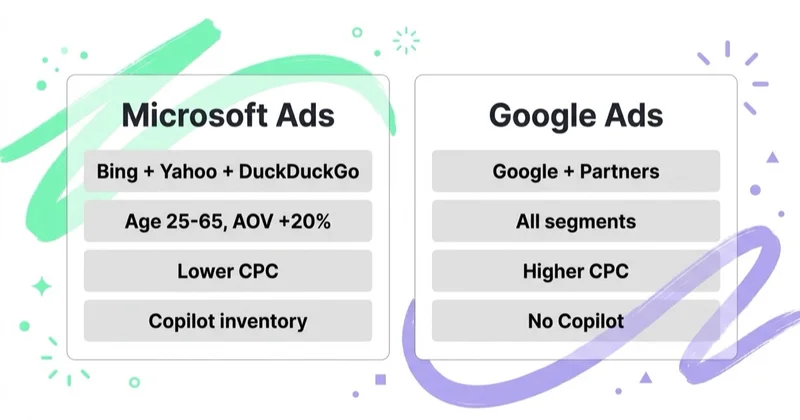
Microsoft Ads and Google Ads are similar enough that Google Ads experience transfers. They are different enough that a copy-paste launch can waste budget.
| Area | Google Ads | Microsoft Ads |
|---|---|---|
| Role in most accounts | Primary paid search and shopping channel | Incremental search, shopping and audience layer |
| Volume | Usually much larger | Smaller, market-dependent |
| Competition | High in most commercial auctions | Often lower, but not always cheap |
| Import workflow | Usually source account | Can import selected Google Ads campaigns |
| Search behaviour | Google Search, Search Partners, AI Max, PMax | Bing, Microsoft Search Network, partners, Copilot-era surfaces |
| Shopping | Google Merchant Center and Google Shopping | Microsoft Merchant Center and Microsoft Shopping |
| Conversion tracking | Google Ads tag, GA4, enhanced conversions | UET, Microsoft conversion goals, offline imports where relevant |
| AI layer | Gemini, AI Max, Google AI Overviews context | Copilot in Microsoft Advertising and Microsoft search ecosystem |
| Best KPI | Marginal CPA/ROAS, lead quality, revenue | Incremental CPA/ROAS, lead quality, additional demand |
The mistake is expecting Microsoft Ads to deliver Google-level volume. A better expectation is smaller scale with potentially attractive marginal economics. In some categories, that layer is too small. In others, it is profitable because competitors ignore it.
For broader paid search context, compare this with Google AI Max for Search and Performance Max campaigns.
When Microsoft Ads is worth testing
Microsoft Ads is usually worth testing when at least one of these conditions is true:
- Google Ads search campaigns already produce profitable conversions;
- the brand operates in a high-CPC category where incremental auctions matter;
- the buyer is likely to research on desktop or during work hours;
- the target audience includes professionals, managers, business owners or older decision-makers;
- CRM data shows that leads from search tend to be high quality;
- the business sells in the US, UK, Canada, Australia, New Zealand or Ireland;
- the e-commerce feed is already stable and product economics are clear;
- the business needs more demand without simply increasing bids on Google;
- there is a strong brand search risk and competitors may bid on brand terms;
- the team can evaluate results beyond last-click platform reporting.
Typical good fits include:
- B2B software and SaaS;
- professional services;
- finance, insurance and lending;
- legal and accounting services;
- healthcare and medical services where policies allow advertising;
- education and training;
- industrial, manufacturing and technical products;
- high-ticket e-commerce;
- travel and hospitality;
- cross-border retail;
- recruitment and employer branding;
- local services in competitive cities.
Microsoft Ads is less attractive when the category depends almost entirely on young mobile-first impulse behaviour, the site cannot track conversions, the offer has weak unit economics, or Google Ads itself has not yet proven demand.
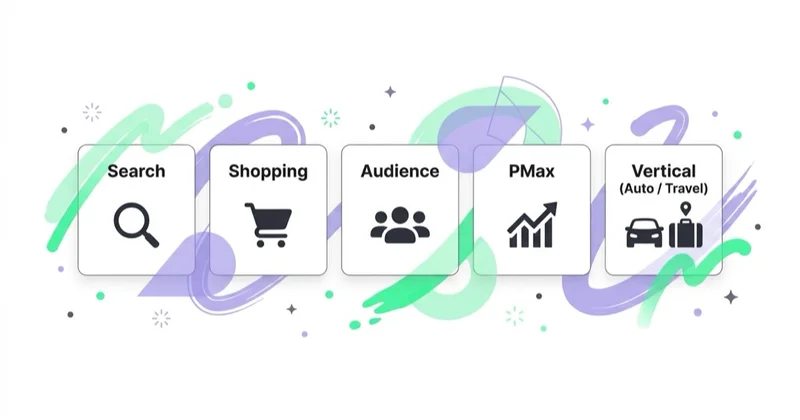
Campaign types to consider
Search campaigns
Search is usually the cleanest entry point. Start with proven high-intent terms from Google Ads, but do not import everything blindly.
Prioritise:
- brand terms and brand protection;
- top non-brand exact and phrase match keywords;
- category terms with proven conversion history;
- competitor terms only if legally and commercially appropriate;
- local service keywords in high-value geographies;
- B2B terms with clear buying intent.
Avoid starting with the broadest informational keywords. The first test should answer whether Microsoft Ads can produce commercially useful traffic, not whether it can spend budget.
Shopping campaigns
Shopping is relevant for e-commerce brands with clean product feeds, clear margins and enough search demand. Microsoft Shopping should be treated as a separate marketplace of attention, not just a mirror of Google Shopping.
Before launch, check:
- feed approval in Microsoft Merchant Center;
- product titles and descriptions;
- GTIN or product identifiers;
- price, availability and shipping data;
- product category mapping;
- conversion tracking with revenue values;
- margin sensitivity by product group.
For feed discipline, the same logic used in Google Merchant Center and Google Shopping campaigns still applies: bad feed data creates bad automation.
Performance Max on Microsoft Advertising
Microsoft Advertising offers Performance Max campaigns that use assets, audience signals and automated targeting to reach users across Microsoft inventory. This can be useful for e-commerce and lead generation, but it should not be the first blind test in every account.
Use it when:
- UET conversion tracking is stable;
- the account has enough conversion volume;
- creative assets are good enough for automated placements;
- search and shopping basics are already under control;
- the team can compare PMax results against standard Search and Shopping.
Do not judge Microsoft Ads only by a new automated campaign with weak tracking. If the data is poor, automation will optimise around poor signals.
Microsoft Audience Network
Audience campaigns can be useful for remarketing, native placements and upper/mid-funnel support. They are not the same as high-intent search. Treat them as a different layer with different KPIs.
Good use cases include:
- remarketing to search visitors;
- lead nurturing;
- product consideration;
- B2B audience expansion;
- content-driven offers;
- supporting longer sales cycles.
For a first Microsoft Ads test, keep Audience Network budgets separate from Search so the performance signal does not get blurred.
Copilot, AI and Microsoft Ads
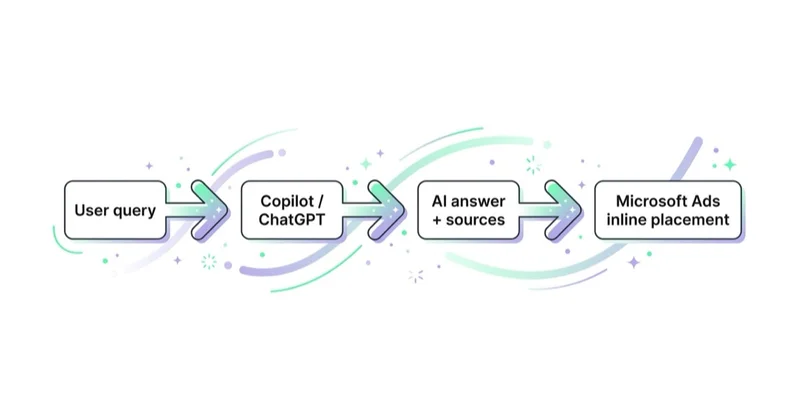
Copilot matters because Microsoft is reshaping search, productivity and browsing around AI-assisted experiences. Microsoft Advertising also promotes Copilot inside the advertising platform as an assistant for campaign creation, insights and asset work.
That does not mean every Microsoft Ads advertiser is automatically buying sponsored answers in ChatGPT. OpenAI's advertising products and Microsoft Advertising are separate buying environments. The safe way to describe the opportunity is this:
- Microsoft Ads gives access to Microsoft's search and advertising ecosystem;
- Microsoft is integrating Copilot into search, productivity and advertising workflows;
- some Microsoft Advertising products can reach Copilot-related Microsoft inventory where available;
- advertisers still need to verify exact placement and campaign availability inside their own account.
This distinction matters. Overclaiming "ChatGPT ads through Bing Ads" can mislead clients and create bad strategy. For actual ChatGPT ad buying, use a separate plan and measurement model.
For related AI search strategy, see AI Overviews and GEO.
How to launch Microsoft Ads in 30 days
Day 1-3: Decide the test market and goal
Do not start with every country. Choose one or two markets where demand already exists and the business can serve customers profitably.
For international campaigns, a practical order is often:
- United States if the brand can serve it profitably.
- United Kingdom if UK demand and landing pages are ready.
- Canada if North American operations are in place.
- Australia and New Zealand if logistics, time zones and pricing work.
- Ireland for B2B, SaaS, education and EU-adjacent services.
- Poland or CEE only when the business has local-language capability or a regional expansion goal.
Define the goal before launch: qualified leads, purchases, revenue, pipeline, new customers, lower marginal CPA or brand defence.
Day 4-7: Set up tracking
Install and verify UET before launching serious campaigns. UET is used for conversion goals and remarketing lists in Microsoft Advertising.
Check:
- base UET tag fires on all important pages;
- conversion events fire after the correct action;
- revenue values are passed for e-commerce;
- lead quality can be matched back to CRM where possible;
- MSCLKID is preserved through redirects and forms;
- GA4 and CRM reporting use clean campaign naming;
- consent and privacy settings are aligned with market requirements.
For analytics hygiene, connect this with UTM parameters, GA4 implementation and server-side tagging where needed.
Day 8-12: Import selectively from Google Ads
Google Import can save time, but it is not a strategy. Import only the campaigns that make sense for Microsoft Ads.
Review after import:
- campaign names;
- location targeting;
- language settings;
- budgets;
- bid strategies;
- ad schedules;
- final URLs;
- tracking templates;
- sitelinks and assets;
- negative keyword lists;
- conversion goals;
- product feeds;
- paused campaigns that should remain paused.
Do not allow scheduled imports to overwrite deliberate Microsoft Ads changes unless the account has a clear governance process. Many teams accidentally keep Microsoft Ads permanently tied to Google changes and then wonder why budget, ads or settings changed unexpectedly.
Day 13-20: Launch high-intent Search first
Start with a controlled budget and narrow intent. The first campaign set should usually include:
- brand search;
- top non-brand exact match;
- top non-brand phrase match;
- remarketing lists where available;
- carefully selected competitor terms;
- one or two high-value geographies;
- clear exclusions for irrelevant traffic.
Budget rules vary, but a practical starting point is often 5-15% of mature Google Search spend in the same market. Smaller accounts can start lower. The goal is enough traffic to evaluate quality without letting an import mistake spend heavily.
Day 21-30: Review and decide the next layer
After the first data cycle, decide whether to:
- expand non-brand terms;
- add Shopping;
- test Performance Max;
- add Audience Network remarketing;
- split campaigns by market;
- pause weak geographies;
- tighten queries and negatives;
- increase budget if marginal CPA/ROAS is acceptable.
The decision should include platform data, GA4, CRM quality, lead disposition, revenue and assisted performance. Platform conversions alone are not enough.
Budget allocation by market
For English-speaking accounts, budget should follow commercial readiness, not search volume alone.
| Scenario | Suggested starting approach |
|---|---|
| US-only brand with mature Google Ads | Start with 5-15% of Google Search budget on Microsoft Search; add Shopping if feed quality is strong |
| UK e-commerce brand | Start with brand, top category terms and Shopping; keep Audience Network separate |
| B2B SaaS selling US + UK | Launch Search in US and UK separately; measure CRM quality by market |
| AU/NZ retailer | Test Australia first, then New Zealand if logistics and margins work |
| Canadian expansion | Use separate CA campaigns instead of copying US targeting blindly |
| International company entering Poland | Build Polish-language campaigns separately; do not reuse English copy |
Microsoft Ads is not a place to dump leftover budget. It is a place to test whether marginal demand is cheaper or higher quality than the next pound, dollar or euro spent on Google, Meta or LinkedIn.
What to measure
Use four layers of measurement.
Platform performance
Track clicks, CPC, conversions, CPA, ROAS, search terms, impression share and campaign type performance. This is useful for optimisation but not enough for business decisions.
Analytics performance
Use GA4 and campaign UTMs to compare sessions, engaged sessions, conversions, revenue and landing page performance. Expect differences between platform and GA4 reporting.
CRM or backend quality
For lead generation, Microsoft Ads should be judged by qualified leads, opportunities, pipeline and closed revenue, not form submissions alone. A lower CPA is useless if the lead quality is poor.
Incrementality
The strategic question is whether Microsoft Ads adds conversions that would not have happened through Google, organic search, direct traffic or brand demand anyway. For larger accounts, this can be tested with holdouts, geo experiments or broader measurement work.
For deeper measurement strategy, see incrementality testing and marketing mix modeling.
How we approach this at Space Ads
Microsoft Ads is cheap, incremental reach for us, not a first-choice channel. Bids tend to run below Google's, and the audience skews toward desktop, older users and B2B — traffic we often miss on Google. The entry barrier is low, since campaigns import straight from Google Ads and can be live in minutes, which makes it an inexpensive test. We usually switch it on once Google Search is maxed out, to pick up demand beyond the main channel's reach, but with realistic expectations on volume. The common mistake is treating Microsoft as a second Google and expecting the same traffic. It's a complement — cheaper, smaller, and capable of adding profitable conversions we wouldn't have had otherwise.
Common mistakes
Copying the whole Google Ads account
The import tool is useful, but importing every campaign can bring weak broad match, bad geos, old experiments, paused structures and budgets that do not fit Microsoft traffic.
Not installing UET properly
Without reliable UET data, smart bidding, remarketing and conversion reporting are weak. This is the most important technical step.
Mixing Search and Audience performance
Search and Audience Network traffic behave differently. Keep budgets and reporting separate until there is enough data to compare them properly.
Treating international markets as one
The US, UK, Canada, Australia, New Zealand and Ireland are not one market. They differ in CPCs, spelling, legal claims, competitors, shipping, taxes, seasonality and buyer expectations.
Overclaiming Copilot placement
Copilot is strategically important, but exact ad formats and availability should be verified in the account. Do not sell Microsoft Ads as a guaranteed shortcut into every AI answer.
Ignoring CRM quality
Microsoft Ads can look efficient in platform reporting and still produce weaker leads. Always check downstream quality.
Leaving auto-import unmanaged
Scheduled imports can be useful, but they can also overwrite account-specific decisions. Use them only with a clear review process.
What about Poland and CEE?
Poland still matters, but it should not define the English version of this article.
For international companies, Microsoft Ads in Poland can be useful when:
- the company sells into Poland or CEE;
- Polish-language landing pages and ads exist;
- Google Ads already validates demand;
- the product is B2B, technical, professional, financial, travel-related or high-value retail;
- the business wants to test lower-competition regional search inventory;
- campaigns are managed locally rather than copied from English markets.
The Polish market should be planned separately: Polish copy, local keyword research, local competitors, PLN budgets, local conversion quality and local regulations. For an international agency website, this is a regional expansion use case, not the main narrative.
FAQ
Is Microsoft Ads the same as Bing Ads?
Bing Ads is the old name many advertisers still use. The current platform is Microsoft Advertising or Microsoft Ads, covering Bing search and broader Microsoft advertising inventory.
Is Microsoft Ads worth it in 2026?
Yes, when the business already has proven search demand and can track conversions properly. It is usually best as an incremental channel, not a replacement for Google Ads.
Which countries should be tested first?
For English-language growth, start with the United States, United Kingdom, Canada, Australia, New Zealand or Ireland if the business can serve those markets profitably. Poland and CEE are useful for regional expansion, but they need local-language campaigns.
Can Google Ads campaigns be imported into Microsoft Ads?
Yes. Microsoft Advertising supports Google Ads imports, including selected campaign structures. The import should still be reviewed manually because budgets, conversion goals, targeting, assets and product feeds may need adjustment.
Does Microsoft Ads show ads in Copilot?
Microsoft Advertising is connected to the Microsoft search and Copilot ecosystem, and some campaign products can reach Copilot-related inventory where available. Exact placement should be verified inside the account. This should not be confused with buying ads directly inside ChatGPT.
What tracking does Microsoft Ads use?
Microsoft Ads uses Universal Event Tracking, or UET, for website activity, conversion goals and remarketing lists. It should be installed and tested before serious spend begins.
How much budget should be allocated to Microsoft Ads?
For a mature Google Search account, a common starting test is 5-15% of comparable Google Search spend in the same market. The right number depends on traffic volume, CPA targets, market size and risk tolerance.
Should Microsoft Performance Max be tested?
It can be tested after conversion tracking, assets and feed quality are strong. For a first Microsoft Ads launch, standard Search and Shopping often provide a cleaner signal.
Key Takeaways
- Microsoft Ads is a global incremental PPC channel, not only a Poland or CEE opportunity.
- International campaigns should be prioritised by demand, commercial readiness, tracking quality and market fit.
- Poland remains relevant for international companies entering CEE, but it should be handled as a localised campaign layer.
- Google Import saves time, but every imported campaign needs QA.
- UET tracking, CRM quality and market-specific reporting decide whether the test is meaningful.
- Copilot increases strategic relevance, but placement claims should stay precise.
Conclusion
Microsoft Ads deserves a more serious role in international PPC planning than it usually receives. It will not replace Google Ads, and it will not deliver the same volume in most accounts. But for the right business, it can add profitable search, shopping and audience demand that competitors overlook.
The best approach is controlled: choose the right market, install UET, import only proven Google Ads structures, review every setting, launch high-intent Search first, then expand into Shopping, Performance Max or Audience Network when the data supports it.
For Poland and CEE, the opportunity is real but secondary in an English-language strategy. Treat it as a local expansion track with local copy, local measurement and local expectations.
Sources and further reading
- Microsoft Advertising: New advertiser FAQs
- Microsoft Advertising: Import tools
- Microsoft Learn: Google Ads Import
- Microsoft Advertising: Universal Event Tracking
- Microsoft Advertising Help: Set up UET
- Microsoft Advertising: Performance Max
- Microsoft Advertising: Copilot in Microsoft Advertising Platform
- Microsoft Advertising: Global market expansion
Continue Learning
Continue reading
Microsoft Advertising Editor: Bulk Editing and Google Ads Import
Microsoft Advertising Editor makes large account changes faster and reviewable before posting. Learn a safe bulk workflow and how to import Google Ads without inheriting broken tracking or unsuitable settings.

Google Ads vs SEO: Paid vs Organic on Google, and How to Use Both
Google Ads vs SEO is a decision about speed, control, cost and durability on the Google results page. This guide explains when to pay for clicks, when to build organic visibility, how to test brand bidding and how to connect paid and organic data.

PPC vs SEO: What to Choose, How to Measure and When to Combine Both
PPC vs SEO is not a channel popularity contest. PPC buys controlled demand now; SEO builds durable organic visibility. This guide shows how to choose and combine them using margin, LTV, payback period, intent, measurement quality and AI search risk.