Meta Advantage+ is a family of automation features, not one campaign switch. Depending on the objective and account, Meta can automate or expand audiences, placements, campaign budgets, creative variations and other settings. A campaign built through the manual workflow still uses Meta's auction and delivery optimisation, while an Advantage+ campaign can retain some business controls.
The useful decision is therefore not whether to "trust AI." It is which settings can vary in pursuit of the optimisation event, which constraints are non-negotiable, and whether the automated setup improves a business outcome in a fair test. Product names and defaults change frequently, so confirm the live options in Ads Manager before applying this framework.
TL;DR
- Separate the components. Advantage+ audience, placements, campaign budget and creative solve different problems and can have different effects.
- Distinguish controls from suggestions. Meta may expand beyond audience suggestions, while location, minimum age, language and eligible custom-audience exclusions can operate as controls.
- Use the right outcome signal. The optimisation event should be valuable, implemented correctly, permitted and frequent enough to inform delivery.
- Manual is not a low-data cure. Narrow targeting does not create conversion evidence and may reduce the available auction opportunities further.
- Protect real constraints. Geography, licensing, inventory, brand safety, age and privacy rules should not be relaxed for a cheaper platform result.
- Test configurations, not ideology. Compare on the same objective, offer, creative standard, attribution settings and business outcome.
- Review incrementality and marginal efficiency. A lower platform CPA does not automatically mean more profitable new customers.
What Advantage+ changes—and what it does not
Meta's delivery system predicts which eligible impression is most likely to produce the selected result. Advantage+ gives that system a wider or more flexible set of opportunities: it can look beyond audience suggestions, choose among more placements or move campaign budget between ad sets. That can improve efficiency when the additional freedom uncovers useful inventory. Meta publishes average improvements from its own product tests, but those averages do not predict the result for a particular account.
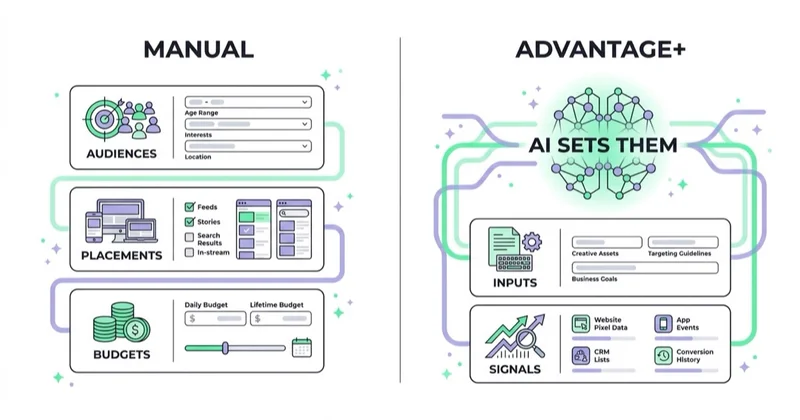
Automation does not choose the commercial goal, validate the event, create a compelling offer, verify contribution margin or determine whether a conversion is incremental. It optimises toward the configured signal inside the constraints and data available to Meta. The advertiser still owns the objective, measurement design, creative claims, data permissions and unit economics. For more product context, see Advantage+ and Andromeda.
When Advantage+ wins
An automated configuration is a strong test candidate when:
- The optimisation event represents value and event matching, deduplication, value and consent have been checked.
- The eligible market is broad enough for audience or placement expansion to discover additional opportunities.
- Creative works across enabled placements or has placement-appropriate versions and safe-area checks.
- Campaigns or ad sets are not needlessly fragmented, allowing more observations to accumulate around the same objective.
- The business can accept wider delivery without breaching geography, age, licensing, inventory or brand-safety requirements.
Pixel and Conversions API can be used together where appropriate, but CAPI is not a licence to share any data. The implementation must follow applicable law, user choices and Meta's terms, and browser and server events need correct deduplication. Better event coverage cannot repair a conversion event that rewards low-quality or unprofitable outcomes.
When manual control still matters
Retain the necessary control when:
- Delivery must stay inside a hard boundary, such as a licensed location, permitted age, language or approved inventory.
- A contract or brand-safety standard excludes placements that the automated mix would otherwise use.
- An experiment requires a defined audience or placement to answer a specific question.
- Budget must be reserved for a segment or business unit for a reason that platform-level efficiency cannot represent.
- The available account control does not reliably enforce the requirement.
First-party lists can support exclusions or audience suggestions, but match rates and data permissions limit their coverage. An "existing customer" exclusion is not proof that every customer was excluded. Likewise, a retargeting list is not automatically more valuable than broader prospecting; it may contain people who would have converted without another ad. Use controls for a documented business reason, then measure their effect.
Glossary
- Advantage+ — Meta's suite of automated campaign products (targeting, placements, budget, optimisation).
- Manual setup — a workflow with more advertiser-selected settings; delivery is still algorithmic.
- Audience suggestion — an input Advantage+ audience may prioritise before expanding beyond it.
- Audience control — a supported boundary Meta says it will not expand beyond.
- Learning phase — a period in which delivery explores how to optimise; performance may be less stable.
- First-party data — data collected directly by the business and used only with the required rights and safeguards.
Build inputs and controls that can be audited
Start with a one-page configuration record: business objective, optimisation event, attribution setting, eligible countries and ages, exclusions, placement requirements, bidding choice, budget logic and creative coverage. Mark each audience input as either a strict control or a suggestion. This prevents a team from assuming that an interest or custom audience is a hard boundary when Meta may expand beyond it.
Provide distinct, policy-compliant creative that renders correctly across the enabled placements. Validate the event in Events Manager and the downstream system, including value, currency and deduplication. Then let the campaign run long enough to cover normal conversion delay and avoid unnecessary significant edits while delivery is learning. "Learning limited" is a diagnostic status, not a reason to optimise for a meaningless higher-funnel event.
If the automated and controlled configurations are both viable, use Meta's experiment tools or another pre-defined test. Keep creative, offer, dates and outcome comparable; avoid comparing a mature campaign with a newly launched duplicate. Assess platform CPA alongside new-customer share, contribution margin, refund or cancellation rate and blended business results. This is part of the operating standard described in choosing a Meta ads agency.
How Space Ads approaches Advantage+ vs manual
We separate the decision into audience, placement, budget, bidding and creative automation rather than labelling an entire account "manual" or "Advantage+." Hard business and policy constraints are documented first. Everything else becomes a testable setting, with a named hypothesis and decision rule.
Before scaling, we verify event quality, privacy choices, creative rendering, customer-status logic and the economics outside Ads Manager. Automated results are reviewed by audience type where available, placement, creative, new-customer share and marginal spend—not only the blended platform ROAS. This lives in Meta Ads and performance marketing.
Stop doing / Do instead
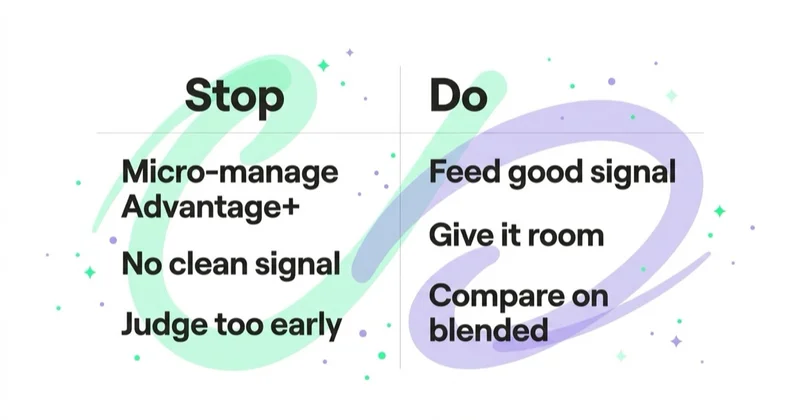
| Stop doing | Do instead |
|---|---|
| Treating Advantage+ as one switch | Decide separately on audience, placement, budget and creative automation |
| Assuming an audience input is a hard limit | Confirm whether it is a suggestion or supported control |
| Narrowing audiences to solve low volume | Consolidate where sensible and fix the event or economics first |
| Relaxing a legal or operational boundary | Preserve hard constraints regardless of platform averages |
| Comparing unlike campaign periods | Run a pre-defined test with comparable inputs and conversion lag |
| Judging only on reported CPA or ROAS | Check new customers, margin, cancellations and incremental value |
FAQ
Is Meta Advantage+ better than manual campaigns?
Not inherently. Advantage+ provides more automation and, in some settings, more delivery freedom. That can improve the selected platform outcome, but the result depends on the event, eligible audience, creative, constraints and business economics. Compare an eligible automated setup with the best viable controlled setup in a fair experiment.
When should I use manual campaigns instead of Advantage+?
Use the required manual controls when delivery must remain within a licensed geography, permitted age, approved placement set, reserved budget or experiment audience and Advantage+ cannot enforce that requirement. Small budget alone is not a reason to narrow targeting: doing so may further reduce delivery opportunities without creating more conversion data.
How do I get better results from Advantage+?
Choose a valuable optimisation event, validate event quality and deduplication, cover enabled placements with suitable creative and preserve hard business controls. Consolidate unnecessary fragmentation and avoid repeated significant edits during learning. Then assess downstream profit and new-customer outcomes, not only the platform's reported result.
Does Advantage+ work with a small budget?
It can run, but sparse outcomes make any conversion-optimised campaign harder to evaluate and may leave delivery in learning limited. Manual targeting does not solve the lack of evidence automatically. Reduce unnecessary campaign fragmentation, choose the deepest meaningful event with usable frequency, and assess whether paid Meta is economically testable at the available budget.
Can I use exclusions with Advantage+?
Meta supports specific audience controls, including eligible custom-audience exclusions, as well as controls for location, minimum age and language. Exact options vary by objective and setup. Use exclusions only with an appropriate data basis and remember that list matching is incomplete; verify the current account controls rather than assuming every audience input is strict.
Should weak creative be fixed before using Advantage+?
Creative quality matters in every setup. Advantage+ creative may generate or adapt variations, but the advertiser remains responsible for the source assets, claims, brand fit and placement rendering. Fix known creative problems before using a campaign-structure test to answer an unrelated question.
Key takeaways
- Advantage+ is a suite of audience, placement, budget and creative features—not one universal campaign type.
- A manual setup still uses algorithmic delivery; an Advantage+ setup can retain supported controls.
- Preserve hard legal, geographic, age, inventory and brand-safety constraints.
- Validate the optimisation event, creative coverage, permissions and deduplication before comparing setups.
- Decide with a fair test and downstream economics, not Meta's average case studies or platform ROAS alone.
Sources and further reading
- Meta for Business — About Meta Advantage+
- Meta for Business — Advantage+ sales campaigns
- Meta for Business — Advantage+ audience and controls
- Meta for Business — Advantage+ placements
- Meta Business Help Center — About Conversions API
Continue learning
Continue reading
Scaling Meta Ads Without Killing ROAS
Scaling Meta ads is a commercial decision, not a promise to preserve the same ROAS at a higher spend. Learn how to set a profitable ceiling, diagnose constraints and increase budget through controlled tests.
How to Choose a Meta (Facebook) Ads Agency in 2026
Choose a Meta Ads agency by examining its measurement, creative process, data governance, experimentation and commercial judgment. Use these questions and contract checks before granting account access.
Why Your Meta Ads Stopped Working (and How to Diagnose It)
When Meta performance changes, diagnose the affected layer before editing campaigns. This guide covers delivery status, billing, event quality, funnel metrics, activity history, creative, offer, website and controlled recovery.