Scaling Meta ads means buying more profitable outcomes, not preserving the same dashboard ROAS at any cost. As spend grows, the campaign may enter auctions it did not need at the previous budget, reach different people or create more conversions that would have happened through another channel. Efficiency can therefore change even when the account is healthy.
The practical job is to define what an additional customer is worth, find the current constraint and test whether more spend creates enough incremental contribution. Creative, audience, offer, website, measurement and budget can all be constraints. This guide explains how to diagnose them and scale without relying on universal budget percentages or platform-reported ROAS alone.
TL;DR
- Set the business limit first. Calculate allowable CAC or contribution ROAS from margin, fulfilment, returns, discounts and the payback period.
- Separate average from incremental return. The blended result describes the whole account; it does not reveal what the latest budget increase caused.
- Diagnose the constraint. It may be creative coverage, audience size, conversion rate, stock, offer, event quality or sales capacity.
- Change one major lever at a time. Use a documented hypothesis, a decision window and guardrails rather than reacting to each day.
- Treat broad and Advantage+ as testable options. They can create more delivery room, but controls, economics and results decide whether they fit.
- Protect measurement quality. Pixel and Conversions API can improve event connectivity, but require correct implementation, deduplication and lawful data use.
- Scale on contribution and incrementality. Platform ROAS is an attribution view, not proof that every attributed sale was caused by the ads.
The mistake: scaling is not a budget dial
The budget field tells Meta how much it may spend; it does not create more demand, stronger product economics or a better landing page. A higher budget can work immediately, expose a hidden constraint or simply buy more expensive outcomes. The result depends on the objective, bid strategy, conversion volume, audience, competition and the size of the change.
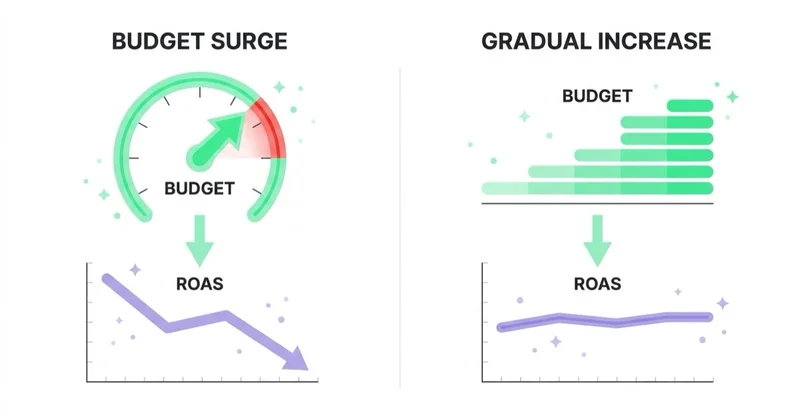
Meta says ad sets enter a learning phase while delivery explores audiences and placements, and that significant edits can make delivery prepare or learn again. That is a reason to avoid unnecessary edits—not evidence for a universal rule such as "increase by exactly 20%" or "doubling always ruins performance." Record the baseline, make an intentional change and allow enough conversion volume for a useful comparison. If cash flow or inventory makes a large jump unsafe, use a smaller step for business reasons rather than treating it as a platform law.
Marginal vs average ROAS: the number that matters when scaling
Average ROAS divides attributed revenue by total ad spend. Marginal ROAS asks how much additional revenue—or, preferably, contribution margin—was generated by the additional spend. Diminishing returns are common, but marginal performance is not guaranteed to be lower in every short period: a new creative, promotion, stock change or auction shift can alter the curve.
Do not estimate marginal return by comparing two noisy days. Use a stable baseline and a planned budget test. Where the account and market support it, Meta's experiments or a geographic/holdout design can provide stronger evidence of incrementality. At minimum, compare the change in spend with the change in orders, new customers, contribution margin and blended revenue over a suitable period, while noting promotions and other channels.
The threshold must reflect the business model. For a simple contribution calculation:
allowable CAC = net revenue − product cost − fulfilment − payment fees − expected returns − required contribution
If repeat purchases are included, state the cohort window and use realised retention where possible. Do not justify unprofitable acquisition with an undefined "lifetime value." For related diagnostics, see why ROAS drops and MER vs ROAS.
Lever 1: creative coverage, not output for its own sake
Meta recommends creative diversification so its delivery system has relevant options for different people and placements. That does not mean an arbitrary weekly quota or dozens of cosmetic variants. More ads can fragment spend and leave each idea without enough evidence.
Build a portfolio of genuinely different concepts: problems, benefits, proof, objections, demonstrations, offers and formats. Map each concept to a customer need and funnel stage. Test new concepts against an appropriate control, then develop meaningful iterations from what the evidence supports. Monitor delivery concentration, spend, frequency, first-time impression ratio and downstream outcomes together; frequency alone does not prove fatigue.
A creative testing framework supports scale when it produces useful learning and replacement options before performance deteriorates. Creative supply should reflect spend, audience size and the speed at which decisions can be made—not a universal number of ads.
Lever 2: give delivery room without abandoning controls
An audience can become a constraint when geography, eligibility or manual interests leave too few opportunities at the intended spend. Advantage+ audience can use advertiser inputs as suggestions and search beyond them, while retaining defined controls such as location, minimum age, language and custom-audience exclusions where available. That distinction matters: a suggestion is not necessarily a hard boundary.
Test broader delivery against the current setup when the product, market and policies allow it. Keep controls required by law, product eligibility, logistics and genuine commercial constraints. Exclude existing customers only when the acquisition definition and measurement require it; otherwise you may change the campaign's job and make comparisons invalid. Broad targeting is an option, not a guarantee, and creative does not replace audience governance.
Consolidation can also provide more learning opportunities per ad set. Adding many overlapping campaigns and audiences in the name of "horizontal scaling" may do the opposite by fragmenting data and making auctions harder to interpret.
Glossary
- Average ROAS — return across all spend; marginal ROAS — return on the additional spend when scaling.
- Profitability threshold — the ROAS (or CAC) below which additional spend stops being worth it.
- Learning phase — a period in which Meta's delivery system explores how best to deliver an ad set; results can be less stable.
- Vertical scaling — adding budget to existing winners.
- Horizontal scaling — adding new audiences, placements, creatives or campaigns.
- Broad / Advantage+ audience — delivery with a large eligible pool; some audience inputs may be suggestions while specified controls remain firm.
- Incrementality — outcomes caused by advertising beyond what would have occurred without it.
Lever 3: run a controlled budget test
Once the likely constraint has been addressed, define the test before changing spend:
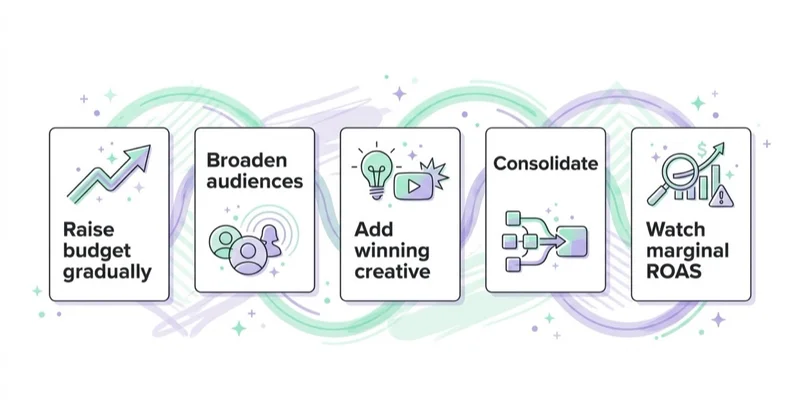
- Baseline: record spend, attributed and blended revenue, orders, new-customer share, CAC, contribution and major business events.
- Hypothesis: state what should happen and why—for example, "a 25% budget increase can add orders while new-customer CAC remains below £X."
- Guardrails: set stock, cash, fulfilment, daily loss and brand-safety limits.
- Change: alter the budget or one structural lever, not several major variables together.
- Observation window: choose it from conversion delay and volume; avoid judging on a single weak day.
- Decision: continue, hold, reverse or investigate based on the predefined business metric.
Vertical scaling increases budget within the existing setup. Horizontal expansion can mean a new market, offer, use case or creative territory—not simply duplicating campaigns. If a new campaign is necessary, define its distinct job and prevent uncontrolled overlap. Sometimes the right move is not more Meta spend: the bottleneck may be stock, conversion rate, sales follow-up or demand better captured elsewhere.
Measurement and signal quality
Pixel and Conversions API can help connect website or server events with Meta. When both send the same event, identifiers and deduplication must be configured correctly. Event names, values, currencies and purchase status should match the underlying transaction; cancelled or returned orders should be handled consistently in business reporting.
Conversions API is not a way to bypass consent, platform policies or European privacy rules—Meta explicitly says so. Document what is collected, the lawful basis or consent where applicable, retention and access. Then compare Ads Manager with analytics, commerce and finance data. Differences are expected because attribution models and windows differ; unexplained discontinuities are a diagnostic signal.
How Space Ads approaches scaling Meta
We start with a scaling brief: commercial objective, allowable CAC or contribution ROAS, new-customer definition, inventory, market, measurement limits and operational capacity. The account audit then identifies the most plausible constraint rather than prescribing broad targeting or more creative by default.
Each meaningful change has an owner, hypothesis, observation window and rollback condition. We reconcile Meta results with commerce and finance data, retain a change log and separate platform optimisation from evidence about incremental growth. This creates a decision trail the client can audit and makes a weaker result useful: it shows where the current ceiling is and what to test next. This work sits within Meta Ads and performance marketing.
Stop doing / Do instead
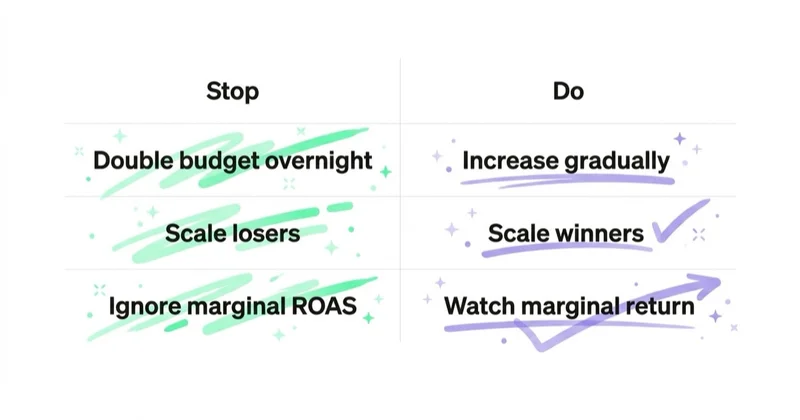
| Stop doing | Do instead |
|---|---|
| Treating scaling as turning the budget up | Raise the ceiling: creative, targeting, gradual budget |
| Applying a universal budget percentage | Size the test from risk, conversion volume and business capacity |
| Producing cosmetic variants to hit a quota | Diversify concepts around needs, proof and objections |
| Assuming broad or narrow always wins | Test eligible audience options with required controls intact |
| Reacting to one day of average ROAS | Assess incremental contribution over a suitable window |
| Duplicating campaigns to "scale horizontally" | Give each campaign a distinct job and limit fragmentation |
| Treating attributed ROAS as causality | Reconcile business data and test incrementality where feasible |
Common mistakes
Common errors include changing budget, audience, bid strategy and creative together; declaring success from attributed revenue alone; using an undefined lifetime value to excuse poor acquisition economics; and continuing to spend when stock or fulfilment is the real constraint. Another is endless editing during learning, which removes the stable observation period needed to understand delivery.
FAQ
How do I scale Meta ads without ROAS dropping?
Set the allowable CAC or contribution threshold, verify measurement, identify the current constraint and test one meaningful change at a time. Increase spend only with stock, cash and operational guardrails. Evaluate the additional spend on new customers, contribution and blended results—not Ads Manager ROAS alone.
Why does ROAS drop when I scale Meta ads?
Possible reasons include diminishing returns, a different auction mix, creative wear, promotion changes, lower conversion rate, measurement shifts or a change in new-versus-returning customer mix. Significant edits can also return delivery to preparing or learning, where results may be less stable. Use a change log and business data to distinguish these causes.
How fast can I increase my Meta ad budget?
There is no universal safe percentage. Choose a change large enough to create a measurable commercial difference but small enough to respect cash, inventory and loss limits. Allow for conversion delay and sufficient volume before deciding. Meta advises minimising changes during learning; it does not provide one percentage that guarantees stable performance for every account.
What is the difference between vertical and horizontal scaling?
Vertical scaling increases spend within an existing setup. Horizontal expansion adds a genuinely distinct source of opportunity, such as a market, offer, use case or creative territory. Creating duplicate campaigns is not inherently horizontal growth and can fragment delivery. Use either method only when it addresses a diagnosed constraint.
Should I use broad or narrow targeting to scale?
Neither by default. Broad or Advantage+ audience can provide more delivery room; a constrained audience may be necessary for eligibility, geography or a specialised offer. Test the eligible options and understand which inputs are controls versus suggestions. Keep legal, logistical and customer exclusions where required.
How do I know when to stop scaling?
Stop or hold when additional spend no longer meets the predefined contribution or payback threshold, a guardrail is breached, measurement is unreliable or operations cannot serve the extra demand. Also stop a test once it has answered its question; do not keep spending merely to recover a sunk loss.
Key takeaways
- Scaling is profitable incremental growth, not maintaining one dashboard ratio.
- Define allowable CAC or contribution ROAS before increasing spend.
- Diagnose the constraint; creative, audience and budget are only three of several possibilities.
- Test broad delivery, creative diversification and structural changes instead of treating them as universal rules.
- Reconcile Meta attribution with business results and use incrementality tests where feasible.
Sources and further reading
- Meta for Business — Performance marketing: account structure, creative diversification, data and testing
- Meta for Business — Advantage+ audience: suggestions and controls
- Meta Business Help Center — About Conversions API
- Meta for Business — Ad budgets, costs and schedules
Continue learning
Continue reading
Meta Advantage+ vs Manual Campaigns: When to Trust the Automation
Meta Advantage+ can automate audience expansion, placements and budget allocation, while manual settings preserve selected controls. This guide explains what each label actually means and how to test the right configuration for a business goal.
How Many Ad Creatives Do You Need Per Campaign?
The right creative count depends on the platform format, objective, audience, budget and question being tested. Use this framework to plan coverage, testing and refreshes without manufacturing a magic number.

Managing Facebook and Meta Ads at Scale: Native Tools vs an AI Workspace
This guide is for teams whose Meta work has outgrown one-account muscle memory. It shows where Ads Manager is enough, where cross-account operations break, and how AI or automation should support audits, reporting and change control after Advantage+.