Choosing a Meta Ads agency is a governance and operating-model decision, not a search for a proprietary targeting trick. Meta automates substantial parts of audience expansion, placement, budget and delivery, but the agency still has to make sound choices about the offer, creative, conversion event, exclusions, legal constraints, budget and measurement.
Evaluate evidence rather than pitch language. Ask to see how the team forms hypotheses, protects data access, verifies Pixel and Conversions API events, reads platform and business results, and decides what to change. No checklist can guarantee performance, but it can reveal whether the agency has a repeatable process and understands the limits of attribution.
TL;DR
- Start with commercial fit. The agency should understand margin, customer value, sales capacity, seasonality and the offer before recommending a campaign structure.
- Inspect the creative system. Ask how customer insight becomes testable concepts, how production rights are handled and how results inform the next brief.
- Audit measurement before promising scale. Pixel, datasets, CAPI, deduplication, event values, consent and CRM feedback must be verified—not merely named.
- Expect nuanced automation choices. Advantage+ audience supports suggestions and strict controls; “always broad” and “always manual” are both weak answers.
- Use several measurement views. Platform attribution, blended efficiency and incrementality answer different questions; none is universally the truth on its own.
- Secure advertiser-controlled access. The business should control its portfolio and assets, grant the agency partner permissions and document offboarding.
- Compare scope, not fee labels. Clarify media, creative, tracking, landing pages, reporting and third-party costs before comparing retainers or spend percentages.
Understand how Meta actually works in 2026 first
Meta's Advantage+ products can automate or expand audience, placement and budget decisions. Advantage+ audience treats many advertiser inputs as suggestions while retaining controls such as location, minimum age, language and custom-audience exclusions. That makes automation competence important, but it does not eliminate audience strategy, legal constraints or the need to distinguish existing customers from acquisition.
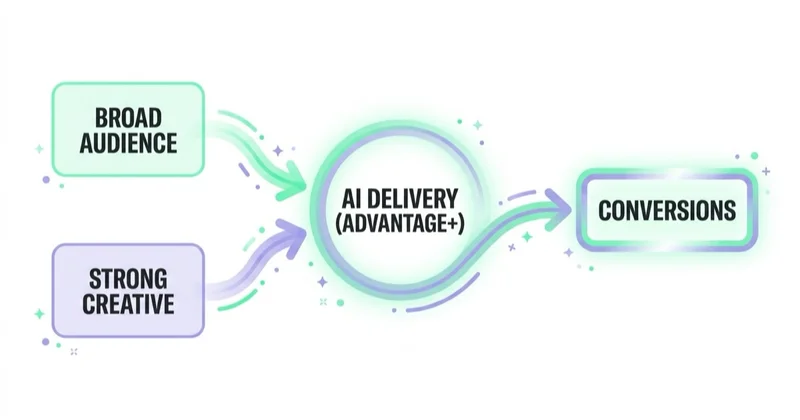
Be cautious when an agency sells “secret audiences” without explaining source, consent, durability or how impact will be tested. Be equally cautious when it promises that broad targeting or Advantage+ will solve every problem. The mature answer defines when suggestions, exclusions, customer lists, geography and manual controls are useful and how the choice will be evaluated. Technical changes such as Andromeda matter only insofar as they change practical decisions.
Creative as a system, not a deliverable
Creative is a major controllable input, but it is not the only one. Ask how the agency connects positioning, offer, customer research, format and landing-page experience. A credible system distinguishes a concept from a resize, records hypotheses and retains usage permissions for creator content.
Ask what determines monthly concept volume, which effect a test is designed to detect, how conversion delay is handled and whether default delivery or a controlled experiment is used. Request one anonymised example showing the brief, variants, result and next decision. Volume without distinct hypotheses can produce many files and little learning. The mechanics sit in dynamic creative and broader creative testing practice.
Signal quality: the infrastructure most agencies skimp on
Measurement implementation should reflect the business and applicable privacy rules. For web outcomes, this may include the Meta Pixel and Conversions API, consistent event names and values, browser/server deduplication, event-match diagnostics and consent handling. Lead-generation accounts may also return qualified or sold outcomes from the CRM through supported datasets.
Naming CAPI is not proof of competence. Ask the agency to demonstrate test events, deduplication keys, value and currency, data-source ownership, diagnostics and reconciliation with orders or CRM records. Meta states that CAPI is not a way to bypass App Tracking Transparency or European privacy rules. The agency should be able to explain what data is sent, on which legal basis and for how long it is retained.
Measurement: use the right view for the question
Meta's attributed ROAS reports outcomes under the platform's attribution settings. It can overlap with other platforms, omit unobserved journeys or differ from analytics and finance systems. It may overstate or understate causal contribution; the direction is not knowable from the dashboard alone.
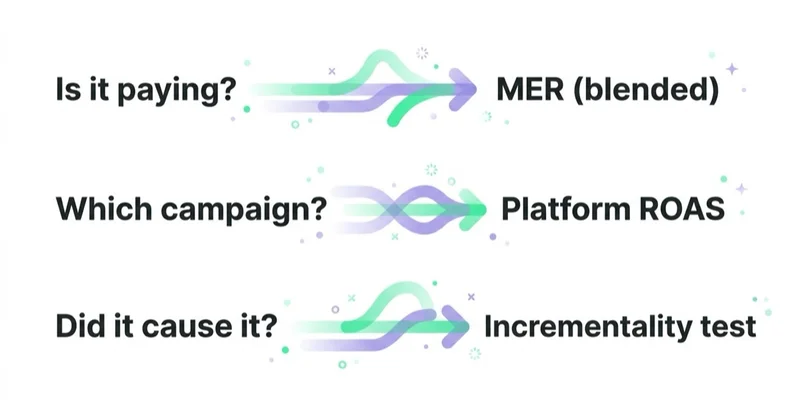
Blended efficiency connects total revenue with total marketing spend, but it is influenced by price, promotions, organic demand, channel mix and existing customers. It does not isolate Meta either. A strong measurement plan uses platform reporting for delivery and optimisation, analytics or warehouse data for cross-channel behaviour, CRM or order data for quality and margin, and randomised lift testing where feasible for incrementality. See marketing attribution read honestly.
Glossary
- Advantage+ — Meta's suite of end-to-end and single-step automation products.
- Andromeda — Meta's retrieval-stage AI that changed how ads are matched and surfaced.
- Pixel — the browser-side tag that records on-site events for Meta.
- Conversions API (CAPI) — a connection for sending permitted marketing events from servers, platforms, apps, CRM or offline sources to Meta.
- Creative fatigue — declining performance as an audience sees the same ad too often.
- Blended efficiency / MER — a broad revenue-to-marketing-spend ratio that does not isolate one channel's causal impact.
- Incrementality — the sales that would not have happened without the ads, measured against a holdout.
Ownership and transparency
The advertiser should control the business portfolio and core assets: Page, Instagram account, ad account, dataset or Pixel, catalog, verified domain and billing arrangements. Grant the agency partner access at the minimum level required and document who can add people, change payment methods and export data. Confirm intellectual-property and usage rights for source files, creator content, music and AI-generated assets. See who owns your accounts when you leave an agency.
The contract should cover access, data processing, creative rights, approvals, incident response and offboarding. The client should see Ads Manager and receive a decision-oriented report, but transparency is more than dashboard access: material changes, exclusions, test design, failures and commercial trade-offs should be explained.
Red flags and green flags
| Red flag | Green flag |
|---|---|
| “Our secret audiences” with no test or provenance | Explains suggestions, controls, exclusions and test logic |
| Promises a fixed creative quota as strategy | Links distinct concepts and formats to a research roadmap |
| Tracking “already set up, don't worry” | Demonstrates events, deduplication, values, consent and reconciliation |
| Treats platform or blended ROAS as causal truth | Uses each measurement view for its proper question |
| Keeps core assets inaccessible to the advertiser | Advertiser controls the portfolio; agency receives partner access |
| Monthly PDF, no account access | Direct account visibility and test transparency |
| Promises a specific ROAS up front | Talks mechanism, ranges and what it can't control |
How priorities shift by business type
- Ecommerce / DTC. Ask about catalog health, margin-aware product priorities, new-customer reporting, returns and creative rights.
- Considered / high-AOV. Require longer measurement windows, sales-quality feedback and content that supports a considered decision.
- Lead generation. Evaluate CRM integration, response time, duplicate and spam handling, qualification and optimisation to downstream events.
- Local / service. Check geographic controls, capacity, call handling, lead quality and local or sector-specific advertising rules.
How Space Ads approaches Meta
Our Meta work begins with commercial objectives, access and measurement, followed by a creative and campaign plan appropriate to the business. We use Advantage+ features where they fit the hypothesis and constraints, and manual controls where geography, exclusions, regulation or the test design requires them.
We reconcile Meta reporting with analytics, CRM or order data and business economics, and use incrementality methods when the decision and scale justify them. The advertiser retains control of its core assets while the agency's access and creative rights are documented. This operating model underpins our Meta Ads and performance marketing work.
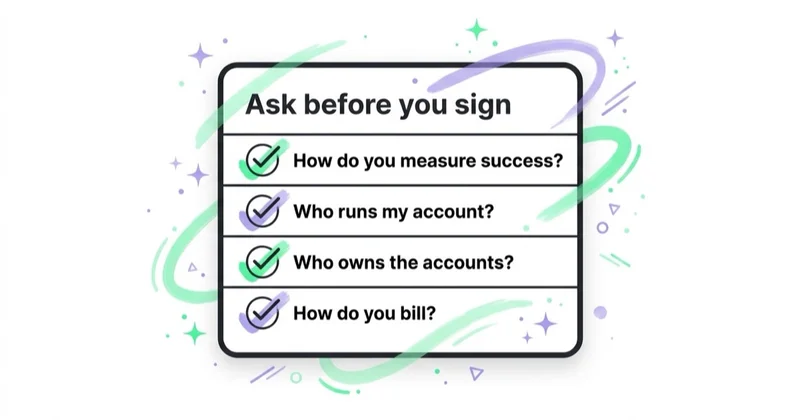
Questions to ask before you sign
- Which business outcome and unit economics will guide decisions? Expect margin, customer value or qualified pipeline—not clicks alone.
- How do customer insights become creative hypotheses? Request an anonymised brief-to-learning example.
- How will you verify Pixel, dataset, CAPI and CRM events? Ask for acceptance criteria and reconciliation.
- When would you use Advantage+ suggestions or stricter controls? The answer should depend on the case.
- How will you separate attribution, blended efficiency and incrementality? Each should have a defined role.
- Which assets and rights remain under our control? Put access, source files, creator usage and offboarding in the contract.
- What is included in the fee? Separate media, production, tracking, landing pages, tools and third-party costs.
- What would make you recommend pausing or reducing spend? A credible partner names stop conditions.
Common mistakes buyers make
Common mistakes are comparing fees without scope, accepting a case study without baseline or selection context, failing to check creative usage rights, and granting access before the offboarding terms are clear. Buyers also confuse a high creative count with learning and treat either platform ROAS or blended MER as causal proof. A short paid diagnostic or pilot with explicit acceptance criteria can reveal more than a polished pitch.
FAQ
What should a Meta ads agency actually be good at in 2026?
It should connect commercial strategy, creative research and production, campaign execution, privacy-aware measurement and transparent decision-making. Technical competence includes Pixel, datasets and CAPI where appropriate; platform competence includes both Advantage+ automation and the controls required by the business. The agency should also understand the limits of attribution and creative rights.
Is manual audience targeting still worth paying for?
It can be, depending on geography, regulation, niche demand, exclusions, remarketing, customer strategy and test design. Meta recommends broad reach and can expand beyond audience suggestions, but it also provides strict controls. Ask the agency to state the hypothesis and compare outcomes rather than treating either manual targeting or broad delivery as doctrine.
How do I know if a Meta agency is measuring honestly?
Check whether it explains what each number can and cannot answer. Meta attribution supports platform optimisation but is not causal proof. Blended efficiency shows overall commercial movement but cannot isolate Meta. CRM or order data validates outcome quality, while a suitable randomised lift test can estimate incrementality. Honest reporting reconciles differences instead of selecting the most flattering view.
How much does a Meta ads agency cost?
Fees vary by market, complexity and model: retainer, spend percentage, project or performance component. Compare a written scope covering markets, accounts, creative concepts and adaptations, tracking, reporting, meetings, landing pages, tools and third-party production. Model total cost under several spend levels and check incentives, minimum term and notice period.
Should I choose a Meta specialist or a full-service agency?
Choose around the coordination problem. A specialist may suit a team that already owns strategy, creative and analytics. A multi-channel partner may reduce hand-offs when budgets and measurement span platforms. In either case, inspect the named delivery team, relevant experience, data access and process; the agency label does not prove depth or integration.
Who should own the Meta Business Manager and Pixel?
The advertiser should control its business portfolio and core assets, with current internal administrators and recovery arrangements. Give the agency partner access needed for the scope rather than shared personal logins. Before signing, document billing, asset transfer or release, data exports, removal of access and rights to final and source creative files.
Key takeaways
- Choose an agency that connects commercial economics, creative, delivery, measurement and governance.
- Expect a case-dependent view of Advantage+ automation and manual controls.
- Verify event implementation and privacy practices; CAPI terminology alone proves little.
- Use platform, blended, CRM and incremental measurement for different questions.
- Keep advertiser control of core assets and put scope, rights, access and offboarding in writing.
Sources and further reading
- Meta Business Help Center — About Advantage+ shopping campaigns
- Meta Business Help Center — About the Conversions API
- Meta for Business — Advantage+ audience and controls
- Meta for Business — Advantage+ products
- Meta Help Center — Ad-account roles and access
Continue learning
Continue reading
Meta Advantage+ vs Manual Campaigns: When to Trust the Automation
Meta Advantage+ can automate audience expansion, placements and budget allocation, while manual settings preserve selected controls. This guide explains what each label actually means and how to test the right configuration for a business goal.
How to Choose a TikTok Ads Agency (and When You Actually Need One)
Choose a TikTok Ads agency by examining creative research and production, creator rights, Spark Ads, measurement, Business Center access and commercial judgment—and decide whether an agency is the right model.

Lead Generation for Online Courses and Education Providers
Education lead generation must connect an honest promise with learner fit, enrolment and course starts—not just form volume. Learn how to design the journey, evidence claims and measure each intake.