Personal injury lawyer marketing is one of the most competitive forms of paid search because the commercial outcome is not a low-value inquiry. A single signed case can justify substantial media cost, but only when the firm can answer quickly, qualify correctly, comply with legal advertising rules and connect marketing data to signed matters.
The mistake is judging personal injury PPC by clicks, form fills or raw calls. Those are only early signals. The real funnel is lead, qualified intake, consultation, retained client, case type, estimated case value and eventual fee value. A campaign that generates inexpensive calls can still lose money if those calls are out of jurisdiction, already represented, outside the firm's case criteria or never reached by intake.
This guide is the personal injury specialization of the broader law firm marketing guide. It focuses on paid search, Local Services Ads, intake speed, case-value measurement and compliance-safe conversion strategy.
This article is marketing guidance, not legal or ethics advice. Attorney advertising rules vary by jurisdiction, so law firms should review ads, landing pages, intake scripts, testimonials, fee language, disclaimers and tracking practices with qualified counsel or the firm's responsible compliance reviewer.
TL;DR
- Personal injury marketing should optimize for signed cases and case value. Lead volume is useful only when it produces retained clients that fit the firm's criteria.
- Case types need separate economics. Auto, truck, motorcycle, pedestrian, premises, wrongful death, catastrophic injury and mass tort campaigns do not have the same value or qualification path.
- Intake is part of PPC performance. Missed calls, slow callbacks and weak scripts can waste expensive demand after the ad already worked.
- Local Services Ads can be valuable where eligible. Badge terminology and screening requirements can vary, so the current account and Google documentation should guide copy.
- Compliance controls the message. Avoid outcome promises, unsupported comparisons, misleading testimonials and jurisdictional overreach.
- Offline conversion imports are critical. Signed-case and case-value feedback helps bidding learn from retained clients, not shallow leads.
Why Personal Injury Marketing Is Different
Personal injury advertising has a rare combination: urgent demand, emotional context, high click cost, wide case-value variance and strict professional responsibility risk.
First, the prospect may be stressed, injured or making a decision on behalf of a family member. The landing page and intake experience need clarity, empathy and speed. Aggressive language may attract attention, but trust and responsiveness convert.
Second, the legal and commercial filters are narrow. The firm may need to know:
- where the incident happened;
- when it happened;
- whether medical treatment occurred;
- whether liability appears plausible;
- whether another attorney already represents the person;
- whether the case type fits the firm's focus;
- whether the jurisdiction and statute-of-limitations context are viable;
- whether the potential value justifies the firm's time and media cost.
Third, case value is uneven. A minor property-damage question, soft-tissue auto claim, commercial trucking case, catastrophic injury and wrongful death matter cannot be evaluated with one cost-per-lead target. The marketing model needs case-type economics.
Fourth, legal advertising rules matter. Many jurisdictions restrict false or misleading communications, require disclaimers, regulate testimonials and control direct solicitation. A PPC account should not create claims faster than the firm can review them.
Case-Type Segmentation
The campaign structure should follow case value, intent and intake handling.
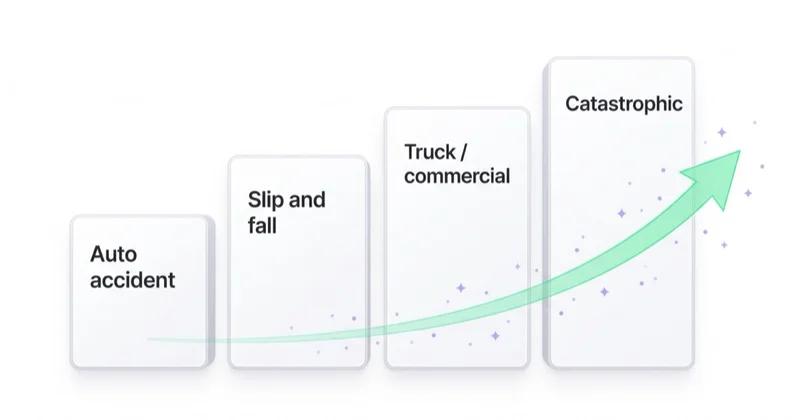
| Case Type | Search Intent | Marketing Need |
|---|---|---|
| Car accident | high-volume local searches | fast intake, location trust, clear next step |
| Truck accident | fewer searches, often higher value | separate pages, commercial-vehicle proof, stronger qualification |
| Motorcycle accident | specific injury and bias concerns | dedicated messaging and intake script |
| Pedestrian / bicycle | serious injury potential, local context | medical and liability qualification |
| Premises liability | slip, fall, unsafe property | incident details, property type, evidence questions |
| Wrongful death | sensitive family decision | restrained language, trust, attorney involvement |
| Catastrophic injury | high-value, complex case | proof of capability, case resources, careful claims |
| Mass tort / product injury | campaign-specific demand | compliance review, eligibility criteria, source controls |
| Brand / attorney name | people already looking for the firm | brand protection and direct intake path |
This structure prevents one of the most expensive mistakes in personal injury PPC: letting broad, cheaper injury traffic control bidding while the firm actually wants a narrower set of cases.
Google Search Strategy
Search campaigns should be built for control. Personal injury terms can be expensive, and broad matching without guardrails can quickly drift into low-fit questions, legal research, employment queries, unrelated practice areas and people outside the service area.
Useful Search groupings include:
- case type campaigns;
- city or region campaigns;
- brand and attorney-name campaigns;
- competitor or comparison campaigns where legally and commercially appropriate;
- emergency or immediate-help campaigns;
- Spanish or multilingual campaigns where the firm can provide intake and service in that language;
- mass-tort campaigns with separate compliance review.
Landing pages should match the case type. A truck accident query should not land on a generic "personal injury" page if the firm can present relevant process, intake questions and proof. A wrongful death query should not use the same tone as a minor accident page. A brand query should provide a direct phone path, reviews and attorney information.
Negative keyword work should be frequent. Common exclusions may include:
- jobs, careers, salary and paralegal training;
- legal templates and sample letters;
- law school and bar exam terms;
- pro bono or free legal aid if not offered;
- non-injury practice areas;
- out-of-state or out-of-jurisdiction terms;
- insurance company support terms;
- medical treatment searches without legal intent;
- case-value calculators if they attract low-fit research;
- already represented phrases where the firm does not accept those inquiries.
The exact list depends on the firm. A weekly search-term review is more defensible than copying a generic legal negative list.
Local Services Ads For Personal Injury Lawyers
Local Services Ads can capture high-intent legal demand above traditional Search ads where the category is eligible. Google's current Local Services documentation lists personal injury lawyer services among eligible categories in the United States and describes a lead-based model where potential customers can call or message through the ad. Google also describes screening and verification procedures that may include license, insurance and background checks depending on category and region.
Badge terminology has changed across Local Services Ads documentation and market presentation over time. Current Google help materials emphasize Google Verified language broadly, while many legal advertisers and older account contexts still refer to Google Screened. The practical rule is to use the badge wording visible in the active account and current Google documentation, not a legacy phrase from an old playbook.
LSA can be useful when:
- the firm has strong reviews and complete profile data;
- practice areas and service areas are accurate;
- intake can answer calls and messages quickly;
- lead feedback is reviewed consistently;
- invalid or out-of-scope leads are handled through the available process;
- signed cases are tracked outside the LSA interface.
LSA is not a replacement for Search. Search provides keyword control, landing-page control, negative keywords, ad copy testing and deeper conversion value logic. LSA provides a different lead source. Both should be compared by signed cases, not lead count.
Intake: The Conversion Rate Lever
In personal injury, intake is not a back-office function. It is conversion rate optimization.
The intake system should answer:
| Intake Question | Why It Matters |
|---|---|
| Was the call answered live? | high-intent callers often contact multiple firms |
| How fast was the first human response? | speed affects whether the firm enters the shortlist |
| Was the caller qualified consistently? | poor scripts create bad case decisions |
| Was the lead routed to the right person? | strong cases need fast attorney or case-manager review |
| Was follow-up documented? | many prospects need more than one touch |
| Was source captured correctly? | signed-case attribution depends on clean source data |
| Was sensitive information handled appropriately? | legal and privacy risk affects tracking design |
Useful intake fields include:
- incident type;
- incident date;
- location and jurisdiction;
- injury severity;
- medical treatment status;
- insurance status where relevant;
- representation status;
- police report or incident report status;
- photos, documents or evidence availability;
- preferred contact method;
- language preference;
- urgency and callback window.
The firm should track speed-to-lead, missed calls, call duration, qualified intake rate, consultation rate, retained-client rate and case-type mix by source. A PPC account cannot be judged accurately when intake data is missing.
Compliance-Safe Messaging
Personal injury marketing has to persuade without overpromising.
Risk-prone copy areas include:
- statements that imply a specific legal outcome;
- unsupported comparisons with other attorneys;
- superlatives without substantiation;
- testimonial copy that implies typical results;
- settlement or verdict references without required context;
- fee language without required disclaimers;
- urgency language that could feel coercive;
- practice-area claims beyond attorney licensing or capability;
- geo claims in jurisdictions where the firm is not authorized.
Safer messaging usually focuses on process and fit:
- free case review where accurate and allowed;
- available consultation path;
- response time expectation;
- relevant case-type focus;
- attorney involvement;
- local jurisdiction experience where accurate;
- explanation of what happens after contact;
- evidence-preservation guidance;
- clear statement that past outcomes do not predict future results where required.
Testimonials, review snippets and case results should go through jurisdiction-specific review before appearing in ads or landing pages. The same applies to call recording, lead sharing, CRM exports and offline conversion uploads when they touch sensitive legal facts.
Landing Pages For Personal Injury PPC
A personal injury landing page should help a stressed user understand whether the firm can help and what happens next.
Strong pages usually include:
- case-type-specific headline;
- local jurisdiction or service area;
- clear phone CTA and form CTA;
- attorney or firm proof;
- explanation of intake process;
- relevant case-type questions;
- client reviews where compliant;
- case results only where approved and properly contextualized;
- fee and consultation language with required disclaimers;
- privacy and confidentiality reassurance;
- accessibility on mobile;
- fast load time;
- FAQ about timeline, documents, medical treatment and next steps.
The form should not ask for more sensitive detail than needed for routing and qualification. It should collect enough information for a meaningful callback without forcing the person to write a full legal narrative. For PPC, the safest design is often a concise form plus fast human intake.
For broader landing-page structure, see what a landing page is and how to build one.
Measurement: Signed Cases And Case Value
Personal injury PPC needs a deeper conversion hierarchy than most local lead generation.
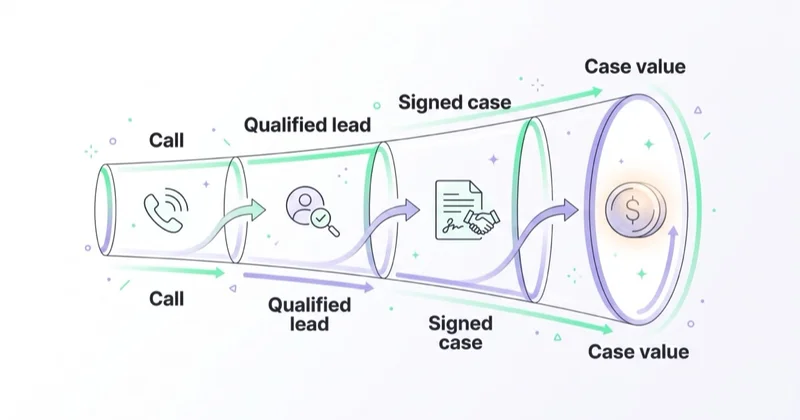
| Stage | Meaning | Platform Use |
|---|---|---|
lead |
call, form, chat or LSA contact | early signal only |
qualified_intake |
meets jurisdiction and case-type criteria | better optimization signal |
consultation_scheduled |
firm schedules attorney or case-manager review | stronger intent |
consultation_completed |
conversation happened | deeper funnel signal |
retainer_sent |
firm wants the case | late-stage signal |
signed_case |
client retained the firm | primary outcome |
estimated_case_value |
early value estimate or case tier | supports value-based logic |
fee_value |
realized fee where available later | strongest but delayed signal |
Google Ads offline conversion imports are designed to connect later offline outcomes back to the original ad click. For personal injury, that means signed-case and case-value data can eventually guide bidding, provided privacy, consent, policy and ethics requirements are handled correctly.
Phone calls also need quality rules. Google Ads call reporting can measure calls from call assets and call ads, but a call is not automatically a viable case. A three-minute call from an out-of-jurisdiction caller may be worthless. A short call that immediately reaches a strong case may be valuable. The CRM has to carry the business meaning.
Case-Value Bidding
Value-based bidding works only when the value signal is credible. In personal injury, the final case value may take months or years to know. That does not mean the account should wait years before optimizing.
A practical value model can use tiers:
| Tier | Example Use |
|---|---|
| low fit | out of jurisdiction, no injury, wrong practice area |
| qualified but uncertain | viable intake, needs review |
| standard case | fits firm criteria, ordinary value range |
| high-priority case | serious injury, strong liability signals |
| strategic case | catastrophic, commercial vehicle, wrongful death or other high-resource matter |
These tiers should be reviewed by the firm, not invented by the media buyer. The goal is not to predict a verdict. The goal is to give bidding systems a better signal than "all calls are equal."
SEO, AEO And Local Trust
Personal injury PPC performs better when the firm's organic and local presence supports trust. Users often click an ad, search the attorney name, read reviews, compare profiles and return later.
Useful supporting assets include:
- case-type pages;
- city and jurisdiction pages;
- attorney bio pages;
- Google Business Profile optimization;
- review response process;
- FAQ content about what to do after an accident;
- content on deadlines and evidence preservation reviewed by attorneys;
- local proof such as courts, service areas and community presence;
- structured internal linking between PPC pages and informational content.
This supports SEO and AEO because search engines and answer systems need clear, entity-rich signals: firm name, attorneys, locations, practice areas, case types, consultation process and local jurisdictions.
How Space Ads Approaches Personal Injury Accounts
At Space Ads, personal injury accounts start with economics and intake, not keywords. The first audit maps case types, service areas, sign rates, estimated case value, intake response, missed calls, CRM stages, compliance constraints and existing Local Services Ads setup.
Then the account is rebuilt around signed cases. Search campaigns are separated by case type and geography. LSA is tested or refined where eligible. Landing pages are matched to intent and reviewed for compliance-sensitive language. Call tracking and CRM imports connect leads to retained clients and value tiers. Budget decisions follow signed-case economics rather than raw lead volume.
For an existing firm, a marketing audit can show whether spend is producing retained clients or only expensive activity. Execution connects Google Ads, Local Services Ads, intake feedback, landing pages, call tracking and performance marketing.
30-Day Optimization Plan
- Map case economics. Break down average sign rate and value tier by case type and jurisdiction.
- Audit intake. Measure missed calls, response time, qualified intake rate, consultation rate and retained-client rate.
- Review compliance. Check ads, pages, reviews, testimonials, fee language, disclaimers and tracking flows.
- Separate campaigns by case type. Build distinct structures for auto, truck, premises, catastrophic, wrongful death, brand and mass tort where relevant.
- Clean search terms. Add negatives for jobs, templates, irrelevant legal research, non-injury practice areas and unserved geographies.
- Evaluate LSA. Confirm eligibility, profile quality, badge wording, service areas, reviews and lead-quality workflow.
- Improve landing pages. Match case type, show process, reduce friction and add compliant proof.
- Connect CRM stages. Track qualified intake, consultation, retainer sent, signed case and value tier.
- Import deeper conversions. Send reliable signed-case or qualified-intake signals back after privacy and compliance review.
- Review by retained value. Compare source, case type and geography by signed cases and value tiers.
Common Mistakes
| Mistake | Why It Hurts | Better Approach |
|---|---|---|
| Optimizing to calls only | many calls are not viable cases | optimize to qualified intake and signed cases |
| Treating all injury cases equally | case value varies widely | segment by case type and value tier |
| Scaling before intake is ready | expensive leads are lost after contact | fix missed calls and response time first |
| Using aggressive outcome language | creates ethics and trust risk | focus on process, fit and approved proof |
| Ignoring LSA lead quality | lead count can hide poor fit | review, qualify and compare by signed cases |
| Broad match without safeguards | legal queries drift quickly | use negatives and search-term review |
| No case-value feedback | bidding learns from shallow signals | import deeper CRM stages |
| Weak local proof | users compare firms before calling | improve GBP, reviews, bios and local pages |
FAQ
What is personal injury lawyer marketing?
Personal injury lawyer marketing is the system used to generate qualified injury inquiries and retained clients through channels such as Google Search, Local Services Ads, local SEO, Google Business Profile, reviews, landing pages, call tracking and intake follow-up. The business goal is signed cases and case value, not lead volume alone.
Why is personal injury PPC expensive?
Personal injury PPC is expensive because competition is high and a retained case can have significant economic value. That does not make every click worthwhile. The account needs case-type segmentation, intake discipline and signed-case feedback to identify which expensive clicks are profitable.
Should personal injury firms use Local Services Ads?
Local Services Ads are worth evaluating where the personal injury category is eligible and the firm can pass the required screening. LSA should be measured by qualified intake and signed cases, not only lead volume. The current badge wording and verification details should be taken from the active account and current Google documentation.
How should personal injury campaigns be measured?
The strongest measurement hierarchy is lead, qualified intake, consultation scheduled, consultation completed, retainer sent, signed case and case value. Offline conversion imports can help connect later signed-case outcomes to the original ad interaction when privacy, consent and compliance requirements are satisfied.
What should a personal injury landing page include?
It should include a case-type-specific headline, phone CTA, short form, local relevance, attorney or firm proof, intake process, compliant reviews or proof, fee/disclaimer language where required, privacy reassurance and clear next steps. Mobile speed and click-to-call usability matter because many users contact from a phone.
How does intake affect PPC performance?
Intake determines whether a paid lead becomes a signed case. Missed calls, slow callbacks, inconsistent qualification and poor routing can make a strong PPC account look unprofitable. Speed-to-lead, qualified intake rate and retained-client rate should be reviewed with media performance.
Can personal injury ads use testimonials or case results?
They may be possible in some jurisdictions, but they require careful review. Testimonials, reviews, settlement references and case results can trigger attorney advertising rules, disclaimer requirements and misleading-impression risk. They should not be added to ads or landing pages without jurisdiction-specific review.
In Short
- Personal injury lawyer marketing should optimize toward retained clients and case value.
- Search, LSA, landing pages and intake must be measured as one system.
- Case-type segmentation matters because value and qualification vary widely.
- Compliance-safe messaging is not optional; outcome claims, testimonials and fee language need review.
- Offline conversion imports and CRM feedback help bidding move beyond raw calls and forms.
Sources
- American Bar Association - Model Rule 7.1: Communications Concerning a Lawyer's Services
- American Bar Association - Model Rule 7.2: Communications Concerning a Lawyer's Services: Advertising
- Local Services Help - How providers qualify for Local Services Ads
- Local Services Help - Getting started with Local Services Ads
- Google Ads Help - About offline conversion imports
- Google Ads Help - About call reporting
Continue Learning
Continue reading

Tree Service Marketing: Storm Leads and Booked Jobs
Tree service marketing has to capture emergency storm demand and steady planned work without wasting crew capacity. This guide covers Google Search, Local Services Ads, Google Verified, storm budgets, safety proof, call triage and cost per booked job.

Moving Company Marketing: Capture High-Intent Movers in Google
Moving company marketing is won through high-intent Search, fast quoting, local trust and booked-move measurement. This guide covers Google Ads, Local Services Ads, local vs long-distance intent, interstate trust signals, seasonality, capacity and CRM feedback.
Electrician Marketing: Google Ads and Local Services for Steady Jobs
Electrician marketing should produce profitable completed work, not just cheap calls. Learn how to connect Google Ads, Local Services Ads, dispatch capacity and job economics.