Law Firm Marketing is one of the least forgiving areas of performance marketing. Search intent can be extremely valuable, competition is intense, intake speed changes outcomes, and advertising copy has to stay inside professional conduct rules. A campaign that would be merely inefficient in another vertical can become expensive fast for a law firm because every weak click, missed call or unqualified lead consumes budget and attorney time.

The solution is not louder ad copy. Strong attorney marketing is built around practice-area segmentation, local trust, compliant messaging, fast intake and a measurement model that follows leads to signed matters. PPC, SEO, Local Services Ads, landing pages and call tracking should all support the same question: which channels produce qualified consultations and signed cases at a viable acquisition cost?
This article is marketing guidance, not legal advice. Every firm should review advertising requirements in the relevant jurisdiction before campaigns go live.
TL;DR
- Law firm marketing should be measured by signed matters. Clicks, impressions and form fills are only useful when they can be tied to consultation quality and retained clients.
- Local Services Ads can be a strong local intake channel. Google lists many lawyer categories in Local Services Ads and describes the format as lead-based, with Google Verified screening in selected verticals.
- Search PPC needs tight intent control. Practice areas, locations, match types, negatives and landing pages should be separated because attorney traffic is expensive and mixed intent is costly.
- SEO is still a trust and demand asset. Practice pages, local pages, attorney bios, FAQs and content hubs help pre-qualify prospects before paid traffic starts.
- Advertising rules shape the copy. ABA Model Rule 7.1 prohibits false or misleading communications, while Rule 7.2 allows communications about legal services but adds requirements around referrals, specialization claims and responsible lawyer or firm information.
- Intake is part of media performance. Missed calls, slow follow-up and weak qualification can make a good campaign look bad.
Why law firm marketing is different
Generic lead-generation advice breaks down in legal services for five reasons.
First, the commercial value of one client can be high, but not all inquiries are equal. A low-value consultation, a matter outside the jurisdiction or a lead looking for free help should not be optimized the same way as a qualified personal injury, family, estate, immigration or business-law inquiry.
Second, search behavior is highly practice-specific. "DUI lawyer near me," "divorce attorney consultation," "estate planning lawyer," "business contract attorney" and "personal injury lawyer after car accident" all imply different urgency, landing-page requirements and intake scripts.
Third, trust is not a decorative layer. Prospects compare credentials, reviews, bar status, attorney bios, case-type experience, fee structure and response speed. A generic landing page with a phone number rarely does enough.
Fourth, messaging is regulated. A law firm cannot rely on exaggerated claims, implied outcomes, unsupported superiority claims or careless testimonial language. Compliance should be part of campaign QA, not a last-minute copy review.
Fifth, media performance depends on intake. A high-intent call after business hours is not valuable if no one answers, no call-back process exists and the intake system cannot identify which campaign produced the prospect.
PPC, SEO and LSA should have separate jobs
Law firm marketing works best when each channel has a clear role.
| Channel | Best role | Typical risk | Better measurement |
|---|---|---|---|
| Local Services Ads | Local, high-intent calls and messages in eligible categories | weak profile, slow response, poor lead review | qualified leads and signed matters by practice area |
| Google Search PPC | Controlled capture of ready-to-hire search intent | broad keywords, mixed practice areas, irrelevant clicks | consultation rate, signed case rate, case value |
| SEO | Durable visibility, trust and topical authority | thin practice pages, generic blogs, weak local signals | organic consultations, assisted conversions, ranking by practice area |
| Meta and remarketing | Consideration, education and retargeting | sensitive targeting and weak creative fit | assisted consultations, return visits, booked calls |
| Email or CRM nurturing | Follow-up, reminders and reactivation | compliance gaps, poor consent records | booked consultations and re-engaged matters |
The mistake is treating all channels as interchangeable lead sources. LSA may generate direct local calls. Search PPC can control the highest-intent queries. SEO builds visibility and proof over time. Remarketing helps prospects who are comparing options. The reporting should show each role instead of forcing every channel into the same cost-per-lead column.

Local Services Ads and Google Verified for attorneys
Google's Local Services Ads help businesses receive phone calls and messages directly from potential customers. Google also lists many lawyer categories as eligible in the United States, including bankruptcy, business, contract, criminal, DUI, estate, family, immigration, IP, labor, litigation, malpractice, personal injury, real estate and traffic lawyer services.
For law firms, the practical advantages are:
- prominent local placement in eligible searches;
- lead-based charging rather than standard click charging;
- profile information that can include reviews and screening signals;
- lead management inside the Local Services Ads interface;
- budget controls and profile controls by service area and category.
The badge language matters. Google documentation now emphasizes the Google Verified badge and says it signals that a business has passed Google's screening process in selected verticals. Older industry language often refers to Google Screened for professional services. Campaign copy and internal reporting should use the wording visible in the actual account and market rather than assuming a universal badge label.
LSA should not be treated as "set and forget." The profile needs accurate practice areas, service locations, attorney information, reviews and response discipline. Leads should be reviewed for category fit, location, urgency, ability to pay, conflict issues and signed-case outcome. Without that feedback loop, the account may scale lead volume while intake quality gets worse.
Google Search PPC for attorneys
Search campaigns should be built around practice-area intent and matter value. A one-campaign structure for "law firm" usually makes reporting and bidding worse because a criminal defense lead, estate planning consultation and business contract inquiry do not have the same economics.
Useful campaign segmentation includes:
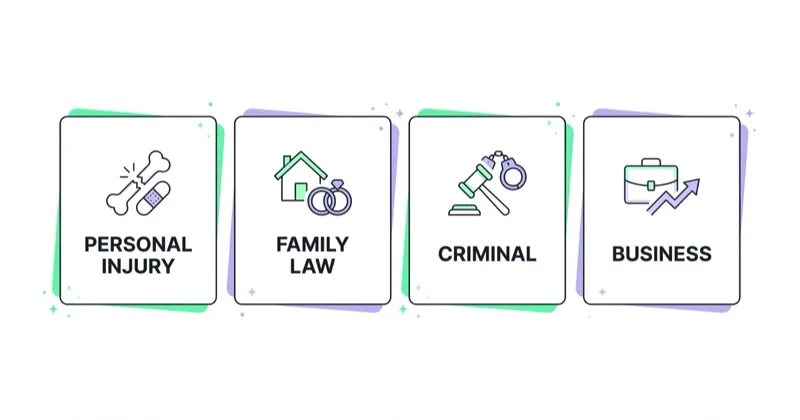
- practice area: personal injury, criminal defense, DUI, family, immigration, estate planning, business law, employment, real estate, bankruptcy;
- geography: city, county, service area, court market or state restrictions where relevant;
- urgency: emergency or immediate help vs considered planning;
- matter value: high-value cases, recurring business work, transactional services, low-margin consultations;
- lead type: phone-first urgent intake vs scheduled consultation;
- brand and competitor terms: separated for budget and compliance review.
Keyword intent should stay close to the landing page. Google recommends grouping keywords into themes related to products, services or categories. In legal PPC, that means "family lawyer consultation" should not share the same ad group as "criminal defense attorney," and neither should land on a generic homepage.
Negative keywords are especially important. A law firm account usually needs exclusions for jobs, salary, law school, templates, free forms, pro bono, DIY, definitions, "how to become a lawyer," irrelevant jurisdictions and practice areas the firm does not handle. The negative keyword workflow should be reviewed weekly while the account is learning and after every major keyword expansion.
Legal landing pages: trust, match and intake
Attorney landing pages need more than a headline and a form. They should help a prospect decide whether the firm handles the matter, operates in the right jurisdiction and can be trusted with a sensitive issue.
Strong practice-area pages usually include:
- exact practice-area match to the keyword and ad;
- jurisdiction and service-area clarity;
- responsible attorney or team information;
- credential and bar-status signals where appropriate;
- plain-language explanation of the process;
- representative case types without implying a specific outcome;
- reviews or testimonials reviewed for compliance;
- fee model or consultation expectations when useful;
- phone-first and form-first paths;
- intake questions that route the matter correctly;
- privacy and confidentiality expectations for submitted information.
Copy should avoid outcome promises and unsupported superiority claims. "Speak with a family law attorney about next steps" is safer and more useful than "win custody fast." "Free consultation" should be used only if the offer, limits and jurisdictional rules allow it.
The same principle applies to landing page strategy: message match, credibility, speed, mobile usability and conversion clarity all affect paid media efficiency. In legal, the trust layer is even more important because the decision is high-stakes and emotionally loaded.
SEO for law firms
SEO should not be treated as a cheaper replacement for PPC. It is a trust and demand asset that compounds when practice pages, local relevance and expert content are built properly.
Important law firm SEO assets include:
- practice-area pages for each service the firm actually wants to grow;
- local pages for markets where the firm can serve clients and comply with jurisdictional rules;
- attorney bios with credentials, admissions, experience and contact paths;
- FAQ sections that answer intake-level questions without giving individualized legal advice;
- content hubs around common legal problems, timelines, terminology and decision criteria;
- internal links from educational content to practice pages and consultation paths;
- review and reputation management across Google Business Profile and relevant legal directories;
- technical SEO so pages are indexable, fast and easy to crawl.
An SEO audit should check more than rankings. It should evaluate whether organic pages answer real client questions, demonstrate experience, connect to intake and avoid thin content that looks interchangeable with every other firm in the market. For technical data, Google Search Console can identify queries, pages and markets where the firm has visibility but weak click-through or conversion paths.
Advertising rules and compliance review
The American Bar Association's Model Rules are not a substitute for state-specific ethics rules, but they provide a useful baseline. Model Rule 7.1 says a lawyer shall not make a false or misleading communication about the lawyer or the lawyer's services. Model Rule 7.2 allows communications about legal services through media, while adding rules about referral compensation, specialization claims and responsible lawyer or law firm contact information.
In practical marketing terms, a compliance QA checklist should cover:
- no outcome promises or implied certainty;
- no settlement, case result or testimonial claims without required context and review;
- no unsupported "best," "top," "number one" or specialist claims;
- clear identification of the responsible lawyer or firm where required;
- jurisdictional disclaimers where needed;
- review of landing pages, ads, extensions, forms, videos and remarketing copy;
- state bar requirements before launch;
- intake scripts and automated replies that match advertising claims.
This can feel restrictive, but it often improves performance. Clear, precise and compliant copy tends to attract better-fit prospects than aggressive copy that creates the wrong expectations.
Intake speed and qualification
Paid legal traffic cannot be optimized separately from intake. A campaign may generate a qualified call, but the commercial value is lost if the call is missed, routed incorrectly or never connected to a consultation.
The intake workflow should define:
- business-hours and after-hours coverage;
- call answering standards;
- conflict-check handoff;
- practice-area qualification;
- jurisdiction and location screening;
- urgency score;
- fee expectation or consultation type;
- appointment scheduling;
- source capture from LSA, PPC, organic, referral and remarketing;
- lost-reason tracking.
Call tracking for PPC is essential because many legal leads start by phone. The tracking setup should preserve privacy, support compliance review and connect calls to lead status without exposing sensitive details unnecessarily. The goal is not to optimize toward longer calls by itself; the goal is to understand which calls become qualified consultations and retained clients.
Measurement: cost per signed matter
The most dangerous law firm dashboard is one that stops at cost per lead. A campaign can generate inexpensive inquiries and still fail if the leads are outside the firm's practice area, cannot pay, are in the wrong jurisdiction or never sign.
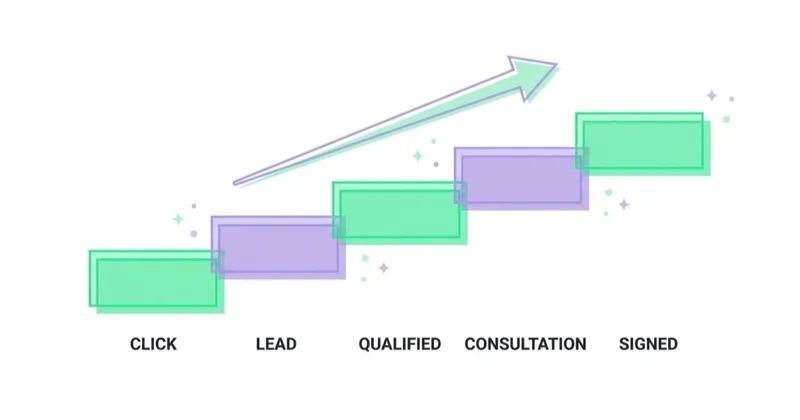
A stronger measurement ladder is:
- Impression and click.
- Call, form or LSA lead.
- Qualified inquiry.
- Consultation scheduled.
- Consultation completed.
- Matter accepted by the firm.
- Client retained or fee agreement signed.
- Estimated matter value or fee value.
- Closed outcome where the CRM supports it.
For bidding, the account should distinguish primary and secondary conversions. A signed matter or qualified consultation should carry more value than a raw form submission. At sufficient volume, offline conversion imports can help Smart Bidding optimize toward better outcomes rather than cheaper inquiries.
Practice-area strategy
Different practice areas need different media economics, content and intake.
| Practice area | Typical decision pattern | Marketing implication |
|---|---|---|
| Personal injury | urgent, high case-value variance, comparison-heavy | fast intake, local trust, case-type pages, careful results language |
| Criminal defense / DUI | immediate need, phone-first | after-hours coverage, location/court relevance, strong call tracking |
| Family law | emotional, trust-driven, longer comparison | attorney bios, process clarity, reviews, consultation scheduling |
| Estate planning | considered, educational | SEO content, packages or process clarity, remarketing |
| Business law | relationship and expertise led | niche pages, LinkedIn/remarketing support, qualified consultation paths |
| Immigration | high trust need, multilingual potential | language support, document/process education, jurisdiction clarity |
| Real estate law | transaction-driven, location-specific | local pages, clear service scope, partner/referral tracking |
One budget across all practice areas makes the firm blind. Each area should have its own acquisition target, intake owner, compliance review and reporting line.
Space Ads operating approach
At Space Ads, high-CPC and regulated categories are audited through the same lens: intent, compliance, tracking and sales quality. Across daily reviews of 25+ client accounts and roughly 14M monthly data points analyzed through Space Ads OS, the recurring law-firm pattern is clear: the account usually needs fewer broad leads and more visibility into qualified consultations and signed matters.
The practical sequence is:
- Map practice areas, jurisdictions and matter-value assumptions.
- Audit LSA eligibility, profile quality, reviews and lead handling.
- Rebuild Search around high-intent practice-area themes.
- Add negative keyword discipline and search-term review.
- Improve landing pages for trust, match and compliance.
- Connect call tracking, forms and CRM stages.
- Review ad and page copy against firm-approved advertising rules.
When an account is spending but the firm cannot see which campaigns produce retained clients, a marketing audit is usually the fastest starting point. Ongoing acquisition, measurement and optimization sit under performance marketing.
30-day action plan
- List every practice area the firm wants to grow and assign an acquisition target to each.
- Review jurisdiction, advertising-rule and approval requirements before copy is written.
- Audit Local Services Ads eligibility, profile details, review strength and response handling.
- Split Google Search campaigns by practice area, geography and intent.
- Add negative keywords for jobs, templates, free forms, law school, DIY and unsupported practice areas.
- Build or improve practice-specific landing pages with compliant trust signals.
- Set up call tracking and form tracking with privacy and compliance constraints in mind.
- Connect intake stages to reporting: qualified, consultation, retained and lost reason.
- Review SEO pages for thin content, weak internal links and missing local relevance.
- Hold a weekly lead-quality review between marketing and intake.
Common mistakes
| Mistake | Better approach |
|---|---|
| Optimizing for cost per click | Optimize for qualified consultations and signed matters |
| One campaign for all practice areas | Segment by practice area, location and matter value |
| Generic landing pages | Use practice-specific pages with attorney proof and intake paths |
| Weak negative keywords | Exclude jobs, DIY, templates, free-only searches and irrelevant jurisdictions |
| Treating LSA as automatic | Review profile quality, lead handling and signed-case outcomes |
| Aggressive ad claims | Use precise, compliant, proof-led messaging |
| Reporting only top-of-funnel leads | Connect ads to intake, consultation and retained-client stages |
| Ignoring SEO while running PPC | Use SEO to build trust, answer questions and support long-term demand |
FAQ
What is law firm marketing?
Law firm marketing is the system used to attract, qualify and convert prospective clients for legal services. It includes PPC, SEO, Local Services Ads, local visibility, content, reputation, landing pages, intake processes, CRM reporting and compliance review.
Should attorneys use PPC or SEO first?
The answer depends on the firm's urgency and existing visibility. PPC can produce faster testing and lead flow, while SEO builds durable trust and organic demand. Many firms need both: PPC for controlled high-intent search and SEO for practice-area authority, local visibility and pre-qualified prospects.
Are Local Services Ads available for lawyers?
Google lists multiple lawyer categories in Local Services Ads in the United States, including personal injury, family, criminal, DUI, estate, immigration, real estate and other legal service categories. Availability and requirements vary by market and account, so eligibility should be checked during setup.
What can law firms say in ads?
Advertising copy should be truthful, not misleading and reviewed against state-specific professional conduct rules. ABA Model Rule 7.1 prohibits false or misleading communications, and Rule 7.2 adds requirements around legal-service communications. Outcome promises, unsupported superiority claims and careless testimonial use are common risk areas.
How should law firm PPC be measured?
The primary metric should be cost per qualified consultation and cost per signed matter. Clicks and leads matter only when they connect to intake quality, consultation completion, retained-client rate and estimated matter value.
Why are negative keywords important for law firms?
Legal search traffic includes many non-client searches: jobs, salary, law school, free templates, definitions, DIY research and irrelevant jurisdictions. Negative keywords protect budget so campaigns can focus on prospects with real hiring intent.
In short
Law Firm Marketing works when acquisition, trust and compliance are managed as one system. Local Services Ads can support local intake, Search PPC captures high-intent demand, SEO builds durable authority and intake tracking shows which leads become retained clients.
The strongest law-firm accounts are not the loudest. They are specific by practice area, disciplined with negative keywords, careful with advertising claims, fast on intake and measured by signed matters rather than superficial lead volume.
Sources
- Google Local Services Help - Getting started with Local Services Ads
- Google Ads - Local Services Ads
- Google Ads Help - Keywords in Search Network campaigns
- Google Ads Help - Call reporting
- American Bar Association - Rule 7.1: Communications Concerning a Lawyer's Services
- American Bar Association - Rule 7.2: Communications Concerning a Lawyer's Services: Specific Rules
Continue learning
- Google Local Services Ads and Google Verified: the guide
- Google Ads for local businesses, home services and contractors
- Call tracking for PPC and lead generation
- Negative keywords in Google Ads: cut wasted spend
- What is a landing page and how to build one
- What is an SEO audit and how to do it properly
Continue reading

Tree Service Marketing: Storm Leads and Booked Jobs
Tree service marketing has to capture emergency storm demand and steady planned work without wasting crew capacity. This guide covers Google Search, Local Services Ads, Google Verified, storm budgets, safety proof, call triage and cost per booked job.

Moving Company Marketing: Capture High-Intent Movers in Google
Moving company marketing is won through high-intent Search, fast quoting, local trust and booked-move measurement. This guide covers Google Ads, Local Services Ads, local vs long-distance intent, interstate trust signals, seasonality, capacity and CRM feedback.

Electrician Marketing: Google Ads and Local Services for Steady Jobs
Electrician marketing should produce profitable completed work, not just cheap calls. Learn how to connect Google Ads, Local Services Ads, dispatch capacity and job economics.