A high-performing email marketing campaign is not just a persuasive message. It needs a permission-based list, clear segmentation, strong deliverability, useful content, compliant unsubscribe handling, reliable tracking and a journey that matches the subscriber's stage. In 2026, email is still one of the most valuable owned channels, but inbox providers now reward trustworthy senders and punish careless bulk sending faster than before.
TL;DR
- List quality beats list size. A smaller opted-in list usually performs better than a large database of disengaged or low-consent contacts.
- Deliverability is strategy, not IT housekeeping. SPF, DKIM, DMARC, low complaint rates and one-click unsubscribe affect whether campaigns reach the inbox.
- Open rate is no longer enough. Apple Mail Privacy Protection and image preloading make opens less reliable, so clicks, conversions, revenue, replies and spam complaints matter more.
- Segmentation improves relevance. New subscribers, first-time buyers, repeat customers, lapsed users and B2B leads need different messages.
- Automation usually creates the most value. Welcome, abandoned cart, post-purchase, replenishment, lead-nurturing and reactivation flows work because they respond to behavior.
- Good newsletters are not only promotions. Education, proof, product guidance, stories and useful updates keep the list engaged between sales moments.
- Compliance and trust are part of conversion. Consent, clear sender identity and easy unsubscribe reduce risk and protect the domain.
- A campaign brief prevents random sends. Define audience, promise, offer, CTA, landing page, suppression logic and success metric before writing.
What email marketing is
Email marketing is the use of email to communicate with subscribers, customers or leads in a way that supports a business goal. It can drive sales, retain customers, educate an audience, nurture B2B leads, announce product updates or build a long-term relationship with a brand.
The channel is powerful because it is owned. A company does not need an algorithm to decide whether an email can be sent. But that does not mean delivery is guaranteed. Gmail, Yahoo, Outlook, Apple Mail and corporate filters all evaluate sender reputation, authentication, engagement and user complaints.
That makes modern email marketing a mix of four disciplines:
- permission and list growth;
- message and offer strategy;
- deliverability and compliance;
- measurement and lifecycle automation.
Ignoring any of these usually weakens the whole channel.
Email marketing vs newsletter vs automation
These terms are often used interchangeably, but they mean different things.
| Term | Meaning | Example |
|---|---|---|
| Email marketing | The full channel strategy | List growth, segmentation, campaigns, flows, reporting |
| Newsletter | A recurring editorial or promotional email | Weekly insights, product updates, curated content |
| Campaign | A one-off or time-bound send | Product launch, seasonal sale, webinar invite |
| Automation / flow | Triggered email sequence based on behavior | Welcome series, abandoned cart, post-purchase |
| Transactional email | Operational message tied to user action | Order confirmation, password reset, invoice |
The strongest programs use all of them. A newsletter keeps the relationship warm. Campaigns create moments. Automations respond to behavior. Transactional emails provide operational trust.
Email marketing campaign brief
Before writing the subject line, define the campaign brief. This makes email less dependent on last-minute copy ideas and more connected to a real business objective.
A useful brief includes:
- business goal: sale, booking, renewal, reactivation, education or retention;
- audience segment: who should receive the message and who should be excluded;
- reason to send now: launch, deadline, behaviour, seasonality or customer need;
- promise: what the recipient gets from reading or clicking;
- primary CTA: one main action;
- landing page or next step: where the click goes and what happens there;
- offer details: pricing, discount, terms, deadline or availability where relevant;
- proof: review, case study, product data, expert insight or guarantee;
- compliance checks: consent, suppression, unsubscribe and sender identity;
- measurement: primary KPI and secondary diagnostics.
This brief is especially useful when several teams touch email: marketing, ecommerce, CRM, sales, legal, analytics and design. It prevents the common problem where a campaign is technically sent on time but the offer, segment and landing page do not match.
The technical foundation: deliverability first
Even the best email copy fails if the message lands in spam.
As of February 2024, Google introduced stricter requirements for senders who send more than 5,000 messages per day to Gmail accounts. The practical standard for serious senders now includes:
- SPF: verifies which servers are allowed to send mail for the domain;
- DKIM: signs messages so receiving servers can verify the sender domain and message integrity;
- DMARC: tells receivers what to do when SPF/DKIM alignment fails;
- one-click unsubscribe: required for subscription messages by major inbox providers;
- low spam complaints: Google recommends keeping spam rates in Postmaster Tools below 0.10% and avoiding 0.30% or higher;
- clear sender identity: no misleading display names, reply tricks or deceptive headers;
- TLS and proper DNS configuration: baseline technical hygiene for reputable sending.
Yahoo's sender guidance points in the same direction: authenticated sending, relevant content, opted-in recipients and list-unsubscribe support.
For most brands, this means marketing should not run email alone. DNS, CRM, ESP, consent management, analytics and legal requirements all touch the channel.
Compliance basics for English-speaking markets
Email compliance depends on jurisdiction, audience type and data source, so legal review may be needed. Still, several practical principles apply across serious email programs:
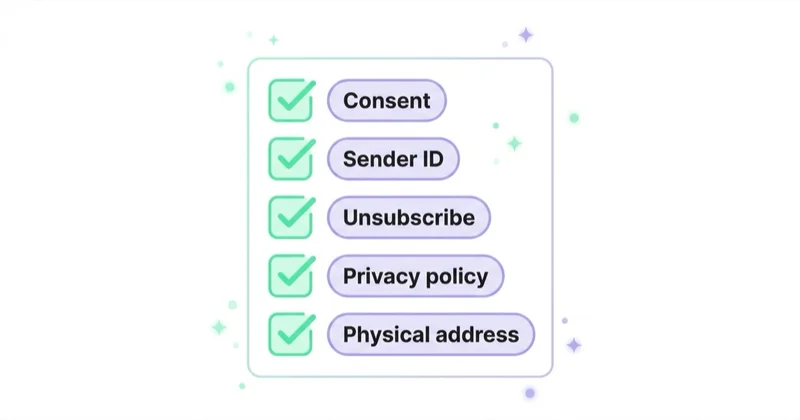
- do not mislead recipients about the sender or subject;
- make marketing intent clear;
- send to people with a valid basis or permission for the type of message;
- keep consent and source records where required;
- include a working unsubscribe mechanism;
- process opt-outs quickly;
- avoid purchased or scraped lists unless the legal and deliverability risks are fully understood;
- separate transactional and marketing purposes carefully;
- keep company identity and contact details clear.
For US campaigns, CAN-SPAM focuses on truthful headers, non-deceptive subject lines, identification of advertising where required, a valid physical postal address and a clear opt-out mechanism. For the UK and many EU-style compliance programs, consent, soft opt-in rules, privacy notices and data protection obligations need closer attention. The safest operational approach is to design for transparency, permission and easy opt-out rather than minimum legal compliance.
Permission and list quality
The list is the asset. Poor acquisition damages the asset.
Good list sources:
- clear newsletter signups;
- gated guides, templates or webinars;
- post-purchase opt-ins;
- account registrations with marketing consent;
- in-store or event signups with documented permission;
- content upgrades that match the page topic;
- referral programs with transparent consent.
Risky list sources:
- purchased databases;
- scraped contacts;
- co-registration lists where the brand relationship is unclear;
- contest-only signups with no real interest;
- pre-checked consent boxes;
- old lists that have not been mailed or refreshed in years.
The goal is not to maximize subscribers at any cost. The goal is to build a list of people who expect the emails and find them useful enough not to ignore, unsubscribe or report spam.
Segmentation and journey stage
Sending the same campaign to everyone is easy, but rarely optimal.
Useful segments include:
| Segment | What matters | Good email approach |
|---|---|---|
| New subscriber | Understanding the brand and promise | Welcome series with value and proof |
| Engaged non-buyer | Confidence and relevance | Education, reviews, use cases, comparisons |
| First-time buyer | Onboarding and second purchase | Post-purchase guidance and product support |
| Repeat customer | Loyalty and lifetime value | Early access, replenishment, VIP content |
| Lapsed customer | Reason to return | Win-back sequence and updated offer |
| Dormant subscriber | Reputation protection | Re-engagement, then suppression |
| B2B lead | Trust, timing and internal buy-in | Nurture sequence, case studies, webinar invites |
Segmentation does not need to be complicated at the start. Even separating buyers from non-buyers, engaged from dormant and B2B leads from e-commerce customers can improve relevance.
What a good email campaign needs
A strong campaign should be planned before writing.
Checklist:
- campaign goal;
- target segment;
- reason the recipient should care now;
- one primary CTA;
- landing page or next step;
- consent and suppression logic;
- subject line and preview text;
- mobile rendering;
- unsubscribe visibility;
- UTM tagging;
- success metric;
- post-send learning.
The message should have one main job. If an email tries to sell five products, promote a blog post, invite to a webinar and ask for a review at the same time, the reader gets no clear direction.
Email content structure
A clear email usually follows a simple structure:
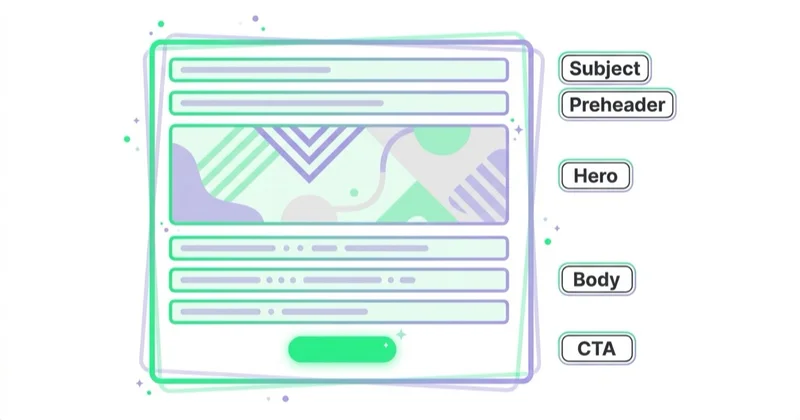
- Recognisable sender and relevant subject line.
- Preview text that extends the promise.
- Opening sentence that confirms why the email matters.
- Short body copy with one main idea.
- Proof, detail or product context where needed.
- Primary CTA.
- Secondary reassurance, such as delivery, returns, privacy, response time or support.
- Footer with company details and unsubscribe.
Long emails can work when the reader needs education, proof or risk reduction. Short emails can work when the offer is already understood. The length should follow the decision, not a universal rule.
For CTA planning, see CTA optimisation. For copy structure, see ad copy that converts.
Subject line, preview text and body
The inbox decides whether the email gets attention. The body decides whether attention becomes action.
Good subject lines are:
- specific;
- honest;
- relevant to the segment;
- short enough for mobile;
- not dependent on fake urgency;
- aligned with the email content.
Preview text should not be wasted on "View this email in browser". It should extend the subject line and explain the benefit.
Good email body structure:
- recognizable sender;
- clear opening promise;
- one main message;
- scannable copy;
- mobile-friendly layout;
- accessible text and buttons;
- visible CTA;
- footer with company details and unsubscribe;
- no image-only design.
Plain text or lightly designed emails often outperform heavy visual templates when trust and clarity matter. For e-commerce launches, strong imagery can help, but the message should still work if images are blocked.
Automations that usually matter most
Email automations create value because they respond to behavior.
Welcome series
A welcome series should confirm the reason for signup, introduce the brand, set expectations and move the subscriber to the next action. For e-commerce, that may be a first purchase. For B2B, it may be reading a case study or booking a consultation.
Abandoned cart or checkout
Abandoned-cart flows should reduce friction. Common angles include delivery information, returns, social proof, product benefits, stock reminders or support availability. Discounts should not be the default first message.
Post-purchase sequence
Post-purchase emails can reduce returns, increase product satisfaction and create the next purchase moment. Good examples include usage tips, care instructions, review requests, cross-sell logic and replenishment reminders.
Re-engagement and sunset
Dormant subscribers damage engagement and can hurt deliverability. A re-engagement sequence gives them a final reason to stay. If there is no response, suppressing them from regular campaigns protects the domain.
B2B nurture
B2B nurture should not be a generic drip campaign. It should map to problem awareness, comparison, internal buy-in and risk reduction. Useful assets include case studies, checklists, ROI logic, implementation explainers and webinar invitations.
E-commerce email marketing
E-commerce email should connect product data, customer behavior and lifecycle stage.
Important flows:
- welcome;
- browse abandonment;
- cart abandonment;
- checkout abandonment;
- post-purchase education;
- review request;
- replenishment;
- price-drop or back-in-stock;
- cross-sell;
- win-back;
- loyalty/VIP.
Good e-commerce emails use more than a discount. They explain fit, size, material, use case, compatibility, delivery, returns and proof. The email should help the customer choose correctly, because lower-quality purchases often create returns, support cost and damaged trust.
Useful ecommerce segmentation examples:
- viewed product but did not add to cart;
- added to cart but did not start checkout;
- started checkout but did not purchase;
- bought once but not again;
- bought a product that needs replenishment;
- high-value customer eligible for early access;
- customer likely to need accessories or support.
The email should match the behaviour. A browse abandonment email can educate. A checkout abandonment email should remove friction. A replenishment email should be timely and practical. A VIP email should not feel like a generic sale blast.
B2B and service email marketing
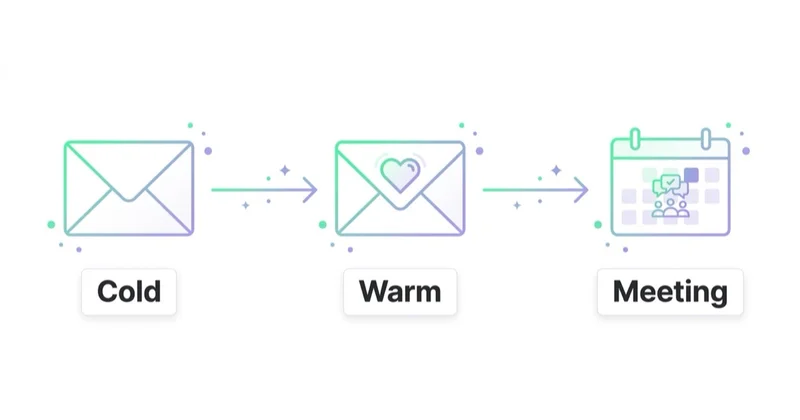
For B2B and services, the goal is often not immediate purchase. Email supports trust and timing.
Useful email types:
- expert newsletter;
- industry commentary;
- educational series;
- case-study sequence;
- webinar invite and follow-up;
- lead-nurturing flow after a download;
- sales follow-up with useful resources;
- reactivation for old opportunities.
The best B2B emails feel like a useful continuation of the buyer's research, not an automated pressure sequence.
B2B email should also respect buying committees. One subscriber may be a researcher, not the final decision-maker. Useful content can help that person explain the problem internally:
- comparison checklists;
- business case templates;
- implementation timelines;
- risk and objection explainers;
- short case studies by industry;
- webinar follow-ups with practical next steps;
- sales emails that include a helpful resource rather than only asking for a meeting.
The conversion may happen weeks or months later. That is why CRM attribution, lead scoring and sales feedback matter more than immediate click volume alone.
Measurement: what to track
Open rate can still be observed, but it should not be the main KPI. Apple Mail Privacy Protection can hide IP addresses and prevent senders from reliably learning whether a message was opened. Other privacy and image-loading behavior can also distort opens.
Better metrics:
- delivered emails;
- bounce rate;
- spam complaint rate;
- unsubscribe rate;
- click-through rate;
- click-to-open rate as a secondary diagnostic;
- conversion rate;
- revenue per recipient or revenue per send;
- lead quality;
- reply rate for B2B;
- automation revenue or assisted revenue;
- list growth by source;
- engagement by segment;
- domain and IP reputation.
Measurement should also distinguish campaign types. A newsletter, abandoned-cart flow and B2B nurture sequence should not be judged by the same benchmark.
Testing email campaigns
Email tests should start with a hypothesis, not a random subject-line tweak.
Useful test areas:
- audience segment;
- offer angle;
- subject line and preview text;
- sender name;
- CTA wording;
- email length;
- product order;
- proof type;
- send time;
- landing page match;
- automation delay;
- discount versus non-discount reassurance.
Avoid over-reading tiny tests. If the list is small, a subject line winner may be noise. For revenue-focused campaigns, a version with fewer clicks but higher order value may be better. For B2B, replies and qualified meetings may matter more than click-through rate.
For conversion planning, see conversion measurement.
Deliverability monitoring checklist
Monitor email health continuously:
- authentication pass rates;
- bounce rate by domain;
- spam complaint rate;
- unsubscribe rate;
- engagement by segment;
- dormant subscriber growth;
- blocklist or reputation warnings;
- Gmail Postmaster Tools where applicable;
- Yahoo sender feedback where available;
- sudden changes after template, ESP or domain changes;
- differences between campaign and automation performance.
Deliverability problems are easier to prevent than repair. Once a domain reputation declines, fixing DNS alone is rarely enough. The list, sending frequency, complaint rate, content relevance and suppression rules all need review.
How we approach this at Space Ads
A newsletter simply pays off for us: there's no charge per open, so revenue from our own list pulls down the average cost of winning a customer. We treat it as a closed loop — paid campaigns fill the list, and the newsletter keeps earning from those people long after the first click, with no further media spend. One email to everyone isn't the move; we segment by behaviour, since a fresh sign-up and a regular customer want different things. And we close the data loop too: who on the list actually bought goes back into the ad systems through offline conversions and customer lists, teaching them what our real buyer looks like. Paid attracts; the newsletter makes that traffic pay back many times over.
Common mistakes
| Mistake | Why it hurts | Better approach |
|---|---|---|
| Buying lists | Legal and deliverability risk | Build opted-in lists |
| No SPF, DKIM or DMARC | Authentication failures and weaker trust | Configure and monitor authentication |
| Obsessing over open rate | Opens are distorted by privacy features | Prioritize clicks, conversions and complaints |
| Sending to dormant users forever | Engagement drops and spam risk rises | Use re-engagement and suppression |
| Image-only email design | Breaks accessibility and image-blocking scenarios | Use real text and accessible buttons |
| Too many CTAs | Reader attention splits | One main goal per email |
| No segmentation | Messages feel irrelevant | Segment by behavior and lifecycle |
| Hard-to-find unsubscribe | Increases spam complaints | Make unsubscribe easy and compliant |
| No UTM tagging | Results disappear in analytics | Tag campaign links consistently |
FAQ
Is email marketing still effective in 2026?
Yes, when it is permission-based, relevant and technically sound. Email remains valuable because it is an owned channel, but inbox providers now punish poor sender behavior more aggressively.
What is the difference between a newsletter and email marketing?
A newsletter is one format inside email marketing. Email marketing also includes campaigns, automations, transactional messages, segmentation, deliverability, testing and reporting.
What should be configured before sending campaigns?
At minimum: SPF, DKIM, DMARC, a reputable ESP, a clear unsubscribe process, suppression lists, UTM tagging and consent records. Bulk senders should also monitor Google Postmaster Tools and complaint rates.
Is open rate still useful?
It can be a secondary signal, but it is not reliable enough as the main KPI. Clicks, conversions, revenue, replies, spam complaints and unsubscribe rates are more useful for decision-making.
How often should newsletters be sent?
Frequency should depend on value and audience expectations. A weekly expert newsletter can work well when it is genuinely useful. A promotion-heavy list may need more segmentation and fewer sends to inactive subscribers.
Can transactional emails include marketing?
Care is required. Transactional emails serve an operational purpose, such as an order confirmation or password reset. Adding promotional content may change how the message should be treated under consent and compliance rules.
What is one-click unsubscribe?
One-click unsubscribe lets recipients unsubscribe without logging in or completing extra steps. Major inbox providers expect subscription messages to support easy unsubscribe, and RFC 8058 defines the List-Unsubscribe-Post mechanism used for one-click handling.
Should purchased email lists be used?
Purchased lists are usually a high-risk tactic. They can create legal, consent, relevance and deliverability problems. Building opted-in lists is slower, but it protects sender reputation and usually produces better long-term results.
What is the best email marketing KPI?
There is no single best KPI for every email. Campaigns may be judged by revenue per recipient, conversions, replies, qualified leads, clicks, retention, churn reduction or support reduction depending on the goal.
Conclusion
Email marketing works when it respects the inbox. Strong campaigns start with permission, deliverability and segmentation before copywriting. The best programs combine useful newsletters, behavior-based automations, clear measurement and clean technical infrastructure.
Sources and further reading
- Google Workspace Admin Help — Email sender guidelines
- Google Workspace Admin Help — Email subscription guidelines for senders
- Yahoo Sender Hub — Sender FAQs
- RFC Editor — RFC 8058: Signaling One-Click Functionality for List Email Headers
- Apple — Mail Privacy Protection and Privacy
- FTC — CAN-SPAM Act Compliance Guide for Business
- ICO — Direct marketing using electronic mail
Continue learning
Continue reading
CRM Marketing Automation: How to Connect Ads, Leads and Sales Follow-Up
CRM marketing automation connects ad campaigns, lead capture, sales stages and follow-up so teams can improve lead quality, response speed, nurture and offline conversion feedback.
Double Opt-In, Unsubscribe and List Hygiene: Keep Your List Healthy
A healthy email list starts with verifiable permission, makes leaving effortless and stops mailing addresses that are no longer valid or engaged. Learn how to implement double opt-in, RFC 8058 one-click unsubscribe, suppression and a defensible sunsetting policy.
Email Marketing Benchmarks: Open, Click and Conversion Rates by Industry
Email benchmarks depend on provider, industry, message type, attribution, and privacy technology. Learn how Apple Mail affects opens, why CTOR and attributed revenue need caveats, and how to build a reliable scorecard.