Performance Max and Standard Shopping can both promote products from Merchant Center, but they are not the same campaign type. Standard Shopping gives more direct control over product groups, bids, exclusions and query analysis. Performance Max uses more automation and can serve across multiple Google channels, not only Shopping surfaces.
For an ecommerce store, the right question is not "which one is better?" The better question is: which campaign type fits the feed quality, budget, margin structure, measurement setup and need for control? In many accounts, both can work together, but only when each one has a clear job.
TL;DR
- Standard Shopping gives more control over product groups, search terms, exclusions and bidding structure.
- Performance Max uses broader automation across Google inventory and optimises toward conversion or conversion value goals.
- Both need a healthy Merchant Center account, clean product feed, reliable conversion value and sensible product segmentation.
- Standard Shopping is often better for query learning, category testing, brand control and high-margin SKU control.
- Performance Max is often better for scaling a clean catalogue when measurement and values are reliable.
- The decision should follow product economics, not only platform recommendations.
The core difference
Standard Shopping is a product campaign where most of the work happens through Merchant Center data, product groups, bids, exclusions and query analysis. Ads are generated from the product feed, but the advertiser keeps more direct control over product structure.
Performance Max is a goal-based campaign type that uses Google AI to optimise across Google channels including Search, Shopping, YouTube, Display, Discover, Gmail and Maps. Google positions Performance Max as a campaign type that complements keyword-based Search campaigns and optimises toward the advertiser's goals, budget, creative assets, audience signals and optional data feeds.
That means PMax can sell products from Merchant Center, but it is not simply a newer version of Shopping. It has a different control model, reporting model and expansion logic.
Comparison table
| Area | Standard Shopping | Performance Max |
|---|---|---|
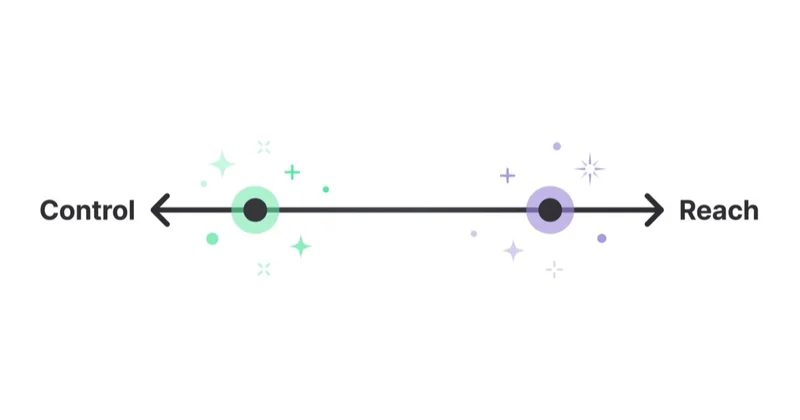
| Main role | product and query control | goal-based scaling across Google inventory |
| Reach | mostly Shopping-related surfaces | Search, Shopping, YouTube, Display, Discover, Gmail, Maps |
| Query control | more visible search-term work and exclusions | more automation, search themes, brand exclusions, negatives |
| Product structure | product groups inside campaigns | asset groups, listing groups and product filters |
| Reporting | clearer product-level reading | broader reporting, but some views are more aggregated |
| Main risk | too manual for large catalogues | scaling weak feed data or low-margin revenue |
| Best use | control, testing and learning | scaling once inputs are clean |
When Standard Shopping is the better starting point
Standard Shopping is useful when the store needs control and clarity. It is especially valuable while the account is still learning which products, terms and categories are profitable.
Use Standard Shopping when:
- a specific category or product group needs a controlled test;
- search-term analysis matters;
- products have very different margins;
- a few SKUs produce most of the profit;
- brand and non-brand need separate evaluation;
- the feed is still being improved;
- the budget is too small to blur signals;
- the team needs more direct exclusions and product structure.
Standard Shopping is also a diagnostic tool. It can show which products get clicks without orders, which queries create waste, whether product titles match demand and whether a category has commercial search volume.
When Performance Max is the better fit
Performance Max makes more sense when the store has clean inputs and wants to scale beyond classic Shopping. PMax needs strong feed data, reliable conversion value, product segmentation, landing pages and creative assets if the campaign is meant to serve broadly.
Use Performance Max when:
- Merchant Center is healthy and products are approved;
- conversion value is reliable;
- the store has enough sales data;
- the catalogue is segmented with custom labels or filters;
- the goal is broader Google reach, not only Shopping coverage;
- the team accepts more automation;
- creative assets are available for non-Shopping inventory;
- Search campaigns have their own role and controls.
PMax should not be a cover for weak feed data. If titles, GTINs, images, prices, availability and margins are messy, automation can scale the problem faster.
When both can work together
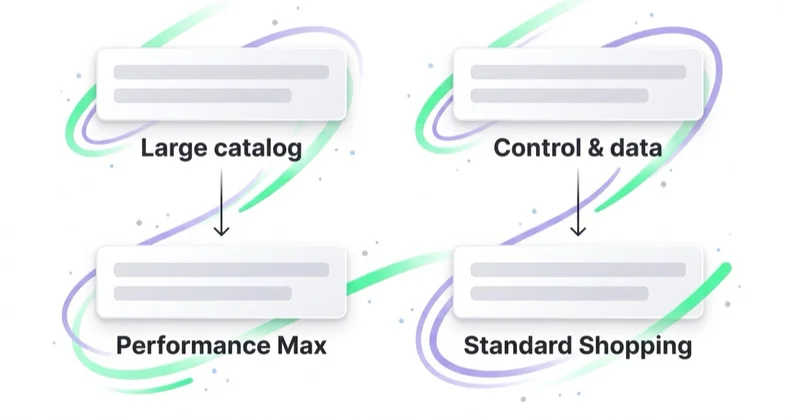
The best structure is often not one or the other. Standard Shopping and Performance Max can sit side by side if they solve different problems.
| Job | Better starting point |
|---|---|
| Testing a new category | Standard Shopping |
| Scaling a clean catalogue | Performance Max |
| Controlling a few high-margin SKUs | Standard Shopping |
| Running broader reach with assets | Performance Max |
| Learning search terms and product titles | Standard Shopping |
| Growing sales across Google channels | Performance Max |
The risk is overlap. If the same products run in several structures with no clear rules, reporting becomes muddy. It becomes hard to know whether growth came from new demand, brand demand, remarketing or shifted delivery between campaigns.
Feed readiness checklist
Before choosing the campaign type, review Merchant Center and the feed:
- disapproved products;
- price and availability;
- titles and descriptions;
- product images;
- GTIN, brand and MPN;
product_type;google_product_category;- custom labels;
- margin and returns;
- product page consistency.
If the feed is not ready, fix the data first. The supporting guides on Merchant Center disapproved products, GTIN and identifier_exists and custom labels in Google Shopping cover those inputs.
How to judge performance
Comparing PMax and Standard Shopping only by ROAS is too shallow. Review:
- how much spend goes to bestsellers;
- whether the campaign scales high-margin products;
- which products receive cost without orders;
- whether brand demand is inflating acquisition results;
- whether PMax is capturing conversions that would have happened anyway;
- how impression share changes;
- which product segments grow;
- what performance looks like after returns.
PMax can look strong in aggregate while pushing low-margin products. Standard Shopping can look slower while giving better query and product learning. The decision needs Google Ads data, ecommerce margin and real sales context.
How we approach it at Space Ads
At Space Ads, we do not choose PMax or Standard Shopping because one is fashionable in the interface. We start with Merchant Center health, feed quality, conversion value, margin, returns, category structure and the role of Search campaigns. Then we decide where control is needed and where automation can support scale.
For ecommerce Google Ads management, we often use Standard Shopping for control and learning, while Performance Max scales segments that have clean inputs. Both connect to product feed optimisation, Merchant Center management, Google Shopping campaigns and Performance Max campaigns.
Common mistakes
| Mistake | Result | Better decision |
|---|---|---|
| Launching PMax on a weak feed | automation scales bad data | fix Merchant Center and feed first |
| One PMax for the whole catalogue | products with different margins share one target | segment by labels and product role |
| Dropping Standard Shopping too early | loss of query and product learning | keep it for tests and control-heavy products |
| Reading only ROAS | good platform metrics may hide weak profit | analyse margin, returns and segments |
| No brand separation | acquisition results look inflated | control brand/non-brand and exclusions |
FAQ
Does Performance Max replace Standard Shopping?
Not always. PMax offers broader automation and inventory, but Standard Shopping remains useful for control, testing and query analysis.
Can Performance Max and Standard Shopping run at the same time?
Yes, but products and objectives need clear separation. Otherwise reporting becomes difficult to interpret.
Which is better for a small ecommerce store?
If budget is limited and the store is still learning demand, Standard Shopping often provides more control. PMax usually makes more sense once feed quality, tracking and sales data are stable.
Can PMax run without creative assets?
Merchant Center feed campaigns can launch without manual creative assets, but Google notes that creative assets help campaigns serve across more surfaces. Feed-only PMax has a different role from a full multi-surface PMax setup.
What should be checked before choosing?
Merchant Center, product feed, conversion value, product segmentation and margins. Campaign type is secondary to data quality.
Key takeaway
Performance Max and Standard Shopping solve different problems. Standard Shopping provides product and query control. Performance Max provides broader automation and reach across Google channels. The right choice depends on data quality, budget, margin, store maturity and the need for control.
If your store needs to decide whether to scale PMax, rebuild Standard Shopping or combine both, our Google Ads team can audit Merchant Center and design a campaign structure around product profitability.
Sources and further reading
Continue reading

Custom Labels in Google Shopping and Performance Max: How to Segment Products
Custom labels let ecommerce teams segment Merchant Center products by margin, season, stock, bestseller status, lifecycle and return risk. Used well, custom_label_0-4 make Shopping, Performance Max and Demand Gen easier to report, filter and optimise by business priority.

Merchant Center Disapproved Products: How to Find and Fix the Cause
Merchant Center disapprovals usually come from a mismatch between the feed, product page, price, availability, identifiers, images, shipping or Google policy requirements. This guide shows how to diagnose the issue, prioritise fixes by business impact and restore Shopping or Performance Max eligibility.
Shopify Google Shopping and Performance Max for DTC: Feed, Margin and Scale
For a Shopify store, Google Shopping performance is decided before the campaign launches: Merchant Center setup, product feed quality, margin-aware conversion values and the right split between Standard Shopping and Performance Max.