4P marketing, also known as the classic marketing mix, is a framework that organises four core strategy levers: Product, Price, Place and Promotion. It helps check whether the offer, pricing, distribution and communication are aligned with the target market.
The model is simple, but still useful. Many marketing problems are blamed on ads even when the real issue is somewhere else: the product does not solve a strong enough problem, the price does not match perceived value, the buying path is inconvenient or the message promises something the offer cannot deliver.
TL;DR
- 4P marketing means Product, Price, Place and Promotion.
- It is a marketing mix framework, commonly associated with E. Jerome McCarthy's 1960s formulation.
- Promotion is only one part of marketing. Ads cannot fix a weak product, wrong price or difficult buying process.
- Product covers the offer itself, including features, quality, packaging, service, experience and proof of value.
- Price covers more than the number on the page. It includes discounts, bundles, payment terms, perceived value and margin.
- Place means distribution and access. In modern marketing, this includes websites, apps, marketplaces, stores, partners and delivery.
- 4P can be extended to 7P when people, process and physical evidence are critical, especially in services, SaaS and B2B.
What 4P marketing is
4P marketing is a practical way to evaluate the foundations of a go-to-market strategy.
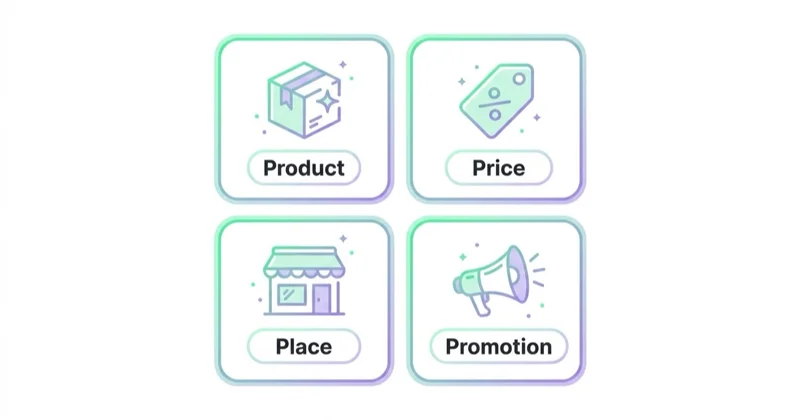
The four Ps are:
- Product: what is being offered and why it matters.
- Price: what the customer pays and what that price signals.
- Place: where and how the customer can access the offer.
- Promotion: how the market finds out, understands and is persuaded.
The model is useful because it prevents a narrow view of marketing. Marketing is not only advertising. It is the combination of offer design, pricing, distribution and communication.
For broader strategy context, read How to Write an Effective Marketing Plan Step by Step.
Why the 4Ps still matter
The 4Ps are old, but the logic is still current.
Digital channels changed how people discover, compare and buy. They did not remove the need for:
- a relevant offer;
- a price that makes sense;
- an easy buying path;
- a clear reason to choose the brand;
- communication that matches the real value.
In fact, digital marketing often exposes weak 4P alignment faster. Paid ads can send traffic immediately, analytics can show drop-offs quickly and users can compare alternatives in seconds. If the offer, price or buying path is weak, promotion will reveal the problem rather than solve it.
Product
Product is the offer itself. It can be physical, digital, service-based, subscription-based or hybrid.
Product analysis should answer:
- What problem does the offer solve?
- Who is it for?
- Which alternatives does the buyer compare it with?
- What makes it meaningfully different?
- What features or benefits matter most?
- What proof supports the value?
- What is included and excluded?
- What experience happens before and after purchase?
- What level of support, onboarding or education is needed?
Product is not only features. A service package, onboarding process, guarantee, documentation, packaging, product photos, installation support and customer success workflow can all be part of the product experience.
Weak product-market fit cannot be solved by better media buying alone. If the offer is not relevant, too complex or poorly differentiated, promotion becomes expensive.
For positioning and audience fit, read Target Audience: How to Define Who Your Customers Are and What Is Blue Ocean Strategy and How to Use It?.
Product questions to ask
Use these questions during a 4P audit:
- Is the offer easy to understand in one sentence?
- Does it solve a painful or valuable problem?
- Is the target audience specific enough?
- Are the strongest benefits visible before the user has to work for them?
- Is there evidence: reviews, case studies, demos, data, photos, examples?
- Are there unnecessary features that create cost but not value?
- Are there missing elements that block purchase?
- Does the product experience match the promotion?
- Are post-purchase expectations clear?
The key is alignment. A premium product needs premium proof, experience and service. A low-cost product needs simplicity, speed and clarity.
Price
Price is both a revenue mechanism and a positioning signal.
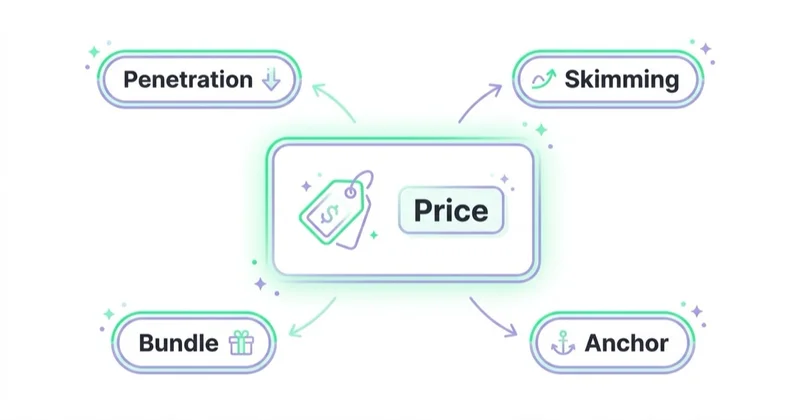
It includes:
- list price;
- discount strategy;
- bundles;
- subscriptions;
- payment terms;
- financing;
- free trials;
- freemium plans;
- delivery cost;
- return cost;
- implementation cost;
- switching cost;
- margin;
- customer acquisition cost;
- lifetime value.
Price communicates quality, risk, accessibility and seriousness. A low price can reduce friction but also reduce perceived value. A high price can improve positioning but demands stronger proof and buyer confidence.
The right price is not just "what competitors charge." It should reflect value, willingness to pay, cost structure, target segment, margin requirements and growth model.
Price questions to ask
- Is pricing clear before the user commits?
- Does the price match perceived value?
- Are discounts strategic or constant?
- Is margin healthy after acquisition cost?
- Does the price support the desired brand position?
- Are bundles or tiers easy to compare?
- Is the buyer paying for what they value?
- Are hidden costs creating friction?
- Does the price work for repeat purchase or retention?
In ecommerce, price also includes delivery thresholds, free shipping rules, promo codes, returns and marketplace comparison. In B2B, price may include implementation, onboarding, support, contract length and procurement risk.
Place
Place means distribution: where and how customers can buy, access or experience the offer.
In modern marketing, place can include:
- ecommerce store;
- service website;
- app;
- marketplace;
- physical store;
- reseller;
- distributor;
- partner channel;
- social commerce;
- call centre;
- sales team;
- demo booking flow;
- delivery and pickup options;
- country or language availability.
Place is often underestimated. A strong offer can fail when the buying path is difficult, the product is unavailable, checkout is confusing, delivery is too slow or the user has to switch channels at the wrong moment.
For online businesses, place includes the entire digital environment where the user acts: landing page, checkout, forms, calendar, payment method, account creation, confirmation emails and post-purchase access.
Place questions to ask
- Can the customer buy or contact easily?
- Is the buying path clear on mobile?
- Are preferred payment methods available?
- Are delivery, returns and timing visible?
- Are marketplaces or partners needed?
- Is the offer available where the audience already shops?
- Are sales and marketing channels aligned?
- Does the website match the promise from ads?
- Are international users blocked by language, currency or delivery?
Place is not only logistics. It is access.
Promotion
Promotion covers communication and demand generation.
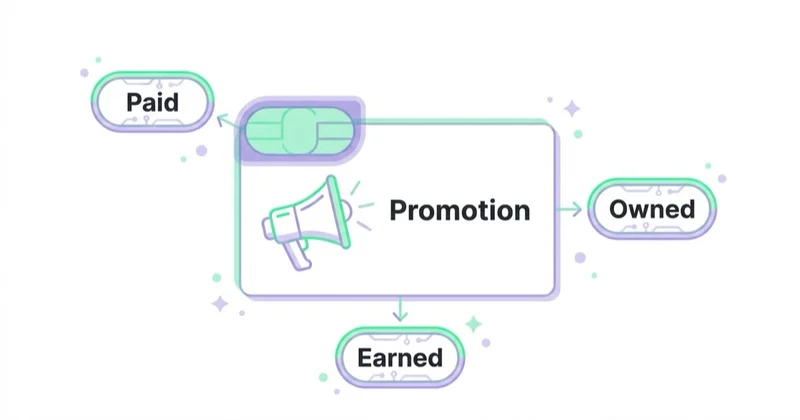
It can include:
- SEO;
- Google Ads;
- Meta Ads;
- TikTok Ads;
- LinkedIn Ads;
- YouTube;
- email marketing;
- content marketing;
- social media;
- influencer marketing;
- PR;
- affiliate marketing;
- events;
- webinars;
- sales enablement;
- promotions and discounts.
Promotion should explain the product, support the price and guide users to the right place. It should not operate as an isolated activity.
If the product is premium, promotion should show proof and value. If the product is simple and low-cost, promotion should reduce friction. If the buying cycle is long, promotion should educate and nurture. If the offer is urgent, promotion should make action clear.
For channel selection, read What Is Internet Marketing and What Do You Need to Know? and Effective Online Advertising: Which Type of Advertising Works Best?.
Promotion questions to ask
- Which audience is the promotion trying to reach?
- Is the message based on the real product value?
- Does it match the buyer's stage?
- Is there enough proof?
- Is the CTA clear?
- Are channels selected by intent, not habit?
- Are brand and performance activity measured differently?
- Are campaigns connected to landing pages?
- Is retention communication planned?
- Are results evaluated by business outcomes, not only clicks?
Promotion is the visible part of marketing, but it depends on the invisible parts. A campaign can amplify a strong marketing mix. It can also expose a weak one.
How the 4Ps work together
The 4Ps should not be analysed separately for too long. A change in one element usually affects the others.
Examples:
- Raising price may require stronger proof, better onboarding or different sales communication.
- Moving from direct sales to marketplace changes price pressure, reviews, margins and promotion.
- Launching a premium version changes product, pricing, distribution and messaging.
- Introducing a subscription changes retention, email marketing, support and reporting.
- Expanding internationally changes language, delivery, currency, compliance and customer support.
The framework becomes useful when it reveals misalignment.
4P marketing in digital channels
Digital marketing adds more touchpoints, but the 4Ps still apply.
| 4P element | Digital interpretation |
|---|---|
| Product | Website experience, service package, SaaS feature set, product page, proof, onboarding |
| Price | Pricing page, discounts, subscription tiers, shipping, free trial, payment methods |
| Place | Website, marketplace, app, social shop, booking flow, checkout, delivery |
| Promotion | SEO, paid media, social, email, content, remarketing, creators |
Digital analytics can help diagnose the 4Ps:
- high ad CTR but low conversion may indicate product or landing page mismatch;
- strong add-to-cart but weak purchase may indicate price, delivery or checkout issue;
- strong organic traffic but weak leads may indicate poor offer or CTA;
- high sales but low profit may indicate pricing or discount problem;
- strong demand but low stock may indicate place and operations issue.
For measurement context, read What Is Conversion Rate and How to Increase It?.
4P marketing in ecommerce
In ecommerce, 4P can be used to audit the store beyond ad performance.
| Element | Ecommerce questions |
|---|---|
| Product | Are product photos, descriptions, variants and reviews strong enough? |
| Price | Is price competitive, profitable and clear after shipping and discounts? |
| Place | Is the store fast, mobile-friendly and easy to buy from? |
| Promotion | Are SEO, Shopping, PMax, Meta, email and remarketing aligned? |
Common ecommerce examples:
- Ads perform poorly because product pages do not show delivery cost clearly.
- Shopping campaigns spend on low-margin products because custom labels are missing.
- Meta ads generate interest but the mobile product page is slow.
- Discounts increase revenue but destroy margin.
- SEO traffic grows but category filters and product sorting are weak.
In ecommerce, marketing mix work should include merchandising, feed quality, product content, checkout, delivery and retention.
4P marketing in services, B2B and SaaS
For services, B2B and SaaS, 4P is still useful but often needs to be extended.
Examples:
- Product: service scope, methodology, onboarding, support, implementation, integrations.
- Price: project fee, retainer, subscription, usage pricing, enterprise quote, setup fee.
- Place: website, demo call, sales process, partner channel, app store, implementation workflow.
- Promotion: content, SEO, LinkedIn, webinars, paid search, case studies, email nurture.
In service businesses, people and process often matter so much that 7P becomes more appropriate. For that extension, read What Is the 7Ps Marketing Mix?.
4P vs 7P
4P is a strong starting point. 7P adds:
- People;
- Process;
- Physical Evidence.
Use 7P when:
- trust depends heavily on the team;
- delivery quality depends on process;
- the offer is intangible;
- proof and credibility are essential;
- onboarding and support shape the product experience;
- the buying cycle is complex.
Use 4P when a simpler audit is enough or when the first goal is to check offer, price, distribution and promotion alignment.
4P audit: step-by-step
1. Define the audience and objective
Start with the buyer and business goal. The same product can need a different mix for enterprise buyers, small businesses, students, parents, developers or procurement teams.
2. Map the current 4Ps
Write the current product, price, place and promotion as they exist today. Avoid idealised descriptions. Use what the customer actually sees.
3. Compare with customer needs
Check whether each P supports the customer's decision:
- Does the product solve the right problem?
- Does the price match value and budget?
- Is the buying path convenient?
- Does promotion answer the right objections?
4. Compare with alternatives
The competitor is not always a direct competitor. It can be a spreadsheet, manual process, marketplace, freelancer, internal team, old supplier or doing nothing.
5. Find the constraint
Identify the element that most limits growth.
Examples:
- promotion is good but product proof is weak;
- traffic is strong but price creates drop-off;
- demand exists but distribution is inconvenient;
- product is strong but promotion targets the wrong stage.
6. Prioritise changes
Not every issue can be fixed at once. Choose the change with the strongest business impact and lowest unnecessary complexity.
Common mistakes
| Mistake | Why it hurts | Better approach |
|---|---|---|
| Treating promotion as all of marketing | Ads get blamed for product, price or place problems | Audit all 4Ps |
| Copying competitor prices | Ignores value, costs and positioning | Price by value, margin and strategy |
| Ignoring distribution friction | Buyers cannot act easily | Improve access and buying path |
| Overloading the product | Complexity rises without value | Remove what users do not value |
| Running campaigns before fixing offer clarity | Traffic exposes confusion | Clarify product and proof first |
| Using one message for all segments | Different buyers value different things | Segment audience and intent |
| Forgetting retention | Marketing ends at purchase | Add lifecycle and post-purchase work |
How we approach this at Space Ads
At Space Ads, we use the 4P framework to separate advertising problems from business model and offer problems. Before we recommend more traffic, we check whether the product promise is clear, whether pricing supports margin and perceived value, whether the buying path removes friction and whether promotion answers the right objections for each audience. In ecommerce, that means connecting ads with product pages, feed data, availability, delivery, returns and margin. In B2B or services, it means linking campaigns with proof, sales process, qualification criteria and post-lead outcomes. The goal is not to fill a template; it is to identify which part of the mix is limiting growth and what should change first.
FAQ
What are the 4 Ps of marketing?
The 4 Ps are Product, Price, Place and Promotion. Together they form the classic marketing mix framework.
Who created the 4P marketing mix?
The 4P formulation is commonly associated with E. Jerome McCarthy, who organised the marketing mix into Product, Price, Place and Promotion in the 1960s.
Is 4P marketing still relevant?
Yes. The model is still useful because every business needs alignment between offer, price, distribution and communication. Digital channels changed the tools, not the underlying need for alignment.
Is promotion the same as marketing?
No. Promotion is only one part of marketing. Marketing also includes product decisions, pricing, distribution, positioning, research, customer experience and retention.
What is the difference between 4P and 7P?
7P extends the classic 4Ps with People, Process and Physical Evidence. It is especially useful for services, SaaS, B2B and other businesses where trust and delivery process strongly influence buying decisions.
Can 4P be used for ecommerce?
Yes. Product means assortment and product pages, Price means pricing and margin, Place means store, marketplace and delivery, and Promotion means SEO, ads, email, social and remarketing.
How often should a 4P audit be done?
Review the marketing mix whenever performance changes, a new product launches, pricing changes, a new market opens or campaigns underperform despite enough traffic and clean measurement.
Conclusion
4P marketing is useful because it keeps strategy grounded. It reminds teams that promotion is not the whole job. A campaign can bring attention, but the product, price and buying path decide whether that attention becomes business value.
The best use of 4P is diagnostic. When growth slows or campaigns underperform, map Product, Price, Place and Promotion together. Look for misalignment, not only weak ads.
In modern marketing, the model works best when combined with audience research, positioning, analytics and customer experience. The tools have changed, but the basic question remains the same: is the offer, price, access and communication aligned with what the customer actually values?
Sources and further reading
- Britannica Money: Marketing and the marketing mix
- Britannica Money: Price, place and promotion in marketing
- CUNY Pressbooks: The 4 Ps - Product, Price, Promotion and Place
- Coursera: The 4 Ps of Marketing
- Southern New Hampshire University: The Four Ps of Marketing
Continue learning
- What Is the 7Ps Marketing Mix?
- How to Write an Effective Marketing Plan Step by Step
- Target Audience: How to Define Who Your Customers Are
- What Is Blue Ocean Strategy and How to Use It?
- What Is Internet Marketing and What Do You Need to Know?
- What Is Brand Marketing and How to Use It?
- How to Plan a Marketing Budget for Effective Digital Marketing
Continue reading
What Is the 7Ps Marketing Mix?
The 7Ps marketing mix expands the classic 4Ps with People, Process and Physical Evidence. Learn how to use it to audit offer, price, channels, trust and customer experience.
How to Write an Effective Marketing Plan Step by Step
A marketing plan connects goals, audience, value proposition, channels, budget, timeline and KPIs. Learn how to write a practical plan that guides weekly decisions.
What Is Blue Ocean Strategy and How to Use It?
Blue Ocean Strategy helps businesses create new market space instead of competing only on price and similar features. Learn value innovation, Strategy Canvas, ERRC Grid and practical examples.