Blue Ocean Strategy is a business strategy framework for creating new market space instead of competing only on the same factors as everyone else. It was developed by W. Chan Kim and Renee Mauborgne and is built around the idea of value innovation: increasing buyer value while changing the cost or complexity structure of the business.
A blue ocean is not just a niche, a slogan or a product with one unusual feature. It is a different value curve. The goal is to make direct competition less important by changing what buyers compare, what they value and what they no longer need to accept as a trade-off.
TL;DR
- Blue Ocean Strategy focuses on creating new demand instead of fighting only in crowded markets.
- A red ocean is an existing competitive space, where companies fight over similar buyers, features, prices and distribution.
- A blue ocean is a new value space, where the offer changes the basis of competition.
- Value innovation is the core idea. The business should increase buyer value and reduce unnecessary cost or complexity.
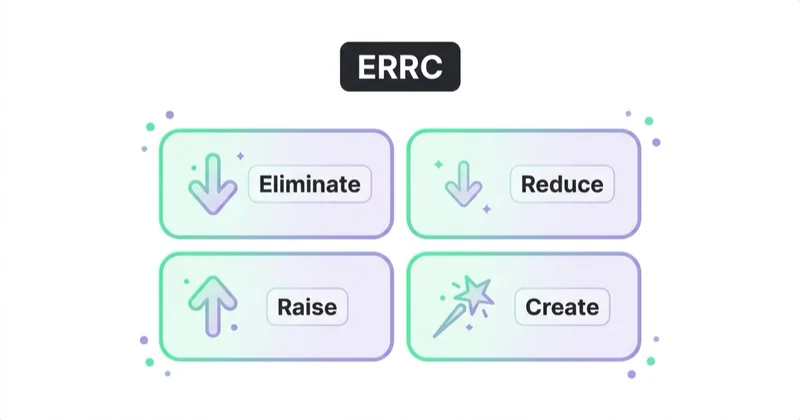
- The four actions are eliminate, reduce, raise and create. They are often used in the ERRC Grid.
- Strategy Canvas helps visualise how the offer differs from the industry standard.
- The framework works for products, services, SaaS, B2B, ecommerce and content businesses, but only when tested against real customer demand.
What Blue Ocean Strategy means
Blue Ocean Strategy is a way of thinking about competition. Instead of asking "how can the business beat competitors on the same battlefield?", it asks "how can the business change the battlefield?"
The framework contrasts two market types:
- Red oceans: known markets with existing rules, clear competitors and crowded comparison points.
- Blue oceans: new or reconstructed market spaces where demand can be created or unlocked.
This does not mean competition disappears forever. It means the company creates a value proposition that is not judged only by the old category rules.
For example, a business may stop competing on the number of features and instead compete on simplicity, speed, trust, convenience, transparency, education, personalisation, community or a new pricing model.
Red ocean vs blue ocean
| Area | Red ocean | Blue ocean |
|---|---|---|
| Market space | Existing and crowded | New, reconstructed or underserved |
| Competitive logic | Beat competitors | Make direct comparison less important |
| Buyer focus | Existing buyers | Existing buyers plus non-customers |
| Price pressure | Often high | Can be reduced if value is redefined |
| Offer design | Similar factors, more or less of each | Different value curve |
| Growth source | Share capture | New demand creation |
| Main risk | Commoditisation | Misreading demand or overbuilding |
Most markets contain both red and blue areas. A company may compete in a red ocean in one segment and create a blue ocean in another. The framework is not an ideology against competition. It is a tool for escaping unnecessary sameness.
Value innovation
Value innovation is the central concept of Blue Ocean Strategy.
The idea is to avoid the traditional choice between:
- differentiation that increases cost too much;
- low cost that reduces buyer value too much.
Instead, the business looks for a configuration that raises what matters, creates new value and removes elements that no longer justify their cost.
This is the most important part: blue ocean thinking is not "add more features." Many weak strategies fail because they keep raising and creating without eliminating or reducing anything. That increases complexity, cost and operational burden.
Strong value innovation asks:
- Which factors do buyers no longer value enough?
- Which category assumptions exist only because competitors copy each other?
- Which underserved buyers avoid the category because it is too complex, expensive or inconvenient?
- Which friction points can be removed?
- Which new benefits could change the comparison set?
- Which costs can be removed because they do not support the new value proposition?
Strategy Canvas
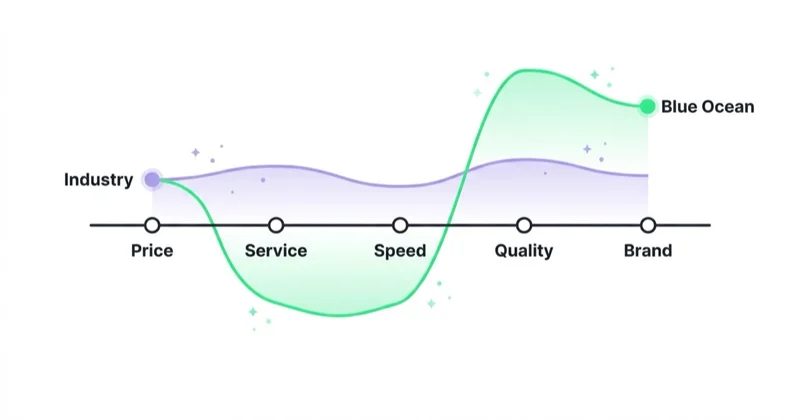
Strategy Canvas is a core Blue Ocean Strategy tool. It visualises the factors on which an industry competes and how different offers perform across those factors.
A simple process:
- List the factors customers use to compare offers.
- Score the main competitors across those factors.
- Score the current business across the same factors.
- Draw the value curves.
- Look for sameness, overinvestment and ignored buyer needs.
- Design a different value curve using eliminate, reduce, raise and create.
Example factors could include:
- price;
- speed;
- number of features;
- support quality;
- onboarding effort;
- delivery time;
- risk reduction;
- expertise;
- customisation;
- convenience;
- transparency;
- community;
- education;
- integration with other tools.
The value of the canvas is not the drawing. The value is the conversation it forces: what is the category really competing on, and which of those factors actually matter to buyers?
ERRC Grid: eliminate, reduce, raise, create
The ERRC Grid turns blue ocean thinking into decisions.
| Action | Question | Purpose |
|---|---|---|
| Eliminate | Which factors should be removed because the industry takes them for granted? | Cut waste and old assumptions |
| Reduce | Which factors should be reduced below the industry standard? | Lower cost or complexity |
| Raise | Which factors should be raised above the industry standard? | Increase value where buyers care |
| Create | Which factors should be created that the industry has not offered? | Unlock new demand |
The order matters. Many teams start with create because it feels innovative. Better work starts with eliminate and reduce. Removing unvalued complexity creates space to raise and create without turning the offer into a costly collection of extras.
How to use Blue Ocean Strategy step by step
1. Define the current category
Start with the market as buyers see it, not as the company describes itself.
Ask:
- What alternatives does the buyer compare?
- What language do buyers use?
- Which competitors appear in search, ads and sales conversations?
- Which problem is the buyer really trying to solve?
- What happens if the buyer does nothing?
A blue ocean cannot be designed without understanding the current red ocean.
2. Map the competitive factors
List the factors that define the category today.
For a marketing agency, those factors might include price, media buying expertise, reporting, creative production, account management, speed, channel coverage, transparency, senior involvement and strategic advice.
For a SaaS product, factors might include feature depth, integrations, onboarding time, support, security, pricing model, automation, reporting and enterprise controls.
The goal is to see where everyone competes in the same way.
3. Study non-customers
Blue Ocean Strategy pays close attention to non-customers. These are people or companies that could benefit from the category but do not buy, buy rarely or choose alternatives.
Non-customers may avoid the category because:
- it is too expensive;
- it is too complex;
- it requires too much time;
- it feels risky;
- it lacks trust;
- it is overbuilt;
- it is under-supported;
- it does not fit their workflow;
- the buying process is unclear.
Non-customers often reveal blue ocean opportunities better than satisfied customers do. Existing customers usually explain how to improve the current category. Non-customers explain why the category is unattractive.
4. Build the ERRC Grid
Use four columns: eliminate, reduce, raise and create.
Do not write vague statements such as "improve quality" or "be more innovative." Make concrete choices:
- eliminate long onboarding calls for simple plans;
- reduce the number of confusing packages;
- raise transparency in pricing;
- create a guided self-assessment before purchase.
If a choice cannot be translated into product, service, pricing, content, operations or distribution, it is probably not specific enough.
5. Design the new value curve
After ERRC, sketch the new value curve. The offer should look meaningfully different from the current competitive average.
Good signs:
- some factors are clearly lower;
- some factors are clearly higher;
- at least one factor is newly created;
- the offer can be explained in simple language;
- the target buyer understands the trade-off;
- costs do not rise everywhere at once.
If everything is raised, the strategy is probably expensive differentiation, not value innovation.
6. Test demand before scaling
Blue ocean ideas still need market validation.
Useful tests:
- customer interviews;
- non-customer interviews;
- landing page test;
- paid search test;
- paid social creative test;
- prototype or concierge version;
- waitlist or pre-order;
- sales outreach;
- content cluster around the new problem framing;
- pricing conversation with real prospects.
Do not rely only on internal workshops. A strategy that looks elegant in a slide deck can fail when buyers do not understand it or do not want to pay for it.
Blue Ocean Strategy in marketing
In marketing, blue ocean thinking is useful when a brand is trapped in comparison.
Symptoms:
- competitors use similar claims;
- ads compete mostly on discount;
- SEO pages target the same generic keywords;
- sales teams answer the same objections every week;
- buyers see the offer as interchangeable;
- the brand cannot explain why it deserves attention.
Possible moves:
- narrow the audience more sharply;
- create a new buying criterion;
- simplify pricing;
- turn expertise into a productised process;
- build education that competitors do not provide;
- remove confusing options;
- combine service with software or templates;
- introduce a diagnostic tool;
- build a community around the problem;
- change the sales process to reduce risk.
Blue ocean marketing is not only messaging. The offer itself must change. Communication can reveal the new value curve, but it cannot fake one.
For planning foundations, read How to Write an Effective Marketing Plan Step by Step and Target Audience: How to Define Who Your Customers Are.
Blue Ocean Strategy for services and B2B
Service businesses often compete in red oceans: similar promises, similar case studies, similar pricing models and similar discovery calls.
Blue ocean opportunities may come from:
- productising a service;
- specialising in one industry;
- reducing project uncertainty;
- publishing a clear methodology;
- offering faster time to value;
- replacing custom proposals with transparent packages;
- adding implementation support competitors ignore;
- creating a diagnostic before the sales call;
- integrating advisory work with execution;
- serving a non-customer group that agencies usually ignore.
Example: instead of being another general performance marketing agency, a company might become the paid media partner for B2B SaaS firms with long sales cycles, CRM-based revenue tracking and strict lead-quality reporting. That narrows the market but changes the value curve.
Blue Ocean Strategy for ecommerce
Ecommerce should not be the only lens for this topic, but it is a useful application.
Online stores often compete on:
- price;
- delivery speed;
- product range;
- discounts;
- free returns;
- marketplaces;
- paid traffic scale.
Blue ocean moves may include:
- curated product selection instead of endless choice;
- expert product advice;
- subscription for repeat purchases;
- category education;
- quiz-based selection;
- try-before-you-buy model;
- repair, refill or circular model;
- B2B purchasing workflow in a narrow category;
- local availability;
- premium post-purchase support;
- bundles based on use cases, not product taxonomy.
The ecommerce risk is copying marketplace logic. A smaller store rarely wins by being a weaker marketplace. It has a better chance by owning a problem, audience, category experience or trust layer.
For ecommerce planning, read How to Start an Online Store and What You Need to Know and How to Audit an Ecommerce Store.
Blue ocean vs niche positioning
Blue Ocean Strategy and niche positioning overlap, but they are not identical.
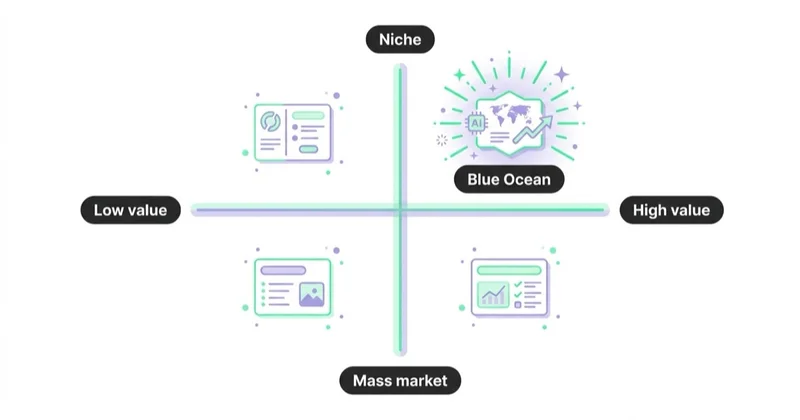
| Concept | Meaning |
|---|---|
| Niche positioning | Focus on a narrower audience or problem |
| Blue Ocean Strategy | Change the value curve and create new demand |
A niche can still be a red ocean if every competitor sells the same thing to the same narrow audience. A blue ocean can start with a niche, but it needs a different value proposition, not only a smaller target group.
Strong positioning answers:
- who the offer is for;
- what problem it solves;
- what alternative it replaces;
- why the value curve is different;
- what trade-offs the company deliberately makes.
How we approach this at Space Ads
We see the red ocean in advertising every day: everyone bidding on the same words and the same audiences, so rates rise and results shrink. The cheapest growth rarely comes from outbidding the competition — more often from a different angle, offer, or an underrated segment nobody is betting on. So before we add budget in a crowded space, we look for a cheaper ocean: an angle of messaging, an audience, or a product use where the same budget buys far more because there's no fight over it. That usually returns better than another bid increase on a phrase everyone is hammering. Advertising won't invent the brand's differentiation for it — but it can quickly test whether a given blue ocean really exists before you invest in it seriously.
Common mistakes
| Mistake | Why it fails | Better approach |
|---|---|---|
| Treating blue ocean as "no competition" | Competition usually appears if the opportunity is valuable | Build a defensible value curve |
| Adding features without removing anything | Costs and complexity rise | Use eliminate and reduce first |
| Confusing a slogan with strategy | Buyers still compare the same things | Change the offer, not only the words |
| Ignoring non-customers | The team only improves the current category | Study people who do not buy |
| Choosing a tiny market with no demand | The idea is different but not viable | Test willingness to pay |
| Copying famous examples literally | Context differs | Use the framework, not the story |
| Forgetting execution | Strategy stays theoretical | Turn ERRC into product, pricing and operations changes |
Practical checklist
Use this checklist before committing to a blue ocean move:
- Is the current red ocean clearly mapped?
- Are the main comparison factors known?
- Have non-customers been interviewed?
- Does the ERRC Grid include real eliminate and reduce choices?
- Does the new value curve look different?
- Can the buyer understand the new category or offer quickly?
- Does the business model support the promise?
- Have costs been considered?
- Has demand been tested with real buyers?
- Is the positioning specific enough for marketing and sales?
- Can the company defend the move after competitors notice?
FAQ
Who created Blue Ocean Strategy?
Blue Ocean Strategy was developed by W. Chan Kim and Renee Mauborgne. The framework is associated with their book "Blue Ocean Strategy" and related tools such as Strategy Canvas, Four Actions Framework and ERRC Grid.
What is the difference between red ocean and blue ocean strategy?
Red ocean strategy competes in an existing market according to established rules. Blue ocean strategy tries to create or reconstruct market space so the offer is judged by a different value curve.
What is value innovation?
Value innovation means increasing buyer value while reducing unnecessary cost, complexity or trade-offs. It is the central idea behind Blue Ocean Strategy.
What are the four actions in Blue Ocean Strategy?
The four actions are eliminate, reduce, raise and create. They help teams decide what to remove, simplify, strengthen and introduce in order to build a different value curve.
Does Blue Ocean Strategy work for small businesses?
Yes, but it must be practical. A small business can use it to specialise, simplify an offer, serve ignored customers or create a clearer buying experience. It still needs demand validation.
Is Blue Ocean Strategy the same as innovation?
No. Innovation can be technological, operational, commercial or experiential. Blue Ocean Strategy focuses specifically on value innovation and market creation, not invention for its own sake.
Can competitors copy a blue ocean move?
Yes. That is why execution, brand, data, distribution, community, switching costs, expertise and continuous improvement matter. A blue ocean is rarely permanently empty.
Conclusion
Blue Ocean Strategy is useful because it forces a business to question the rules of its category. Instead of competing only on price, features and the same marketing claims, it encourages a different value curve.
The strongest work comes from combining Strategy Canvas, non-customer research and the ERRC Grid. Eliminate what buyers do not value, reduce what is overbuilt, raise what matters and create something that changes the decision.
The framework should end in real choices: product changes, pricing changes, service design, positioning, content strategy, sales process and operational trade-offs. A blue ocean is not found by naming it. It is built by designing a value proposition that buyers can understand, want and pay for.
Sources and further reading
- Blue Ocean Strategy: What is Blue Ocean Strategy?
- Blue Ocean Strategy: Strategy Canvas
- Blue Ocean Strategy: Four Actions Framework
- Blue Ocean Strategy: ERRC Grid
- Blue Ocean Strategy: ERRC Grid template and examples
- Britannica Money: Blue Ocean Strategy explained
Continue learning
- How to Write an Effective Marketing Plan Step by Step
- Target Audience: How to Define Who Your Customers Are
- What Is Brand Marketing and How to Use It?
- What Is Digital Marketing and Why Is It Important?
- What Is the 7Ps Marketing Mix?
- How to Plan a Marketing Budget for Effective Digital Marketing
- Effective Online Advertising: Which Type of Advertising Works Best?
Continue reading
What Is Brand Marketing and How to Use It?
Brand marketing builds recognition, trust, memory and preference so a company is easier to choose when buyers enter the market.
What Is the 7Ps Marketing Mix?
The 7Ps marketing mix expands the classic 4Ps with People, Process and Physical Evidence. Learn how to use it to audit offer, price, channels, trust and customer experience.
How to Write an Effective Marketing Plan Step by Step
A marketing plan connects goals, audience, value proposition, channels, budget, timeline and KPIs. Learn how to write a practical plan that guides weekly decisions.