Benefit-led copywriting explains what a product, service or feature changes for the customer. Instead of listing only technical details, it translates those details into practical value: saved time, lower risk, easier work, better control, faster decisions, more comfort, higher confidence or a clearer outcome.
This is not a manipulation trick. Used well, benefit-led copy helps people understand why an offer matters and how it compares with alternatives. Used badly, it becomes vague hype. The difference is specificity and proof.
TL;DR
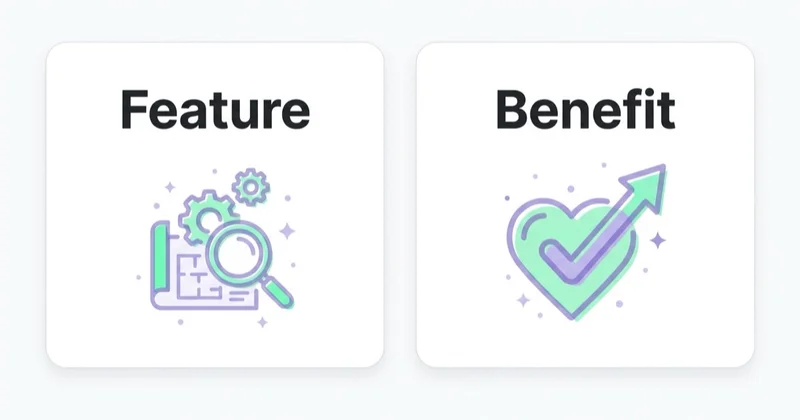
- A feature says what something is. A benefit explains why it matters.
- The simplest structure is feature -> advantage -> benefit.
- Benefit-led copy should be specific, credible and tied to a real customer problem.
- Strong benefits are supported by proof: examples, reviews, data, process, demo, warranty or case study.
- It works in ads, landing pages, product descriptions, category copy, email, sales decks and CTAs.
- B2B benefits often focus on risk, time, cost, control, compliance and decision quality.
- Ecommerce benefits often focus on use case, fit, comfort, delivery, trust, returns and product confidence.
- Benefits should not overpromise. The real experience after the click must support the claim.
What is benefit-led copywriting?
Benefit-led copywriting is writing that translates features into customer value.
It answers:
- What does this feature enable?
- What problem does it reduce?
- What outcome does it support?
- What risk does it lower?
- What decision does it make easier?
- What changes for the customer?
- Why should the reader care now?
Example:
| Feature-only copy | Benefit-led copy |
|---|---|
| Advanced reporting dashboard | See cost, revenue and margin in one place before budget decisions |
| Waterproof membrane | Keep feet dry on wet trails and reduce discomfort during long walks |
| Server-side tracking | Send more reliable conversion signals when browser-only tracking is limited |
| Guest checkout | Let mobile buyers complete the order without creating an account first |
| CRM integration | Give sales the campaign source before follow-up starts |
The stronger version explains practical meaning. It does not force the reader to guess why the feature matters.
Feature, advantage, benefit and outcome
The easiest framework has four levels.
| Level | Question | Example |
|---|---|---|
| Feature | What is it? | The shoes have a waterproof membrane |
| Advantage | What does it do? | It helps block moisture |
| Benefit | Why does that matter? | Walking in rain is more comfortable and less distracting |
| Outcome | What larger goal does it support? | A full-day route is easier to finish without wet feet |
Many ads and product pages stop at the first level. That forces the reader to do the mental work. Benefit-led copy completes the connection.
The outcome level is useful when the offer is complex or expensive. In B2B, a feature may support a department-level outcome. In ecommerce, a feature may support confidence, comfort, fit or lower purchase risk.
Why benefits improve conversion
People rarely buy because a feature exists. They buy because the feature helps them achieve something or avoid something.
Benefits can improve conversion because they:
- reduce confusion;
- make value easier to compare;
- connect the offer to a problem;
- support faster decision-making;
- make technical features understandable;
- reduce perceived risk;
- help different audience segments see relevance;
- create stronger ad and landing page alignment;
- make CTAs and product descriptions more useful.
For broader conversion work, read What Is Conversion Rate Optimization (CRO) and How Does It Increase Sales?.
Benefit-led copy is not hype
Weak copy often sounds positive but says little.
Examples:
- innovative solution;
- highest quality;
- professional service;
- modern platform;
- best-in-class performance;
- customer-first approach.
These phrases are not automatically wrong, but they need proof and specificity. "Professional service" becomes stronger when the copy explains the process, response time, owner, guarantee or experience behind it.
The test is simple: if a competitor could copy the sentence without changing anything, it is probably too generic.
How to write benefit-led copy
1. Start with the customer problem
Benefits should come from real pain points or goals.
Ask:
- What is frustrating?
- What is slow?
- What is risky?
- What is expensive?
- What is unclear?
- What decision is hard?
- What would make the process easier?
- What would make the purchase feel safer?
Benefit-led copy starts with the customer's world, not the company's internal feature list.
2. Translate features into outcomes
For every important feature, ask "so what?" until the practical value is clear.
| Feature | So what? | Benefit |
|---|---|---|
| Real-time stock updates | Customers see availability before checkout | Fewer cancelled orders and less frustration |
| CRM integration | Leads go directly to sales | Faster follow-up and cleaner source tracking |
| Product filter by material | Shoppers narrow choices quickly | Easier product discovery on mobile |
| Offline conversion import | Google Ads sees qualified leads | Bidding can optimize toward better lead quality |
| Clear return policy | Buyers understand risk before ordering | More confidence before checkout |
The benefit is the business or user result, not the internal capability.
3. Be specific
Specificity makes copy more believable.
| Vague | More specific |
|---|---|
| Save time | Build weekly reports without copying data manually |
| Better quality | Tested stitching, reinforced sole and 2-year warranty |
| Improve campaigns | Find search terms, tracking gaps and landing pages wasting spend |
| Easy checkout | Pay with saved wallet and skip account creation |
| Better support | Every ticket has an owner and response window |
Specific does not always mean numeric. It means concrete enough to understand.
4. Add proof
Benefits are stronger when supported.
Proof can include:
- review;
- customer quote;
- case study;
- product demo;
- screenshot;
- sourced benchmark;
- certification;
- guarantee;
- return policy;
- process detail;
- before-and-after;
- comparison;
- expert explanation.
If the copy says "faster", show what makes it faster. If it says "safer", show the security, process or policy. If it says "better for teams", show the workflow improvement.
5. Match the funnel stage
Benefits should change by stage.
| Stage | Better benefit focus |
|---|---|
| Awareness | problem clarity, education, why it matters |
| Consideration | comparison, proof, risk reduction |
| Decision | offer, pricing, guarantee, delivery, next step |
| Retention | support, onboarding, repeat value, loyalty |
Cold audiences may need context. High-intent buyers may need proof and action.
Benefit-led copy in ads
Ads have little space, so benefits must be fast to understand.
A simple structure:
- Name the problem or intent.
- State the useful outcome.
- Add proof or specificity.
- Give a clear CTA.
Example:
| Element | Example |
|---|---|
| Problem | Google Ads spend is rising but lead quality is weak |
| Benefit | Find which queries, forms and landing pages waste budget |
| Proof | Audit covers Google Ads, GA4 and CRM feedback |
| CTA | Book a PPC audit |
For ad-focused writing, read How to Write Ad Copy That Converts.
Benefit-led copy in ecommerce
In ecommerce, benefits should help shoppers understand fit, use and risk.
Useful ecommerce benefit areas:
- comfort;
- durability;
- size and fit;
- material;
- compatibility;
- delivery speed;
- return policy;
- product use case;
- reviews;
- care instructions;
- bundle value;
- warranty;
- trust.
Example:
| Feature | Benefit |
|---|---|
| 1-litre bottle | Fewer refills during the day |
| Cotton-linen blend | More breathable comfort in warm weather |
| Magnetic phone mount | Attach and remove the phone with one hand |
| Free returns | Check size at home with lower purchase risk |
| Item group variants | Compare sizes and colors without leaving the product page |
Ecommerce benefit copy should not hide product facts. It should make them meaningful.
For product-page context, read How to Write a Product Description That Sells and What It Must Include.
Benefit-led copy in B2B
B2B benefits often focus on risk and decision quality.
Common B2B benefits:
- faster implementation;
- fewer manual errors;
- clearer reporting;
- better compliance;
- lower operational risk;
- easier approval;
- stronger sales follow-up;
- cleaner attribution;
- better customer support;
- easier vendor comparison.
Example:
"CRM integration" becomes "Sales can see which campaigns created qualified opportunities instead of reviewing raw form submissions."
B2B copy should also consider multiple stakeholders. Users, managers, finance, IT, procurement and leadership may care about different benefits.
| Stakeholder | Likely benefit |
|---|---|
| End user | Easier workflow and fewer repetitive tasks |
| Manager | Better visibility and accountability |
| Finance | Cost control and predictable ROI logic |
| IT | Security, integration and maintenance clarity |
| Leadership | Lower risk and clearer business outcome |
Benefit-led copy on landing pages
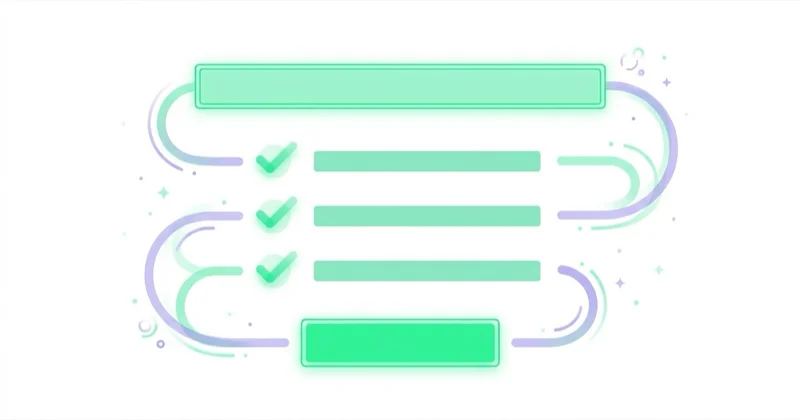
Landing pages need more than a benefit-led headline. Benefits should appear across the page:
- hero section;
- subheading;
- feature blocks;
- proof sections;
- comparison tables;
- FAQ;
- CTA copy;
- form text;
- testimonials;
- post-click reassurance.
Good landing page benefit flow:
- Main outcome.
- Who it is for.
- How it works.
- Why it is credible.
- What risk is reduced.
- What action to take next.
For message sequencing, the AIDA model can help organize the page.
Benefit-led CTAs
CTAs often become generic.
| Generic CTA | Benefit-led CTA |
|---|---|
| Submit | Get the audit checklist |
| Learn more | See how the process works |
| Buy now | Check sizes in stock |
| Contact us | Book a 20-minute consultation |
| Download | Download the budget template |
| Sign up | Start the free workspace |
The CTA should explain the next step or value of clicking.
For a deeper CTA guide, read What Is a CTA and How to Create an Effective Call to Action?.
Benefit-led copy and storytelling
Benefit-led copy and storytelling work well together.
Benefit-led copy explains value clearly. Storytelling shows that value in context.
Example:
- Benefit: "Reduce manual reporting work."
- Story: "The team used to spend every Monday combining exports from five tools. After dashboard cleanup, the weekly meeting focused on decisions instead of spreadsheet repair."
The story makes the benefit easier to picture. The benefit keeps the story commercially relevant.
Read What Is Storytelling in Marketing and How to Use It?.
How to check if copy is truly benefit-led
Use these questions:
- Does the copy explain why the feature matters?
- Is the benefit tied to a real customer problem?
- Is the benefit specific enough to understand?
- Is there proof?
- Is the promise realistic?
- Does the page still include factual product or service details?
- Does the CTA explain the next step?
- Does the benefit match the funnel stage?
- Would the audience use the same language?
- Could a competitor copy the sentence without changing it?
If most answers are weak, the copy probably needs more customer insight and proof.
How we approach this at Space Ads
Benefit-led copy is translating a feature into a consequence for the customer, with one caveat: the benefit that actually sells is found by testing, not decided in a meeting. A brand tends to promote the strength it's proud of; the customer often buys for a completely different reason. So rather than bet on one "main benefit", we write several angles — time saved, peace of mind, status, simplicity — and let the data pick the one that lands. The benefit also has to answer a real job the customer is trying to get done, not whatever sounds impressive in a deck. "Waterproof to 50 m" is a feature; "swim without taking your watch off" is a benefit. Which benefit wins, though, is settled by an ad on live traffic, not by our hunch.
Common mistakes
| Mistake | Why it hurts | Better approach |
|---|---|---|
| Confusing benefits with adjectives | "Modern" and "professional" do not explain value | Translate features into outcomes |
| Overpromising | Trust drops after the click | Match benefits to real delivery |
| No proof | The copy becomes a claim | Add reviews, examples, process or data |
| Too many benefits at once | The message becomes unfocused | Prioritize by audience and funnel stage |
| Same message for every segment | Relevance drops | Adapt benefits to intent and stakeholder |
| Hiding technical details | Users cannot verify fit | Pair benefits with facts |
| Generic CTAs | Next step feels unclear | Make CTA value specific |
| Writing for the company, not the customer | The copy feels self-centered | Start with customer problem and outcome |
FAQ
What is benefit-led copywriting?
Benefit-led copywriting is writing that explains what a product, service or feature changes for the customer. It translates features into practical value.
What is the difference between a feature and a benefit?
A feature says what something is. A benefit explains why that feature matters for the customer. For example, "waterproof membrane" is a feature; "keeps feet dry during wet walks" is a benefit.
Does every feature need a benefit?
Not every minor feature needs a full explanation, but every important feature should have a clear meaning. This is especially important when the feature is technical or unfamiliar.
Is benefit-led copywriting useful in B2B?
Yes. B2B benefits often focus on risk, cost, time, reporting, compliance, implementation, control and decision quality.
Is benefit-led copywriting emotional?
It can be emotional or rational. A benefit can be comfort, confidence and status, but it can also be fewer errors, faster reporting or lower operational risk.
Can benefit-led copy go too far?
Yes. If the copy promises outcomes that the product or service cannot deliver, it becomes hype. Benefits need proof and realistic boundaries.
Where should benefits appear on a page?
Benefits should appear in headlines, subheadings, feature blocks, proof sections, CTAs, FAQs, product descriptions and comparison areas. They should not replace clear factual details.
Key takeaways
Benefit-led copywriting makes value easier to understand. It connects features with customer problems, outcomes and proof. The best version is specific, credible and useful. It helps users compare options and decide what to do next.
The practical workflow is simple: start with the customer problem, translate features with "so what?", make the result specific, support it with proof and adapt the message to the funnel stage.
Sources and further reading
- Google Search Central - Creating helpful, reliable, people-first content
- Google Ads Help - About responsive search ads
- Content Marketing Institute - What is content marketing?
- Nielsen Norman Group - Writing digital copy for specialists vs general audiences
Continue learning
- How to Write Ad Copy That Converts
- What Is Storytelling in Marketing and How to Use It?
- What Is the AIDA Model in Marketing and How to Use It?
- What Is a CTA and How to Create an Effective Call to Action?
- What Is a Landing Page and How to Build One?
- How to Write a Product Description That Sells and What It Must Include
Continue reading
What Is a CTA and How to Create an Effective Call to Action?
A CTA works when the next step is clear, relevant, low-friction and supported by enough context for the user's level of commitment.
What Is Storytelling in Marketing and How to Use It?
Storytelling in marketing uses narrative structure to explain a customer problem, transformation and result. Learn how to use it in ads, landing pages, ecommerce, B2B and case studies.
What Is a Sales Funnel and How to Use It?
A sales funnel helps organise content, campaigns, sales activity and measurement around the stages people pass through before and after conversion.