Real-time marketing (RTM) is a brand's fast, relevant response to a current event, trend, conversation or cultural moment. Good RTM is not simply posting a joke quickly. It combines timing, brand fit, audience relevance, creative clarity and risk control. Bad RTM is forced, late, insensitive or disconnected from the brand.
RTM can create reach and memorability because it joins a conversation that people already care about. It can also damage trust when a brand uses a sensitive topic, misunderstands a community or copies a trend without adding anything meaningful. The practical skill is knowing when to react and when to stay silent.
TL;DR
- RTM means reacting to live cultural, social, industry or platform moments.
- There are two main types: planned real-time marketing around known moments and reactive real-time marketing around unexpected trends.
- Speed matters, but relevance and safety matter more.
- Not every trend is a brand opportunity. If the link to the brand is weak, the post will look forced.
- Sensitive topics need strict exclusion rules. Tragedy, death, illness, conflict and unclear breaking news should usually be avoided.
- RTM needs a process. Monitoring, risk check, creative idea, short approval, publishing and response monitoring should be defined before the trend appears.
- AI can support monitoring and drafts, but humans should own context, tone and final approval.
What real-time marketing is
Real-time marketing is communication that responds quickly to what is happening now. The trigger may be a social trend, meme, sport event, industry announcement, platform feature, news story, viral sound, cultural conversation, local moment or live event.
RTM can appear as:
- a social post;
- a Reel or TikTok;
- a comment from the brand account;
- a Story;
- a paid reactive creative;
- an email;
- a landing page;
- a blog post;
- a PR comment;
- a live event activation;
- a product bundle or promotion.
The best RTM feels natural because the brand has a real reason to join the conversation. The worst RTM feels like a brand saw a meme and forced itself into it.
RTM vs trendjacking vs newsjacking
These terms overlap, but they are not identical.
| Term | Meaning | Example |
|---|---|---|
| Real-time marketing | Broad response to a current context | A brand reacts to a live sport result with a relevant offer |
| Trendjacking | Using a social trend, meme, sound or format | A brand adapts a TikTok format to its product |
| Newsjacking | Joining a current news story or industry announcement | A software company explains what a new regulation means |
| Moment marketing | Planned communication around predictable moments | A campaign prepared for the Super Bowl, Black Friday or a product launch |
RTM is the broader discipline. Trendjacking and newsjacking are tactics inside it.
Two types of RTM
Planned RTM
Planned RTM uses moments known in advance.
Examples:
- seasonal holidays;
- sports finals;
- award shows;
- product launch dates;
- industry events;
- election debates where relevant and safe;
- public shopping moments;
- cultural anniversaries;
- local events;
- platform-specific moments.
This is safer because the team can prepare assets, rules and fallback versions before the moment arrives.
Planned RTM is useful when:
- the moment is predictable;
- creative can be prepared in advance;
- approvals can happen before the event;
- the brand knows possible outcomes;
- the risk is manageable.
Reactive RTM
Reactive RTM responds to unexpected conversations.
Examples:
- a meme becomes popular;
- a creator format spreads quickly;
- a sound gains momentum;
- a platform feature changes behavior;
- a surprising event creates a shared joke;
- users start mentioning a brand organically;
- a competitor creates a conversation;
- a category trend accelerates.
Reactive RTM can create high visibility, but it is riskier. The team has less time to understand context, check sensitivity and produce a strong idea.
When RTM makes sense
React when the topic passes these tests:
- Brand fit: the brand has a natural reason to join.
- Audience fit: the audience understands and cares about the moment.
- Timing: the response can be published while the topic is still alive.
- Value: the brand adds a perspective, joke, utility, explanation or offer.
- Safety: the context is not harmful, exploitative or unclear.
- Channel fit: the format works on the chosen platform.
- Execution quality: the idea can be produced well enough quickly.
- Measurement: the team knows what success means.
If the post only says "we saw the trend too", it probably is not worth publishing.
When not to use RTM
Do not use RTM when the topic involves:
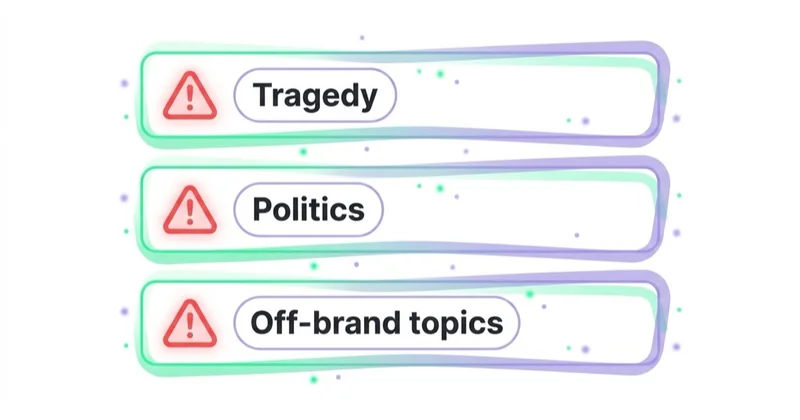
- tragedy;
- death;
- illness;
- war;
- natural disasters;
- violence;
- discrimination;
- vulnerable groups;
- active legal cases;
- unclear breaking news;
- political conflict without clear brand mandate;
- personal scandals unrelated to the brand;
- misinformation or unverified claims.
Silence is often the strongest brand safety decision. A missed trend is usually cheaper than a public trust problem.
A practical RTM decision filter
Before publishing, ask:
- Is the context fully understood?
- Is the source reliable?
- Would the target audience understand the reference?
- Does the brand have permission to participate in this conversation?
- Is the idea useful, funny, insightful or distinctive?
- Could any group reasonably see it as exploitative?
- Does it depend on someone else's misfortune?
- Can the team respond to comments after publishing?
- Would the post still make sense if seen tomorrow?
- Is the legal or compliance risk acceptable?
If the answer is uncertain, do not force the post.
Build a real-time marketing process
Good RTM looks spontaneous, but it usually depends on preparation.
Define:
- who monitors trends;
- which sources are checked;
- which topics are off-limits;
- who can approve quickly;
- who checks brand safety;
- who writes and designs;
- who publishes;
- who monitors responses;
- when a post should be deleted or clarified;
- how learnings are documented.
Without this process, teams either publish too slowly or skip risk checks.
Suggested RTM workflow
- Monitor: social platforms, Google Trends, creator activity, industry news, customer conversations.
- Classify: planned moment, reactive trend, industry update, local event or risk topic.
- Check fit: brand, audience, timing and platform.
- Check risk: sensitivity, misinformation, compliance, legal, tone.
- Generate idea: one clear creative angle.
- Approve fast: one accountable person or a small approval group.
- Publish: in the native format of the platform.
- Monitor: comments, shares, sentiment and media pickup.
- Respond: answer comments or clarify if needed.
- Review: document whether it worked and why.
The approval path should be short. A five-level approval process usually kills reactive RTM.
RTM by platform
TikTok
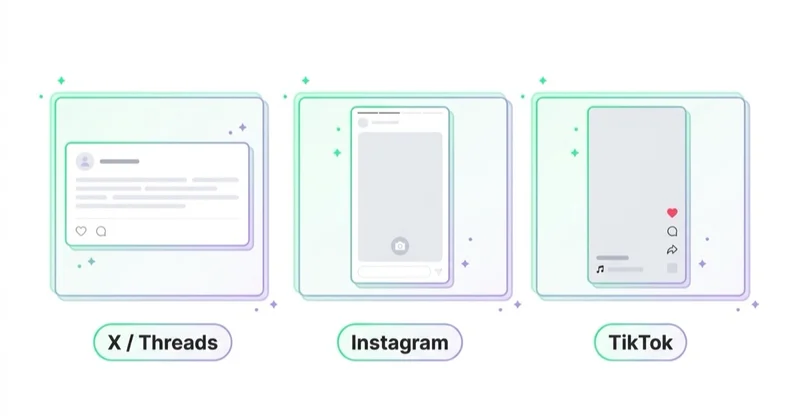
TikTok is strong for trendjacking, sounds, creator formats, fast editing patterns and niche community language. The best RTM usually adapts a trend with a brand-specific twist instead of copying the format exactly.
Use:
- TikTok Creative Center;
- creator observation;
- comment sections;
- trend velocity checks;
- brand-safe sound choices;
- quick native production.
For deeper TikTok research, read TikTok Creative Center: What It Is and How to Use It.
Instagram Reels
Reels can work for quick educational reactions, visual trends, product demos, behind-the-scenes content and creator-style edits.
Use Reels when:
- the idea is visual;
- the first seconds are clear;
- the trend can be adapted naturally;
- the brand can produce a native vertical video quickly.
Read What You Need to Know About Instagram Reels for platform context.
Facebook can work for local moments, community reactions, events, comments and practical updates. It is often less about viral trend speed and more about relevance to an existing audience or local community.
For Page management, read How to Create and Manage a Facebook Page.
LinkedIn RTM is usually not meme-first. It works best as:
- expert commentary;
- industry interpretation;
- quick analysis of regulation;
- lessons from a market event;
- response to a platform or technology change.
The tone should match professional context. Speed still matters, but clarity and credibility matter more.
Email and blog
Email and blog content are slower but useful for deeper RTM.
Use them when:
- the topic needs explanation;
- the brand has expertise;
- the audience expects analysis;
- social posts are too shallow;
- SEO or long-term discoverability matters.
This is useful for industry changes, platform updates and regulatory news.
Brand safety rules
Every RTM process should include a brand safety list.
Create three categories:
Green topics
Safe and relevant topics the brand can usually react to quickly.
Examples:
- product category trends;
- industry updates;
- planned events;
- creator formats;
- customer questions;
- local community moments.
Yellow topics
Topics that need extra review.
Examples:
- politics;
- regulation;
- competitor mistakes;
- cultural tensions;
- jokes involving identity;
- health-related content;
- financial or legal advice.
Red topics
Topics the brand avoids.
Examples:
- tragedy;
- death;
- disasters;
- violence;
- active crises;
- unverified accusations;
- vulnerable groups used as a punchline.
The red list saves time. The team should not debate obvious no-go topics during a fast trend.
RTM and AI
AI can help with real-time marketing, but it should not replace judgement.
AI can support:
- trend summaries;
- social listening classification;
- draft variations;
- headline ideas;
- risk prompts;
- competitor scan summaries;
- repurposing one idea into several formats.
Humans must still handle:
- cultural context;
- sensitivity;
- brand tone;
- legal risk;
- final creative judgement;
- decision to publish or not publish.
AI is useful for speed. It is not a substitute for responsibility.
How to measure RTM
The right metric depends on the goal.
Measure:
- reach;
- impressions;
- engagement rate;
- shares;
- saves;
- comments;
- sentiment;
- follower growth;
- profile visits;
- website clicks;
- mentions;
- earned media;
- creator pickup;
- lead or sales impact;
- cost per result if boosted;
- response time;
- brand lift where available.
Do not overvalue likes. A real-time post can get many reactions and still be strategically irrelevant. Conversely, a B2B RTM post may generate fewer reactions but create high-quality conversations.
RTM in ecommerce
Ecommerce brands can use RTM, but the product link must feel natural.
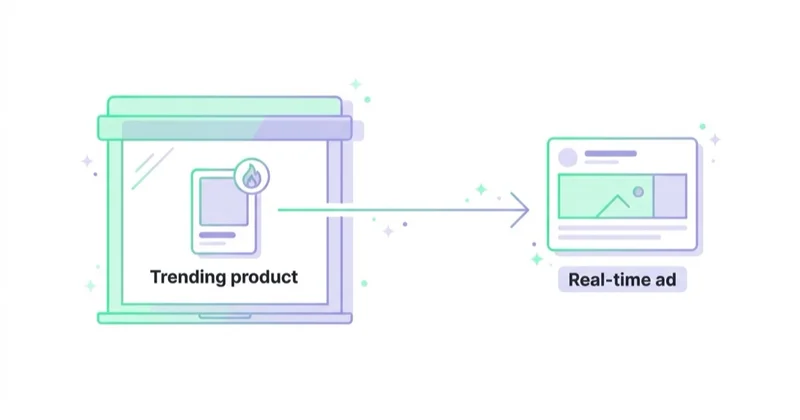
Examples:
- reacting to a weather shift with relevant products;
- preparing content around a sport or entertainment event;
- using a trending format to show a product problem-solution;
- creating fast bundles for a seasonal moment;
- responding to user-generated content;
- using Reels or TikTok to show a product in a trend context.
Avoid forcing products into unrelated tragic or political moments. Also avoid launching a "real-time" promotion if operations cannot support stock, fulfilment and customer service.
RTM in B2B
B2B RTM is usually more about expert timing than viral humour.
Examples:
- a quick explainer after a platform update;
- a comment on a new regulation;
- a short analysis after a market report;
- an industry event reaction;
- a myth-busting post during a public debate;
- a checklist after a tool changes.
The value is credibility. The best B2B RTM helps the audience understand what the moment means for their work.
Examples of good RTM angles
Good angles often start from one of these patterns:
- "What this means for..."
- "Three mistakes brands will make with this trend"
- "How to use this moment without damaging trust"
- "A practical checklist for..."
- "The brand-specific version of this meme"
- "What customers are really asking after this update"
- "One useful thing to do before the trend peaks"
These angles work because they add something, not just repeat the trend.
How we approach this at Space Ads
RTM is high-variance: most attempts to "hook into the moment" vanish without a trace, and a handful break through. We don't run it as a plan, but as an opportunity we're ready for. That readiness is three things: a pre-agreed approval path fast enough to react in hours rather than days; a clear no-go list (tragedies, politics, anything that could singe the brand); and a rule never to stake budget on virality itself. When something genuinely catches, we put paid reach behind it, and that is what turns RTM into a real channel rather than a one-off funny post. The worst RTM is the forced kind, posted because "we have to put something out" — chasing every trend costs the brand more than it returns.
Common mistakes
| Mistake | Why it hurts | Better approach |
|---|---|---|
| Reacting to every trend | Brand becomes unfocused | Use a fit filter |
| Being too late | The moment has passed | Build a fast approval path |
| Ignoring context | Risk of insensitive content | Check source and background |
| Copying a meme exactly | Brand adds no value | Add a brand-specific angle |
| Using tragedy for attention | Trust damage | Put sensitive topics on the red list |
| No comment monitoring | Crisis can grow | Monitor after publishing |
| Too much corporate tone | Content feels unnatural | Use platform-native language |
| No measurement | Learning is lost | Track outcome by objective |
| Letting AI decide | Context errors | Keep human final approval |
RTM checklist
Before publishing, confirm:
- The topic is current.
- The reference is understandable.
- The brand has a natural reason to join.
- The audience is likely to care.
- The source is reliable.
- The context is not sensitive or harmful.
- The creative idea is simple.
- The format fits the platform.
- Approval is clear.
- Someone will monitor comments.
- A rollback or clarification plan exists.
- Success metric is known.
FAQ
What is real-time marketing?
Real-time marketing is a brand's fast response to a current event, trend, conversation or cultural moment, usually through social media, content, email, PR or paid media.
Is RTM the same as trendjacking?
No. Trendjacking is one type of RTM focused on social trends, memes, sounds or formats. RTM is broader and can include news, events, industry updates and planned moments.
Does RTM have to be funny?
No. RTM can be helpful, expert, local, educational, supportive or practical. Humour is only one possible tone.
Can B2B brands use RTM?
Yes. B2B RTM works best as quick expert commentary, analysis, checklists or interpretation of industry changes. Viral consumer memes are not always the right format.
How fast should RTM be?
It depends on the platform and moment. Some TikTok trends move quickly, while industry commentary may remain useful for several days. Speed matters, but not at the cost of accuracy and brand safety.
What topics should be avoided?
Avoid tragedy, death, violence, illness, disasters, vulnerable groups, unverified allegations and sensitive conflicts unless the brand has a clear, responsible role in the conversation.
Can AI create RTM content?
AI can help with monitoring, drafts and variations, but human review should decide whether the context is safe, relevant and brand-appropriate.
How should RTM be measured?
Measure based on the goal: reach, engagement, shares, comments, sentiment, website clicks, leads, sales, earned media, creator pickup or learning for future content.
Conclusion
Real-time marketing can make a brand feel current, human and culturally aware. It can also make a brand look careless if speed replaces judgement.
The best RTM is selective. It reacts only when the brand has a real reason to join, the audience understands the moment and the risk is acceptable. A simple process, a short approval path and a clear no-go list are more valuable than endless brainstorming after a trend appears.
React quickly when it makes sense. Stay silent when the context is wrong. That discipline is what separates useful real-time marketing from forced trendjacking.
Sources and further reading
- TikTok Newsroom: TikTok Next 2026 trend forecast
- TikTok Creative Center
- Meta for Business: Instagram and Facebook Reels ads
- Facebook Help Center: Reels
- Google Trends Help
- Google Trends Help: Find related searches
Continue learning
- TikTok Creative Center: What It Is and How to Use It
- What You Need to Know About Instagram Reels
- How to Create and Manage a Facebook Page
- How to Increase TikTok Reach: Promote Your Account and Grow Followers
- Why Brand Awareness Matters and How to Build a Successful Campaign
- Is Video Marketing Worth Using Online?
Continue reading

How to Run Facebook Contests and What to Know
Facebook contests can build engagement, UGC and leads, but they need clear rules, Meta policy compliance, privacy discipline and relevant prizes.
How to Use Instagram Hashtags?
Instagram hashtags support discovery, classification and campaigns, but they are not a magic reach lever. Learn how to use precise tags with social SEO, captions and measurement.

How to Engage Fans and Increase Reach with Facebook Posts
Facebook posts can still build reach and community when they are native, useful and measured properly. Learn Reels, video, groups, organic reach, boosting and engagement strategy.