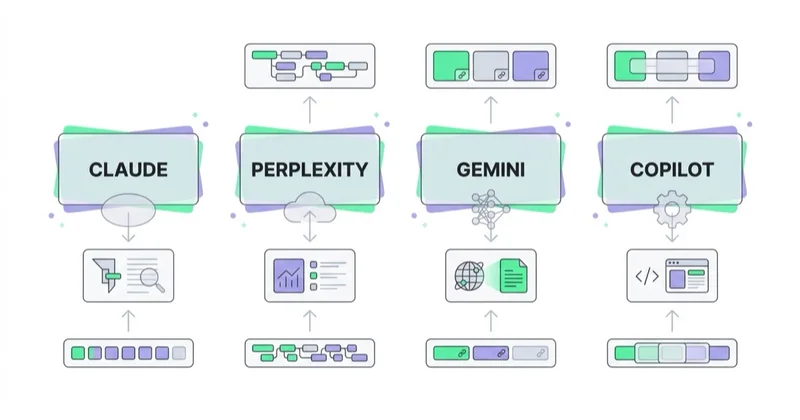
Claude, Perplexity, Gemini and Copilot expose different routes to current web information. Their public documentation describes crawler tokens, developer search tools, citation objects and webmaster reports — but it does not disclose complete selection logic for the consumer applications. This article compares what can be verified, then separates shared publishing practices from controls that genuinely differ by provider.
TL;DR
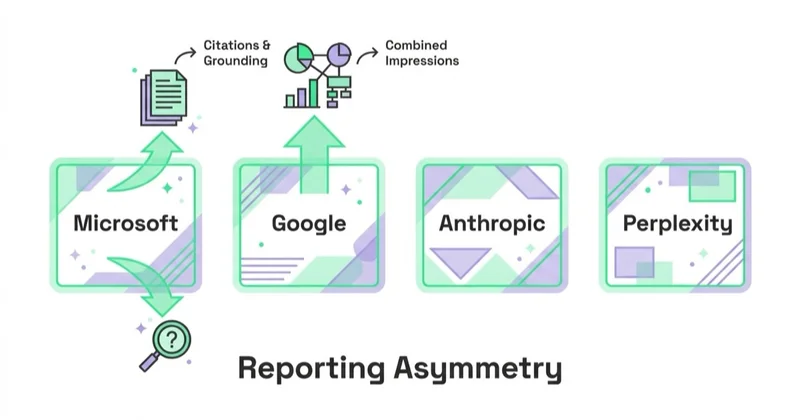
- Microsoft provides the broadest general webmaster citation report of the four. Bing AI Performance reports citations, cited pages and sampled grounding queries across supported Microsoft experiences. Google reports generative impressions; Perplexity offers additional reporting only through specific publisher arrangements; Anthropic has no comparable general owner console.
- Searching is a decision, not a default. Anthropic documents that Claude determines when to search based on the prompt; Google documents that the model analyses the prompt and determines if a Google Search can improve the answer.
- Claude API web-search citations are always enabled. Anthropic documents URL, title and up to 150 characters of cited text for this tool. That statement should not be generalised to every Claude product surface.
- The application can exclude your site, and you cannot see it. Claude's web search tool accepts
allowed_domainsorblocked_domains, and an admin can restrict which domains it searches at all. - Perplexity's APIs expose date-aware retrieval. The documented Search and Sonar APIs support publication and update filters and can return
dateandlast_updated; this proves the capability, not a universal weighting rule in the consumer app. - Gemini is two different things under one name. Grounding with Google Search in the Gemini API is documented in detail; AI Overviews and AI Mode are Search features governed by Googlebot access instead.
- Google-Extended is a training and grounding control, not a visibility switch. Google states it does not impact a site's inclusion in Google Search and is not used as a ranking signal.
- No provider publishes complete selection weights. A claimed "Claude ranking factor" or equivalent should be labelled as an inference unless the provider documents it.
What actually differs between the four
Start by separating two questions that get merged constantly. The first is how the assistant gets to a page: which agent fetches, whether the model decided to search, what filters the request passed through. The second is what the site owner can see and set. The first question has four different answers. The second has one boring answer for three of the providers and a genuinely different one for Microsoft.
Microsoft reports per-URL citations and sampled grounding queries across supported AI experiences. Google reports impressions for its generative Search features. Anthropic has no comparable general webmaster console, while Perplexity's publisher reporting is tied to a commercial programme rather than universally available site verification. The planning conclusion is that core data quality, access and page usefulness can be shared, while measurement and provider controls remain surface-specific. This is why our AI SEO work uses one strategy with separate evidence streams rather than pretending that one score represents all four.
ChatGPT sits outside this article on purpose — its chain has its own quirks and we covered them in how ChatGPT picks what to cite. For the umbrella view of how these surfaces relate to classic search, start from AI SEO across search engines, AI Overviews and LLMs.
Short glossary
- Grounding — supplying a model with retrieved content at answer time, so the response reflects sources rather than only model parameters.
- Citation annotation — a structured object attached to generated text that names the source URL, its title and often the exact fragment used.
- Domain filter — a request-level allowlist or blocklist deciding which sites a search may return, set by whoever built the application.
- Page age — a freshness value a search result can carry, describing when the source page was last updated.
- Grounding query — the phrase the assistant actually retrieved with, which is rarely the phrase the user typed.
- Connector — an authenticated integration that lets an assistant read a specific system directly, instead of reaching it through the public web.
- Product token — the name a provider publishes for use in robots.txt, which may differ from the user-agent string you see in logs.
Claude SEO: a tool call, forced citations, and a filter you do not own
Anthropic's documentation for the web search tool describes the sequence in three steps: Claude determines when to search based on the prompt, the API runs the searches and provides Claude with the results — a process that can repeat multiple times in a single request — and at the end of its turn Claude provides a final response with cited sources. Three details in it matter more than the rest to anyone who owns a website.
Citations are compulsory in this API tool, and they carry a quoted fragment. Anthropic states that citations are always enabled for web search. Each cited source arrives with the URL, page title and cited_text of up to 150 characters. This makes passage-level clarity relevant to how a developer can display the cited evidence; it does not create a public rank or reveal why one source was selected over another.
Results carry a freshness value. Every search result includes page_age, documented as when the site was last updated. You do not control how it is weighted, and Anthropic publishes no weighting. You do control whether your pages carry honest, visible update information instead of a silent edit history.
Somebody else can filter you out entirely. The tool definition accepts allowed_domains or blocked_domains, one or the other, applied per request. On top of that, Anthropic notes that web search is enabled for an organisation unless an administrator has disabled it in the Claude Console, where they can also restrict which domains it searches. Read that as an operator: a company building an internal assistant can restrict retrieval to a handful of approved domains, and if yours is not among them, no amount of on-page work reaches that audience. No signal, no report, no appeal. This is a normal property of assistant distribution, and it is worth knowing before someone promises you a "Claude ranking".
Newer tool versions add dynamic filtering. Instead of loading every result into the context window, Claude can write and run code that filters results so only relevant content reaches the model. This proves that retrieval and inclusion in model context are separate stages. Anthropic does not publish the filtering weights, so no page format can be claimed to "survive" reliably. Clear, self-contained passages remain a sound editorial practice because cited fragments need context, not because the documentation promises preferential selection.
Anthropic's web-search documentation lists a price of $10 per 1,000 searches on the Claude API, plus standard token costs (checked July 2026). The tool also lets a developer cap search uses, and Claude may answer without searching for stable knowledge. These are application-design facts, not evidence that a consumer-app answer skipped search for a particular commercial reason. Accuracy in model-only answers and retrievability are therefore separate diagnostic questions, covered further in LLM SEO.
Connectors are a different mode from crawling
Claude can also reach data through connectors built on the Model Context Protocol. Anthropic documents that when you add a custom connector, Claude connects to your remote MCP server from Anthropic's cloud infrastructure rather than from your local device, over authenticated access that can read and in many cases write. That is not a visibility channel and should never be sold as one: it is a private, permissioned pipe into one system, opened by whoever holds the credentials, and nothing you publish makes it more or less reachable. It is worth naming only because briefs conflate the two — "we want Claude to use our data" sometimes means public citability and sometimes means an integration.
What is documented and what is not
Anthropic publishes three crawler tokens with distinct jobs — ClaudeBot for content that may contribute to training, Claude-SearchBot for search result quality, and Claude-User for visits made when a person asks Claude a question — plus an IP list for verification. The whole allow-or-block decision is in AI crawlers: what to allow; set that policy there, not here.
What is not documented is the consumer side. Everything above comes from Anthropic's developer documentation, which describes the platform tool rather than the Claude app. It is the most detailed public account of how Claude retrieves and cites; where app behaviour diverges, nobody outside Anthropic knows. Treat the mechanics as reliable, the app-level specifics as unknown, and do not let anyone sell you the difference.
Perplexity SEO: citation-shaped by design, and date-aware
Perplexity is the one product here built around visible sourcing rather than adding it later. Its crawler documentation frames PerplexityBot as designed to surface and link websites in search results on Perplexity, and states it is not used to crawl content for AI foundation models. Separately, Perplexity-User handles fetches a user's question requires; Perplexity documents that this fetcher generally ignores robots.txt rules, which is a policy detail rather than a visibility one.
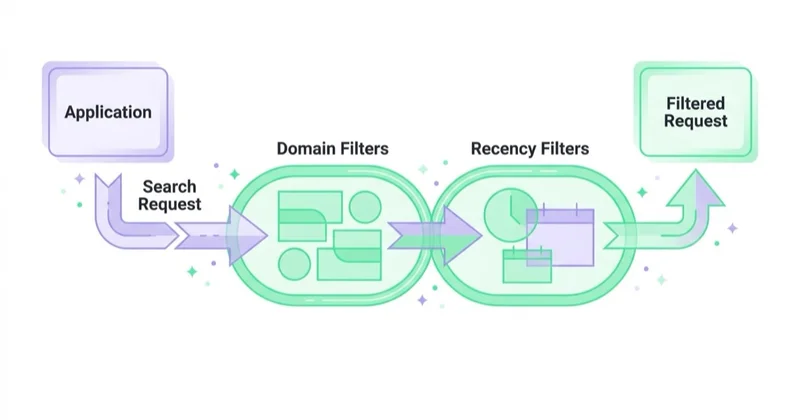
The API is where source selection becomes concrete, because the filters exposed to developers tell you what the retrieval layer understands about a page:
| Request parameter | What Perplexity documents it does | What it implies for a page |
|---|---|---|
search_recency_filter |
Filter by publication recency: hour, day, week, month or year | Undated content can be excluded by a filter, not by a judgement |
search_after_date_filter / search_before_date_filter |
Return results published after / before a given date | Publication dates are parsed and compared, so a wrong one is worse than none |
search_domain_filter |
Limit search results to specific domains | The application can scope retrieval to a shortlist you are not on |
search_results in the response |
Search results used for context, each with title, URL, publication date, last updated date, snippet and source type | Both dates travel with the result, so a stale-looking page is visibly stale |
Dates can be hard filters in the documented APIs. A request can limit results by publication recency or by before-and-after publication and update dates. A page with an unavailable or incorrect date may therefore be excluded or misclassified in that request. Publish accurate visible dates where they help users, align them with structured metadata, and change an updated date only after a substantive revision. The API documentation does not disclose how often the consumer product applies these filters.
The APIs return both result snippets and citations. Perplexity's Search API returns structured results with title, URL, snippet and optional date fields, while Sonar responses can include a citations array of source URLs and the search results used as context. A self-contained passage helps a reader and makes extracted text easier to interpret, but the provider does not publish a preferred passage length or number of competing sources.
Perplexity also runs a publishers' programme that shares revenue with partner publishers and gives them reporting on how their content is cited. That is a commercial partnership, not a setting.
For a site owner outside that programme, there is no generally available Perplexity equivalent of Search Console. Verified PerplexityBot requests in logs, referral sessions and a controlled prompt sample provide different evidence, and none reveals the complete citation population or turns a fetch into proof of citation.
Gemini SEO: one name, two very different surfaces
Gemini SEO is where most confusion lives, because "Gemini" covers a consumer assistant, an API, and — in casual usage — the AI features inside Google Search, which are not Gemini at all. Split them.
Grounding with Google Search, in the Gemini API. Google documents that the model analyses the prompt and determines if a Google Search can improve the answer. When it grounds, the response carries the search queries the model executed, inline url_citation annotations with URLs and titles, and a search_suggestions HTML snippet whose display is governed by the terms of service. That last item is unusual: Google requires the built application to show the search suggestions it returns, so grounded Gemini answers are designed to push some traffic back into Search rather than terminate the journey.
AI Overviews and AI Mode, in Google Search. These are Search features, not a separate assistant with a dedicated crawler. Google's technical guidance says there is no special schema or AI-only optimisation requirement: ordinary Search eligibility and snippet eligibility apply. In 2026 Google also began rolling out a Search Console control that lets a subset of properties include or exclude their links and content from supported generative AI features in Search and Discover. How those features assemble an answer, including query fan-out, is covered in Google AI Mode and what it means for brands.
Google-Extended, which is neither. Google-Extended is a robots.txt product token, not an HTTP user agent you will see in logs. It governs specified uses of crawled content for Gemini model training and grounding, and Google states that it does not affect inclusion or ranking in Google Search. It is therefore a separate rights and editorial decision and does not switch off AI Overviews or AI Mode. The new Search generative AI control is the relevant property-level setting for supported Search and Discover features where it is available.
On reporting, Google sits in the middle. The generative AI performance report in Search Console shows impressions for AI Overviews and AI Mode over time, by page, device and country. Two caveats for any client conversation: the capabilities are reported together rather than split per feature, and data from Search Labs experiments is excluded. Real data, not a per-feature breakdown.
Copilot SEO: Bing controls and the strongest general owner citation report
Microsoft's public webmaster documentation does not list a dedicated Copilot crawler token; Bing's index and controls are the documented site-owner surface. Microsoft published per-page NOARCHIVE and NOCACHE robots-meta behaviour for generative answers: under that guidance, NOARCHIVE excludes content from answers, while NOCACHE permits a more limited use of URL, title and snippet. Product names and policies evolve, so verify the current Bing documentation before deploying either directive across templates. The mechanics are covered in our AI crawlers guide.
The measurement advantage is Bing Webmaster Tools AI Performance, introduced in public preview in February 2026 and expanded in June 2026 with views for intents, topics, citation share and comparison. Microsoft describes its scope as Microsoft Copilot, AI-generated summaries in Bing and select partner integrations. The original report includes:
| Metric | What Microsoft says it shows |
|---|---|
| Total citations | The total number of citations displayed as sources in AI-generated answers in the selected period |
| Average cited pages | The average number of unique pages from your site shown as sources per day |
| Grounding queries | The key phrases the AI used when retrieving content that was referenced in answers |
| Page-level activity | Citation counts for specific URLs from your site |
| Visibility trend | How citation activity changes over time across supported AI experiences |
Grounding queries are a useful view of retrieval phrasing within the supported Microsoft sample. Microsoft states that the data represents a sample of overall citation activity. Use it to identify vocabulary and topic gaps worth investigating, then validate the page against user research and broader search data. A mismatch is a diagnostic clue, not proof that the page is wrong, and Microsoft queries should not be presented as a proxy for Claude, Gemini or Perplexity behaviour.
The four side by side
| Assistant | What fetches the page | How sources are shown | What you can actually set | Where the documentation lives |
|---|---|---|---|---|
| Claude | Claude-SearchBot for search quality, Claude-User for user-triggered visits, ClaudeBot for training |
Citations always enabled, with URL, title and up to 150 characters of cited text | Access per agent in robots.txt; nothing about selection. Domain filters belong to the application, not to you | Anthropic crawler support article; web search tool documentation |
| Perplexity | PerplexityBot to surface and link sites, Perplexity-User for user-triggered fetches |
Numbered inline source links; API returns a citations array plus full search results | Access for PerplexityBot; your published and updated dates, which the retrieval layer parses |
Perplexity bots guide; Perplexity API reference |
| Gemini | Googlebot for Search; Google-Extended is a product token, not a crawler | Inline url_citation annotations and search suggestions in grounded API answers |
Search eligibility and snippet controls; Search generative AI control where available; Google-Extended for specified Gemini uses | Google crawler documentation; grounding with Google Search; Search Console guidance |
| Copilot | Bing index; public docs do not list a dedicated Copilot crawler token | Cited sources; owners get citation and sampled grounding-query data across supported experiences | Bing crawl access plus documented NOARCHIVE / NOCACHE behaviour |
Bing Webmaster blog on generative controls and AI Performance |
Do this once. Do this per assistant.
| Do once, and it works for all four | Why it transfers |
|---|---|
| Make important passages understandable outside the page's opening | API citation formats attach sources to fragments, so missing subjects and qualifiers create ambiguity |
| Publish accurate, consistent published and updated dates where relevant | Perplexity exposes date filters and fields; Claude search results can carry page_age |
| Keep the brand's facts identical everywhere they appear | Many brand questions are answered from model memory with no page fetched at all |
| Use headings that describe the question or decision in plain language | Clear information architecture helps users and makes sections easier to retrieve and interpret |
| Give tables unambiguous headers and self-explanatory rows | Extracted rows remain understandable without relying on visual position alone |
| Allow documented search agents when retrieval visibility is the goal, then verify delivery | Access creates eligibility for retrieval; it does not guarantee a citation |
| Genuinely per assistant | What to do about it |
|---|---|
| Measurement | Bing Webmaster Tools AI Performance for Copilot; Search Console generative AI report for Google; repeated prompt sampling plus server logs for Claude and Perplexity |
| Training opt-outs | Separate tokens per provider, each a business decision rather than a visibility one |
| Per-page generative controls | Only Microsoft offers them, via NOARCHIVE and NOCACHE in page templates |
| Third-party gatekeeping | Application-level domain filters exist in Claude's and Perplexity's APIs and cannot be influenced from your side |
Everything not in the second table is in the first. That is the whole planning argument.
How Space Ads approaches this
At Space Ads, we start with an access and evidence audit: documented crawler policy, verified requests where identity methods exist, edge responses, index eligibility and platform reports. This distinguishes a content problem from a WAF, CDN, robots or account-setting problem before editorial work begins.
We then review commercially important pages at passage level. Subjects, claims and qualifiers should remain clear when a paragraph or table row is encountered outside the page opening. This is a usability and editorial-quality requirement supported by citation formats, not a claimed ranking factor. We avoid creating duplicate "AI versions" where the same audience need can be served by improving the canonical page.
Measurement stays unmerged. Bing citations and citation share, Google generative impressions, verified bot access and repeated prompt samples are different units. Each report carries its coverage and sampling limits; none is averaged into a single "AI visibility score". Findings lead to a named action — access, factual consistency, page structure, evidence or external-source correction — rather than a generic content recommendation.
Order of work
- Inventory the agents in your logs, verified against each provider's published IP list rather than by user-agent name, and note which URL groups the search-side agents actually reach. Fix self-cancelling rules while you are in there — a blocked agent plus a meta directive that only works if the page can be read is the common one.
- Use the reporting that exists. Verify the site in Bing Webmaster Tools and inspect AI Performance; check the Search Console generative AI performance report and Search generative AI control where available. Record rollout and coverage limits.
- Review sampled grounding queries against user research, Search Console data and page vocabulary. Treat disagreement as an investigation lead, not an automatic rewrite instruction.
- Pick the answer-material pages: category explainers, comparisons, pricing logic, scope, eligibility, constraints, and anything a buyer checks before contacting you.
- Edit each page block by block. Name the subject in the first sentence of every section. Move qualifiers inside claims. Add real published and updated dates.
- Write the prompt set for Claude and Perplexity from real buying questions, not from keywords, and run each prompt several times, logging conditions.
- Assign a cadence and trigger owner. Choose intervals the team can repeat, and re-check access, documentation and baselines after material provider, CDN, WAF, product or market changes.
Common mistakes
| Mistake | What to do instead |
|---|---|
| Treating "AI SEO" as four unrelated projects | Share core data, access and content-quality work; keep provider controls and measurement separate |
| Buying a "Claude ranking" or "Perplexity position" report | No provider publishes ranking or position; ask what the sampling method was |
| Ignoring Bing Webmaster Tools because Bing's search share is small | It is the only place anyone hands you per-URL citations and grounding queries |
| Assuming Gemini and AI Overviews are the same surface | Gemini grounding is documented in the API; AI features in Search are governed by Googlebot access |
| Disallowing Google-Extended to reduce AI answers in Search | It affects training and grounding in Gemini products, not Search inclusion or ranking |
| Leaving pages undated, or backdating "updated" fields | Perplexity filters on dates and returns both dates with every result; a false date is worse than none |
| Reading one assistant answer as evidence of presence | Sample repeatedly with conditions logged, and report a share of runs |
| Selling connectors as AI visibility | Connectors are authenticated integrations into a specific system, not a public surface |
FAQ
What is Claude SEO?
Claude SEO is the practice of making a site reachable and quotable in Claude's web search path: allowing the Anthropic agents that fetch pages, publishing content that answers a question inside a single self-contained passage, and keeping dates and brand facts accurate. Anthropic documents that Claude decides when to search, that citations are always enabled for web search, and that each citation carries up to 150 characters of cited text — but publishes no selection or ranking logic.
How do you get cited in Perplexity?
Perplexity documents PerplexityBot as the agent used to surface and link websites, so allowing verified access preserves that retrieval route. Its Search and Sonar APIs expose domain, language, publication and update-date filters and return snippets and citations. These capabilities support accurate dates, complete metadata and self-contained explanations as sensible practices, but Perplexity publishes no guaranteed formula for citation in the consumer product.
What is Gemini SEO, and is it the same as ranking in AI Overviews?
No. Gemini grounding is documented for the Gemini API, where the model can execute Google searches and the response carries citation annotations and search suggestions. AI Overviews and AI Mode are features inside Google Search. Ordinary Search and snippet eligibility apply, while a separate Search generative AI control is rolling out to a subset of Search Console properties. Google-Extended controls different Gemini uses and does not determine Search inclusion.
What is Copilot SEO?
Microsoft's public webmaster documentation centres Copilot visibility on Bing's index rather than listing a dedicated Copilot crawler token. Bing access is therefore foundational, and Microsoft has documented per-page NOARCHIVE and NOCACHE behaviour for generative answers. Bing Webmaster Tools AI Performance then provides citation data across supported Microsoft experiences. Verify current directive behaviour before changing templates because the control documentation predates the latest reporting features.
Which assistant tells me whether I was cited?
For generally available webmaster reporting among these four, Microsoft provides the clearest citation data. Bing AI Performance covers supported Microsoft experiences and includes citation metrics plus sampled grounding queries. Google Search Console reports impressions rather than citations for AI Overviews and AI Mode. Anthropic has no comparable owner console, while Perplexity's additional publisher reporting is tied to a specific commercial programme.
Can an application stop Claude or Perplexity from using my site?
Yes. Both providers expose request-level domain filters — allowed_domains or blocked_domains in Claude's web-search tool and search_domain_filter in Perplexity's APIs. Anthropic also documents organisation-level restrictions. A site owner cannot override an application's allowlist. From outside the application, however, absence from an answer does not prove that a domain filter caused it; many other retrieval and selection stages can produce the same observation.
Do I need a different page version for each assistant?
Usually not. Clear canonical pages, accurate entity facts, honest dates and documented crawler access serve users across these surfaces. Provider-specific work is mainly measurement and supported control settings. A separate page is justified only by a distinct user intent, market, language or product experience — creating an "AI version" with duplicate meaning adds maintenance risk without a documented provider requirement.
Sources and further reading
- Anthropic — Does Anthropic crawl data from the web, and how can site owners block the crawler? (ClaudeBot, Claude-SearchBot, Claude-User, IP list) and the web search tool documentation (search decision, citations,
page_age, domain filters, pricing). - Perplexity — PerplexityBot and Perplexity-User, the Search API and Sonar API (domain and date filters, result fields and citations).
- Google — Grounding with Google Search, Google crawlers and Google-Extended, AI features and your website, the generative AI performance report and Search generative AI control.
- Microsoft — AI Performance in Bing Webmaster Tools and options for controlling content use in generative answers (
NOCACHE,NOARCHIVE).
State as of July 2026 — providers rename their agents and change their rules. Check the current documentation before writing a robots.txt policy or a measurement plan.
In short
- The four assistants differ in how they retrieve; they barely differ in what makes a page usable to them.
- Claude's API web-search tool decides when to search, always cites search-derived claims, returns up to 150 cited characters and exposes
page_ageon results. - Perplexity's documented APIs parse publication and update dates and can apply date filters; this proves a retrieval capability, not a consumer-app ranking weight.
- Gemini grounding and Google's AI features in Search are different surfaces; Google-Extended governs training and grounding, not Search inclusion.
- Microsoft's public webmaster documentation does not list a dedicated Copilot crawler token, and Bing provides the strongest general per-URL citation reporting of the four.
- Application-level domain filters mean a third party can exclude your site from an assistant without you ever seeing it.
- Do the passage, entity, date and access work once; run measurement per assistant and never merge the sources into one score.
Continue learning
- How ChatGPT picks what to cite — the same mechanics for the assistant this article leaves out.
- AI crawlers: GPTBot, ClaudeBot, PerplexityBot and what to allow — the full allow-or-block decision per agent.
- Google AI Mode: what it means for brands — how generative features inside Google Search assemble an answer.
- LLM SEO: make your brand easier for AI tools to cite — entity consistency and the brand description models already hold.
- AI SEO services — crawler access, brand entity, citable content and citation measurement as one workstream.
Continue reading

Shopify SEO: The Checklist That Matches How the Platform Actually Works
Shopify handles several SEO basics automatically, but rankings still depend on the decisions it cannot make for you. Use this checklist to audit indexation, collections, products, filters, variants, performance and international stores in the right order.

What an ASO Service Should Deliver (and When You Do Not Need One)
ASO should deliver research, store-specific metadata, creative tests and a reusable learning system—not a promised ranking. Here is the scope, evidence and ownership to expect.

App Store Optimization (ASO): How It Works and How It Differs From SEO
ASO improves app discovery and product-page conversion, but Apple and Google use different metadata, behavioural signals and testing tools. Learn what is officially documented, what remains an operating hypothesis, and how to coordinate store work with paid acquisition.