An ecommerce promotion is profitable only when it changes customer behaviour enough to cover its cost. It may acquire an incremental customer, increase a basket, reactivate a valuable buyer or release cash from ageing inventory. If it simply gives a lower price to people who would have purchased anyway, the campaign can produce record revenue and weaker economics at the same time.
The right question is therefore not “How large should the discount be?” It is: What behaviour should change, what contribution are we giving up, and how will we prove that the change was incremental? Answer those three questions before selecting a code, creative or countdown timer.
The short answer
- Start with contribution margin, not revenue or gross merchandise value.
- Calculate how much additional volume the discount needs just to preserve existing contribution.
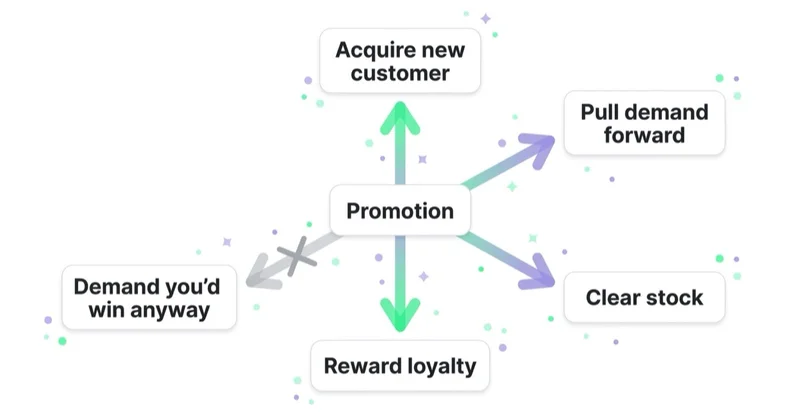
- Choose the mechanic for a defined job: acquisition, basket growth, reactivation, inventory clearance or loyalty.
- Segment customers and products so the offer does not subsidise demand that was already likely to convert.
- Set stacking, eligibility, return and channel rules before launch.
- Use a randomised holdout where possible and measure contribution per eligible customer—not only revenue from redeemers.
- Review full-price cannibalisation, returns and 30/60/90-day cohort quality after the campaign.
- Make reference prices and urgency claims accurate. Promotion law varies by market; in the EU, announced reductions generally reference the lowest price applied in the previous 30 days.
Why a 20% discount can require twice as many sales
Revenue is a poor guide to promotion economics because a discount comes out of the portion that pays for fulfilment, acquisition and profit. Use a contribution view for the products and orders in scope.
A practical order-level definition is:
Contribution = net selling price after discount
             − product cost
             − shipping subsidy
             − fulfilment and payment costs
             − expected returns/cancellations
             − variable media or affiliate cost
Use the cost structure that matches your business. The important point is to include costs that change when the order happens, rather than confusing revenue, gross margin and final accounting profit.
Consider a product sold for $100 with $60 of variable cost. Before promotion, each unit contributes $40. A 20% discount lowers revenue to $80 and contribution to $20. The store must sell twice as many units to generate the same total contribution—before allowing for extra ad spend, fulfilment pressure or higher returns.
The simplified formula is:
Required volume multiplier = contribution before discount ÷ contribution after discount
Break-even volume lift = required multiplier − 1
This calculation does not prove that a promotion is bad. It shows what the campaign must achieve. Vendor funding, reduced storage cost, avoided write-offs or valuable repeat purchases can change the answer, but they should appear explicitly in the business case.
Five legitimate jobs for a promotion
Every offer should have one primary job and a metric that matches it.
1. Acquire an incremental customer
A first-order incentive can function as customer acquisition cost. It makes sense when it attracts buyers who would not otherwise purchase and the acquired cohort generates adequate future contribution. The risk is paying existing high-intent shoppers to create a new account or discounting customers who would have converted anyway.
2. Increase profitable basket size
A spend threshold, bundle or gift can encourage customers to add another item. Measure incremental contribution per order, not AOV alone: a larger basket filled with heavily discounted, costly-to-ship products may be less profitable.
3. Reactivate a valuable customer
A targeted win-back offer can restart a relationship after a meaningful lapse. Eligibility should reflect the normal buying cycle; someone who buys once a year is not necessarily lapsed after 90 days. Compare reactivated behaviour with a holdout and watch whether subsequent orders return to full price.
4. Clear ageing or seasonal inventory
A markdown can release working capital and avoid a deeper future write-off. Evaluate recovery against inventory age, storage, seasonality and liquidation alternatives. Do not spread the discount across healthy full-price stock unless that is necessary to make the clearance work.
5. Reward loyalty without resetting the public price
Member benefits, early access, gifts or points can recognise valuable customers while preserving the public reference price. The benefit still has a cost and should support retention or share of wallet. A loyalty programme should not become an automatic discount for every order.
Pulling demand forward can also help cash flow or operational planning, but it is not automatically incremental. A strong week followed by a weak one may simply mean customers bought earlier.
Promotion mechanics: when they help and where they fail
No mechanic is always “gentle” or “expensive”. Its cost depends on product economics and customer behaviour.
| Mechanic | Best use | Main risk |
|---|---|---|
| Free-shipping threshold | Increase basket value above a calculated threshold | Shipping cost, split shipments and returns can exceed the extra margin |
| Spend threshold | Encourage one more item or a larger pack | Discount applies to customers already near or above the threshold |
| Bundle or multi-buy | Increase units, attach complementary products, move selected stock | Cannibalises single-item sales or bundles low-contribution products |
| Gift with purchase | Create high perceived value at lower economic cost | Stock-outs, fulfilment complexity and unwanted gifts |
| New-customer offer | Reduce trial friction | Account duplication, code leakage and subsidised high-intent demand |
| Targeted win-back | Reactivate a genuinely lapsed cohort | Teaches repeat buyers that waiting produces a coupon |
| Markdown/clearance | Recover cash from ageing inventory | Damages price perception if mixed with core products too frequently |
| Site-wide percentage off | Simple execution during a genuine commercial event | Maximum leakage to full-price demand and broad margin loss |
A free-shipping strategy is only self-funding when the threshold creates enough additional contribution to cover the incremental shipping subsidy. Bulky products, remote zones and high return rates can reverse the usual assumption that free shipping is safer than a price cut.
How to set a threshold without guessing
Do not choose “free shipping over $50” because it looks familiar. Use current order data.
- Calculate baseline AOV and median order value by customer type and market.
- Identify common basket gaps—for example, orders clustering between $42 and $48.
- Estimate the contribution from the likely added products.
- Subtract the additional shipping, pick-and-pack, payment and return cost.
- Model customers who already spend above the threshold and would receive the benefit without changing behaviour.
- Test at least one threshold against a holdout or alternative level.
The threshold must create more incremental contribution than the benefit costs across all eligible orders, not only those that add an item.
Protect full-price demand and reference price
Repeated promotions can affect the price customers expect. Research on reference-price adaptation shows that exposure to promotional prices can lower the price used to judge later offers, with frequency and format influencing the effect. This does not mean every promotion permanently damages a brand; it means promotion cadence is part of pricing strategy, not merely campaign scheduling.
Protect the full-price business by:
- giving each promotion a credible reason and finite duration;
- limiting eligibility to the customer, product or inventory problem being solved;
- avoiding predictable coupon cycles that reward waiting;
- using benefits other than price when they create better economics;
- tracking the percentage of orders and revenue sold at full price;
- measuring the weeks after the event for demand pull-forward.
Premium brands may use gifts, access, service or loyalty recognition instead of public markdowns. Our guide to premium and luxury growth without discounts explores that model in more detail.
Segment the offer by customer and product
Broad promotions are easy to launch because they avoid decision-making. They also maximise leakage. Build eligibility around the job.
Customer rules
- New customer: define whether “new” means no prior order, no household match or no order within a period.
- Lapsed customer: use the category's repurchase cycle, not an arbitrary global window.
- Loyal customer: select by contribution and relationship, not revenue alone.
- Employee, reseller and fraud-risk segments: define exclusions.
Product rules
- include SKU, collection and variant eligibility;
- exclude low-stock, regulated, marketplace-restricted or structurally low-margin items where appropriate;
- decide whether discounted items count toward thresholds;
- define treatment of subscriptions, pre-orders and gift cards;
- model the likely mix shift, not only average product margin.
Channel rules
Decide whether the offer appears on the website, in paid media, affiliates, email, marketplaces and customer service. A private retention code that leaks to coupon sites can become a public discount within hours. Use single-use or account-bound eligibility where the platform supports it.
Prevent stacking and operational leakage
Promotion cost often expands through implementation rather than strategy. Before launch, test:
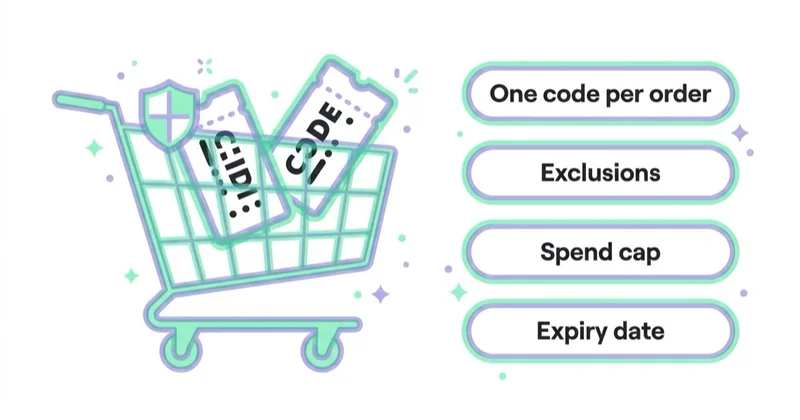
- whether two codes, loyalty points, sale prices and free shipping can stack;
- whether the threshold is evaluated before or after returns, tax and shipping;
- whether a partial return should recalculate the discount;
- whether gift returns or cancelled items create unintended refunds;
- whether the code works in excluded countries, currencies or channels;
- whether affiliates receive commission on heavily discounted orders;
- whether customer service can override the rule and how overrides are logged;
- whether inventory and fulfilment can handle the expected product mix.
Write these rules into the promotion brief and quality-assurance checklist. Margin should not depend on an unwritten assumption in the checkout code.
How to measure incremental contribution
Promotional revenue answers “How much did people buy with the offer?” It does not answer “How much did the offer cause?” The second question requires a counterfactual.
Where feasible, randomly assign eligible customers to:
- a treatment group that can receive or redeem the offer;
- a holdout group that receives the normal experience.
Measure both groups on an intention-to-treat basis. Do not compare redeemers with non-redeemers: redeemers often had higher buying intent before the promotion, so that comparison exaggerates the effect.
A useful calculation is:
Incremental contribution per eligible customer
= contribution per customer in treatment
 − contribution per customer in holdout
 − incremental campaign operating cost per customer
Then assess:
- conversion and contribution during the event;
- AOV, units and product mix;
- new versus returning-customer mix;
- cancellations, returns and customer-service cost;
- full-price revenue immediately after the event;
- repeat contribution at 30, 60 and 90 days or a cycle appropriate to the category.
If individual randomisation is not practical, a matched geography, store or audience holdout may help. A simple year-on-year or week-before comparison is weaker because seasonality, media spend, inventory and competitor activity also change.
The promotion brief: one page before production
Require the owner to complete these fields:
| Field | Decision |
|---|---|
| Business job | Acquisition, basket, reactivation, inventory or loyalty |
| Target behaviour | The specific action expected to change |
| Eligible audience | Inclusion, exclusion and abuse rules |
| Eligible products | SKU, inventory and channel scope |
| Mechanic | Benefit, threshold, code and stacking logic |
| Economics | Baseline and promoted contribution, break-even lift |
| Guardrails | Maximum cost, stock, complaint, return and fulfilment limits |
| Measurement | Holdout, primary metric and analysis window |
| Stop rule | Conditions that pause or end the campaign |
This prevents the offer from reaching creative production before anyone has defined success.
Price claims, urgency and compliance
Promotional claims must be genuine and transparent. Do not inflate a “was” price, restart a timer that claims an offer is ending, or hide mandatory fees until checkout. Requirements vary by jurisdiction, product and mechanic, so local review is necessary.
For consumer goods in the EU, an announced price reduction generally has to show the lowest price the trader applied during at least the previous 30 days, subject to defined national exceptions. UK competition guidance also warns against misleading reference prices and false urgency. In the United States, the FTC's Guides Against Deceptive Pricing address fictitious former-price comparisons.
Compliance is not only a legal task. A customer who discovers that the “exclusive final offer” appears every week has learned not to trust the brand or its full price.
How we approach promotions at Space Ads
We treat a promotion as a controlled commercial experiment. Before media or creative is scaled, we map order-level contribution, likely leakage, eligible customer and product cohorts, operational constraints and the measurement design. The promotion enters the calendar only when its primary job and break-even condition are explicit.
During the event, we monitor contribution and guardrails alongside traffic and revenue. After it, we look for return-rate changes, post-event softness and cohort quality. This connects performance marketing with merchandising, CRM and finance rather than asking advertising reports to explain the whole result.
The objective is not to avoid discounts. It is to use them where the changed behaviour is worth more than the contribution given away.
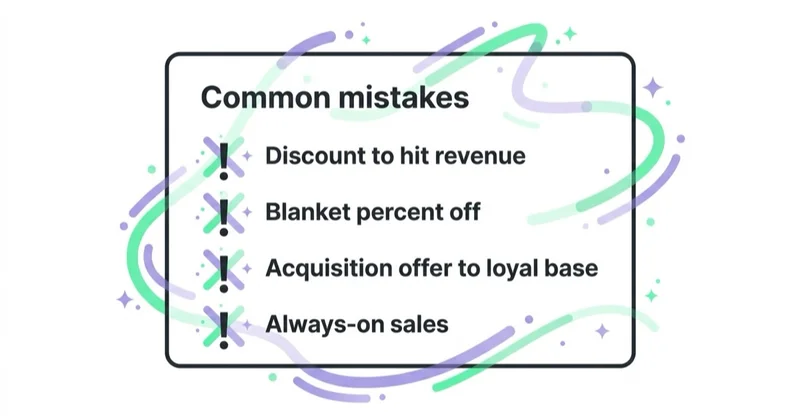
Common mistakes
- Approving a promotion from revenue targets without a contribution model.
- Applying one margin assumption to every SKU and shipping zone.
- Ranking mechanics as universally cheap or expensive.
- Giving a new-customer code to existing high-intent demand.
- Ignoring customers who would qualify without changing their basket.
- Allowing unplanned stacking, affiliate cost or coupon-site leakage.
- Evaluating only redeemers or the promotional week.
- Calling pull-forward incremental growth.
- Using fictitious reference prices or permanently restarting urgency cues.
Frequently asked questions
How do I calculate whether a discount is profitable?
Calculate contribution before and after the offer, including product cost, shipping subsidy, fulfilment, payment fees, expected returns and variable acquisition cost. Divide contribution before by contribution after to estimate the required volume multiplier. Then test whether the promotion actually creates that incremental volume rather than merely discounting existing demand.
What is the safest ecommerce promotion for margin?
There is no universally safest mechanic. A threshold can work when the added basket contribution exceeds the benefit across all qualifying orders. A bundle can work when it improves product mix. A gift can create high perceived value at low cost. Model the actual SKU, shipping, return and customer behaviour before choosing.
How should I set a free-shipping threshold?
Start with basket distribution and contribution, not a round number. Estimate which customers will add products, the contribution those products create, the shipping cost and the number of existing high-value orders that will receive free shipping without changing. Test the proposed threshold against a holdout or another level.
Why is promotional revenue misleading?
It includes customers who would have bought at full price, purchases shifted forward from a later period and orders that may be returned. Measure the difference in contribution per eligible customer between treatment and holdout, then subtract incremental campaign and operating costs.
Do promotions always train customers to wait?
No, but predictable and frequent discounting increases the risk. Research shows that promotional exposure can change reference prices, while long-term sales effects vary by category and context. Track full-price share, time to next order and post-promotion demand rather than assuming either permanent damage or no effect.
How often should an ecommerce store run promotions?
There is no universal cadence. Frequency should reflect the brand position, inventory cycle, category seasonality and evidence from prior tests. Set an annual promotion architecture, protect full-price periods and require a defined job for each event instead of filling every quiet week with a code.
Key takeaways
- A promotion must create enough incremental contribution to cover the margin and operating cost it gives away.
- Break-even volume can rise dramatically after even a familiar-looking percentage discount.
- Choose the mechanic for a defined customer or inventory job; no format is universally margin-safe.
- Segment audience, SKU and channel eligibility, then test stacking and return logic before launch.
- Measure treatment against a holdout on contribution per eligible customer and follow the cohort after the event.
- Keep reference prices, urgency and total-price claims genuine in every market.
Sources and further reading
- European Commission — Price Indication Directive and price-reduction guidance
- UK Competition and Markets Authority — urgency and price-reduction claims online
- US Federal Trade Commission — Guides Against Deceptive Pricing
- Journal of Retailing and Consumer Services — reference-price adaptation after promotion exposure
- Journal of Marketing Research — long-term effects of price promotions
Continue learning
Continue reading
WhatsApp Marketing for Business: How It Actually Works
WhatsApp marketing can support service, order updates, lead qualification, re-engagement and conversational commerce—but only with the right product, consent, templates and measurement. Learn how the Business App and Platform differ and how current per-message pricing works.
Loyalty Programs for Ecommerce and DTC: What Actually Works
An ecommerce loyalty program works only when it changes customer behaviour profitably. Compare points, tiers, cashback and paid membership, model the reward economics and measure incrementality without member-selection bias.
Free Shipping Strategy for Online Stores (Threshold, Margin, When)
Free shipping can improve the offer, but only when the additional contribution it generates exceeds the delivery subsidy. Learn how to choose a model, calculate a threshold and test the impact on profit rather than AOV alone.