Luxury and premium brand marketing should grow demand, distribution and customer value without weakening the cues that support the proposition and price. Luxury and premium are not interchangeable: a scarce heritage house, premium consumer product, high-end hotel and specialist service have different purchase cycles, inventory economics and pricing freedom. Frequent or poorly governed promotions can train some customers to wait and compress contribution, but not every markdown or value-added offer damages every brand. The operating task is to define which customers, channels, prices and experiences strengthen the franchise, then make paid media optimise for those outcomes rather than conversion volume alone.
TL;DR
- Start with the brand and business model. Define what makes the offer premium, which elements are scarce and where price flexibility is operationally necessary.
- Treat promotions as a governed portfolio decision. Measure who buys, margin after discount, repeat at full price, returns and channel effects — not only the campaign ROAS spike.
- Use paid media for several jobs: distinctive reach, product or category education, demand capture, client development and selective re-engagement.
- Optimise for meaningful value. Feed platforms contribution-aware or qualified values where reliable, and audit whether automation concentrates on low-margin or promotion-sensitive demand.
- Measure full-price and promotional cohorts separately, alongside contribution, returns, retention, distribution quality and brand evidence.
- Keep price and availability claims truthful. Artificial scarcity and resetting countdowns are deceptive practices, not luxury strategy.
- Growth can come from new audiences, markets, occasions, categories, service and retention without making the core proposition permanently cheaper.
Why the performance playbook fights luxury
Conversion-volume optimisation selects the outcomes encoded in the account. If every purchase has the same value, the system has no reason to distinguish a full-price new client from a low-margin repeat order, high-return product or promotion-only buyer. That is a measurement and objective problem, not proof that performance marketing is inherently incompatible with premium brands.
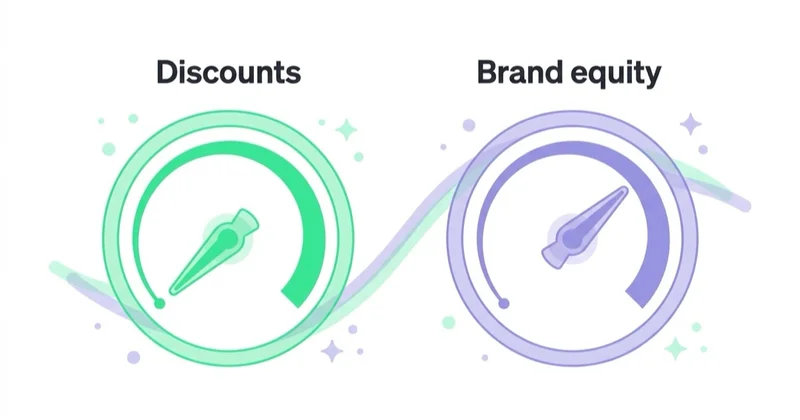
Price can signal quality, status or scarcity, but it also reflects materials, craft, service, distribution and supply. Repeated, predictable promotions may reset reference prices for some customers; the effect varies by brand, category, customer and promotion design. Academic research on downward luxury extensions likewise finds context-dependent dilution effects rather than one universal rule. Evaluate both the immediate contribution and the behaviour of subsequent cohorts.
False urgency is a separate issue. The US Federal Trade Commission identifies baseless countdown timers, false limited-time messages and fake discount claims as dark patterns. Genuine limited availability can be communicated clearly; invented scarcity should not be used by any brand.
What premium marketing optimises for instead
The shift is from "cheapest conversion" to "desire and full-price demand, protected over time". In practice:
| Dimension | Weak default | Premium operating choice |
|---|---|---|
| Primary lever | Price and promotion used without a role | Product, service, meaning, distinctiveness, availability and governed price |
| Creative | Interchangeable product and urgency claims | Evidence of design, craft, performance, provenance or experience |
| Audience | Cheap reach treated as qualified demand | Target-market coverage plus observed customer and cohort quality |
| Retargeting | High frequency and automatic discount escalation | Controlled frequency, relevant sequencing and truthful availability |
| Bidding | Every conversion receives the same value | Values aligned with contribution or qualified commercial outcomes |
| Success metric | Platform ROAS in isolation | Full-price and promotional contribution, customer quality and brand evidence |
The objective is not to make paid media “tasteful” but unaccountable. Each campaign needs a defined audience, role, message, exposure policy, business event and evaluation method. Brand activity can use reach quality, controlled lift or geo tests; demand capture can use contribution and new-client quality; client development can use cohort retention and value.
Running paid media for a premium brand
Paid channels work for luxury and premium — the discipline is in how they are used.
- Distinctive reach creates memory and context. Use video, visual social, publishing or partnerships where the audience and environment fit; assess target-market coverage, frequency and suitable brand or sales-lift evidence.
- Search captures expressed intent. Separate brand from non-brand and new from returning demand. A branded query is useful demand evidence but does not prove the ad created it.
- Re-engagement should be relevant and controlled. Set frequency and recency rules by purchase cycle, exclude recent buyers where appropriate and avoid automatic discount escalation.
- Value-based bidding needs credible values. Google Ads can optimise toward reported conversion value, but the system follows the values supplied. Use transaction-level contribution, qualified lead values or another defensible proxy and monitor cohort quality.
- Channel governance protects consistency. Agree marketplace, wholesale, outlet, private-client, markdown and geographic rules, while respecting applicable competition and pricing law.
The category-specific version of this for fashion is covered in luxury fashion marketing: build desire, not discounts; the principles extend to premium across categories — spirits, design, hospitality, automotive, high-end services.
Glossary
- Price integrity — maintaining a coherent and credible relationship between price, proposition, channel and customer experience.
- Brand equity — the accumulated value of a brand's perception, which premium pricing depends on.
- Full-price sell-through — the share of product sold at full price rather than on markdown.
- Premium positioning — the differentiated value and evidence that support a higher willingness to pay; it is not synonymous with artificial exclusivity.
- Value-based bidding — optimising toward the conversion values supplied to the platform, which are only as useful as their definition and measurement.
- Grey market / marketplace leakage — uncontrolled discounted presence that undermines the brand's price.
The discount trap
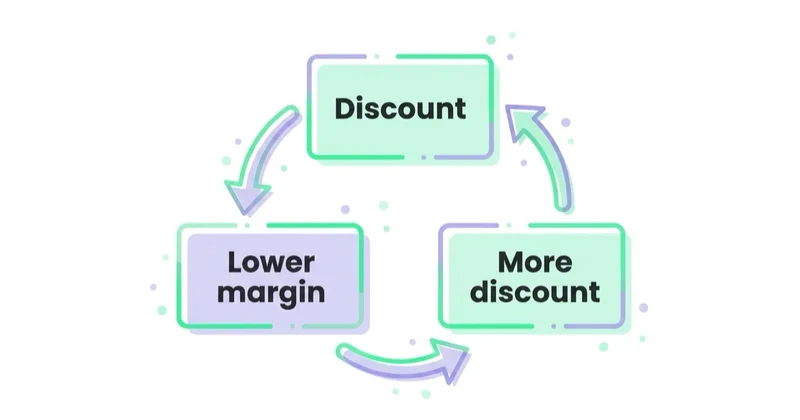
When sales soften or seasonal inventory remains, a promotion can improve sell-through and cash — or simply bring forward purchases that would have happened at full price. The answer is not “never discount.” It is to define the reason, eligible products and customers, channel, duration, expected contribution, inventory effect and post-promotion measurement before launch.
Separate a temporary inventory action from the core brand proposition. Alternatives may include private-client access, service, bundles, repair or care, limited editions, product architecture, geographic allocation or a controlled outlet. Each can also dilute the brand if poorly fitted or overused. The correct choice depends on customer response, unit economics and distribution, not a universal luxury rule.
Measurement: past discount-driven ROAS
Judging a premium brand on the same last-click, discount-driven ROAS as a mass brand actively pushes it toward the tactics that erode it. Better measures:
- Full-price sell-through — the clearest sign the brand is holding its value.
- Target-market reach and consideration — is the brand reaching and moving the intended audience at an appropriate frequency?
- Brand search and direct demand — useful demand signals, interpreted alongside seasonality, PR, distribution and other causes.
- Brand lift or controlled sales lift — measured with a suitable design and uncertainty range.
- Contribution after protecting price, not ROAS inflated by markdowns.
For high-consideration premium purchases, last-click also undersells brand-building the same way it does any demand-creation channel — which is why incrementality thinking matters here too.
Protect price integrity in the operating system
Premium positioning fails when media, CRM, retail, and sales use different rules. The operating plan should define promotion authority, channel-specific price floors, approved value-add offers, distribution exclusions, and what happens when a reseller discounts. Creative approval should check materials, setting, language, landing page, and neighboring inventory — not only the logo.
Measurement should separate full-price new customers, repeat customers, markdown buyers, and wholesale or marketplace volume. Contribution margin, return rate, time to second purchase, and full-price retention reveal whether growth strengthened the franchise. Platform ROAS can look excellent while concentrating demand among promotion-sensitive customers.
Incrementality matters when substantial direct, retail, referral or branded demand overlaps with paid media. Valid geo tests or audience holdouts can estimate lift for the tested activity. MMM can support portfolio scenarios, but its causal interpretation depends on controls, priors and partly untestable assumptions.
How Space Ads approaches premium and luxury
Our planning starts by defining the commercial architecture: target customer, full-price proposition, product and service hierarchy, distribution, inventory constraints, promotion authority and the role of each media channel. We then audit whether conversion events and values reward the behaviour the business actually wants.
The media plan separates distinctive reach, intent capture, client development and experiments. Reporting distinguishes full-price and promotional cohorts, new and returning customers, contribution, returns and distribution source. Value-based bidding is used only when the input values are reliable, and material promotions receive a pre-defined evaluation plan. That is performance marketing adapted to premium economics; the broader offer is on the luxury marketing service page. A fractional CMO can own the trade-offs across brand, ecommerce, retail, finance and merchandising.
Stop doing / Do instead
| Stop doing | Do instead |
|---|---|
| Running ungoverned discounts and false urgency | Define the promotion's role and keep availability claims truthful |
| Optimising every purchase to the same value | Use contribution-aware or qualified values and audit cohorts |
| High-frequency discount-led retargeting | Apply recency, frequency, exclusions and relevant sequencing |
| Volume-first bidding | Quality- and value-led bidding with first-party data |
| Judging on discount-driven ROAS | Measure full-price sell-through and brand equity |
| Using a markdown without a counterfactual | Model inventory, contribution, purchase timing and post-promotion behaviour |
FAQ
What is luxury and premium brand marketing?
It is the discipline of growing demand and customer value while preserving the proposition, experience, distribution and economics that support a higher willingness to pay. Luxury and premium models differ, so the media, price and measurement system should reflect the category, customer, inventory and purchase cycle.
Why shouldn't luxury brands discount?
They can discount, but should avoid frequent, predictable or poorly targeted promotions without measuring the long-term effect. A markdown may clear seasonal stock or serve a specific channel; it can also compress contribution, shift purchase timing and attract promotion-sensitive cohorts. Govern the purpose, products, audience, duration and post-promotion analysis.
Can you run paid ads for a luxury brand?
Yes. Paid media can build distinctive reach, explain product value, capture intent, support launches and develop client relationships. Define the role and evaluation method for each campaign. Use truthful scarcity, controlled frequency and conversion values aligned with contribution or qualified outcomes rather than relying on one platform ROAS.
How do you measure premium brand marketing?
Use a balanced view: full-price and promotional sell-through, contribution, returns, new-client quality, repeat purchase at full price, distribution mix, target-market reach and suitable brand or sales-lift evidence. Platform attribution remains useful for operations but does not establish incremental brand or revenue impact.
What is price integrity and why does it matter?
Price integrity is a coherent relationship between the price, proposition, channel and customer experience. It does not require identical prices in every situation, but it does require governed promotions, clear channel roles and an explanation for differences. Legal and contractual constraints must be reviewed before imposing reseller price controls.
How do premium brands grow without discounts?
Options include reaching new target customers and markets, increasing relevant occasions, improving service and retention, developing well-fitted products or experiences, strengthening distribution and removing purchase friction. Test each route against contribution, customer quality and brand evidence; lower price is only one lever, not a forbidden one.
Key takeaways
- Luxury and premium are distinct operating models; neither has one universal promotion or media rule.
- Frequent or poorly governed discounting can alter contribution, reference price and customer mix, but effects must be measured rather than assumed.
- Paid media should have explicit roles and optimise toward reliable business values, not undifferentiated conversion volume.
- Separate full-price and promotional cohorts and measure contribution, returns, retention, distribution and brand evidence.
- Keep scarcity and urgency truthful, and use experiments or assumption-aware models for material causal claims.
Sources and further reading
- Oxford Academic — Luxury brand extensions and perceived luxury
- Journal of Product & Brand Management — Vertical versus horizontal line extensions and dilution effects
- US Federal Trade Commission — Bringing Dark Patterns to Light
- Google Ads Help — Value-based bidding for Search and Shopping
- Google Meridian — Incremental outcome and response curves
Continue learning
- Luxury fashion marketing: build desire, not discounts
- How to choose a luxury fashion marketing agency
- Fashion marketing fundamentals
- Incrementality testing: geo experiments across Meta and Google
- Luxury marketing, run to protect price and desire
- Fractional CMO: ownership of brand and growth together
Continue reading
How to Choose a Performance Marketing Agency
Choose a performance marketing agency with a defined brief, evidence-based scorecard and clear commercial safeguards. This guide covers team evaluation, measurement, account access, fees, contracts and handover.
How to Get More From Your Existing Ad Budget (Improve Marketing Efficiency)
Improve the return from an existing ad budget by validating measurement, protecting profitable demand, testing allocation, improving the offer and conversion path, and tracking marginal business value.
Why Is My ROAS Dropping? The Usual Suspects, in Order
A ROAS decline can come from reporting, media cost, traffic mix, conversion, order value or a changed business context. Use this diagnostic sequence to protect downside, compare mature data and isolate the real driver.