A loyalty programme is a designed exchange: the customer shares attention, data or repeat business, and the retailer provides benefits in return. It succeeds only when that exchange changes behaviour enough to cover rewards, technology, operations and communication.
High member revenue is not proof. Customers who already prefer a brand are more likely to join its programme, so a simple comparison between members and non-members exaggerates the programme's effect. The commercial question is: what profitable behaviour occurred because the programme existed?
This guide explains when a loyalty programme fits an ecommerce or DTC model, how points, tiers, cashback and paid membership differ, how to model the economics and how to measure incremental contribution without confusing selection with impact.
TL;DR
- Do not launch a programme without a specific behaviour to change: second purchase, replenishment, cross-category adoption, frequency, retention or referral.
- Members are often better customers before joining. Measure against a valid control, not an unmatched non-member group.
- Match the mechanism to the purchase cycle. Points do not create purchase occasions that the category does not naturally have.
- Model reward cost, expected redemption, fulfilment, technology, service, fraud, returns and accounting treatment before setting the earn rate.
- Make progress and value easy to understand. Complex currencies and hidden expiry may reduce trust even if they increase short-term breakage.
- Treat programme enrolment, marketing consent and profiling transparently; they are not automatically the same permission.
- Fix product, service and delivery problems first. A rewards layer cannot compensate for a weak reason to return.
What is an ecommerce loyalty programme?
An ecommerce loyalty programme gives defined benefits in exchange for defined customer actions. Purchases are the most common action, but a programme may also recognise a product review, referral, subscription renewal, category trial or another behaviour with genuine business value.
This is different from customer loyalty itself. A customer may repeatedly buy because of product quality, convenience, habit, availability or emotional preference without joining any formal scheme. Conversely, a programme can produce reward-seeking behaviour without strengthening preference for the brand.
That distinction matters. A programme can aim to influence:
- behavioural loyalty: frequency, recency, spend, category breadth or share of wallet;
- attitudinal loyalty: preference, recognition, belonging or advocacy;
- data visibility: identifying purchases across channels and understanding customer patterns.
Choose which outcome matters before choosing points, levels or software.
When a loyalty programme is likely to fit
A programme has a stronger starting case when:
- customers have a credible reason to buy again;
- the natural purchase cycle is short enough to maintain progress;
- contribution margin can fund a meaningful benefit;
- there are useful products or categories to discover next;
- the brand can deliver rewards and resolve exceptions reliably;
- customer identity can be joined across relevant channels;
- the business has enough volume and time to measure change.
It has a weaker case when purchases are extremely infrequent, margins are thin, the experience is unreliable, customers buy only on deep promotion, or the expected benefit would be too small to matter. In these situations, improving product, service, availability, delivery or post-purchase communication may create more value.
Do not assume retention is automatically cheaper than acquisition. Existing customers still generate CRM, discount, service, return and fulfilment costs. Some would repurchase without an incentive. Acquisition and retention play different roles; compare their incremental contribution and payback rather than repeating a universal cost ratio.
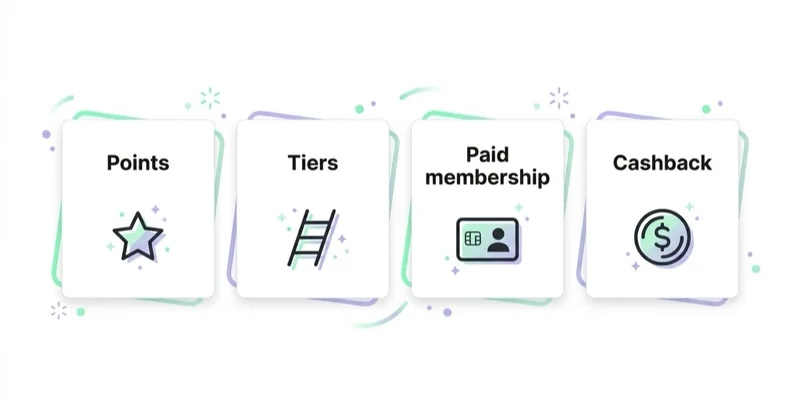
Loyalty programme types compared
| Model | How it works | Behaviour it may support | Main design risk |
|---|---|---|---|
| Points or stamps | A customer earns a currency and exchanges it for a reward | Repeat purchase and progress toward a goal | Slow progress or an opaque exchange rate |
| Cashback or store credit | A defined value is returned for future use | A next purchase within the validity period | Becoming an indiscriminate discount |
| Tiers | Benefits change when a customer reaches a status level | Concentration of spend, recognition, access | Benefits cost more than the changed behaviour |
| Paid membership | A recurring or fixed fee unlocks ongoing benefits | Frequency and commitment where value is clear | Weak value, involuntary renewal or heavy-user cost |
| Experiential or access programme | Members receive priority, services, content or events | Brand connection and differentiated treatment | Benefits are desirable but difficult to scale |
| Partner or coalition programme | Value can be earned or used across several businesses | Faster earning and broader utility | Data, liability and customer ownership become complex |
These models can be combined. A points programme may include tiers; a paid membership may offer free delivery and early access. More mechanics are not necessarily better. Every additional rule increases communication, technology and service complexity.
Points and stamps
Points work best when progress is visible, the reward is attainable within a relevant time and the exchange rate is understandable. Research on goal pursuit shows that perceived progress can increase completion effort, but that does not mean arbitrary “bonus” points will be profitable in every category.
Define:
- which actions earn points;
- how value maps to points;
- when points become available;
- minimum redemption and eligible rewards;
- expiry and notification rules;
- treatment of cancellations, refunds and partial returns;
- whether points and vouchers can be combined.
Use a reward catalogue only if the additional choice justifies the operational burden. A simple account credit can be clearer, while exclusive products or services can preserve perceived value without matching their retail price in cost.
Tiers
Tiers can recognise valuable behaviour and make benefits easier to differentiate. They are not inherently aspirational. A customer must understand the next level, believe it is attainable and value the incremental benefit.
Base status on a metric aligned with the goal—eligible contribution or purchase activity may be safer than raw revenue where margins vary widely. Set a qualification and requalification window, explain downgrades and model the cost of benefits used by customers who would have spent the same amount anyway.
Cashback and store credit
Cashback is easy to understand when the value is explicit. It is also close to a future discount, so it should have a job: encourage a second purchase, reactivate a specific cohort or support a category transition.
Track whether credit changes timing or merely subsidises the next order. A short expiry can create urgency but may frustrate customers; a long expiry increases outstanding balances and can delay learning. Conditions must be clear and compliant with local consumer law.
Paid membership
A paid programme needs a value proposition strong enough to justify the fee without relying on forgotten renewals. Benefits may include delivery, services, access, support or member pricing. Model usage by cohort: the customers most likely to subscribe may also consume the benefit most intensively.
State the billing period, renewal, price, benefits, exclusions and cancellation process before enrolment. Rules for recurring subscriptions vary by market. In the US, for example, the FTC continues to regulate negative-option practices through several laws and rules; businesses should verify current requirements rather than relying on an outdated “click-to-cancel” summary. Obtain local legal advice for every sales market.
Model the economics before setting an earn rate
Start with the incremental unit, not a headline reward percentage.
Incremental programme contribution = contribution caused by changed behaviour − reward and benefit cost − technology and operations − incremental communication and service cost − fraud and other variable programme costs
Avoid subtracting the same cost twice. If the order contribution already includes product, fulfilment, payment and return costs, do not add them again at programme level.
Estimate the expected cost of issued rewards
For a simple points currency:
Expected reward cost per point issued = probability of redemption × fulfilment cost per redeemed point
Refine the calculation by cohort, reward and expiry period. Redemption is not fixed: making the programme easier to use can increase both customer value and cost. Include taxes, delivery, partner settlement and service costs where applicable.
Then model:
- points or credit issued on purchases that would happen anyway;
- incremental orders and contribution generated;
- points reversed after cancellations and returns;
- benefit usage by high-frequency members;
- unredeemed balances and expiry assumptions;
- fraud, account sharing and promotion stacking;
- platform, integration, support and creative cost;
- the time between cost, redemption and incremental value.
Do not design around breakage—the share of rewards never redeemed—as a hidden profit source. High breakage may indicate that customers cannot see or use the value. It can also distort liability estimates and damage trust.
Accounting treatment depends on the programme and applicable standards. Under IFRS 15, some award credits can represent a separate performance obligation, with part of the transaction price allocated to them and recognised as a contract liability until the obligation is satisfied or expires. Work with a qualified accountant rather than treating all issued points as an immediate marketing expense.
A simple programme economics example
Assume an eligible customer would normally place two orders per year, each producing $24 of contribution before programme cost. A proposed programme issues a benefit that has an expected cost of $4 per order.
If the programme does not change behaviour, annual contribution falls from $48 to $40 before technology and service costs. If it causes an additional order with $24 contribution, total contribution becomes $72 less $12 of reward cost across three orders, or $60 before fixed programme costs. The incremental programme contribution is $12—not the $24 revenue-like value of the extra contribution in isolation.
Now account for customers who would have placed three orders without the programme, different redemption rates and returns. The result can change quickly. This is why average member revenue is not an economic model.
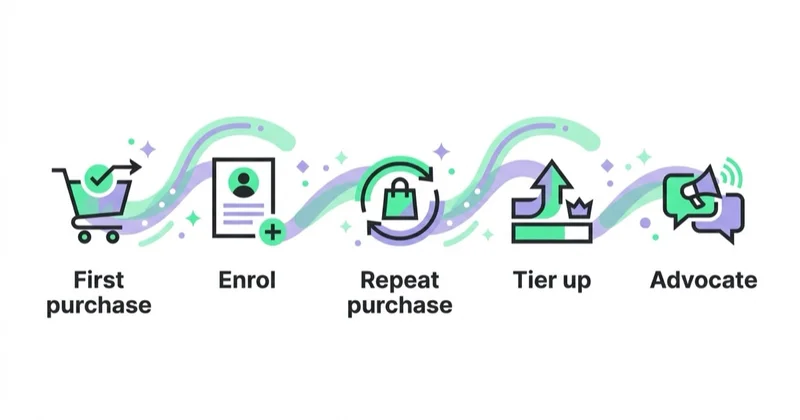
Design the member journey, not only the reward table
1. Enrolment
Explain the value in one sentence and show the essential conditions before sign-up. Ask only for data needed at that stage. Do not assume that accepting programme terms automatically creates valid permission for every email, SMS or profiling activity.
2. Activation
Define the first meaningful action: first identified purchase, profile completion, reward progress or another behaviour. A sign-up bonus should move a member toward useful participation, not create a balance that is too small to use or easy to exploit.
3. Earning and progress
Show balance, value, eligible actions and distance to the next meaningful benefit. Update progress reliably across ecommerce, stores and support channels. If points are pending during a return window, say so.
4. Redemption
Make redemption discoverable and test it on mobile. Avoid surprise exclusions at checkout. Decide whether members can combine points with discounts, gift cards, subscriptions and free-shipping thresholds, then apply the rule consistently.
5. Service and exceptions
Prepare for missing points, merged accounts, changed email addresses, cancelled orders, partial returns, fraud flags, deceased customers and programme closure. Service teams need permission and audit trails to correct balances safely.
6. Expiry, downgrade and exit
Notify customers before meaningful value expires or status changes. Explain what happens to points when an account is closed or the programme changes. Legal requirements differ by jurisdiction; programme terms should be reviewed locally.
Use communication to add utility, not noise
Programme messages should answer a customer question: What have I earned? What can I use now? What is expiring? What benefit is relevant to my next need?
Useful lifecycle communication can include:
- welcome and benefit explanation;
- progress after an eligible action;
- reward availability;
- relevant replenishment or category education;
- upcoming expiry or tier review;
- redemption confirmation;
- reactivation based on a plausible purchase cycle.
Frequency should respond to customer behaviour and channel permission. A loyalty account is not a licence for unlimited promotional contact. In the UK, ICO guidance states that organisations must use a valid lawful basis for direct marketing, be transparent about profiling and respect objections. Other markets have their own privacy and electronic-marketing rules.
For programme-triggered lifecycle design, see customer retention marketing and Klaviyo flows for ecommerce.
How to measure whether the programme works
Do not compare members with all non-members
This is the central measurement error. Loyalty research using Dutch grocery panel data found that the estimated effect on share of wallet was seven times smaller after accounting for customers self-selecting into membership than in a naïve model. The precise ratio belongs to that study and should not be generalised, but the direction is fundamental: better customers are more likely to join.
Prefer randomised eligibility or invitation
Where operationally and legally appropriate, randomly assign eligible customers to:
- programme access or a delayed-access control;
- different benefit structures;
- a communication treatment and holdout;
- a targeted reward and no-reward control.
If every customer must be allowed to join, a randomised invitation can estimate the effect of encouraging enrolment, although not every invited customer will participate. Preserve assignment and analyse customers in the group to which they were assigned. This avoids counting only people who chose to act.
When randomisation is not feasible, use a credible quasi-experimental design with pre-programme behaviour and clearly state its limitations. Simple matching can reduce observable differences but cannot guarantee that unobserved motivation has been removed.
Choose a decision-relevant primary metric
For many programmes, the commercial primary metric is:
Incremental contribution per eligible customer over a defined period
Supporting metrics include:
- enrolment and activated-member rate;
- time to first and second purchase;
- purchase frequency and interpurchase time;
- contribution per order and per customer;
- cross-category adoption;
- issued, redeemed, expired and reversed value;
- reward cost and outstanding liability;
- cancellation, return and fraud rates;
- paid-member renewal and benefit utilisation;
- opt-out, complaint and service-contact rates.
Choose a window that reflects the natural purchase cycle. A 30-day test cannot evaluate annual repurchase or paid-member renewal. Avoid repeatedly checking results and ending the experiment as soon as one metric looks favourable.
Which customers should receive which benefit?
More generous treatment should not simply go to the highest historical spenders. Heavy buyers may have little room to change, while light or moderate buyers may respond—but only if their lower activity reflects opportunity rather than weak fit.
Segment on a decision hypothesis:
- recent first-time buyers who need a reason for a second purchase;
- replenishment customers approaching a normal reorder window;
- multi-category prospects with a relevant next product;
- valuable customers at genuine risk of lapsing;
- members close to an attainable reward;
- paid members underusing a benefit they knowingly purchased.
Test uplift by segment. A predictive “likely to buy” score often selects customers who need no incentive. An uplift model or experiment asks the more useful question: who is more likely to change because of this treatment?
How Space Ads approaches loyalty strategy
We treat a loyalty programme as a measurable customer proposition, not a plugin or points calendar. The working sequence is:
- define the behaviour and eligible customer group;
- establish the natural baseline and measurement window;
- model reward, fulfilment, return and operating economics;
- choose the simplest mechanism capable of changing the behaviour;
- design enrolment, progress, redemption and service journeys;
- implement a valid control or the strongest feasible alternative;
- evaluate incremental contribution and customer safeguards;
- scale, redesign or stop based on evidence.
A marketing audit can identify whether current loyalty reporting confuses membership with impact. Email marketing and performance marketing can then work from the same customer definitions, permissions and commercial outcomes.
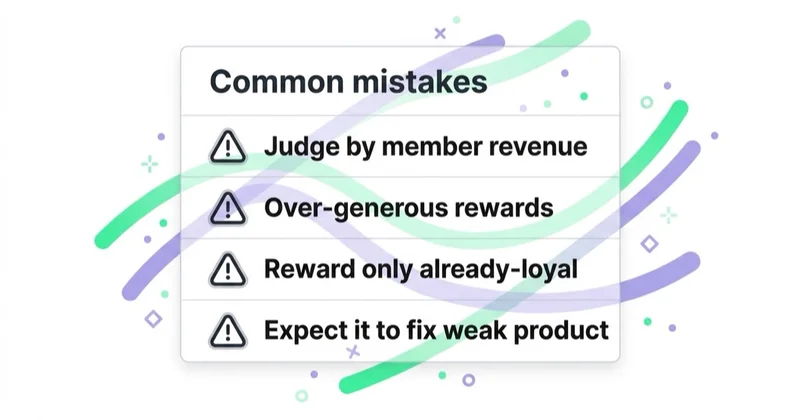
Common mistakes
| Mistake | Better approach |
|---|---|
| Launching points because competitors have them | Define the behaviour and economics first |
| Treating all member revenue as programme impact | Use randomised eligibility, invitation or a credible counterfactual |
| Setting rewards as a percentage of revenue | Model expected cost against incremental contribution |
| Giving the richest rewards to existing heavy buyers | Test where treatment changes behaviour profitably |
| Making value difficult to understand | Show the exchange rate, progress, conditions and expiry clearly |
| Ignoring returns and fraud | Reverse rewards consistently and monitor abuse |
| Equating membership with marketing consent | Manage terms, privacy and channel permission separately |
| Depending on expired points for profit | Build a benefit customers can understand and use |
| Measuring too soon | Match the evaluation window to the purchase cycle |
FAQ
Do ecommerce loyalty programmes work?
They can change purchase behaviour, but effects vary by programme, segment and category. Research also shows that naïve member-versus-non-member comparisons can greatly overstate impact because stronger customers self-select into programmes. Evaluate incremental contribution against a valid control and include reward and operating costs.
Which loyalty programme type is best for ecommerce?
There is no universally best type. Points can support repeated progress, cashback offers explicit value, tiers differentiate treatment, and paid membership can fund ongoing benefits. Choose the simplest mechanism aligned with the behaviour, purchase cycle, margin and service capability you actually have.
How should loyalty points be valued?
Define both customer-facing value and expected business cost. For cost, estimate redemption probability multiplied by fulfilment cost per redeemed point, then refine for reward mix, expiry, delivery, returns and cohort behaviour. Accounting value may differ; obtain advice under the standards applicable to your business.
What is a good loyalty programme redemption rate?
There is no universal benchmark. A high rate can indicate useful rewards or excessive generosity; a low rate can indicate new balances, long purchase cycles, poor communication or unattractive value. Compare redemption by cohort and age of points, then judge it alongside incremental contribution, liability and customer feedback.
How do I measure loyalty programme ROI?
Estimate the additional contribution caused by the programme and subtract reward, benefit, technology, service, communication and fraud costs. Divide by the programme investment only if the numerator and denominator use the same period and cost scope. A randomised holdout provides a stronger causal baseline than total member revenue.
Should rewards target the most loyal customers?
Recognition and retention of valuable customers can be a valid objective, but heavy buyers may have limited incremental potential. Test benefits among defined segments, including first-time, moderate and at-risk customers, and distinguish appreciation from a promotion intended to cause extra purchases.
Should loyalty points expire?
Expiry can limit open-ended balances and encourage use, but it can also reduce trust and may be regulated. Set a period appropriate to the purchase cycle, disclose it clearly, notify customers before material value expires and verify local consumer and accounting requirements.
Can a loyalty programme fix low repeat purchase?
Only if the main barrier is something the programme can change. If customers do not return because of product quality, service, availability, delivery or poor category fit, rewards may subsidise a small number of purchases without fixing the cause. Diagnose the repeat-purchase problem first.
Key takeaways
- Formal rewards and genuine customer loyalty are not the same thing.
- Start with a changeable behaviour, eligible group and contribution model.
- Programme mechanics must fit the natural purchase cycle and customer value proposition.
- Member revenue is biased by self-selection; measure against a valid counterfactual.
- Include reward redemption, operations, returns, fraud, liability and privacy in the design.
- A clear, usable benefit is more sustainable than profit built on confusion or breakage.
Sources and further reading
- International Journal of Research in Marketing — Do loyalty programs really enhance behavioral loyalty? An empirical analysis accounting for self-selecting members
- Journal of Marketing — The Long-Term Impact of Loyalty Programs on Consumer Purchase Behavior and Loyalty
- Journal of Consumer Research — The Endowed Progress Effect: How Artificial Advancement Increases Effort
- IFRS Foundation — IFRIC 13 Customer Loyalty Programmes and transition to IFRS 15
- UK Information Commissioner's Office — Direct marketing guidance
- US Federal Trade Commission — Negative Option Rule
Continue learning
Continue reading
Ecommerce Promotions and Discounts Without Killing Margin
A promotion should change profitable customer behaviour, not merely lower the price of orders that would have happened anyway. Learn how to calculate break-even lift, choose the right mechanic, prevent leakage and measure incremental contribution rather than promotional revenue.
WhatsApp Marketing for Business: How It Actually Works
WhatsApp marketing can support service, order updates, lead qualification, re-engagement and conversational commerce—but only with the right product, consent, templates and measurement. Learn how the Business App and Platform differ and how current per-message pricing works.
Marketing Calendar 2027: Plan the Year Around Lead Times, Not Dates
Build a practical 2027 marketing calendar with verified US and UK dates, market-specific checks and realistic lead times. Use the planning framework to align campaigns, stock, creative, tracking and fulfilment.