Free shipping can make an ecommerce offer easier to understand and more attractive. It can also turn profitable orders into loss-making ones. The delivery cost has not disappeared: the retailer has agreed to subsidise it.
The right question is therefore not simply “Does free shipping increase conversion?” It is: “Does the additional contribution generated by this policy exceed the shipping subsidy, fulfilment cost and any change in returns?” A threshold may be the right answer, but unconditional free delivery, a flat rate, collection or a membership benefit can be better in a different business model.
This guide explains how to make that decision using order economics and a controlled test—not a copied competitor threshold or an arbitrary percentage above average order value.
TL;DR
- Free shipping is a pricing and fulfilment policy, not a cost-free promotion.
- Do not choose a threshold from AOV alone. Use the full distribution of basket values, contribution margin, delivery zones, product weight, fulfilment and returns.
- A higher AOV does not prove success. The main commercial measure should be contribution per visitor or eligible customer.
- A threshold has two opposing effects: some customers add products, while others pay for delivery or leave. It also subsidises orders that would have qualified anyway.
- Show costs, eligibility rules and delivery times early. The conditions shown in ads, product feeds and the store must agree.
- Test several economically viable policies against a holdout before rolling one out to every customer.
What does “free shipping” actually mean?
Free shipping means the customer is not charged a separate delivery fee under specified conditions. It does not mean fulfilment is free. The retailer still pays some combination of carrier charges, packaging, picking and packing, insurance, cross-border fees and the operational cost of returns.
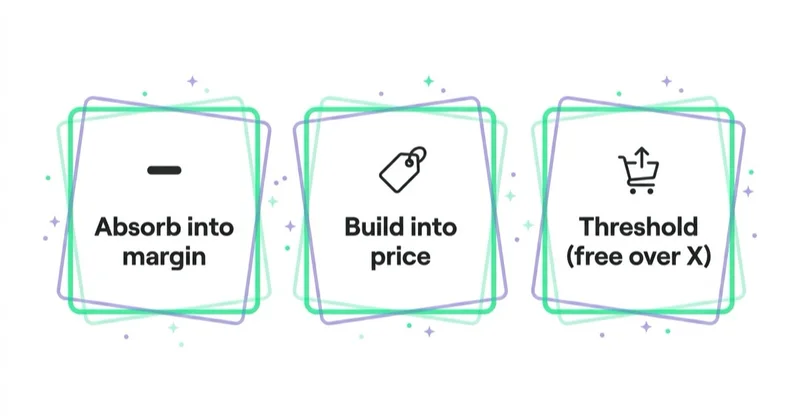
The policy can take several forms:
| Model | Customer proposition | When it may fit | Main risk |
|---|---|---|---|
| Unconditional free shipping | Standard delivery is free on every eligible order | High contribution margins and predictable delivery costs | Subsidising small or expensive-to-ship orders |
| Order-value threshold | Delivery is free above a stated basket value | Customers can sensibly add complementary products | Lost orders if the threshold feels unreachable |
| Flat rate | One clear delivery fee applies | Costs vary, but simplicity matters | Undercharging costly orders or overcharging local ones |
| Product- or region-specific policy | Eligibility depends on SKU, weight or destination | Bulky ranges and wide geographic coverage | Rules become difficult to understand |
| Member benefit | Free delivery is tied to a paid or loyalty tier | Repeat purchase and retention are central to the model | Heavy users consume more benefit than their value supports |
| Limited promotion | Free delivery applies for a defined period or campaign | Incrementality can be measured against a holdout | Training customers to wait for offers |
| Collection or local delivery | A lower-cost fulfilment option replaces parcel delivery | Stores, lockers or local routes are available | Poor coverage or an inconvenient customer experience |
The strongest strategy is not always the one with the word “free” in it. It is the model that gives customers a clear proposition while preserving the economics needed to fulfil the promise reliably.
Why shipping cost affects conversion
Delivery cost is part of the purchase decision, even when it appears late in the journey. In Baymard Institute's 2025 US survey, 39% of respondents who had abandoned during checkout cited extra costs—including shipping, tax and fees—as a reason. That finding supports cost transparency, but it does not prove that every retailer should absorb delivery on every order.
Customers can respond to a free-shipping threshold in several ways:
- add a useful product and qualify;
- replace an item with a higher-priced alternative;
- accept the delivery fee;
- postpone or abandon the purchase;
- add a product only to return it later.
Academic research on nonlinear shipping fees confirms that purchase incidence and basket size can change, but the effect is heterogeneous. A promotion may generate more revenue and still be unprofitable after forgone shipping income and differences between customer segments. This is why a universal claim such as “free shipping always increases profit” is not credible.
Calculate order contribution before choosing a policy
AOV is useful context, but it is not a profit measure. Start with contribution at order level:
Order contribution = product revenue + delivery revenue − cost of goods − carrier cost − picking, packing and packaging − payment fees − expected return and cancellation cost − other variable costs
Depending on the decision, include variable acquisition cost as well. Keep the definition consistent between the baseline and test group.
Why a higher AOV can still reduce profit
Assume a customer has a $55 basket and would pay $6 for delivery. A $70 free-shipping threshold encourages them to add a $15 item. After product cost, payment fees and the expected return provision, that item contributes $5. The retailer then gives up the $6 delivery charge.
The basket value has increased by $15, but order contribution has fallen by $1—before any extra weight, split shipment or handling cost. The threshold has improved AOV and made the economics worse.
This simple example reveals two common measurement errors:
- treating revenue from an added item as if it were margin;
- looking only at orders that reached checkout, rather than all visitors exposed to the policy.
How to set a free-shipping threshold
There is no reliable rule that the threshold should sit 15%, 20% or 30% above AOV. An average hides the shape of the order distribution. Two stores can have the same AOV and require very different thresholds because one has tightly clustered baskets while the other mixes many small orders with a few very large ones.
Use the following process.
1. Segment the economics
Analyse at least the dimensions that materially change cost or behaviour:
- market, currency and delivery zone;
- new versus returning customer;
- product category, weight and dimensions;
- standard, express, locker and collection options;
- margin band and promotional status;
- single- versus multi-parcel fulfilment;
- return rate and return cost.
A single global threshold is easy to communicate, but it may subsidise remote zones, oversized products or low-margin categories disproportionately. If exclusions are necessary, keep them limited and explain them plainly.
2. Examine the full basket-value distribution
Review the median, percentiles and number of orders within practical intervals—not only AOV. Identify:
- the share of orders that would already qualify at each candidate threshold;
- how far non-qualifying baskets are from that threshold;
- which genuinely useful products could close the gap;
- the contribution those products generate;
- whether customers are likely to need multiple items or an implausibly large addition.
Orders that already qualify create subsidy leakage: the store loses delivery revenue without changing the customer's behaviour. That cost belongs in the model.
3. Model realistic customer responses
For every candidate threshold, estimate several outcomes rather than assuming that all customers will add an item:
- no behavioural change and delivery is subsidised;
- profitable basket expansion;
- unprofitable basket expansion;
- customer pays for delivery;
- customer abandons;
- customer qualifies, then returns the filler item;
- order becomes heavier or requires another parcel.
Use historical basket combinations and product margins where possible. A convenient add-on is only valuable if customers actually want it and the extra contribution exceeds the cost it triggers.
4. Shortlist policies that can work economically
Compare candidate thresholds with credible alternatives, such as:
- a clear flat rate below the threshold;
- free collection or locker delivery;
- a lower threshold for low-cost zones;
- exclusions for oversized products;
- free standard delivery but paid express delivery;
- a member benefit for customers with sufficient expected lifetime value.
Do not test options that fail under reasonable assumptions. Experimentation should resolve behavioural uncertainty, not rescue a policy that is structurally loss-making.
5. Run a controlled test
Randomly assign eligible visitors or customers to a control policy and one or more viable variants. Keep assignment stable so the same person does not see contradictory conditions during one decision journey.
Measure results for long enough to capture normal weekday, campaign and payday effects. Where returns are material, wait for a representative return window before making the final decision.
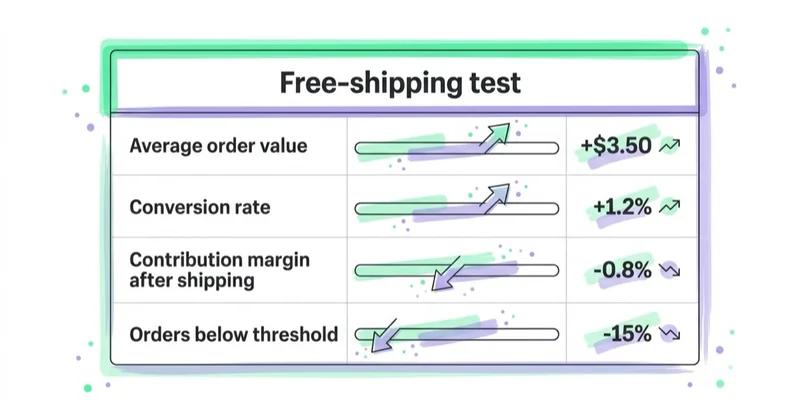
What to measure in the experiment
The primary metric should connect behaviour to economics. In many stores that is:
Contribution per eligible visitor = total contribution generated by the group ÷ eligible visitors assigned to the group
Contribution per customer or session may be appropriate if assignment and identity resolution support it. Use the same unit in every variant.
Diagnostic metrics should include:
- conversion rate;
- AOV and median order value;
- units per transaction;
- contribution per order;
- delivery subsidy per order;
- share of orders already above the threshold;
- paid versus free delivery mix;
- split-shipment and fulfilment cost;
- cancellation and return rate, including returns of threshold-filling items;
- delivery-option selection;
- repeat purchase and customer contribution over a defined window.
Do not declare victory because conversion or AOV moved in isolation. A threshold is commercially successful only when the incremental value exceeds its full incremental cost within the decision horizon.
Design the customer experience around clarity
A profitable policy can still fail if customers discover its conditions too late. State the delivery proposition on relevant product pages and repeat it in the basket. Once destination or postcode is known, show the applicable cost and delivery estimate rather than a generic promise.
A useful threshold experience should answer:
- what basket value qualifies;
- whether the value is calculated before or after discounts and tax;
- which country, region, product and delivery service is eligible;
- whether gift cards, subscriptions or marketplace items count;
- what happens to delivery charges after a partial return;
- whether express delivery remains paid.
A basket progress message can show how much remains, but it should not pressure customers into irrelevant purchases. Recommend complementary products only when they are useful, available and economically sensible.
The same rules must be reflected in product feeds and campaigns. Google Merchant Center supports a free_shipping_threshold attribute and requires complete, accurate shipping cost and speed information. Rates and conditions in Merchant Center should match the website; bulky or exceptional products can use product-level shipping settings.
Price-transparency law varies by market. For example, UK guidance requires mandatory charges to be included in the total price shown upfront and prohibits hiding unavoidable fees until later. Confirm the rules in every country in which you sell rather than treating one jurisdiction's guidance as global legal advice.
When each shipping model is more likely to fit
Consider unconditional free standard delivery when
- contribution margin is high enough to absorb the cost;
- carrier and fulfilment costs are predictable;
- small orders are uncommon or still profitable;
- the price architecture can support the benefit without becoming uncompetitive;
- a controlled test shows positive contribution, not only higher conversion.
Consider a free-shipping threshold when
- customers can add genuinely complementary products;
- the added products have enough contribution to fund the subsidy;
- a manageable proportion of orders already qualifies;
- the target is attainable without encouraging excessive returns;
- the policy can be communicated without a long list of exceptions.
Consider a flat rate, collection or segmented policy when
- shipping cost varies sharply by weight, dimensions or region;
- the range includes bulky or low-margin products;
- the threshold would be unrealistically high;
- local collection is convenient and materially cheaper;
- customer segments have very different purchase frequency or lifetime value.
Free shipping or a product discount?
Neither option is universally stronger. A product discount changes the price of the merchandise; free shipping removes a delivery charge. Customers may perceive them differently, and their costs differ by basket, zone and product mix.
Compare offers with a similar expected cost to the business and measure contribution per visitor. For example, a 10% discount can be much more expensive on a high-value basket, while free shipping can be more expensive on a low-value, remote or bulky order. The correct comparison uses actual order economics, not the face value of the message.
If promotions are frequent, evaluate how the shipping policy interacts with voucher stacking, sale items and loyalty benefits. See our guides to ecommerce promotions without killing margin and loyalty programmes for ecommerce and DTC.
How Space Ads approaches free-shipping decisions
We treat free shipping as part of offer design, measurement and fulfilment economics. The working sequence is:
- define the baseline policy and contribution formula;
- segment baskets and delivery costs;
- model thresholds and alternative delivery propositions;
- remove variants that cannot work economically;
- test the viable options against a stable control;
- evaluate contribution, customer behaviour and operational effects;
- document the policy and monitor it as product mix and carrier rates change.
This approach avoids two shortcuts: copying another store's threshold and optimising for platform revenue alone. A marketing audit can connect offer economics with tracking quality, while performance marketing helps test the proposition across acquisition and onsite behaviour.
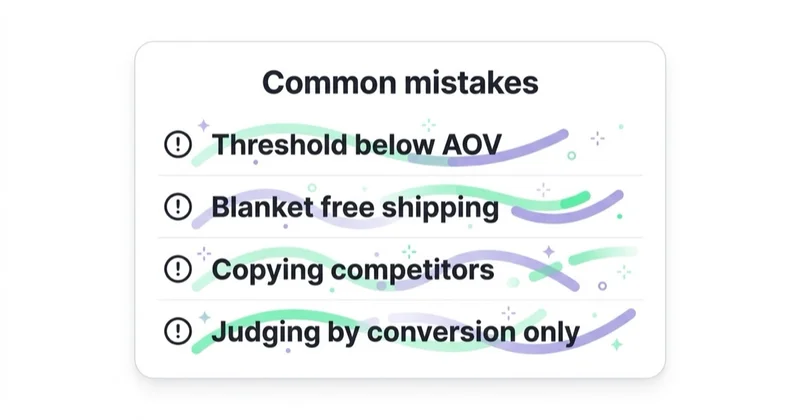
Common mistakes
| Mistake | Better decision |
|---|---|
| Setting the threshold at an arbitrary percentage above AOV | Use the basket distribution and contribution model |
| Counting all qualifying orders as incremental | Separate changed behaviour from orders that already qualified |
| Judging success by AOV or conversion alone | Measure contribution per eligible visitor or customer |
| Ignoring returns and split shipments | Include expected post-purchase and fulfilment cost |
| Copying a competitor's threshold | Model your products, margins, customers and zones |
| Hiding conditions until checkout | Show accurate costs, eligibility and timing early |
| Offering one rule across a highly variable range | Use simple, explicit exclusions or alternative services |
FAQ
Does free shipping increase ecommerce sales?
It can increase conversion or basket value, but the size and profitability of the effect depend on the store, customer segment and policy. Some customers add products, some pay for delivery and some leave. Test the effect on contribution per visitor rather than assuming a general conversion uplift applies to your store.
How far above AOV should a free-shipping threshold be?
There is no defensible universal percentage. AOV does not show how baskets are distributed or how much contribution an extra item generates. Model candidate thresholds using basket-value bands, already-qualifying orders, product margin, shipping cost and returns, then test the economically viable options.
How do I calculate whether free shipping is profitable?
Compare contribution under the current and proposed policies. Include product revenue, any delivery revenue, cost of goods, carrier and fulfilment cost, payment fees, returns and other variable costs. Evaluate the result per eligible visitor or customer so both conversion changes and order economics are represented.
Should I build shipping cost into product prices?
Only if the resulting prices remain credible and the allocation is fair across customers and products. A uniform price increase can make local or multi-item orders subsidise expensive deliveries and may weaken price competitiveness. Model it as one policy option, not as a way to make delivery cost disappear.
Should free shipping include free returns?
Not automatically. Outbound delivery and returns are separate economic and customer-experience decisions. State who pays for a return, which products qualify, the return window and how refunds affect an original shipping benefit. Follow consumer law in each market.
What happens if a partial return takes the order below the threshold?
The answer depends on the store's published policy and local law. Decide in advance whether the original delivery fee can be deducted from the refund, explain the rule before purchase and implement it consistently. Seek local legal advice before using a deduction that could conflict with consumer rights.
How often should the threshold be reviewed?
Review it when carrier rates, product margins, basket mix, currencies, return behaviour or delivery zones change materially. Also monitor it after major promotions and assortment changes. A threshold that worked last quarter can become unprofitable without any visible change in conversion.
Key takeaways
- Free shipping is a subsidy that must be funded by incremental contribution.
- A threshold is one option, not the default answer for every store.
- Use the basket distribution and full order economics; do not rely on AOV alone.
- Count subsidy leakage, fulfilment, returns and behavioural differences between segments.
- Keep conditions clear and consistent across the store, campaigns and product feeds.
- Make the rollout decision from a controlled test with contribution as the primary commercial outcome.
Sources and further reading
- Baymard Institute — Cart abandonment rate statistics and reasons
- INFORMS, Marketing Science — An Empirical Study of the Impact of Nonlinear Shipping and Handling Fees on Purchase Incidence and Expenditure Decisions
- SSRN — Free Shipping Is Not Free: A Data-Driven Model to Design Free-Shipping Threshold Policies
- Electronic Commerce Research and Applications — Filler-item recommendations and free-shipping thresholds
- Google Merchant Center Help — Free shipping threshold attribute and shipping configuration guidance
- UK Competition and Markets Authority — Providing clear and accurate information about prices
Continue learning
Continue reading
Ecommerce Promotions and Discounts Without Killing Margin
A promotion should change profitable customer behaviour, not merely lower the price of orders that would have happened anyway. Learn how to calculate break-even lift, choose the right mechanic, prevent leakage and measure incremental contribution rather than promotional revenue.

Marketing Calendar 2027: Plan the Year Around Lead Times, Not Dates
Build a practical 2027 marketing calendar with verified US and UK dates, market-specific checks and realistic lead times. Use the planning framework to align campaigns, stock, creative, tracking and fulfilment.
Loyalty Programs for Ecommerce and DTC: What Actually Works
An ecommerce loyalty program works only when it changes customer behaviour profitably. Compare points, tiers, cashback and paid membership, model the reward economics and measure incrementality without member-selection bias.