Email, SMS, and push are permission-based direct channels, but none is fully “owned.” Reach depends on valid contact data or device tokens, user permission, mailbox providers, carriers, operating systems, browsers, vendors, and applicable law. Each also has a different cost, format, identity model, and level of interruption.
Choose the channel from the customer need and message purpose. A delivery alert is not the same as a promotion; a back-in-stock request is not blanket permission for every sale. Use the least intrusive channel that can do the job, respect stated preferences, and measure whether adding another contact creates incremental value.
TL;DR
- Email supports depth and broad addressability. It also depends on deliverability, rendering, permission, and inbox competition.
- SMS is concise and interruptive. It normally carries per-message and carrier costs plus country-specific sender, consent, registration, and quiet-hour requirements.
- Push can be timely and contextual. It requires app or browser permission on each device, implementation infrastructure, and a clear value exchange.
- Service and marketing must be separated. Order, security, and delivery notifications can have different customer expectations and legal treatment from promotions.
- Permission is channel-, purpose-, sender-, and market-specific. A phone number, email address, app install, or prior order is not universal marketing consent.
- Orchestration is suppression as well as sending. Stop later touches after purchase, resolve overlaps, cap frequency, and honor channel preference.
- Measure marginal value. Compare the incremental contribution and opt-out cost of adding SMS or push to an email-only journey.
Three channels, three jobs
Start with six questions: Is the message transactional, service-related, or promotional? How quickly does it lose value? How much information must it carry? Which channel and purpose did the person choose? What does delivery cost? What happens if the message is delayed, duplicated, or missed?
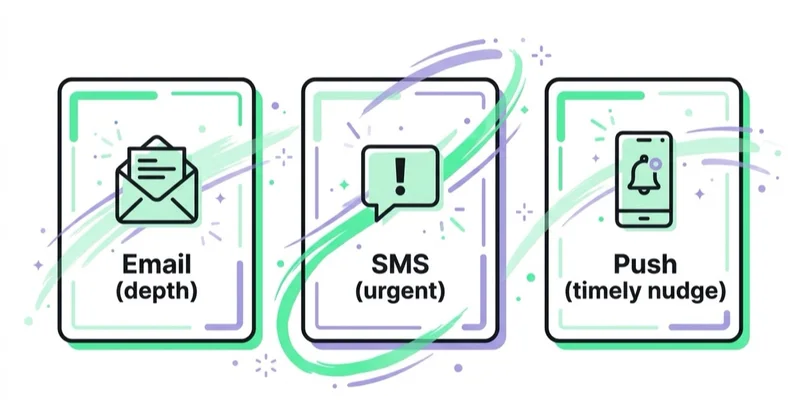
The answer is not fixed by format alone. A customer may prefer email for price alerts, SMS for delivery, and no marketing push at all. A flash-sale text is appropriate only when the deadline is genuine, the person agreed to promotional texts, local timing rules permit it, and the expected value justifies the interruption and cost.
Email: the workhorse
Email supports longer copy, images, accessible links, preference management, and many lifecycle use cases. It often has a lower marginal delivery cost than SMS, but it is not free or universal: platform fees, profile limits, creative production, data quality, mailbox rules, and inbox placement all matter. A person can also use several addresses or withhold permission.
Do not infer attention from opens alone, especially after Apple Mail Privacy Protection. Follow sender authentication and unsubscribe requirements, and measure filtered clicks, on-site behavior, commercial outcomes, and complaints. Candidate automations are discussed in the Klaviyo flows every store needs.
SMS: scarce, immediate, powerful
SMS appears prominently on many devices and works with short text and links, but “open rate” is not measured in the same way as email and should not be used as a cross-channel proof point. Delivery receipts also do not prove a human read. Costs vary by country, sender type, carrier, direction, and message length or encoding.
Twilio's messaging policy requires prior express consent for messages sent through its services, clear sender identification, and a straightforward opt-out. US programs can also require sender registration and quiet-hour controls; other markets have their own laws and carrier rules. Separate promotional SMS from essential service notifications in both consent and reporting. See SMS and RCS marketing.
Glossary
- Direct channel — communication sent to an address, number, app, or browser endpoint subject to permission and intermediary rules.
- Push notification — an app or browser notification delivered through platform and push-service infrastructure after permission.
- Delivery receipt — a technical delivery status, not proof that the person read or acted on a message.
- Permission / consent — the documented basis for a specific sender, purpose, channel, recipient, and market.
- Orchestration — coordinating channels so each does its strength within one flow.
- Speed-to-read — how fast a message is seen; SMS within minutes, email on the user's schedule.
Push: contextual re-engagement
Push requires an app or supported browser, device-level permission, a valid subscription or token, and technical infrastructure. A user must grant web permission separately on each browser or device. The per-message network charge may be low, but development, platform, data, and operations are real costs.
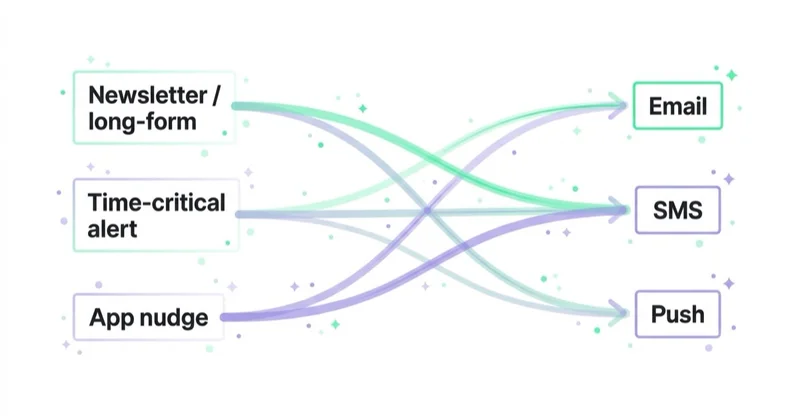
Ask for permission after a meaningful user action, when the benefit is clear. Google's web guidance warns against requesting notification permission on page load and recommends an obvious value proposition plus a way to disable notifications. Useful examples include a requested back-in-stock alert or delivery update. Behavioral data still needs appropriate privacy governance and truthful context.
Orchestrate, don't duplicate
Orchestration begins with eligibility and suppression. Before each step, check purchase, refund, service case, inventory, consent, quiet hours, recent contacts, and channel preference. Decide which channel has priority and what evidence justifies a fallback. An abandoned-cart journey does not need all three channels by default.
Sometimes repetition is useful—for example, an important service update requested on two channels. The problem is unplanned duplication. Use marketing automation to coordinate timing and suppression, then test whether the additional channel improves incremental contribution enough to offset message cost, opt-outs, and complaints.
How Space Ads approaches channel choice
At Space Ads, channel choice starts with purpose, customer preference, urgency, information density, market rules, expected contribution, and downside if the message is missed. Transactional and promotional journeys are mapped separately, with channel-specific permission and suppression logic.
We establish an email-only or existing-journey baseline, then test whether SMS or push adds incremental conversions, margin, or service value. The scorecard includes cost, delivery, complaints, opt-outs, downstream quality, and customer outcomes. This lives in email marketing, SMS marketing, and marketing automation.
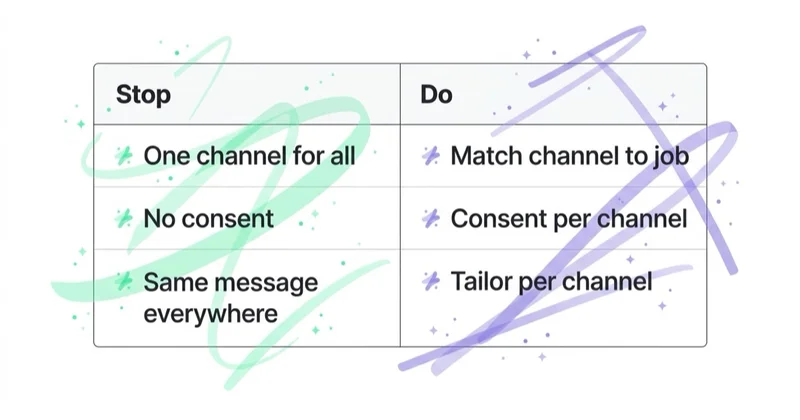
Stop doing / Do instead
| Stop doing | Do instead |
|---|---|
| Blasting the same message on all three channels | Match each message to the channel that fits it |
| Adding channels because they are available | Add one when customer need and incremental economics justify it |
| Over-texting your SMS list | Reserve SMS for urgent/high-value moments, sparingly |
| Treating push as a broadcast channel | Use push for behaviourally-triggered, contextual nudges |
| Treating contact details as universal permission | Store permission by sender, purpose, channel, market, and source |
| Sending channels in isolation | Orchestrate them within one flow, each doing its strength |
FAQ
What's the difference between email, SMS and push for marketing?
Email supports richer content and often lower marginal cost. SMS is concise, interruptive, and usually priced per message plus carrier fees. Push can be contextual but requires an app or supported browser, device permission, tokens, and infrastructure. Reach and rules differ, so choose by purpose and customer preference rather than a universal hierarchy.
When should I use SMS instead of email?
Consider SMS when the message is concise, time-sensitive, expected by the recipient, permitted for the exact purpose, and valuable enough to justify cost and interruption. Delivery updates and promotions should be treated as different use cases. Do not assume delivery equals a near-certain read.
Are push notifications worth it?
They can be, when enough eligible users understand the value and the use case improves service or incremental contribution. Account for implementation and platform costs, permission rate, token health, delivery, opt-outs, and downstream action. Start with explicit use cases such as requested stock or delivery alerts rather than broad notification volume.
Should I send the same message across all three channels?
Usually not by default. Define channel priority, timing, and suppression so a completed action stops later messages. Some essential updates may reasonably use more than one requested channel. Test the incremental value and customer impact of duplication rather than banning or applying it universally.
What consent do I need for each channel?
Requirements depend on market, recipient, purpose, sender, and provider. Record what the person agreed to, where and when, keep promotional email and SMS permissions distinct, request push permission in context, provide required identification and opt-out controls, and suppress withdrawals promptly. Obtain local legal advice for each market.
How do I orchestrate email, SMS and push together?
Map eligibility, purpose, permission, priority, delay, quiet hours, frequency cap, fallback, and suppression for every step. Check purchase and service status before each send. Then compare the multi-channel journey with a suitable control to learn whether the extra contact creates incremental value.
Key takeaways
- Email, SMS, and push are direct, intermediary-dependent channels with different permission, reach, cost, and format constraints.
- Separate transactional, service, and promotional purposes before selecting the channel.
- Use channel- and purpose-specific permission, preferences, quiet hours, frequency controls, and suppression.
- Push permission should be requested when the value is clear, not automatically on page load.
- Test the incremental contribution and customer impact of adding another channel to a journey.
Sources and further reading
- Twilio — Messaging Policy: consent, sender identity, and opt-out
- Twilio — Guide to US SMS compliance
- Google web.dev — Push notification overview and permission
- Google web.dev — Push permission UX
- UK Information Commissioner's Office — Direct marketing using electronic mail
Continue learning
Continue reading
Klaviyo Flows Every Ecommerce Store Needs (and the Order to Build Them)
Klaviyo flows automate relevant email and SMS messages around key customer actions. This guide explains which flows to prioritise, how to set their triggers and exclusions, and how to measure their real contribution to revenue.
The Welcome Email Series That Converts New Subscribers
A welcome series should deliver the signup promise, establish expectations and help an eligible subscriber take the next useful step. Learn how to design, sequence, govern and measure it without relying on a universal template.
Klaviyo vs Mailchimp for Ecommerce: Which Email Platform Fits
Klaviyo and Mailchimp both support ecommerce email and automation, but the right choice depends on your store integration, required events, workflow logic, channels and operating cost. This guide turns those requirements into a practical decision.