SMS and RCS marketing uses mobile messages to communicate with people who have given the required permission. Unlike an advertising auction, the business controls when to contact its permissioned list, although every send still depends on carriers, messaging providers, platform policies and per-message costs. SMS is the broad text baseline. RCS (Rich Communication Services) adds verified business identity, media, buttons and richer layouts on supported devices and networks. Both can deliver time-sensitive communication, but neither excuses weak consent, excessive frequency or an irrelevant message.

TL;DR
- SMS and RCS are permissioned direct channels. A send incurs provider and carrier costs rather than an advertising-auction bid, but the contact remains a person with withdrawal rights—not an asset the business owns.
- The channel is personal and interruptive. Relevance and frequency determine whether it is useful or becomes an opt-out or complaint.
- RCS adds a richer business-messaging format on supported devices and networks. Fallback to SMS must be designed and checked; it is not safe to assume every message falls back automatically.
- Consent and suppression are operational controls. US, UK and EU requirements differ by message, technology, recipient and jurisdiction, so legal review is necessary before launch.
- Best use cases are timely and transactional-adjacent — order updates, back-in-stock, abandoned cart, launches, loyalty — not constant discounting.
- It belongs inside automation, triggered by behaviour and synced with email, not sent as isolated blasts.
- Measure incremental outcomes and list health. SMS has no dependable native open metric; use delivery, clicks, conversions, opt-outs, complaints and controlled tests where feasible.
Why owned messaging is different from paid media
Paid advertising typically buys access to an audience through an auction. Direct messaging uses contact details collected by the business under a stated permission. That creates more control over timing, but not ownership of the recipient or guaranteed delivery. The company still pays a messaging provider, follows carrier and platform rules, protects personal data and honours withdrawal.
The practical advantage is proximity: messages appear in an inbox people also use for personal and operational communication. That makes a requested delivery alert or appointment reminder useful, while an unexpected promotion can feel intrusive. Because SMS does not expose a reliable native open event, claims that messages are “almost always read” should not be used as a forecast. Measure the behaviour available in your own programme.
So the mental model is not "another broadcast channel". It is a permission-based, high-trust channel where the currency is restraint. The businesses that win with SMS and RCS send less than they are tempted to, and make each message count.
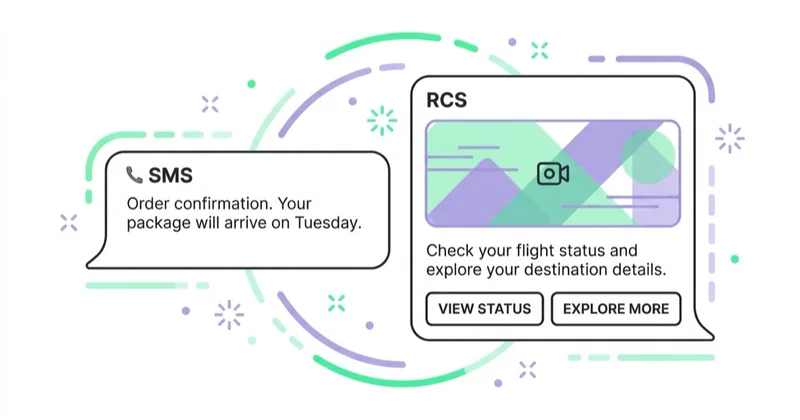
SMS vs RCS: what changed
Google renamed RCS Business Messaging to RCS for Business in September 2025. It is not merely “SMS with images.” A brand launches a verified agent that can send rich cards, media, suggested replies and actions, then receive responses through webhooks. In 2026, verified agents gained a visible checkmark in Google Messages.
Coverage is not universal. When a device, client, carrier or agent launch does not support the service, Google's API can return an error and the sender must invoke a controlled SMS or other-channel fallback. The system should first confirm non-delivery to avoid duplicates and should set an expiry for time-sensitive messages. RCS for Business is not end-to-end encrypted; Google documents encryption between the agent and Google, and between Google and the recipient. Verification confirms the business behind an agent, but it does not make the channel suitable for protected health information or other sensitive content.
SMS remains the broadest baseline, but its character limit is more nuanced than “160 characters”: encoding, Unicode characters and concatenation determine how a message is segmented and billed. Sender presentation also varies by country and route. RCS changes the format substantially, but reach must be checked for the recipient, carrier and agent rather than inferred from device type alone.
| Dimension | SMS | RCS |
|---|---|---|
| Sender | A phone number or short code | A verified, branded business profile |
| Content | Plain text, ~160 characters, links | Rich cards, images, carousels, buttons |
| Trust signal | None inherent | Verified sender badge |
| Analytics | Delivery, click (via links) | Delivery, read receipts, richer interaction data |
| Fallback | — | Requires a designed SMS or other-channel fallback |
| Best for | Universal reach, simple alerts | Branded, interactive, media-rich messaging |
The practical guidance is not “abandon SMS”. Use RCS when its richer interaction improves the task and the recipient is capable, then provide an explicit fallback for everyone else. A verification checkmark can help a recipient identify the sender, but it does not guarantee trust, delivery or conversion. The message still needs a recognisable context, clear purpose and safe destination URL.
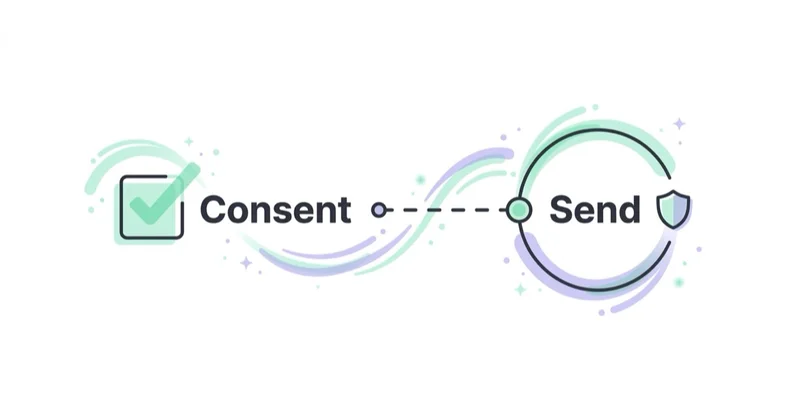
Consent and compliance: the real foundation
The legal basis depends on the recipient, message, sending technology and market. US promotional robotexts can fall under the TCPA, FCC rules, Do-Not-Call requirements and state laws. UK electronic marketing is governed by PECR alongside UK GDPR. EU programmes require an ePrivacy and GDPR analysis under the relevant member state's implementation. A number collected during checkout or lead generation is not automatically permission for every promotional message. This section is an operating checklist, not legal advice.
The consent ledger should retain source, disclosure text, timestamp, user identifier, jurisdiction, and withdrawal history. Suppression must run before every campaign, including journeys triggered by a CRM or external messaging partner. Legal permission should be separated from frequency, topic, and channel preferences so a user can reduce communication without losing essential service messages.
Do not reduce these regimes to one global opt-in rule. At minimum, map the country, recipient type, purpose, technology, consent language, sender identity, quiet-hour obligations and withdrawal mechanism with qualified counsel.
- United States — TCPA and related rules. Prior express written consent is required for covered telemarketing robotexts, and revocation can be made through reasonable methods—not only the word STOP. State rules may add requirements, including time restrictions.
- United Kingdom — PECR + UK GDPR. Marketing texts to individuals generally require consent unless every condition of the narrow “soft opt-in” is met. The recipient must receive a simple opt-out at collection and in every message.
- European Union — ePrivacy + GDPR. Requirements come from ePrivacy rules as implemented in each member state and the GDPR treatment of personal data. Validate the specific markets rather than copying a UK workflow.
Consent is not a checkbox added after the journey is built. The opt-in language determines what the person was told, and the suppression system determines whether withdrawal is honoured across campaigns and vendors. Clear permission may reduce complaints, but it does not guarantee engagement or delivery. Keep evidence of the exact disclosure shown and test the full opt-out path before sending at scale.
Use cases that earn their place
The messages that work are timely and useful, sitting close to something the customer already cares about.
| Use case | Why it works | Frequency |
|---|---|---|
| Order and shipping updates | Expected operational information when kept free of promotion | Per relevant event |
| Abandoned cart / browse | Timely nudge at high intent | Triggered |
| Back-in-stock / price drop | The customer asked to be told | Triggered |
| Early access / launches | Rewards the list with exclusivity | Occasional |
| Loyalty and VIP offers | Recognises the best customers | Segmented |
| Appointment / booking reminders | Reduces no-shows, genuinely useful | Per booking |
| Constant broad discounts | Trains the list to expect discounts, drives opt-outs | Avoid |
The unifying principle is relevance to an action or stated preference. Keep operational and promotional purposes separate: adding an offer to a service message can change its legal and customer-experience treatment. A requested back-in-stock alert has clear context; repeated broad discounts are harder to justify and more likely to drive withdrawal.
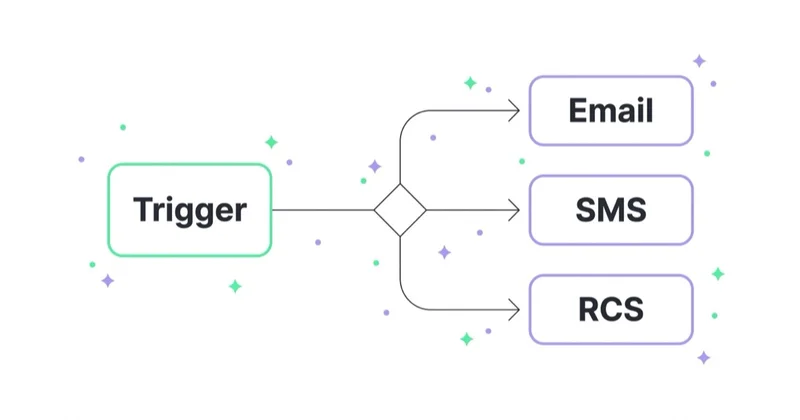
SMS and RCS belong inside automation
Sending isolated blasts wastes the channel's biggest advantage: immediacy triggered by behaviour. The strongest programmes run messaging inside a broader automation and CRM setup, so a text fires at the right moment — cart abandoned, order shipped, subscription lapsing — and coordinates with email rather than duplicating it.
That coordination matters. Email and SMS should divide the work, not both shout the same promotion. A common split: email carries the longer story and the catalogue; SMS carries the time-sensitive, short, high-priority nudge. Behavioural triggers decide which channel fires and when, and suppression rules stop a customer getting the same message twice. This is the same logic as connecting the whole lifecycle in CRM marketing automation and lead nurturing without increasing ad budget.
Measurement: past the vanity of open rates
Standard SMS does not provide a dependable native open receipt. Link trackers can measure clicks, and RCS may provide read events where supported and permitted, but neither should be confused with business impact. Judge the programme on outcomes and health instead.
- Revenue or qualified outcomes per delivered message — useful directional efficiency, with attribution rules stated clearly.
- Conversion rate per campaign or flow — did the message drive the intended action?
- Net permissioned-list change — new valid opt-ins minus opt-outs, invalid numbers and suppressions.
- Opt-out rate — the early warning; a rising opt-out rate means the frequency or relevance is wrong.
- Deliverability / spam complaints — the health of the sending reputation.
The tension is short-term attributed revenue versus future permission and trust. More sends can create more attributed orders while also increasing opt-outs and complaints. Compare holdout groups or frequency tests where scale allows, because attributed conversions alone do not show how many orders would have happened without the message.
Glossary
- RCS (Rich Communication Services) — a richer messaging standard supporting verified business agents, media and interactive elements on capable devices and networks.
- Short code — a short number used for high-volume messaging, distinct from a standard phone number.
- TCPA — the US law governing marketing calls and texts, requiring express written consent and opt-out.
- Soft opt-in — a UK/EU allowance to message existing customers about similar products, with an easy opt-out.
- Opt-out / revocation — a recipient's withdrawal of permission. STOP is a common keyword, but applicable rules may require other reasonable expressions to be recognised too.
- Deliverability — the rate at which messages actually reach handsets, tied to consent quality and reputation.
How Space Ads approaches SMS and RCS
Our audit starts with permission, suppression and message purpose before creative. We inspect the disclosure captured at opt-in, whether withdrawals propagate to every sending system, whether operational messages contain promotion, and whether fallback logic can create duplicates. Only then do we evaluate timing, segment, offer and format.
We then design a message calendar around what people requested and coordinate it with email so the channels do not duplicate one another. Reporting pairs attributed outcomes with delivery, opt-outs, complaints and net list change; controlled frequency or holdout tests are added where volume permits. That is the retention layer of performance marketing, run alongside marketing automation and email marketing.
Stop doing / Do instead
| Stop doing | Do instead |
|---|---|
| Treating SMS as another broadcast channel | Treat it as a permission-based channel where restraint is the currency |
| Building lists on pre-ticked boxes | Build on clear, specific opt-in — good consent is good performance |
| Sending constant broad discounts | Lean transactional-adjacent and behaviour-triggered |
| Reporting an assumed SMS open rate | Report delivery, attributable outcomes, opt-outs and complaints |
| Running SMS separately from email | Coordinate inside automation so the channels divide the work |
| Ignoring RCS | Use RCS where supported for verified, richer messaging, with SMS fallback |
FAQ
What is the difference between SMS and RCS marketing?
SMS is broadly supported text messaging sent through routes such as long codes, short codes or approved sender IDs. RCS for Business adds a verified business agent, images, buttons and rich cards on supported devices and networks. The sender must design fallback behaviour and confirm non-delivery before sending a duplicate through SMS. Neither channel guarantees reach.
Is SMS marketing legal?
It can be lawful when the programme satisfies the rules that apply to the recipient, purpose, technology and country. US TCPA/FCC rules, UK PECR and UK GDPR, EU national ePrivacy laws and other local rules differ. Obtain jurisdiction-specific legal advice, retain evidence of permission and make withdrawal easy across every connected system.
How often should you send marketing texts?
Less than you are tempted to. SMS is a personal channel, so frequency is the main driver of opt-outs. The best programmes lean on behaviour-triggered and transactional-adjacent messages — order updates, abandoned cart, back-in-stock — rather than frequent broad promotions.
What should you measure in SMS marketing?
Track delivery, clicks where measurable, attributed and incremental outcomes, net list change, opt-outs, complaints and cost per delivered message. Standard SMS has no reliable native open metric. Read receipts in RCS describe a message event, not the commercial value created.
Should SMS replace email marketing?
No — they divide the work. Email carries the longer story and catalogue; SMS carries short, time-sensitive, high-priority nudges. Run both inside automation with suppression rules so a customer is not messaged twice about the same thing across channels.
What is RCS Business Messaging?
RCS for Business lets a verified business agent exchange media-rich messages, suggestions and replies through Google's API and webhooks on supported networks. Unsupported or undelivered messages require a planned fallback. The service is not end-to-end encrypted, and verification should not be treated as permission to send or as evidence that sensitive data is appropriate.
Key takeaways
- SMS and RCS are permissioned direct channels with provider costs and platform dependencies, not advertising auctions.
- The channel is personal and high-engagement, so restraint and relevance are the currency.
- RCS provides verified business identity and rich interaction where supported; fallback must be designed rather than assumed.
- Consent, suppression and jurisdiction-specific review are the foundation of compliance.
- Run messaging inside automation, coordinate with email, and measure revenue per message against opt-out rate.
Sources and further reading
- FCC — TCPA rules for calls and texts
- ICO (UK) — Electronic mail marketing under PECR
- Google — How RCS for Business works and handles fallback
- Google — Brand and agent verification
- Google — Latest RCS for Business releases
- Google — Data security and the limits of RCS encryption
- GSMA — RCS for business messaging
Continue learning
Continue reading
Klaviyo Flows Every Ecommerce Store Needs (and the Order to Build Them)
Klaviyo flows automate relevant email and SMS messages around key customer actions. This guide explains which flows to prioritise, how to set their triggers and exclusions, and how to measure their real contribution to revenue.
Email vs SMS vs Push: Which Owned Channel for Which Message
Email, SMS, and push differ in permission, identity, reach, cost, format, and interruption. Use this decision framework to choose a channel by customer need, separate service from promotion, and measure incremental value.
Marketing Calendar 2027: Plan the Year Around Lead Times, Not Dates
Build a practical 2027 marketing calendar with verified US and UK dates, market-specific checks and realistic lead times. Use the planning framework to align campaigns, stock, creative, tracking and fulfilment.