A welcome email series is an automated sequence triggered when an eligible person joins a marketing list. Its first responsibility is to fulfil the signup promise and make the sender, content and future frequency clear. For an ecommerce brand, it may also help a non-customer choose a first product; for a service or publisher, the next step may be education, preference selection or a booking.
Recent signup is a useful timing signal, but not proof of purchase intent. Someone may want a guide, product alert or discount without being ready to buy. The sequence, timing and measurement should therefore follow the signup context, consent and customer status—not a fixed template.
TL;DR
- Confirm eligibility before sending. Record the signup source, wording, time, market and customer status; apply local email-marketing rules.
- Deliver what was promised. Make the guide, code, access or preference confirmation easy to find and use.
- Use as many messages as the job requires. One good email may be enough; a longer series needs a distinct role for every send.
- Set expectations honestly. Identify the sender, content and likely frequency, with an easy way to unsubscribe or manage preferences.
- Coordinate other automations. Exit purchasers where appropriate and prevent collisions with cart, browse, post-purchase and campaign sends.
- Segment only from appropriate data. Signup context and declared interests are often more reliable than inferred browsing.
- Measure incremental value. Include confirmed first purchases, margin, discount cost, returns, complaints and unsubscribes—not attributed revenue alone.
Why signup context matters
A triggered message can respond to the action a person just took. That relevance is the real advantage: the sender can deliver the requested item, confirm preferences and explain the next step without waiting for the next calendar campaign.
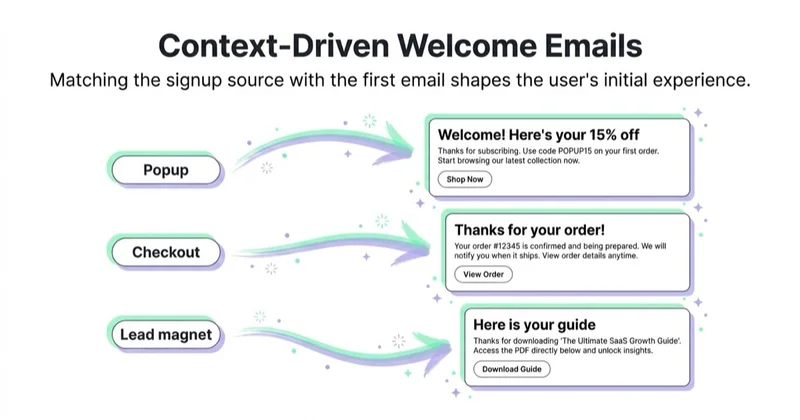
Not every signup means the same thing. A footer subscription, waitlist, downloadable guide, checkout opt-in and product-specific alert communicate different expectations. Preserve this source in the profile and design the first message around it. Do not treat a person who requested a transactional alert as a marketing subscriber unless the legal basis and notice cover that use.
Welcome-flow revenue is often high because the audience is new and may already be close to buying. That also creates selection bias: attributed purchases are not necessarily caused by the messages. Use a holdout test where volume permits and compare confirmed business outcomes. The wider automation context is covered in the Klaviyo flows guide.
Choose the sequence from the subscriber's next questions
There is no universal three-to-five-email optimum. A low-frequency publisher may need one welcome; a considered purchase may require education over several weeks; a time-limited retail offer may use a shorter sequence. Add a message only when it has a distinct user job and does not create an unreasonable total frequency.
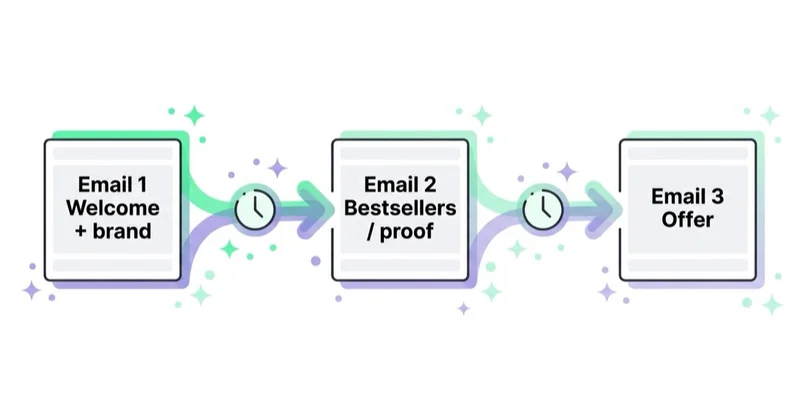
An illustrative ecommerce sequence:
| Timing | Job | |
|---|---|---|
| 1 | Promptly after confirmed eligibility | Deliver the promise; identify the sender and set expectations |
| 2 | Based on decision cycle | Help the person choose: category, use case, guide or preference |
| 3 | After engagement or a suitable delay | Provide relevant proof, policy, demonstration or objection answer |
| 4 (optional) | Before a genuine deadline | Remind the person of an existing offer and its exact terms |
| Exit | On purchase, withdrawal or rule expiry | Move to the appropriate customer, nurture or regular-send state |
The timing should reflect time zone, conversion delay, purchase cycle and the messages the person may receive from other automations. Test the sequence against a simpler control; more messages can increase both conversions and fatigue.
Deliver the signup promise first
Deliver the promised guide, code, alert setup or access promptly after any required confirmation step. Display material terms clearly: eligible products, minimum spend, region, expiry, exclusions and whether the code can be combined. Do not invent urgency after signup, and do not say an offer expires unless the deadline is genuine and enforced consistently.
Separate fulfilment from marketing where the distinction matters. Gmail advises senders not to mix promotional content into transactional messages, and legal treatment varies by market. A download delivery does not automatically authorise a promotional series. The signup experience should explain what the person is agreeing to before submission.
The first message also needs a recognisable sender, accurate subject, accessible layout, working links and an easy opt-out for promotional content. Test code redemption, mobile rendering and the plain-text alternative before launch.
Glossary
- Welcome series — the automated email sequence a new subscriber receives after opting in.
- Signup promise — the incentive offered at opt-in (discount, guide, access) that must be delivered first.
- Revenue per recipient — attributed revenue divided by delivered or eligible recipients; useful but dependent on attribution rules.
- Expectations-setting — telling subscribers what and how often they'll hear from you.
- Branching — varying the series by how someone signed up or what they browsed.
- Suppression / exit — preventing or ending sends when a person purchases, withdraws, bounces or meets another rule.
- Holdout — an eligible group intentionally not sent the series, used to estimate incremental effect.
Introduce the brand, then earn the sale
After fulfilment, help the subscriber answer the next decision question. Useful content may include a category selector, sizing or compatibility guide, product demonstration, delivery and returns information, credible customer evidence or an explanation of the service process.
A founder story is not mandatory. Use it when it provides relevant evidence—origin, expertise, materials or service philosophy—not as an autobiographical detour. Bestsellers can reduce choice only if they fit the signup context. Reviews and guarantees must be accurate, current and qualified where needed.
The call to action can appear in the first message if it naturally follows the promise. "Value first, sell later" and "sell immediately" are both slogans; the appropriate sequence depends on what the person requested and what they need to decide.
Set expectations and segment where you can
Tell people who is writing, what categories of content they can expect and how often. Provide a clear unsubscribe link and, where useful, a preference centre. Gmail requires one-click unsubscribe for qualifying bulk marketing and subscribed messages and recommends respecting recipient choice; applicable law may impose additional requirements.
Branch first on reliable, relevant fields: signup source, declared interest, market, language and customer status. Browsing data may be incomplete or subject to consent; a viewed category is a weak signal, not a fact about identity or intent. Do not expose sensitive or surprising inferences in email copy.
Coordinate the series with the rest of the programme. Typical rules include:
- exclude suppressed, bounced or ineligible profiles;
- decide whether existing customers need a customer welcome instead;
- exit or reroute on purchase;
- prevent simultaneous cart, browse and welcome reminders;
- cap total marketing frequency and preserve critical service messages;
- keep a test profile for every branch and market.
How Space Ads approaches the welcome series
We begin with an entry-and-exit map: every signup form, the exact notice and promise, consent evidence, existing-customer logic, market, suppression rules and competing automations. Only then do we write the sequence.
Each message has one primary job, approved offer terms and a testable reason to exist. Before launch, we validate authentication, links, codes, rendering, accessibility, personalisation fallbacks, one-click unsubscribe where applicable and purchase exits. Reporting connects delivered messages with confirmed first orders, contribution, discounts, returns and recipient feedback. A holdout is preferred when volume supports it. This lives in email marketing and marketing automation.
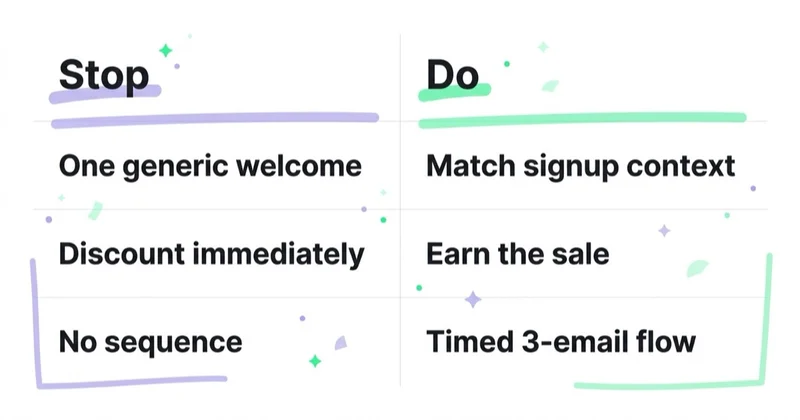
Stop doing / Do instead
| Stop doing | Do instead |
|---|---|
| Adding everyone who requests a resource to marketing | Verify what the signup notice and applicable rules permit |
| Using a fixed 3–5-email recipe | Give each message a distinct job and test against a simpler control |
| Hiding offer conditions | Show redemption, expiry and eligibility terms clearly |
| Letting welcome and cart emails collide | Define priority, frequency and exit rules |
| Personalising from weak browsing signals | Prefer declared interest and appropriate, consented data |
| Reporting attributed revenue alone | Include contribution, discount, returns, complaints and holdout lift |
Common mistakes
Common failures are sending promotions without the required permission, failing to deliver the promised item, using expired codes, and continuing the prospect sequence after purchase. Other issues include excessive frequency across overlapping flows, broken personalisation, misleading countdowns and measuring success before returns or cancellations are known.
FAQ
What is a welcome email series?
A welcome email series is an automated set of messages sent to an eligible new subscriber. It delivers the signup promise, explains what to expect and helps the person take a relevant next step. Its length and goal depend on signup context, consent, market and customer status.
How many emails should a welcome series have?
There is no universal number. Start with the fewest messages needed to fulfil the promise and answer the subscriber's next questions. Add a send only when it has a distinct role and enough value to justify the additional frequency. Test the sequence against a shorter version or holdout.
What should the first welcome email include?
Include the promised item or clear access instructions, sender identity, relevant terms, expectations and an easy opt-out for marketing. A next step can be included when it follows naturally. Test the subject, links, code, personalisation, mobile rendering and accessibility before launch.
Should the welcome series include a discount?
Use the discount if it was promised, with clear and genuine conditions. If no discount was promised, do not add one automatically. Test whether an incentive creates incremental contribution after discount cost, order mix, returns and customers who would have purchased anyway.
How is a welcome series different from a regular email campaign?
A welcome series is triggered by an eligibility event and follows person-level timing and rules. A campaign is scheduled for a selected audience at a calendar time. Neither is inherently more valuable; they serve different jobs and can overlap unless frequency and suppression are coordinated.
How do I measure if my welcome series is working?
Track eligibility, delivery, clicks as diagnostics, confirmed first-purchase or qualified-action rate, contribution, discount cost, returns, unsubscribes and complaints. Open rates are unreliable and Gmail states it cannot verify third-party open-rate accuracy. Use a holdout or controlled sequence test to estimate incremental value.
Key takeaways
- Confirm marketing eligibility and preserve evidence of the signup context.
- Deliver the exact promise promptly, with clear offer terms and sender expectations.
- Use only the messages the subscriber journey requires; there is no universal sequence length.
- Coordinate purchases, suppression, frequency and competing automations.
- Measure incremental contribution and recipient feedback, not attributed revenue or opens alone.
Sources and further reading
- UK Information Commissioner's Office — Direct marketing using electronic mail
- Google Gmail Help — Email sender guidelines
- Google Gmail Help — Sender guidelines FAQ: unsubscribe and spam rate
- US Federal Trade Commission — CAN-SPAM compliance guide for business
Continue learning
Continue reading
Klaviyo Flows Every Ecommerce Store Needs (and the Order to Build Them)
Klaviyo flows automate relevant email and SMS messages around key customer actions. This guide explains which flows to prioritise, how to set their triggers and exclusions, and how to measure their real contribution to revenue.
Klaviyo vs Mailchimp for Ecommerce: Which Email Platform Fits
Klaviyo and Mailchimp both support ecommerce email and automation, but the right choice depends on your store integration, required events, workflow logic, channels and operating cost. This guide turns those requirements into a practical decision.
Email vs SMS vs Push: Which Owned Channel for Which Message
Email, SMS, and push differ in permission, identity, reach, cost, format, and interruption. Use this decision framework to choose a channel by customer need, separate service from promotion, and measure incremental value.