Klaviyo flows are automated email and SMS sequences triggered by customer data: a subscription, checkout, purchase or period of inactivity. Unlike a scheduled campaign, a flow responds to an event in the customer journey. That usually makes it more relevant, but automation alone does not make it effective. The trigger, exclusions, timing, consent rules and message all need to be correct.
Most ecommerce stores should evaluate welcome, abandonment and post-purchase flows first because they address frequent, high-intent moments. Browse abandonment, replenishment, win-back, back-in-stock and price-drop messages depend more heavily on the product, buying cycle, catalogue data and available audience. This guide shows how to choose and build them without treating a template as a universal strategy.
TL;DR
- Flows and campaigns do different jobs. Flows respond to lifecycle events; campaigns support launches, promotions and editorial communication.
- Prioritise by opportunity and data quality: welcome, abandonment and post-purchase are common starting points, not a fixed sequence for every store.
- Cart, checkout and browse abandonment need different logic because they represent different levels of intent.
- Post-purchase communication should help first and sell second. Delivery guidance, product education and support often come before cross-sell.
- Filters prevent bad sends. A person who completes a purchase should not keep receiving abandonment reminders.
- Email and SMS require channel-specific consent and frequency controls. One permission does not automatically cover every channel or market.
- Measure incrementality where possible. Platform-attributed flow revenue is useful for diagnosis, but it is not proof that the flow caused every order.
Why flows deserve an early place in the roadmap
A campaign is scheduled for a chosen audience. A flow begins when a profile meets defined conditions, such as joining a list or starting checkout. The advantage is timing: a welcome message can arrive soon after a valid subscription, while a post-purchase message can reflect the product just ordered.
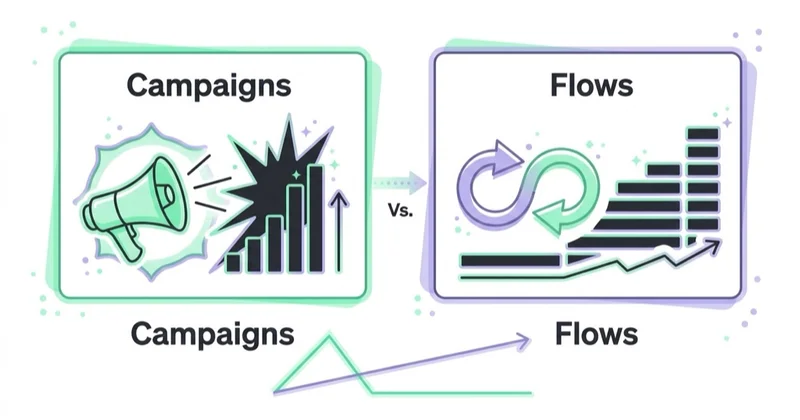
Flows can produce strong revenue per recipient because they are tied to recent behaviour, but they are not set-and-forget assets. Catalogue changes, promotions, consent, brand positioning and customer behaviour all change. Review entry volume, skipped profiles, conversion lag, complaints, unsubscribes and downstream purchases regularly. Campaigns remain important when the message is timely for a wider audience, such as a launch or seasonal collection. The two formats should work together, just as they do in a broader CRM and marketing automation system.
The core flows, in build order
Use the table as a prioritisation framework, not a rigid recipe. Start with flows supported by reliable events and enough eligible profiles. A store with long delivery times may need operational post-purchase messages before cross-sell; a replenishable product may justify replenishment before browse abandonment.
| Priority to assess | Flow | Typical trigger | Job |
|---|---|---|---|
| 1 | Welcome / sign-up | Joins a marketing list with valid consent | Deliver the signup promise, introduce the brand and set expectations |
| 2 | Checkout or cart abandonment | Starts checkout or adds an item, then does not order | Help the shopper resume and address genuine friction |
| 3 | Post-purchase | Places an order | Reassure, educate and support the next appropriate action |
| 4 | Browse abandonment | Views a product without progressing | Provide a restrained reminder when there is enough intent |
| 5 | Win-back or replenishment | Passes the expected repurchase window | Re-engage in line with the product's buying cycle |
| 6 | Back-in-stock / price-drop | Eligible product becomes available or crosses a set threshold | Notify people who showed relevant interest |
| 7 | Sunset / list hygiene | Meets a sustained-inactivity definition | Offer a final choice, then identify profiles for suppression |
1. Welcome flow — fulfil the signup promise
The welcome flow begins after a person validly joins the relevant marketing list. Its first job is to deliver what the signup form promised, whether that is early access, a guide or an offer. The next messages can explain the product, answer a common objection and set expectations for future communication.
There is no universally correct number of emails. A simple product and an incentive-led signup may need fewer messages than a considered purchase that requires education. Start with the shortest sequence that completes the job, then use behaviour and unsubscribe data to decide whether another message adds value.
2. Abandoned cart — recover earned demand
An abandonment flow helps a shopper return to an unfinished journey. The event depends on the ecommerce integration: an "Added to Cart" event is not the same as "Started Checkout". In either case, add a filter that checks whether the person has placed an order since entering the flow. Otherwise, a successful buyer may still receive reminders.
Lead with a useful route back to the basket or checkout. Address shipping, returns or payment only when those are real sources of friction, and do not assume every abandonment needs a discount. The full mechanics — timing, exclusions and the roles of email and SMS — are covered in abandoned cart email and SMS flows.
3. Post-purchase — improve the experience before the next sale
After an order, the useful message depends on fulfilment and product use. It may explain what happens next, help the customer get started, request a review after enough time has passed, or recommend a genuinely compatible item. Trigger filters and branches should use the ordered product or category so the advice is relevant. Promotional messages must not conflict with transactional updates or arrive before the customer has received the order.
The second purchase is an outcome to earn, not a promise. Measure repeat-purchase rate and time to next order by cohort, as described in customer retention marketing.
4–5. Checkout and browse abandonment
Checkout abandonment usually indicates more intent than a product view, but the reason for stopping is unknown. Make it easy to resume and surface verified information about delivery, payment or returns without inventing an objection. Browse abandonment is lower intent and can quickly become intrusive, so use a meaningful delay, frequency controls and eligibility rules. For low-traffic stores, a browse flow may not be worth building yet.
6–8. Win-back, back-in-stock and sunset
Win-back should begin after the expected repurchase window, not after an arbitrary number of days. Replenishment works only when consumption is reasonably predictable. Back-in-stock and price-drop flows require accurate catalogue events and clear eligibility rules; they are poor candidates when stock or price data is unreliable.
A sunset flow is a final, limited attempt to confirm interest before suppression. In Klaviyo, the flow can tag people who remain inactive, but standard flow actions do not automatically suppress them. The team must review and suppress the resulting segment or implement a controlled API process. Define inactivity using more than opens alone: purchases, clicks and site activity provide stronger evidence, especially where privacy features can distort open data.
Segments make flows work
A flow should use the minimum segmentation needed to stay relevant. Product category, order status, purchase history, geography and consent status are often more useful than a large collection of decorative segments. RFM (recency, frequency and monetary value) can help distinguish loyal, new and lapsing customers, but it does not replace lifecycle logic.
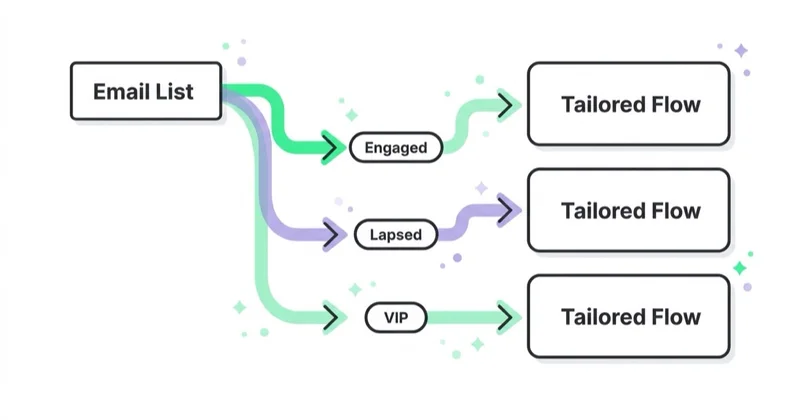
The most important controls are usually filters. For example, exclude anyone who has purchased since starting an abandonment flow, and prevent an incompatible cross-sell based on the item ordered. Klaviyo evaluates profile filters before actionable steps, so test the entry conditions, filters, branches and dynamic product data before moving messages from manual review to live sending. Smart Sending can reduce message collisions, but it should be configured deliberately: some high-intent or operational messages may need different rules from general marketing.
Glossary
- Flow — an automated Klaviyo sequence triggered by an event (signup, cart, purchase), as opposed to a manual campaign.
- Trigger — the event that starts a flow (e.g. "added to cart," "placed order").
- Campaign — a one-off broadcast sent manually to a segment.
- Segment — a group defined by behaviour or attributes, used to target or branch flows.
- RFM — recency, frequency, monetary segmentation.
- Sunset flow — a final re-engagement sequence that can tag persistently inactive contacts for review and suppression.
- Deliverability — whether messages reach the inbox rather than spam.
Email and SMS together, with consent
Klaviyo can coordinate email and SMS in one flow, but using both is not automatically better. Email can carry detail; SMS can provide a short, time-sensitive update. Only add a channel when the person has the required permission for that channel and the message justifies the intrusion. Do not treat an email signup as SMS permission or send the same message twice without a clear reason.
Consent rules vary by channel, recipient type and market. For example, UK PECR includes a limited "soft opt-in" for an organisation's own similar products when its conditions are met; it is not a blanket permission. Obtain legal advice for the markets in which you operate, preserve evidence of consent and make withdrawal easy.
Deliverability also starts before the copy. Gmail requires authentication and other sending controls; bulk senders to personal Gmail accounts need SPF, DKIM and DMARC, aligned domains and one-click unsubscribe for marketing and subscribed messages. Authentication does not guarantee inbox placement, so monitor complaints, bounces and volume changes as well.
How Space Ads approaches Klaviyo flows
We start with the customer journey and the data available in the account, not a template count. The first audit covers event quality, consent by channel, current flows, message collisions, catalogue data, deliverability and the gap between attributed revenue and store-level outcomes. That tells us whether the next priority is a missing flow, a faulty filter or an existing sequence that needs improvement.
We then prioritise by eligible volume, commercial value, implementation risk and confidence in the trigger. Each flow gets a purchase exclusion where relevant, channel consent checks, frequency controls, QA scenarios and an agreed measurement plan. Platform attribution helps diagnose performance; cohort analysis and, where sample size allows, a holdout help estimate incremental effect. This work sits across email marketing and marketing automation.
Stop doing / Do instead
| Stop doing | Do instead |
|---|---|
| Relying only on campaigns | Automate repeatable lifecycle moments and retain campaigns for timely broadcasts |
| Copying every template into the account | Prioritise flows supported by reliable data and a clear customer need |
| Treating post-purchase as an immediate cross-sell | Help the customer receive and use the first order before promoting the next one |
| One "you left something" message for every signal | Match the message and pressure to browse, cart or checkout intent |
| Sending every flow to everyone | Segment with RFM and branch on behaviour |
| Texting at every step | Use SMS selectively and only with valid channel-specific permission |
| Letting inactive profiles accumulate | Define inactivity, run a restrained sunset sequence and suppress after review |
Common mistakes
The most expensive mistakes are often logical, not creative. A missing purchase filter sends cart reminders after an order. A welcome flow accepts profiles from the wrong source. Browse messages fire after a single accidental view. Promotions overlap because Smart Sending and exclusions were never reviewed. Dynamic blocks display the wrong product, or a post-purchase cross-sell recommends an item the customer already bought.
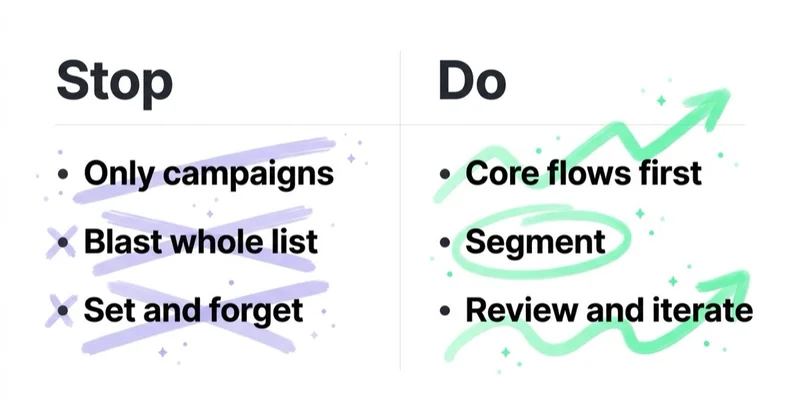
Test each path with representative profiles before launch. Confirm the trigger event, consent state, delays, filters, re-entry rules, message links, dynamic data and exit after purchase. Then watch skipped reasons and unexpected entry volume after launch rather than assuming that "Live" means correct.
FAQ
What Klaviyo flows should every store have?
There is no universal minimum. Most stores should assess welcome, checkout or cart abandonment and post-purchase first. Browse, win-back, replenishment, back-in-stock, price-drop and sunset flows should be added when the customer journey, catalogue data, consent and eligible audience support them.
What is the difference between a flow and a campaign in Klaviyo?
A campaign is scheduled for a selected audience. A flow is an automated sequence that begins when a profile meets defined conditions, such as joining a list or placing an order. A flow can respond faster to individual behaviour, but it still requires monitoring, QA and periodic revision.
Which Klaviyo flow makes the most money?
It depends on eligible volume, average order value, buying cycle, attribution settings and how each flow is defined. Welcome and abandonment flows often report strong revenue per recipient, but reported revenue is not the same as incremental revenue. Compare flows on a consistent attribution window and examine cohort or holdout results before declaring a winner.
How many emails should a welcome flow have?
Use as many messages as needed to fulfil the signup promise and answer the next important question — no more. Start with a concise sequence, then evaluate clicks, conversions, unsubscribes and message-level drop-off. The correct length varies with the product and reason for signup.
Should Klaviyo flows use SMS as well as email?
Only when SMS adds value and the person is eligible under the rules that apply in the relevant market. Permission for email does not automatically provide permission for SMS. Use channel-specific consent, coordinate frequency and avoid duplicating the email without a clear reason.
How do I measure whether my flows are working?
Start with delivery, skipped reasons, clicks, conversion, unsubscribe and complaint rates. Connect those diagnostics to store outcomes such as repeat-purchase rate, contribution margin and time to next order. Keep attribution windows consistent. Where audience size permits, use a properly designed holdout to estimate incremental revenue; small samples can produce misleading conclusions. Opens are useful but imperfect because privacy and machine activity can distort them.
Key takeaways
- Flows respond to lifecycle events; campaigns remain useful for timely communication to a wider audience.
- Assess welcome, abandonment and post-purchase early, then prioritise the rest from store data and the buying cycle.
- Cart, checkout and browse signals represent different levels of intent and need different logic.
- Purchase exclusions, consent checks and tested dynamic data matter more than the number of flows in the account.
- Use platform attribution for diagnosis and stronger designs, such as cohorts or holdouts, to estimate incremental impact.
Sources and further reading
- Klaviyo Help Center — Understanding flow triggers and filters
- Klaviyo Help Center — Understanding Smart Sending
- Klaviyo Help Center — How to create a sunset flow
- Gmail — Email sender guidelines
- UK Information Commissioner's Office — Direct marketing using electronic mail
Continue learning
Continue reading
The Welcome Email Series That Converts New Subscribers
A welcome series should deliver the signup promise, establish expectations and help an eligible subscriber take the next useful step. Learn how to design, sequence, govern and measure it without relying on a universal template.
Email vs SMS vs Push: Which Owned Channel for Which Message
Email, SMS, and push differ in permission, identity, reach, cost, format, and interruption. Use this decision framework to choose a channel by customer need, separate service from promotion, and measure incremental value.
Klaviyo vs Mailchimp for Ecommerce: Which Email Platform Fits
Klaviyo and Mailchimp both support ecommerce email and automation, but the right choice depends on your store integration, required events, workflow logic, channels and operating cost. This guide turns those requirements into a practical decision.