An abandoned cart flow is an automated sequence sent to an identifiable shopper who added a product to the cart or started checkout but did not complete an order. It can remove friction, answer a final question, or simply remind someone who was interrupted. It cannot repair a broken checkout, an uncompetitive offer, or missing consent.
Because cart creation does not guarantee purchase intent, this is often one of the first lifecycle automations a store should evaluate. The result depends on accurate events, purchase-exclusion filters, relevant messages, deliverability, and lawful use of email or SMS—not on switching on a generic template and leaving it untouched.
TL;DR
- Cart abandonment is normal. Shoppers compare prices, check delivery costs, save products for later, or simply get interrupted. Diagnose the reasons in your own store instead of treating a market average as a target.
- Start with a short sequence, then test it. Two or three messages are a practical starting point, but the right number and delay depend on the purchase cycle and evidence from your store.
- Email and SMS play different roles. Email can carry detail and product images; SMS is immediate and intrusive, so use it selectively, only with valid channel-specific consent and local legal review.
- The first message is a reminder, not a discount. Leading with a coupon trains shoppers to abandon on purpose; save any incentive for later in the sequence, if at all.
- Implementation matters as much as copy. Exclude anyone who purchases, prevent duplicate platform messages, restore the correct cart, authenticate email, and honor opt-outs.
- Distinguish cart, checkout and browse abandonment — they are different intents and deserve different messages.
- Attribution needs care. A recovered sale is not always incremental; some shoppers would have returned anyway, so read the flow against a holdout, not just its claimed revenue.
Why an abandoned cart flow deserves early attention
An abandoned-cart shopper has shown more intent than a cold visitor, but the strength of that intent varies. Someone may have been comparing prices, checking shipping, saving an item for later, or testing a coupon. The flow is valuable because it responds to a known behavior with relevant information; it should not assume that every cart was one message away from a sale.
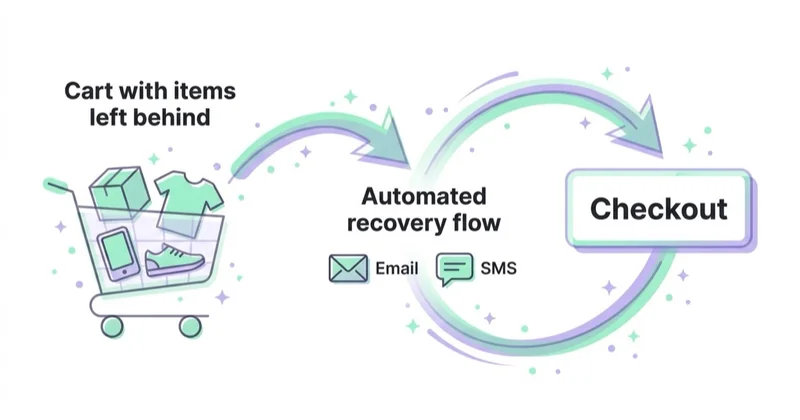
Cart abandonment is not a metric to drive to zero. Some people are comparing prices, checking delivery costs, saving an item for later, or browsing without immediate intent. Others leave because of a fixable problem such as a payment error, an unexpected charge, or a confusing form. Those problems belong on the store's conversion path. Messaging is a second layer, not a substitute for that work.
The anatomy of a recovery flow
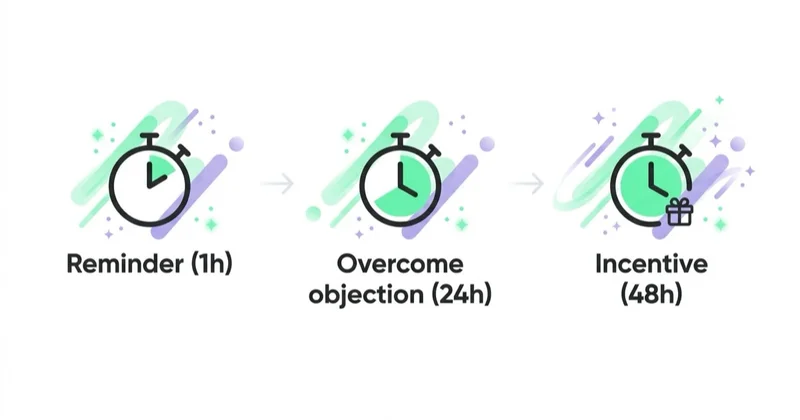
A short sequence gives you room to remind, answer objections, and stop before the messages become excessive. Use the following as a testable starting point, not a universal schedule.
| Step | Timing (from abandonment) | Channel | Job of the message |
|---|---|---|---|
| 1 | 30 minutes–2 hours | Restore the cart and remove obvious friction | |
| 2 | 18–30 hours | Answer likely objections: delivery, returns, fit, trust, or product use | |
| 3 | 36–48 hours | Email or SMS | Final useful reason to return; incentive only if economics and testing support it |
Set the delay around the normal buying cycle. A low-consideration item may justify an early reminder; an expensive or configured product may need more time. Before every send, apply a current purchase filter so a customer who completed an order does not receive another cart message. Also disable any overlapping reminder sent by the ecommerce platform, and test whether the link restores the correct items, variants, and currency on mobile and desktop.
Email and SMS do different jobs
Email and SMS are complementary, not interchangeable, and the flow is strongest when each does what it is good at.
- Email carries detail: the cart contents with images, product reviews, shipping and returns information, and the reassurance that handles objections. It has room to persuade.
- SMS carries immediacy: a short, timely nudge that lands on the lock screen and drives a quick return. It is powerful precisely because it is scarce and personal — which is also why it must be used sparingly and only with explicit consent.
A sensible pattern is to use email for the main sequence and reserve SMS for subscribers who have separately agreed to receive marketing texts. Avoid sending both channels at the same moment, observe quiet hours, and apply country-specific rules. In the United States, for example, Klaviyo documents additional carrier requirements for cart-abandonment SMS, including double opt-in, one message per recipient, and sending within 48 hours. Requirements differ by market and provider, so review them before launch. This complements the broader SMS and RCS marketing playbook.
Lead with a reminder, not a discount
Opening every flow with a coupon can discount orders that would have happened without it and may encourage repeat shoppers to wait for an offer. Start by testing a clear reminder and useful reassurance. If an incentive is necessary, segment it by factors such as first-time status, cart value, margin, or customer value rather than issuing it indiscriminately.
Measure the offer on contribution margin and incremental orders, not only conversion rate. A higher attributed revenue figure can still be a worse business result if discounts and message costs consume the gain.
Message examples you can adapt
Use precise details from the store rather than generic pressure.
Email 1 — reminder
- Subject: “Your cart is saved”
- Opening: “You left [product name] in your cart. Return to the same items and options here.”
- Support: “Delivery to [market] takes [verified range]. Returns are available within [verified policy].”
- CTA: “Return to cart”
Email 2 — answer an objection
- Subject: “A quick answer before you decide”
- Body: explain the issue most likely to delay this purchase—fit, compatibility, ingredients, delivery, warranty, or returns—and link to the relevant policy.
- CTA: “Review your cart”
SMS — where permitted and consented
- “[Brand]: Your cart is saved: [short link]. Questions? Reply here. [Required opt-out wording].”
Only claim scarcity, an expiry, or a reserved cart when the underlying system makes that statement true.
Glossary
- Abandoned cart flow — an automated email/SMS sequence sent to shoppers who added items and left without buying.
- Cart abandonment rate — the share of created carts that do not result in a purchase, measured with a consistent definition and time window.
- Cart vs checkout vs browse abandonment — leaving after adding to cart, after starting checkout, or after only viewing products; different intents, different messages.
- Flow / automation — a message sequence triggered by a behaviour, as opposed to a one-off broadcast campaign.
- Deliverability — the ability to reach the inbox; influenced by authentication, reputation, engagement, complaints, list quality, and sending practices.
- Opt-in / consent — permission to use a channel for marketing. The exact legal standard and available exceptions depend on the recipient, market, and applicable law.
- Incrementality — whether a recovered sale would have happened anyway; measured against a holdout.
Cart, checkout and browse abandonment are different
Treating all pre-purchase drop-off the same weakens the flow. Three distinct behaviours deserve three responses:
- Browse abandonment — the shopper viewed products but never added to cart. Lowest intent; a soft "still thinking about this?" nudge, not a hard recovery push.
- Cart abandonment — added to cart, didn't start checkout. Medium intent; the classic reminder-plus-objections sequence.
- Checkout abandonment — started checkout, didn't finish. Highest intent; often a friction or cost surprise, so lead with reassurance (shipping, security, returns) and make completion effortless.
Separating these lets each message match the actual intent, which converts better than one generic "you forgot something" for every case.
Consent, deliverability and the rules that make or break the flow
A recovery flow only works if the messages arrive and are allowed. Two things decide that.
- Permission and local rules. Do not treat possession of an email address or phone number as universal permission to market. Record when, where, and what the person agreed to; keep email and SMS consent separate; provide the required sender identity and opt-out; and suppress unsubscribed profiles promptly. Rules vary by country, recipient type, and prior customer relationship, so have the implementation reviewed for every market you serve.
- Deliverability. Authenticate the sending domain and follow mailbox-provider requirements. Gmail requires SPF or DKIM for all senders to personal Gmail accounts and imposes SPF, DKIM, DMARC, alignment, spam-rate, and one-click-unsubscribe requirements on senders above its bulk threshold. Authentication alone does not guarantee inbox placement: complaints, invalid addresses, unexpected volume, and irrelevant messages still matter.
These are not optional extras; they are the difference between a flow that recovers revenue and one that quietly sends to the void.
Measure against a holdout, not just claimed revenue
Automation platforms report attributed or “recovered” revenue, but the decisive question is how much additional profit the flow caused. Some shoppers return without a reminder, and attribution windows can credit a message that had little influence.
Where volume allows, use a randomized holdout and compare purchase rate, revenue per eligible profile, and contribution margin. Also monitor click rate, unsubscribe rate, spam complaints, SMS opt-outs, failed sends, and the share of messages suppressed after purchase. At lower volume, read results over a longer period and be explicit about uncertainty. Connecting flow performance to store economics rather than a platform label follows the same discipline as tying ad spend to revenue in analytics.
How Space Ads approaches abandoned cart flows
At Space Ads, implementation starts with the event map: which action enters a person into the flow, which purchase event removes them, and which existing messages could overlap. We then separate browse, cart, and checkout behavior where the platform data supports it, define channel permission by market, and test the restored-cart experience before any message goes live.
Copy and timing come next. The sequence should reflect the actual product, customer objections, margin, and buying cycle. Reporting connects delivery and engagement data to orders and contribution margin, with a holdout where volume permits. The work spans email marketing, marketing automation, and SMS marketing.
Stop doing / Do instead
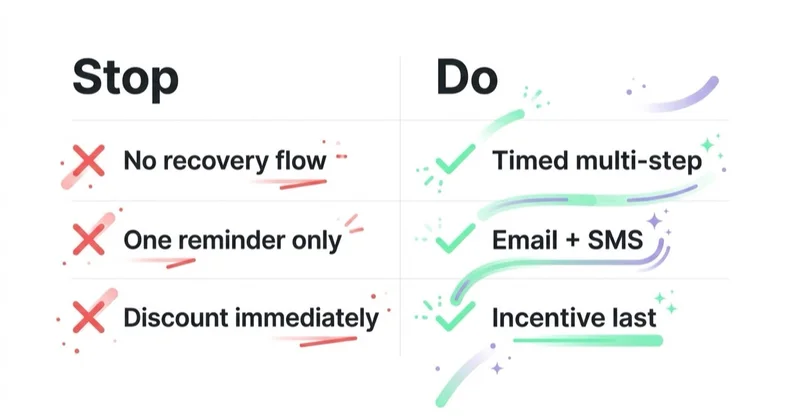
| Stop doing | Do instead |
|---|---|
| Assuming one reminder or four reminders is always right | Start with a short sequence and test message count and delay |
| Opening every flow with a discount | Lead with help; test incentives against incremental margin |
| Blasting email and SMS together | Email for detail, SMS for one timely nudge, with consent |
| Treating all abandonment the same | Separate cart, checkout and browse with different messages |
| Treating contact details as permission | Record channel-specific permission, honor opt-outs, and review local rules |
| Trusting platform "recovered revenue" | Read the flow against a holdout / real store revenue |
| Looping the flow indefinitely | Exit to normal marketing after the last step |
Common mistakes
The most damaging errors are often technical: the purchase filter is missing, the order event arrives late, an ecommerce-platform reminder duplicates the automation, or the return link opens an empty cart. Other common problems include unsupported urgency, indiscriminate coupons, identical messages for browse and checkout behavior, use of SMS without valid permission, and reporting every attributed order as incremental revenue.
FAQ
What is an abandoned cart flow?
An abandoned cart flow is an automated sequence for an identifiable shopper who added an item or started checkout but did not complete an order. Its trigger and purchase-exclusion filter are as important as its copy: buyers should leave the flow immediately, and every link should restore the relevant cart or checkout.
How many abandoned cart emails should I send?
Two or three emails are a reasonable starting point, not a benchmark. Test the number and delays against the normal purchase cycle, incremental orders, margin, and unsubscribe or complaint rates. High-consideration products may need longer delays; low-consideration purchases may benefit from an earlier reminder.
Should abandoned cart emails include a discount?
Usually not in the first message. Start with a reminder and useful information, then test whether a later incentive creates enough incremental contribution margin to justify its cost. Consider restricting it by customer status, cart value, or product margin instead of discounting every cart.
Is SMS or email better for cart recovery?
Neither is universally better. Email provides space for product and policy details. SMS is immediate but more intrusive, subject to separate consent and market-specific requirements, and should be used sparingly. Test each channel's incremental value rather than assuming that adding SMS always improves the flow.
What is a normal cart abandonment rate?
There is no single useful benchmark for every store because the result changes with category, price, device, traffic source, market, and measurement definition. Compare like-for-like periods and segments in your own data. Investigate where shoppers leave before deciding whether the priority is checkout design, the offer, traffic quality, or a recovery flow.
Do I need consent to send abandoned cart messages?
You need a valid legal basis or permission appropriate to the channel, recipient, and market. SMS and email rules are not interchangeable, and some jurisdictions provide limited exceptions for existing customers. Record the source and scope of permission, provide required identification and opt-out mechanisms, suppress withdrawals promptly, and obtain local legal advice before launch.
Key takeaways
- Around 70% of carts are abandoned, so recovery — not prevention — is the flow's job.
- A short sequence is a sensible starting point, but message count and timing should be tested for the store's buying cycle.
- Lead with a reminder and objection-handling; keep any discount for the last step, if at all.
- Email carries detail; SMS is immediate and more intrusive. Use each only where permission and local rules allow.
- Accurate triggers, purchase exclusions, working cart links, consent, and deliverability determine whether the flow works.
- Measure incremental orders and contribution margin against a holdout where volume permits.
Sources and further reading
- Klaviyo Help Center — How to create an abandoned cart flow
- Klaviyo Help Center — How to add SMS to an abandoned cart flow
- Gmail Help — Email sender guidelines
- UK Information Commissioner's Office — Rules for direct marketing by electronic mail
Continue learning
Continue reading
Klaviyo Flows Every Ecommerce Store Needs (and the Order to Build Them)
Klaviyo flows automate relevant email and SMS messages around key customer actions. This guide explains which flows to prioritise, how to set their triggers and exclusions, and how to measure their real contribution to revenue.
The Welcome Email Series That Converts New Subscribers
A welcome series should deliver the signup promise, establish expectations and help an eligible subscriber take the next useful step. Learn how to design, sequence, govern and measure it without relying on a universal template.
Email Authentication Explained: SPF, DKIM and DMARC for Marketers
SPF authorises sending infrastructure, DKIM signs selected message content, and DMARC connects those results to the domain recipients see in From. Learn how alignment works, what Gmail, Yahoo and Outlook require, and how to move from inventory to monitored enforcement safely.