Google is testing and developing ad experiences in which Gemini helps tailor an explanation, product selection, creative treatment or conversation to a person's query. In May 2026, Google described five such formats or experiences: Conversational Discovery ads, Highlighted Answers, AI-powered Shopping ads, Business Agent for Leads and an expanded Direct Offers pilot.
“Gemini ad formats” is useful shorthand, but it is not one campaign type that every advertiser can switch on. The products have different availability, inputs and purposes. Some were described as tests, some as coming in the following months, and Direct Offers as an existing pilot being expanded. Account, market and campaign eligibility can therefore differ.
The immediate opportunity is not to chase an unavailable placement. It is to improve the data, content, controls and measurement that automated campaigns already use—and that these experiences are likely to depend on.
TL;DR
- Google announced five distinct Gemini-powered ad experiences, not one replacement for Search or Shopping campaigns.
- Conversational Discovery ads and Highlighted Answers were announced as tests in AI Mode. Google says both include an independent AI explainer alongside advertiser creative and remain labelled “Sponsored”.
- AI-powered Shopping ads use Gemini to select relevant products and generate a tailored explanation. Business Agent for Leads places a chat experience in an ad and answers from the advertiser's website.
- Direct Offers has been piloting since January 2026; Google announced more promotion types, AI-constructed deals, native checkout for eligible UCP merchants and a planned travel expansion.
- Advertisers still control important inputs: product data, approved assets, campaign goals, landing pages, URLs, brand guidance, offers and measurement.
- Prepare by improving feed completeness, site accuracy, claim governance, AI Max controls, conversion values and testing design.
- Treat Google's 75% decision-confidence figure as commissioned survey evidence for a defined group of AI-shopping users—not proof that a format will improve an individual advertiser's results.
What Google announced—and how certain it is
Google's 20 May 2026 announcement used precise availability language. That language matters more than a speculative rollout date.
| Experience | Where Google described it | What it does | Announcement status |
|---|---|---|---|
| Conversational Discovery ads | AI Mode in Search | Uses Gemini to tailor creative to the person's specific question and highlight relevant features; includes an independent AI explainer | Testing |
| Highlighted Answers | Recommendation lists in AI Mode | Allows relevant, high-quality ads to appear as a highlighted recommendation with an AI explainer | Testing |
| AI-powered Shopping ads | Search | Selects relevant advertiser products and generates an explanation of why one may fit the query | Announced for the coming months |
| Business Agent for Leads | Search ads | Adds a “Chat” interaction that answers based on the advertiser's website | Announced for the coming months |
| Direct Offers | AI-assisted exploration, including AI Mode | Surfaces a relevant offer and is being expanded with more offer types and transaction options | Pilot launched January 2026; expansion announced |
An announcement is not evidence that a feature is generally available. Advertisers should verify eligibility in their own Google Ads or Merchant Center account, read the current help documentation and confirm market limitations with Google support where necessary.
1. Conversational Discovery ads
Conversational searches contain more context than a short keyword. Google's example describes a person looking for low-maintenance ways to make a home smell like a spa or rainy forest. A Conversational Discovery ad uses Gemini to build creative suited to that question and highlight relevant product features.
Google also says the format includes an independent AI explainer that evaluates and synthesises information about the product or service, displayed alongside the advertiser's creative. It remains clearly labelled as sponsored.
This is an important correction to the idea that the advertiser no longer writes the ad. There are at least two layers:
- advertiser-controlled assets, product or service information and campaign setup;
- Google-generated contextual treatment or explanation.
The operational implication is to make source claims specific, current and consistent. A vague landing page gives the system little reliable material; conflicting statements create a risk that the customer encounters a different promise at each step.
2. Highlighted Answers
AI Mode can return a list of recommendations as part of a response. Google says an eligible, relevant and high-quality ad may appear in that list as a Highlighted Answer.
This format changes the competitive context. The ad is not merely beside ten links; it may sit among answers intended to help a user evaluate options. Relevance therefore depends on whether the offer genuinely addresses the query and whether Google's systems can understand the supporting information.
Advertisers should not try to write pages that imitate every possible question. Build clear topic and product coverage:
- who the product or service is suitable for;
- important specifications and limitations;
- comparison criteria that help a decision;
- price, availability, delivery and eligibility information;
- evidence for performance or compliance claims;
- answers to recurring pre-purchase questions.
That content also improves ordinary landing-page usefulness, organic discovery and sales enablement even if the format never becomes available to the account.
3. AI-powered Shopping ads
Google describes AI-powered Shopping ads as selecting the advertiser's most relevant products and generating a custom explanation of why a product may fit the person's needs. The company's example is a considered purchase such as an espresso machine, refrigerator or television.
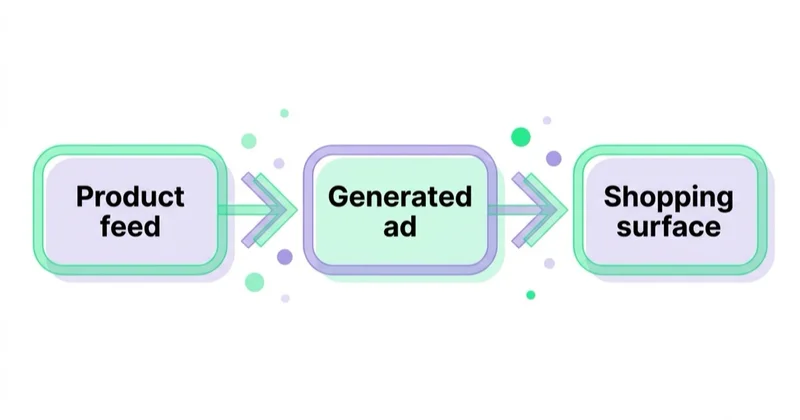
The format raises the value of structured product facts. For a model to distinguish products, the catalogue needs more than an ID, price and generic title.
Prioritise:
- accurate brand, GTIN and category information where applicable;
- product type, variants, material, size, colour and technical attributes;
- price, sale price, availability and shipping consistency;
- high-quality primary and additional imagery;
- clear product titles and factual descriptions;
- structured technical specifications using supported attributes.
Google's Merchant Center documentation says the optional product_detail attribute can provide structured specifications and help products appear across AI-driven surfaces such as AI Mode. In 2026 Google also introduced a video_link product-data attribute. These are opportunities to supply useful evidence, not invitations to insert promotional keyword lists.
Feed optimisation must remain faithful to the product page and actual item. Incorrect or embellished attributes can mislead customers and create policy or disapproval risk.
4. Business Agent for Leads
Business Agent for Leads puts a brand agent inside an ad. In Google's example, a prospective university student selects “Chat” and receives answers based on the institution's website instead of beginning with a static lead form.
The announcement does not establish that the agent will replace every form or how every lead-data workflow will operate. Treat those details as product- and account-specific until Google publishes definitive implementation documentation.
It does establish a strategic requirement: the website becomes an answer source. Audit it as if a prospective customer were asking questions without a salesperson present.
Content readiness checklist
- Are products, services, markets and eligibility stated clearly?
- Are price ranges, fees or commercial terms current?
- Are limitations and exclusions visible, not buried in an old PDF?
- Do location, availability and delivery details agree across pages?
- Are regulated or performance claims approved and evidenced?
- Are high-value questions answered in accessible page content?
- Are outdated campaign pages excluded or removed?
Lead-process checklist
- Which questions indicate genuine fit or urgency?
- What information is necessary before a human follow-up?
- Where should the conversation hand over to sales or support?
- What response-time commitment can the business meet?
- How will consent, privacy notices and data retention work?
- How will misleading, incomplete or unsafe answers be escalated?
Do not publish confidential qualification logic, personal data or advice that requires a licensed professional merely to give the agent more source material. Content readiness still needs legal, security and subject-matter review.
5. Direct Offers
Google launched the Direct Offers pilot in January 2026 and named Chewy, Gap and L'Oréal as participating brands. The experience surfaces relevant offers while shoppers explore their options.
In May, Google announced three expansion areas:
- promotion bundling: advertisers can provide promotions, eligible products and guardrails, while Gemini constructs a relevant deal such as a product bundle;
- native checkout: eligible Universal Commerce Protocol merchants can let customers act on an offer through a Google-rendered checkout experience connected to the merchant's systems;
- travel offers: Google said travel partners would later be able to surface offers during AI-assisted trip planning.
Native checkout is not a simple ad setting. Google's developer documentation requires a merchant implementation for its UCP checkout flow, including APIs and authentication options. It affects product, promotion, inventory, checkout, payment, order and support operations.
For offers, define commercial boundaries before automation:
- eligible products, markets and customer groups;
- minimum contribution after discount and fulfilment;
- stock and fulfilment constraints;
- stacking, exclusion and expiry rules;
- brand and channel-conflict limits;
- refund, cancellation and customer-service treatment;
- the control group needed to estimate incrementality.
A conversion caused by a discount is not automatically profitable or incremental. The evaluation must include margin and whether the customer would have purchased without the offer.
What changes for advertisers—and what does not
More of the final experience is assembled dynamically
The exact combination of product, explanation, landing page or offer can respond to a richer query. This increases the importance of machine-readable facts and coherent content.
The website and feed become more active inputs
Landing pages already inform Google's text customisation and Final URL expansion. Product feeds already determine Shopping eligibility and matching. The new formats extend that direction; they do not create it from zero.
Control moves toward inputs, boundaries and monitoring
Advertisers may have less control over every final sentence, but they still control meaningful constraints. In AI Max for Search, for example, Google documents controls for search-term matching, text customisation, URL inclusions and exclusions, brand inclusions/exclusions and text guidelines. AI Max for Shopping is a separate beta suite with text customisation and Final URL expansion.
Commercial fundamentals remain unchanged
An ad must still reach an appropriate customer, represent a credible offer and generate enough incremental contribution to justify its cost. A conversational interface does not repair weak economics, poor fulfilment or an unsuitable product.
How to prepare: a practical work plan
1. Establish the source of truth
Assign an owner to each changing fact: price, promotion, inventory, product specification, service scope, legal term and claim. Document which system or page is authoritative and how quickly updates propagate.
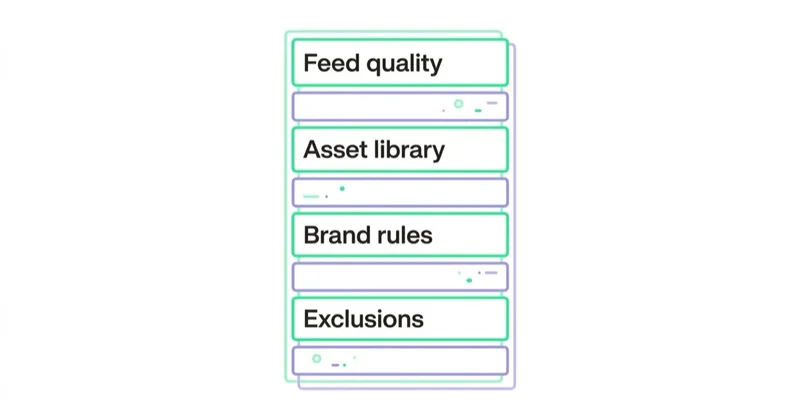
Remove duplicate or abandoned pages that contradict the current offer. Use redirects where appropriate and prevent campaign URL expansion from reaching non-commercial or obsolete sections.
2. Improve product data systematically
Start with diagnostics and coverage, not keyword stuffing:
- fix rejected and limited products;
- reconcile price and availability with landing pages;
- provide required unique identifiers correctly;
- complete category-relevant attributes;
- improve titles while keeping them factual and readable;
- add supported structured detail and media where useful;
- monitor feed changes and item-level eligibility.
Segment the catalogue by commercial priority so the team improves high-impact products first.
3. Build answer-ready website content
Interview sales, support, returns and product teams to identify recurring questions. Turn verified answers into product pages, service pages, comparison guides and help content located where a customer needs it.
Answer-ready does not mean writing in robotic question-and-answer fragments only. Use clear headings, direct summaries, comparison tables where helpful, precise terminology and evidence links. State uncertainty or necessary consultation rather than inventing a universal answer.
4. Review AI Max foundations and controls
Google's announcement recommends building a foundation with AI Max for Search, AI Max for Shopping and Performance Max. That is product guidance, not proof every advertiser should activate every feature immediately.
For each eligible campaign, decide deliberately:
- whether expanded search-term matching suits the objective;
- whether text customisation is appropriate for the brand and sector;
- which URLs may or may not receive traffic;
- whether brand inclusions or exclusions are needed;
- which restricted terms, tone or message rules belong in text guidelines;
- whether pinned assets or strict landing-page requirements conflict with Final URL expansion;
- which campaign and account reports will be reviewed after activation.
Run a controlled experiment where Google supports one. Avoid enabling several new automation layers and changing bidding, budget and conversion goals simultaneously, because the result will be difficult to interpret.
5. Send economically meaningful conversion values
Generated experiences will optimise against the signals available to the campaign. Check that purchase values exclude obvious test or duplicate events, currencies are correct and lead events distinguish a useful business outcome from a low-intent interaction.
For ecommerce, consider the effect of margin, returns and new-customer value. For lead generation, connect later qualified outcomes where lawful, reliable and sufficiently frequent. A chat start is usually an engagement signal, not proof of revenue.
6. Create a claims and brand governance process
Build a register of claims that require evidence or approval, including medical, financial, environmental, comparative, pricing and performance statements. Identify pages that must never be used as advertising destinations and establish a rapid route for correcting an inaccurate representation.
Review generated or assembled outputs wherever Google exposes them. AI Max reporting can show headlines and URLs associated with search terms and performance for optimised assets. For independent AI explainers, visibility may differ, so combine available reports with live observations, customer feedback and support issues.
7. Design the evaluation before access arrives
Record:
- the campaign, market and products eligible for the format;
- launch date and any simultaneous changes;
- primary metric based on realised contribution or qualified value;
- guardrails such as margin, cancellations, returns and lead quality;
- baseline and comparison method;
- minimum observation period and decision rule.
If format-level reporting is limited, do not manufacture certainty. Describe performance at the level the data supports and use campaign experiments, geographic tests or other incrementality methods for material budget decisions.
How to interpret Google's 75% statistic
Google reports that 75% of surveyed people said they made faster, more confident decisions using AI Mode in Search. The footnote matters: it was a Google-commissioned Ipsos online survey conducted in December 2025 among 13,189 adults in selected countries who had recently made a considered consumer-goods purchase and used AI Overviews and/or AI Mode for shopping. The average was not weighted to represent the population.
The finding supports the idea that conversational search can aid some shopping journeys. It does not demonstrate a 75% conversion increase, represent all search users or guarantee that a sponsored format improves confidence. Advertisers should treat it as product-context research and measure their own commercial outcome.
Measurement questions to answer
| Question | Appropriate evidence |
|---|---|
| Did the format serve and where? | Google Ads placement, campaign and availability reporting as provided |
| Did it attract relevant engagement? | Search/query context, product and landing-page diagnostics, qualified visits or chats |
| Did it produce business value? | Net purchases, qualified leads, contribution and downstream outcomes |
| Did it create additional value? | Experiments or credible holdout/geo design |
| Did it create risk? | Claims review, complaints, returns, cancellations, policy issues and wrong destinations |
Do not compare a new format only with an old campaign's platform ROAS if customer mix, product coverage, discounting or measurement changed at the same time.
Common mistakes
| Avoid | Do instead |
|---|---|
| Treating all five announcements as generally available settings | Verify status and eligibility in the current account and market |
| Saying the advertiser no longer creates the ad | Separate advertiser creative and inputs from Google's generated layer |
| Waiting for access before improving inputs | Fix feed, site content, claims, goals and URL controls now |
| Adding promotional language to every product attribute | Submit accurate, supported and category-relevant facts |
| Assuming Business Agent can safely answer from the whole domain | Audit content, remove contradictions and establish governance |
| Treating a Direct Offer sale as incremental profit | Measure discount, contribution and a counterfactual where possible |
| Activating multiple automation features at once | Stage changes and use supported experiments |
| Citing a commissioned survey as a performance promise | Read the sample and test the advertiser-specific outcome |
How Space Ads prepares accounts for AI-powered Search
We treat the format as the final layer of a system. Before seeking more automated reach, we check the commercial goal, conversion values, query coverage, landing-page set, product data, claims and account controls. That reduces the chance that a capable model scales an incorrect input.
When new access appears, we document eligibility and isolate the change as far as the product permits. Reporting separates platform delivery from realised business value and causal evidence. The aim is not to be first to use a label; it is to learn quickly without surrendering commercial or brand discipline.
For the underlying campaign layer, read our guide to AI Max for Search. For the broader discovery experience, see what AI Mode means for brands.
FAQ
What are Google's Gemini ad formats?
The phrase refers to several ad experiences in which Gemini helps tailor an explanation, product selection, creative treatment, conversation or offer. Google announced Conversational Discovery ads, Highlighted Answers, AI-powered Shopping ads, Business Agent for Leads and an expanded Direct Offers pilot in May 2026.
Are Gemini ad formats available to all advertisers?
No. Google described Conversational Discovery ads and Highlighted Answers as tests, AI-powered Shopping ads and Business Agent for Leads as coming in the following months, and Direct Offers as a pilot. Availability may vary by market, account and campaign; confirm it in current Google documentation and your account.
Does Gemini write the entire ad?
Not necessarily. Google says the two tested AI Mode formats include an independent AI explainer alongside advertiser creative. Other experiences can generate a product explanation, tailor assets, select products or construct an eligible offer within supplied guardrails. Advertisers still provide and control important inputs.
What is Business Agent for Leads?
It is an announced Search ad experience that lets a person select “Chat” and receive answers based on the advertiser's website. Google presented it as an alternative to beginning with a static form in its example. Detailed availability and lead-workflow behaviour should be verified as documentation develops.
What are Direct Offers?
Direct Offers surface relevant promotions during AI-assisted consideration. The pilot began in January 2026. Google has announced support for more promotion types, AI-constructed bundles within merchant guardrails, native checkout for eligible UCP merchants and planned travel offers.
How should an advertiser prepare?
Improve product-data accuracy and completeness, make website answers current and consistent, configure AI Max and URL controls deliberately, send useful conversion values, govern claims and define an experiment and risk-monitoring plan before rollout.
Will these formats replace Search and Shopping campaigns?
Google has not described them as wholesale replacements. The company recommends foundations including AI Max for Search, AI Max for Shopping and Performance Max, indicating that existing campaign systems supply or support access to the new experiences.
How should performance be measured?
Use realised contribution or qualified downstream value, with margin, returns, cancellations, lead quality and brand risk as guardrails. Use an experiment or credible holdout for incrementality when the decision warrants it. Availability and platform attribution alone do not prove additional business value.
Key takeaways
- Google's five Gemini-powered experiences have different functions and rollout stages.
- Generated explanations complement or transform advertiser inputs; they do not eliminate advertiser responsibility.
- Product data, website content, campaign controls and conversion values become more—not less—important.
- Business Agent makes website accuracy part of conversational lead generation.
- Direct Offers require economic guardrails and, for native checkout, meaningful technical integration.
- Verify current availability, stage activation and measure realised and incremental value.
See how we manage these foundations in our Google Ads and Google Shopping Ads work.
Sources and further reading
- A new generation of ads for the AI era of Search — Google
- Google Marketing Live 2026 announcements — Google
- What's ahead for commercial experiences in 2026 — Google
- How AI Max for Search campaigns works — Google Ads Help
- About AI Max for Shopping campaigns — Google Ads Help
- Product detail attribute — Google Merchant Center Help
- Merchant Center product data specification update 2026 — Google
- Universal Commerce Protocol checkout integration — Google for Developers
- Google Ads experiments
Continue reading
Google Ads Experiments: Testing That Produces a Decision
A useful Google Ads experiment starts with a decision, an effect worth detecting and enough statistical power. Learn how to choose the test, split, metric and interpretation.
Google Ads Account Suspended: Why It Happens and What to Do
A Google Ads suspension requires evidence, not panic. Learn how suspension differs from a hold or pause, what the strike system covers and how to diagnose and appeal safely.
How to Choose a Google Ads Agency: A Verification Protocol
Choose a Google Ads agency by verifying diagnosis, measurement, account access, commercial understanding and operating discipline—not by comparing badges, promises or dashboards.