A product launch is a learning and commercial process, not one announcement. This 90-day framework divides the work into three phases: validate and prepare before launch, concentrate distribution during the launch window, then decide what deserves continued investment. Ninety days is a planning template rather than a universal duration. A simple extension for an established brand may move faster; an enterprise, regulated or genuinely new-category product may need much longer.
TL;DR
- Use three phases and evidence gates. Move from preparation to launch to scale only when the relevant risks have been reduced.
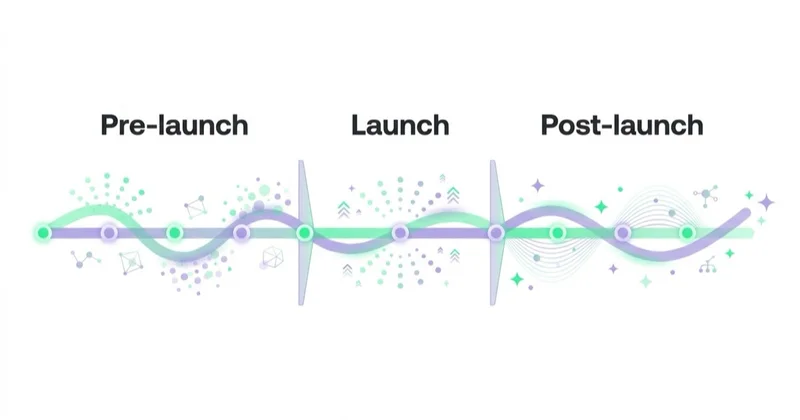
- Pre-launch (illustratively days 1–30) validates the problem, audience, claims, offer and operational readiness while building permission-based demand.
- Launch (illustratively days 31–45) coordinates owned, paid, partner and earned distribution around a product that can be sold and delivered.
- Post-launch (illustratively days 46–90) studies customers, activation, returns and economics before scaling, changing or stopping.
- Positioning and product readiness come before reach. More distribution amplifies both a strong proposition and a broken experience.
- A waitlist is a signal, not proof of revenue. Measure qualified intent and behaviour after the product becomes available.
- Protect margin, cash and trust. Preorders, claims, consent, inventory and support are launch decisions, not legal or operational footnotes.
Why launch day is the wrong focus
The instinct is to pour effort and budget into the announcement and launch-day spike. That can work for an established brand extending a familiar range, but it is fragile when the category, brand or use case needs explanation. In that situation, buyers need evidence and context before a concentrated media push can perform efficiently.
Pre-launch should do more than collect email addresses. It should expose weak assumptions while they are still inexpensive to change: who has the problem, how they describe it, what alternative they use, which claim is credible, what prevents purchase and whether the product can be delivered as promised. Launch day then concentrates attention around a better-prepared offer, while the weeks after reveal whether the first customers activate, stay, reorder or return the product.
This framework is the operational companion to the go-to-market strategy: the strategy decides ICP, positioning, motion and channels; this is how the launch executes over 90 days.

Before you start: offer and positioning
No launch framework rescues an unclear offer. Before meaningful media spend, an intended buyer should be able to understand what the product does, who it is for, when it is useful and why it is preferable to the current alternative. The company should also know which claims require evidence and which words imply more than the available evidence supports.
This is where product, product marketing, growth, sales, operations, finance and support need one launch brief. The product marketing and growth split still matters, but ownership must extend beyond message and funnel. Write down who can approve claims, release inventory, change price, pause campaigns, handle incidents and communicate delays.
Choose the launch motion before choosing channels
| Launch situation | Primary risk | Pre-launch emphasis |
|---|---|---|
| New product for an existing customer base | Cannibalisation, offer clarity, operational readiness | customer research, segmentation, cross-sell and controlled release |
| Existing category, new brand | Trust and efficient discovery | proof, creator or partner distribution, product comparison and demand capture |
| New category or behaviour | Education and adoption | problem validation, demonstration, trial and longer consideration measurement |
| Enterprise or regulated product | Stakeholder consensus, evidence and compliance | sales enablement, pilots, security/legal review and account-level demand |
The same calendar and channel mix should not be imposed on all four.
Phase 1 — Pre-launch (illustratively days 1–30): validate and prepare
The pre-launch phase reduces the risks that paid reach cannot fix. Building permission-based demand is one output, but so are evidence, operational readiness and a measurement baseline.
| Week | Focus | Actions |
|---|---|---|
| 1–2 | Evidence and economics | Interview intended buyers; define alternatives, price hypothesis, margin, capacity and stop conditions |
| 2–3 | Product and launch readiness | Validate claims; test onboarding or fulfilment; prepare support, inventory, consent and measurement |
| 3–4 | Permission-based demand | Build useful problem and product content; invite relevant prospects to a waitlist, demo, pilot or early-access cohort |
The outputs are a launch brief, a clear offer, substantiated claims, a tested purchase or signup path, an operational plan, a baseline and a reachable group of relevant prospects. A waitlist should be segmented by source and intent. A free signup can overstate willingness to pay, and a retargeting audience requires a lawful basis and platform-appropriate consent where applicable.
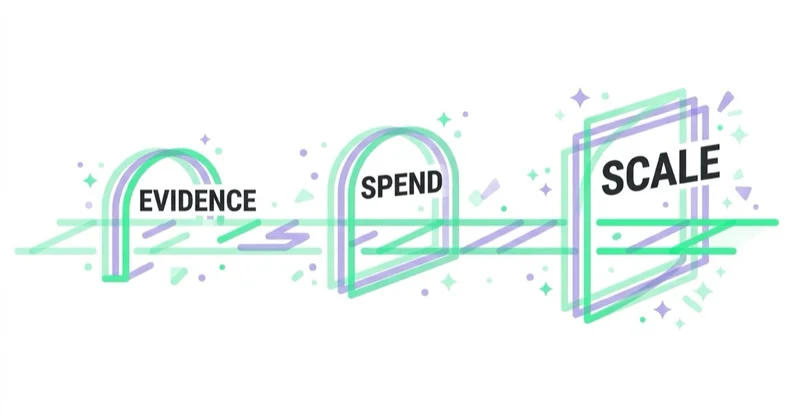
Gate to launch: can the team explain the customer problem in the customer's language, deliver the product as promised, support the first cohort, measure the primary outcome and state what result would stop further spend? If not, the calendar should move rather than forcing a launch date.
Phase 2 — Launch (days 31–45): capture demand
With the offer and operation ready, the launch phase coordinates distribution. Allocation between existing audiences and new acquisition depends on the launch motion. An established brand may have meaningful owned demand; a new entrant may need partners, creators, search demand or paid prospecting to reach enough qualified buyers.
- Serve the highest-intent prospects appropriately — contact waitlist, pilot, demo and customer segments with the message and next step they requested.
- Use retargeting selectively — exclude customers and unsuitable visitors, control frequency and respect consent and market-specific privacy rules.
- Coordinate the push — paid, owned (email, social), earned (PR, partnerships) landing together for momentum.
- Test new-customer acquisition deliberately — choose channels from observed buying behaviour, not the desire to be everywhere.
- Remove friction — the path from ad or announcement to purchase or signup should be as short as possible.
Do not compare warm and new audiences as if they were equivalent: existing customers and waitlist members were selected by prior interest. Report them separately, but do not let the cheaper warm conversion rate make the whole launch look like efficient new-customer acquisition.
If the launch uses preorders, advertise a shipping date only when there is a reasonable basis for it and make the terms clear. In the United States, the FTC's Mail, Internet, or Telephone Order Merchandise Rule requires sellers that cannot ship within the promised period to obtain consent to the delay or provide a refund; if no shipping time is stated, the rule generally uses 30 days. Other markets have their own consumer rules.
Gate to continued spend: are real customers buying or activating at acceptable contribution, and can fulfilment, sales and support maintain service quality? Traffic, press mentions and waitlist size do not pass this gate on their own.
Phase 3 — Post-launch (days 46–90): scale what works
The post-launch phase determines whether the result is repeatable. Early data is selected and noisy: enthusiasts, existing customers and promotional buyers may not represent the next cohort. Read behaviour as well as campaign reports.
| Week | Focus | Actions |
|---|---|---|
| 7–9 | Read the customer and operation | Review activation, objections, returns, support load, cohort source and contribution |
| 9–11 | Confirm or revise | Retest promising messages and channels; fix product, offer or funnel issues before adding spend |
| 11–13 | Scale, hold or stop | Build an ongoing motion only where marginal economics and capacity remain acceptable |
The outcome by day 90 should be a decision, not a predetermined scale plan. The evidence may support an ongoing acquisition motion, a narrower segment, a new price, product work or a stop. Refusing to scale weak evidence is a successful use of the framework. This is where demand generation and lead generation settle into their ongoing roles.
Glossary
- Pre-launch — the phase before launch that builds a warm, retargetable audience.
- Warm audience — people with a prior relationship or recorded interaction; a heterogeneous group, not proof of purchase intent.
- Waitlist — people who asked for launch information or access; a demand signal whose quality depends on source and commitment.
- Coordinated push — paid, owned and earned channels landing together at launch for momentum.
- Launch signal — the data on what converted, used to scale post-launch.
- Evidence gate — a pre-agreed condition that must be met before more budget or exposure is released.
Measure from day one
A launch without measurement cannot be corrected while it still matters. Before day 1, define the primary outcome, observation window, unit economics and guardrails. A signup may be the first event, but activation, qualified pipeline, paid purchase, return rate, retention and contribution often determine whether the launch created value.
Pre-launch metrics should distinguish learning from demand: interview patterns, message comprehension, qualified opt-ins and readiness defects. Launch metrics should separate existing from new customers and platform attribution from store or CRM outcomes. Post-launch adds cohort activation, refunds, contribution, repeat behaviour and operational load. Google Ads experiments can isolate selected campaign changes, but Google recommends allowing many tests four to six weeks and accounting for the conversion cycle; a two-week launch window may be too short for a conclusive platform experiment.
Use launch gates, not calendar optimism
Each phase should release the next spend tranche only after relevant evidence appears. Pre-launch needs repeated problem language from the intended segment, a credible offer and delivery readiness. Launch needs qualified demand and an operation that meets the promise, not merely traffic. Post-launch needs acceptable activation, contribution, payback and customer outcomes before scale.
Define stop conditions in advance: the maximum test budget, minimum sample, review date, and the result that forces a change in audience, positioning, offer, price, or product. Without them, teams keep buying attention to defend the launch plan.
The measurement sheet should record baseline demand, holdout or geo opportunities, new-versus-existing customers, refunds, contribution margin and subsequent cohort behaviour. Where a controlled experiment is impractical, state the limits of the inference. A launch spike is not durable growth unless customer outcomes and acquisition economics survive beyond promotional demand.
How Space Ads approaches a product launch
At Space Ads, launch planning begins with the commercial and measurement brief rather than a media plan. We clarify the audience, promise, unit economics, baseline demand and evidence gates, then identify the role paid acquisition can realistically play. Media cannot determine product readiness, substantiate claims or repair fulfilment after the fact.
Where paid media fits, we use it to test messages, capture existing intent, reach defined new audiences and create measurable learning within a capped budget. Landing pages, analytics and CRM outcomes are prepared before scale. Performance marketing can then support a launch without pretending platform attribution is proof of incrementality. When ownership spans positioning, pricing, channels and internal readiness, it belongs in a broader fractional CMO mandate.
Stop doing / Do instead
| Stop doing | Do instead |
|---|---|
| Treating launch as a single day | Run it as three phases over ~90 days |
| Forcing every product into 90 days | Adapt the phases to category, risk and buying cycle |
| Treating waitlist size as demand proof | Segment intent and observe paid behaviour |
| Spending across every channel | Assign each chosen channel a job and evidence threshold |
| Amplifying an unclear offer | Sharpen positioning before the 90 days begin |
| Ending at the launch-day spike | Use post-launch to scale what worked into an engine |
| Measuring a vanity launch number | Instrument from day one against real conversion targets |
FAQ
How do you market a new product?
Use three phases: validate and prepare, coordinate launch distribution, then evaluate customer outcomes and economics. A 90-day plan is a useful template, but the buying cycle, category novelty, regulation and operational risk determine the real duration. Release budget through evidence gates rather than by date alone.
Why do product launches fail?
Launches fail for different reasons: an unimportant problem, unclear positioning, weak proof, unsuitable price, poor distribution, unreliable delivery, insufficient support or scaling before activation and retention are known. Treat launch as a phased learning process so the team can identify which assumption failed rather than blaming reach alone.
What is a pre-launch phase and why does it matter?
Pre-launch validates the customer problem, offer, claims and operational readiness before broad exposure. It can also build a permission-based audience through useful content, a waitlist, demos, pilots or early access. Its purpose is to reduce expensive uncertainty, not merely accumulate retargeting cookies or email addresses.
How long should a product launch campaign run?
Use 90 days as a starting template, not a rule. A known product extension may need weeks; enterprise, regulated or new-category launches may need several quarters. Set phase length from the buying cycle, product readiness, sample needed for a decision and the time required to observe activation, returns or retention.
What should you measure in a product launch?
Define a primary business outcome, observation window and guardrails before day one. Track message and readiness evidence pre-launch; existing-versus-new customer conversion and contribution during launch; and activation, returns, qualified pipeline, retention and operational load afterward. Separate platform attribution from incremental evidence.
Should you spend the launch budget on cold acquisition?
Not by default. Allocate budget according to the launch motion and evidence. Existing customers and high-intent prospects deserve an appropriate owned-channel path, while new-customer acquisition should be tested separately. A new brand may require prospecting from the beginning; an established brand may rely more on owned demand. Compare cohorts rather than blending their economics.
Key takeaways
- Use preparation, launch and post-launch phases, but adapt their length to the product and buying cycle.
- Pre-launch must validate the problem, offer, claims, delivery and measurement — not just build an audience.
- Separate existing demand from new-customer acquisition and assess each on its proper economics.
- Let post-launch evidence lead to scale, revision, a narrower market or a stop.
- Protect contribution, cash, customer trust and operational capacity from day one.
Sources
- Google Ads Help — Set up and evaluate campaign experiments
- Google Meridian — Scenario planning and evidence-based budget allocation
- Federal Trade Commission — Mail, Internet, or Telephone Order Merchandise Rule
- Federal Trade Commission — Advertising substantiation policy
Continue learning
- Go-to-market strategy: the paid-acquisition layer most launch plans skip
- Product marketing vs growth marketing: who owns the number?
- Product-led growth still needs paid: how PLG companies acquire
- Demand generation vs lead generation in B2B
- Performance marketing applied to a launch
- Landing pages built to convert a warm launch audience
Continue reading
Go-to-Market Strategy: The Paid-Acquisition Layer Most Launch Plans Skip
A go-to-market strategy connects a defined customer, problem, offer, buying motion and route to market. This guide shows where paid acquisition fits, when it should wait and how to test demand without confusing platform leads with viable growth.
Brand Strategy vs Performance: How Brand Work Actually Shows Up in Revenue
Brand building and sales activation serve different time horizons, but neither belongs to a single channel. Learn how to set objectives, use the 60/40 finding responsibly, connect brand indicators to commercial outcomes, and measure incremental impact.
Product Marketing vs Growth Marketing: Who Owns the Number?
Product marketing usually leads market and message decisions; growth marketing leads the experiment portfolio. This guide maps decision rights, metrics and one accountable owner for the commercial target.