Product-led growth (PLG) is an operating model in which people can experience meaningful product value before, or with limited help from, a sales conversation. Product experience may support acquisition, conversion, retention and expansion, but it does not remove the need for distribution. Paid acquisition is one possible distribution lever—not a compulsory stage. When its cohort economics work, paid should be judged on verified product and commercial outcomes rather than the cheapest signup.
TL;DR
- PLG is not the absence of marketing. Product experience can drive adoption, while content, community, partnerships, sales and paid media can contribute to distribution.
- Paid is optional, not inevitable. Use it when incremental customers and cohort contribution justify the acquisition cost—not simply because organic growth slowed.
- Optimise beyond signups. A useful activation event must be shown to predict retained use or commercial value; otherwise it is another proxy metric.
- The product experience is often the offer. Some segments may still need a demo, security review, procurement or sales-assisted onboarding.
- Feed a validated downstream event or value back to platforms when consent, signal quality and sufficient volume make that appropriate. Use a staged proxy when the deepest event is too sparse.
- PLG and sales-assisted motions coexist — paid supports self-serve at the bottom and pipeline for larger accounts.
- Measure activated CAC and free-to-paid conversion, not cost per signup.
The myth that PLG means no marketing
The appeal of PLG is efficient self-service adoption: a useful free experience, invitations, integrations, templates, community and word of mouth can all distribute the product. Some businesses can sustain growth through those mechanisms; others cannot. Neither outcome determines whether the company is “truly” product-led.
When growth slows, diagnose the constraint before buying more traffic. The problem may be limited awareness, but it may also be weak activation, poor retention, an exhausted use case, pricing friction or a product that does not spread. Paid can test new audiences and messages, but it will amplify an unresolved product constraint as readily as it amplifies a strong experience.
The correct framing is a capital-allocation decision. Estimate the full acquisition cost, model conversion and contribution by cohort, define a payback limit and test whether paid creates customers who would not otherwise have arrived. Paid should feed the product-led motion only while marginal economics and product capacity remain acceptable.
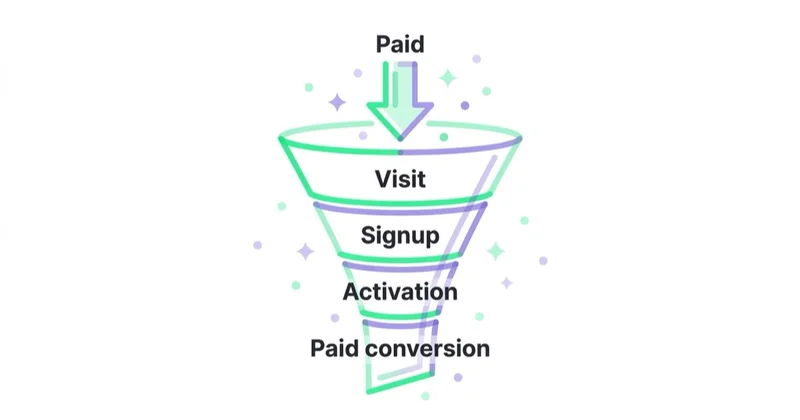
Where paid fits in a PLG funnel
Paid plays specific roles in PLG, different from its role in a sales-led model.
- Demand creation tests — reaching people who do not yet know the category or product, measured with lift or controlled-market designs where scale permits rather than “assisted activation” alone.
- Category education — teaching a market that a better way exists, especially for new categories where search demand does not yet exist.
- Activation-optimised acquisition — bringing users to a frictionless signup and, crucially, to the first value moment, not just the signup form.
- Re-engagement toward activation — helping consented signups complete a relevant next step, while comparing paid retargeting with lower-cost in-product, email or support interventions.
- Expansion and upsell tests — reaching eligible existing users when paid media adds value beyond in-product and lifecycle communication.
The through-line is that PLG paid must connect the click with what happens inside the product and later in billing. Clicks and signups remain useful diagnostics, but they are not sufficient business outcomes.
Optimise to activation, not signups
A signup proves account creation, not value. If the platform is optimised only to signups, it may find people likely to complete a short form rather than people likely to use and pay for the product. The size of that gap varies by product, source and signup design, so measure it by cohort rather than relying on a generic benchmark.
Define activation from evidence. Start with candidate behaviours such as completing a useful workflow, connecting a required integration or collaborating with a teammate. Compare users who perform each behaviour with comparable users who do not, then check retained use and paid conversion across mature cohorts. Avoid circular definitions such as choosing an event because active users perform it. Where the event has enough volume and can be shared lawfully and reliably, send it—or an appropriate value—to the ad platform. Where it is sparse, use a closer proxy and periodically validate it against revenue. This mirrors the B2B principle in SaaS paid acquisition: optimise toward the best reliable signal available, not merely the easiest event.
When the product experience is the offer
For a self-serve segment, the paid offer is often a free trial, free tier, interactive demo or template rather than a sales call. The ad should make the use case and next step clear, and the landing journey should help an eligible user reach value without hiding important limits. Enterprise or regulated buyers may still need a demo, security material and a sales-assisted path.
This also means conversion optimisation shifts from a landing page to the signup-and-onboarding flow. A great PLG ad that drops users into a high-friction signup or a confusing first-run experience wastes the spend at the last step. The conversion work that matters most in PLG is the path from click to activation, not the ad itself.
Glossary
- PLG (product-led growth) — a model where the product drives acquisition, conversion and expansion.
- Activation — a defined behaviour or set of behaviours shown by cohort evidence to predict retained use or another meaningful outcome.
- Free-to-paid conversion — the share of free users who become paying customers.
- Activated CAC — acquisition cost per user who actually activates, not per signup.
- Viral loop — a product mechanic where users bring in more users.
- Expansion revenue — additional revenue from existing users (upgrades, seats, usage).
PLG and sales-assisted motions coexist
Some PLG companies run a hybrid: self-serve for suitable users and sales assistance for accounts with complex security, integration, procurement or rollout needs. For self-serve acquisition, measure validated activation and eventual contribution. For sales-assisted acquisition, connect campaigns to qualified opportunities and revenue while respecting rules on combining product and advertising data.
Do not force one journey across both. A team already using the product has different context from an enterprise buying group that has never evaluated it. Define when a product signal qualifies for human follow-up, what consent and privacy rules apply, and how sales avoids disrupting successful self-service adoption. The product marketing and growth split matters here too—one integrated owner must resolve conflicts between the motions.
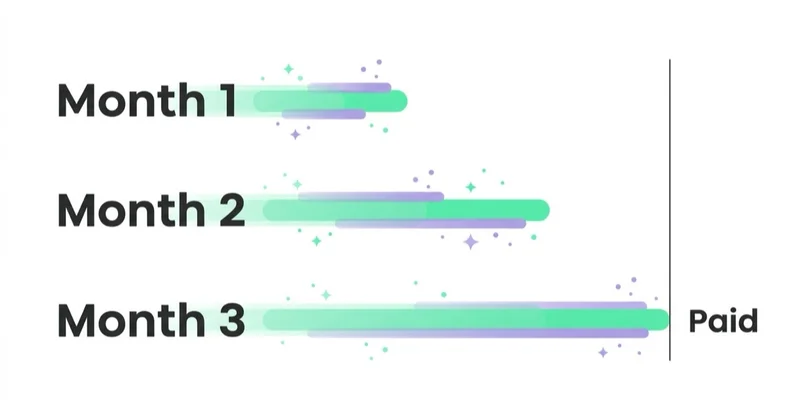
Model paid PLG by cohort, not signup volume
The paid-acquisition table should follow each cohort from click to signup, activation, retained use, paid conversion, expansion, and contribution margin. CAC based on signups is a media metric; customer CAC includes the full cost of acquiring paying customers. Payback starts only when contribution, not booked revenue, recovers that cost.
Free users also consume infrastructure and support. A campaign can report cheap activation while attracting use cases that never reach the paid threshold. Segment cohorts by source, persona, product use case, plan, and market, then compare retained activation and monetization.
Paid should scale when the activation definition predicts retention, marginal payback remains acceptable, and the product can absorb more users without degrading experience. It should pause when acquisition volume outruns onboarding, support, or the team's ability to learn from behavior.
How Space Ads approaches PLG paid
Our starting point is the event chain from ad interaction to signup, candidate activation, retained use, payment, expansion and contribution. We verify event definitions and cohort maturity before using a downstream signal for bidding. A low signup cost is not treated as success unless later product and financial outcomes support it.
We test whether candidate activation events predict retention and payment, choose a signal with enough volume and quality, and reconcile platform reporting with mature cohorts. Paid is scaled only when marginal contribution and payback remain acceptable. Self-serve and sales-assisted motions receive separate journeys and measurement. That is performance marketing adapted to a product-led funnel, with channels such as LinkedIn considered for the sales-assisted layer when the audience and economics fit.
Stop doing / Do instead
| Stop doing | Do instead |
|---|---|
| Assuming PLG means either “no paid” or “paid is inevitable” | Test paid against cohort economics and incremental value |
| Optimising paid only to signups | Use a validated downstream signal with sufficient volume |
| Selling a demo in PLG ads | Make the free product the offer; reduce friction to value |
| Ignoring the onboarding flow | Optimise the path from click to activation |
| Forcing one paid approach on all users | Split self-serve and sales-assisted motions |
| Judging on cost-per-signup | Judge on activated CAC and paid conversion |
FAQ
Does product-led growth need paid marketing?
Not necessarily. A PLG company needs distribution, but that can come from product loops, search, community, partners, content, sales and paid media in different proportions. Paid is justified when tests show incremental customers with acceptable contribution and payback, and when the product can activate and retain the additional users.
What should PLG paid campaigns optimise for?
Use the deepest reliable event that has adequate volume and predicts retained or commercial value. That may be a validated activation event, a qualified product action, a paid conversion or a value signal. If the deepest event is too sparse, use a staged proxy and validate it against mature cohorts.
Why might a PLG company start running paid ads?
They may use paid to reach a new market, test positioning, accelerate a launch or diversify distribution. Slower organic growth alone is not enough reason: first determine whether the constraint is awareness, activation, retention, monetisation or product capacity.
What is activation in PLG?
Activation is a product behaviour or set of behaviours that the company has shown to predict retained use or another meaningful outcome. Creating a project or inviting a teammate may be a candidate, not proof. Validate candidates across mature cohorts and review the definition as the product and user mix change.
How is PLG paid different from sales-led paid?
Self-serve paid usually offers direct product experience and measures activation through payment. Sales-assisted paid usually offers evaluation or contact and measures qualified opportunity through revenue. A company may run either or both, with separate journeys and clear rules for when a product user should enter sales follow-up.
How do you measure PLG paid acquisition?
Follow acquisition cohorts through signup, validated activation, retained use, payment, expansion and contribution margin. Include media, creative, tools and relevant labour in customer acquisition cost, state the attribution method, and compare incremental or holdout results where feasible. Cost per signup remains a diagnostic, not the final decision metric.
Key takeaways
- PLG still needs distribution, but paid is one option rather than an inevitable stage.
- Diagnose whether awareness, activation, retention or monetisation is the constraint before buying more traffic.
- Optimise beyond signups using a downstream signal validated against mature cohorts.
- For self-serve segments, product experience can be the offer—reduce unnecessary friction while setting honest expectations.
- Measure activated CAC and free-to-paid conversion; split self-serve and sales-assisted motions.
Sources
- Google Analytics Help — Cohort analysis for retention
- Google Analytics Help — A/B tests and randomised variants
- Google Analytics Help — User lifetime analysis
Continue learning
- Go-to-market strategy: the paid-acquisition layer most launch plans skip
- SaaS paid acquisition: Google and Meta for pipeline, CAC and payback
- Product marketing vs growth marketing: who owns the number?
- Conversion optimization across ecommerce, B2B and services
- Performance marketing for a product-led funnel
- LinkedIn Ads for the sales-assisted PLG layer
Continue reading
Lead Generation for Online Courses and Education Providers
Education lead generation must connect an honest promise with learner fit, enrolment and course starts—not just form volume. Learn how to design the journey, evidence claims and measure each intake.
How to Choose a Performance Marketing Agency
Choose a performance marketing agency with a defined brief, evidence-based scorecard and clear commercial safeguards. This guide covers team evaluation, measurement, account access, fees, contracts and handover.
Website Marketing: How to Actually Drive Revenue From Your Site
A website creates commercial value when it helps the right people complete the right task and gives the business reliable feedback. This guide connects audience journeys, acquisition, experience, measurement and experimentation.