Product marketing typically focuses on the market, buyer, positioning, messaging, launches and sales enablement. Growth marketing typically runs measurable experiments across acquisition, activation, conversion and retention. These are operating patterns, not standard job definitions; responsibilities vary by company. The useful question is therefore not which title “owns revenue”, but who makes each decision and who is accountable for the integrated commercial target.
TL;DR
- Product marketing usually owns a market-facing decision set. Customer insight, positioning, messaging, launches, competitive context and enablement.
- Growth marketing usually owns an experimentation system. Acquisition, activation, conversion, lifecycle and measurement tests.
- They overlap on demand and messaging, which is where the friction lives.
- One commercial or executive owner should be accountable for the integrated number. Product marketing and growth own named inputs and decisions; product, sales and finance also affect the result.
- Paid spend exposes the gap. Growth amplifies product marketing's positioning — if the two are disconnected, the budget burns on a message that does not land.
- The fix requires a decision map and feedback loop. In some companies responsibilities or reporting lines also need to change.
- Small teams collapse both roles into one person — that is fine, as long as both jobs are consciously done.
What each discipline actually does
The titles blur in practice, so define the work, not the label.
Product marketing commonly turns customer and market evidence into an ideal customer profile, positioning against alternatives, a messaging framework, launch plan, competitive context and sales enablement. It works across product, sales, customer success and marketing; it cannot make the product wanted through messaging alone.
Growth marketing commonly designs experiments across acquisition, activation, conversion and lifecycle communication, then uses evidence to decide what should be scaled, revised or stopped. Some activation and retention changes belong to product or customer-success teams, so growth needs explicit decision rights rather than assumed ownership of the whole funnel.
A useful shorthand is that product marketing establishes the market and message hypothesis, while growth turns parts of that hypothesis into measurable distribution and journey tests. The shorthand is incomplete: product strategy shapes the promise, sales conversations provide evidence, and growth tests can reveal channel behaviour without proving the overall positioning.
Where they overlap — and where the friction starts
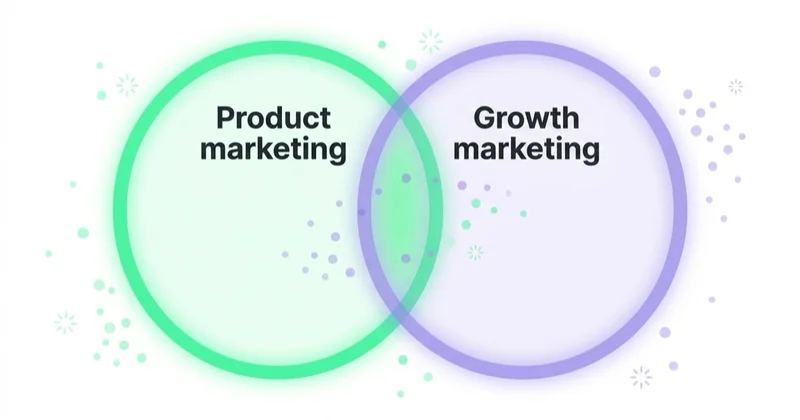
The overlap is demand and messaging, and it is unavoidable. Growth needs a message to put in an ad; product marketing wrote it. Product marketing needs to know which message actually converts; growth has the data. When the handoff works, this is a virtuous loop. When it does not, it becomes a blame cycle.
| Area | Product marketing's role | Growth marketing's role |
|---|---|---|
| Positioning | Maintains the competitive frame and evidence | Tests how selected expressions perform in defined channels |
| Messaging | Maintains the framework, proof and hierarchy | Tests variants and reports results with audience and context |
| Launch | Owns the narrative and timing | Owns the acquisition push and measurement |
| Channels | Advises on audience and message fit | Owns selection, budget and optimisation |
| Creative | Owns the message and proof points | Owns format, iteration and performance |
| Analytics | Defines questions and uses qualitative and quantitative evidence | Owns agreed experiment instrumentation; analytics engineering may own the data layer |
Friction often appears at the seams: positioning that was not tested with enough market evidence, or growth experiments that drift the message away from the strategy without a recorded decision. Both point to unclear governance and a weak feedback loop rather than an automatic failure of either discipline.
Who owns the number?
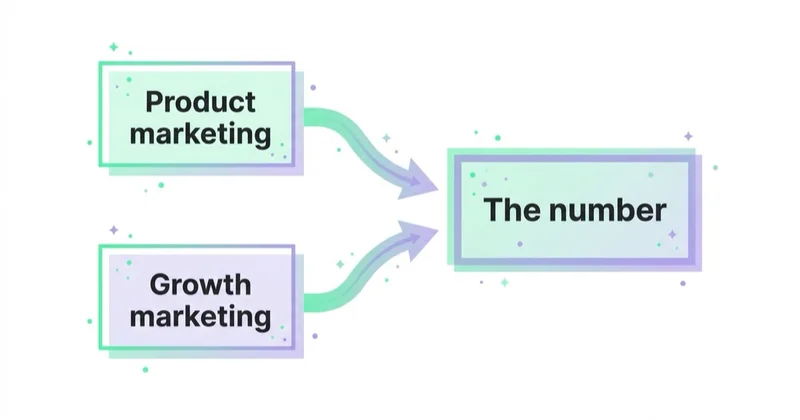
Revenue, pipeline or profitable growth should have one accountable business owner—often a CEO, CRO, GM or marketing executive depending on the model. Several functions contribute, but “shared accountability” should not mean that nobody can resolve a trade-off.
- Product marketing owns named market and message decisions, with evidence such as customer interviews, message comprehension, competitive outcomes, sales adoption and qualified response.
- Growth marketing owns the experiment portfolio and agreed acquisition or lifecycle decisions, with metrics such as incremental conversions, customer acquisition cost, activation and payback.
- The integrated owner is accountable for pipeline or revenue, while product, sales, finance and customer success retain their own decisions and constraints.
The dysfunction appears when a team receives a revenue target without authority over the decisions required to achieve it, or when several teams can veto a decision but none can make it. Build a decision map: who approves positioning, who controls channel budget, who owns pricing, who changes onboarding, and who resolves conflicts. Then connect those decisions to the go-to-market strategy and its financial model.
Why paid spend exposes the gap fastest
Paid acquisition makes a disconnect visible because every test consumes budget. Growth turns a market and message hypothesis into ads and landing journeys. A weak result can come from positioning, but also from audience selection, offer, price, proof, format, landing-page experience, product friction, sales follow-up or measurement. Diagnose the full path before assigning the problem to one function.
A strong click-through rate and weak post-click conversion only tells you that the ad earned clicks more readily than the measured next step. It does not identify the cause. Segment by audience, query, creative and device; validate the conversion event; inspect page speed and usability; compare ad promise with landing-page proof; and review downstream lead or customer quality. Product marketing and growth should interpret that evidence together before changing positioning or spend. This is how positioning connects to performance marketing without becoming a catch-all explanation.
Glossary
- Product marketing — the discipline owning positioning, messaging, launches, competitive intelligence and enablement.
- Growth marketing — the discipline owning funnel experimentation across acquisition, activation, conversion and retention.
- Message hypothesis — a testable claim about which buyer, problem, promise and proof will make the offer relevant; no message alone creates product-market fit.
- Sales enablement — the assets and narratives that help sales and marketing sell (decks, battlecards).
- Funnel efficiency — how economically demand converts through the stages, measured by CAC, conversion and payback.
How they should collaborate
Start with a loop and defined handoffs. If authority remains ambiguous or workload is structurally misplaced, the organisation design may also need to change.
- Product marketing sets the positioning and message hierarchy — the strategic input.
- Growth turns it into testable variants across channels and creative.
- Growth feeds conversion data back — which messages, audiences and proof points actually move people.
- Product marketing refines positioning with that evidence, not opinion.
- The integrated commercial owner reviews the result with both teams, while each owner decides within an explicit remit.
Cadence and structure both matter. A weekly or biweekly review can connect customer evidence, experiment design and commercial results, but it will not repair unclear authority by itself. Record the decision, owner, evidence, expected effect and review date so the meeting produces action rather than shared commentary.
Use one decision map across the launch funnel
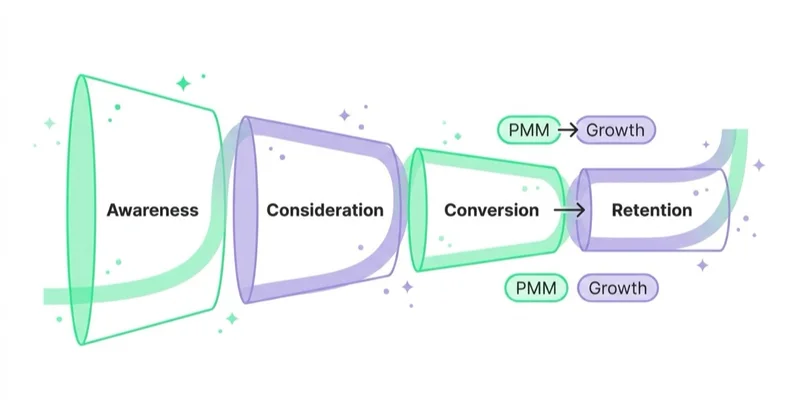
The cleanest split assigns one directly responsible owner to each decision. Product marketing owns ICP evidence, positioning, message architecture, launch readiness, and sales enablement. Growth owns experiment design, acquisition and lifecycle execution, funnel economics, and scaling. Product owns the experience that creates activation and retention. Revenue leadership owns the integrated target and resolves trade-offs.
Shared metrics still need a primary decision owner and an agreed definition. Product marketing can be accountable for message adoption and qualified response; growth for the experiment portfolio and acquisition economics; product for activation and retained use. All three can review cohort revenue and retention, but the executive owner resolves trade-offs. Cohort analysis is especially useful because aggregate growth can hide weaker retention in newly acquired groups.
A weekly growth review should carry one hypothesis from customer insight through message, channel, product behavior, and commercial result. This prevents growth from testing weak promises faster and product marketing from producing positioning that never meets market evidence.
Which org model fits your stage
| Stage | Typical model | Watch out for |
|---|---|---|
| Early / seed | One person (or founder) does both | Doing one job and neglecting the other unconsciously |
| Growth | Separate PMM and growth, tight loop | Siloing them so the feedback loop breaks |
| Scale | Teams for each, shared revenue target | Ownership of the number falling between them |
At small scale, one person wearing both hats is normal and efficient — the risk is that they instinctively favour the half they enjoy (usually the measurable growth half) and let positioning drift. At scale, the risk inverts: separate teams that stop talking. The constant across stages is that both jobs must be consciously done and connected to the same revenue number.
How Space Ads approaches this
As a paid-acquisition partner, we need a clear market and message hypothesis, but we do not treat every weak campaign as a positioning failure. We first validate the event and data path, then examine query or audience quality, creative, offer, landing experience and downstream sales quality. Only the combined evidence can show whether positioning is the main constraint.
Our approach is to document the hypothesis and decision map, run controlled tests where volume permits, and combine channel data with customer interviews, CRM outcomes and cohort behaviour. An ad result describes a particular audience, promise, format and moment; it does not validate the entire market position. When product marketing exists, we partner with it on that loop. When it does not, we help establish the evidence and message needed for performance marketing. A fractional CMO can serve as the integrated decision owner when the company has not assigned one internally.
Stop doing / Do instead
| Stop doing | Do instead |
|---|---|
| Assigning revenue without matching authority | Name one integrated owner and map each contributing decision |
| Running paid on an undocumented message | State the audience, promise, proof and expected behaviour before testing |
| Letting growth drift the message for clicks | Keep a loop so positioning and creative stay aligned |
| Treating PMM as decks and growth as ads | Treat them as one system with defined handoffs |
| Reorganising to fix the tension | Fix the feedback loop and cadence instead |
| Assuming weak conversion behind strong clicks proves positioning is wrong | Validate tracking and diagnose audience, offer, page, product and follow-up |
FAQ
What is the difference between product marketing and growth marketing?
Product marketing usually leads customer insight, positioning, messaging, launches and enablement. Growth marketing usually leads an experiment portfolio across acquisition, conversion and lifecycle. Boundaries vary, especially around activation and retention, so define decisions and outputs rather than relying on titles.
Who owns revenue: product marketing or growth marketing?
Name one integrated business owner for revenue or pipeline and give that person authority to resolve trade-offs. Product marketing and growth then own specific decisions and leading indicators within that model. They contribute to the number but do not control product quality, pricing, sales execution or retention alone.
Do you need both product marketing and growth marketing?
Yes, though at small scale one person can do both. Product marketing without growth produces positioning that is never tested or scaled; growth without product marketing is expensive experimentation on an unvalidated message. They function as one system connected by a feedback loop.
Why do my ads get clicks but not conversions?
It is a diagnostic pattern, not a diagnosis. Check event accuracy, audience or query quality, click intent, landing speed and usability, offer, proof, price, device mix and sales follow-up. A promise that earns curiosity but does not match the page may be the issue, but positioning is only one hypothesis.
How should product marketing and growth marketing work together?
Through a defined loop: product marketing sets positioning and message hierarchy, growth turns it into testable variants, growth feeds conversion data back, product marketing refines positioning with that evidence, and both review the revenue number together. The regular cadence matters more than the org chart.
Should product marketing or growth marketing own the ad creative?
Both, at different layers. Product marketing owns the message and proof points; growth owns the format, iteration and performance. The creative that works is a collaboration — the right message (PMM) expressed in the highest-converting form (growth), improved by shared conversion data.
Key takeaways
- Product marketing commonly owns market and message decisions; growth marketing commonly owns the experiment portfolio.
- They overlap on demand and messaging, which is where friction and burned budget appear.
- One integrated business owner should be accountable for revenue, with each team owning defined decisions and indicators.
- Paid spend exposes gaps quickly, but a click-to-conversion drop does not identify the cause by itself.
- Start with a decision map, evidence loop and review cadence; change the organisation when responsibilities or capacity remain structurally wrong.
Sources
- US Bureau of Labor Statistics — Marketing management duties and cross-functional responsibilities
- Google Analytics Help — A/B tests and randomised variants
- Google Analytics Help — Cohort analysis for retention
Continue learning
- Go-to-market strategy: the paid-acquisition layer most launch plans skip
- Demand generation vs lead generation in B2B
- Content marketing in B2B that supports the sales pipeline
- SaaS paid acquisition: Google and Meta for pipeline, CAC and payback
- Fractional CMO: ownership of positioning and the growth number
Continue reading

Go-to-Market Strategy: The Paid-Acquisition Layer Most Launch Plans Skip
A go-to-market strategy connects a defined customer, problem, offer, buying motion and route to market. This guide shows where paid acquisition fits, when it should wait and how to test demand without confusing platform leads with viable growth.

What Is Performance Marketing? (And How It Differs From Growth and Brand)
Performance marketing connects media investment with measurable business outcomes and improves those outcomes through continuous testing. Learn how it works, which channels it covers, how to measure it beyond platform ROAS and how it complements growth and brand marketing.
Brand Strategy vs Performance: How Brand Work Actually Shows Up in Revenue
Brand building and sales activation serve different time horizons, but neither belongs to a single channel. Learn how to set objectives, use the 60/40 finding responsibly, connect brand indicators to commercial outcomes, and measure incremental impact.