A go-to-market (GTM) strategy explains how a specific offer will reach, convert and retain a defined market. It connects the customer and problem with positioning, pricing, distribution, sales or product motion, delivery capacity and measurement. Paid acquisition can accelerate learning and demand, but it is one layer of the system—not a substitute for product–market evidence or a requirement for every launch.
The common execution gap is broader than “not enough ads.” Teams approve an ICP and positioning deck without deciding where buyers will encounter the offer, which action signals progress, how sales will respond, what economics can support acquisition or what evidence will unlock more budget. A usable GTM turns those decisions into an operating plan.
TL;DR
- A GTM strategy is a set of connected choices. It defines the market, problem, offer, differentiation, price, buying motion, distribution and success criteria.
- Paid acquisition is an evidence and distribution layer. It can test messages, capture existing intent and create reach, but it cannot repair weak retention, poor delivery or an offer buyers do not value.
- Buying motion shapes the funnel. A self-serve product, an enterprise sale and a local service require different conversion events, response processes and measurement windows.
- Economics are ranges before they are facts. Set a target CAC, payback ceiling and cash constraint, then replace assumptions with observed cohorts.
- Qualified outcomes beat cheap volume. Optimize toward activation, qualified pipeline or realized contribution—not registrations and form fills that never create value.
- Launch is a sequence of evidence gates. Increase spend only when customer, offer, conversion and delivery evidence support the next step.
- Measurement must reach the revenue system. Ad-platform attribution is useful for optimization, but it is not the same as incrementality or finance-grade profitability.
What a go-to-market strategy actually contains
GTM has become a broad label, but the underlying decisions are concrete. A complete plan answers at least eight questions.
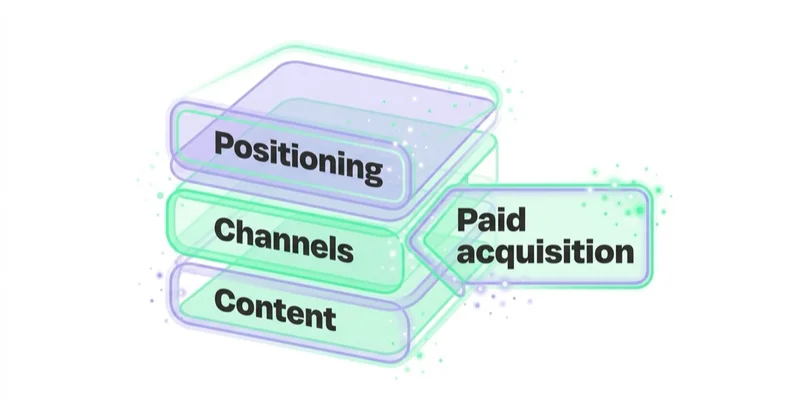
- Market and ICP — which organizations or consumers have the problem, ability to buy and conditions for a good outcome.
- Problem and trigger — what changes enough for the buyer to act now rather than tolerate the status quo.
- Alternatives — direct competitors, internal workarounds, adjacent products and doing nothing.
- Position and proof — why this offer fits the situation and what credible evidence supports the claim.
- Price and packaging — how value is captured, which features or services belong together and what creates expansion or delivery cost.
- Buying and delivery motion — whether the customer self-serves, speaks with sales, goes through procurement or books a service, and what happens after purchase.
- Distribution and demand — where buyers discover, evaluate and validate the offer across owned, earned, partner, sales and paid channels.
- Measurement and ownership — which teams own each transition, what data is collected and what evidence changes the next decision.
Treating these as independent workstreams creates predictable breaks. A broad ICP produces generic positioning. A sales promise unsupported by onboarding produces churn. A low entry price can create a segment that is expensive to serve. A media plan tied only to leads can overwhelm sales with poor-fit demand. Record the dependencies and resolve the highest-risk assumptions before scaling distribution.
The often-missing layer: executable acquisition
Many launch plans name channels without explaining their job. “Content, LinkedIn and Google Ads” is not an acquisition strategy. The plan must show whether each channel is meant to reach a new audience, capture expressed demand, build trust, support sales, create a trial or reactivate known prospects.
The paid layer then answers five practical questions:
- Audience and intent: which buyers can be reached, and are they actively looking or still learning about the problem?
- Channel role: will the campaign create reach, capture intent, retarget engaged demand or test an offer?
- Decision event: should optimization use a purchase, activation, qualified lead, accepted opportunity or another downstream event?
- Test budget: how much is required to observe enough eligible traffic and outcomes without exceeding the company's risk limit?
- Feedback loop: how will product usage, CRM stages, cancellations, returns and realized value flow back into decisions?
Paid acquisition is most useful when it has a defined job. Search may reveal which problem language converts. Paid social may compare propositions among a relevant audience. Retargeting may support a longer evaluation. In some markets, partner distribution, founder-led sales, marketplaces or organic demand should come first. The correct answer depends on access to the buyer and the economics, not an agency's preferred inventory.
Match acquisition to how the customer buys
“Motion” describes how the customer moves from interest to value. Labels are useful, but many companies use more than one motion by segment.
| Motion | How it is bought | Useful acquisition routes | Primary decision event |
|---|---|---|---|
| Product-led | Self-serve trial or purchase; value is experienced in product | Search, educational content, communities, referrals, integrations and paid social | Activation or retained usage, not signup alone |
| Sales-led | Discovery, evaluation, commercial process and sometimes procurement | Outbound, referrals, partners, events, high-intent search and account-based programs | Sales-accepted opportunity and eventual realized revenue |
| Marketing-led commerce | Buyer evaluates and purchases without a salesperson | Shopping, search, creators, email, organic social and paid social | Contribution after discounts, returns and fulfillment |
| Local or booked service | Buyer verifies fit, geography and availability before booking | Local search, maps, referrals, directories and paid search | Qualified booking and completed profitable job |
| Hybrid | Different routes by segment, product or contract value | Separated channel and sales journeys | Segment-specific outcome |
A channel is not inherently PLG or sales-led. The same paid search campaign can send a small customer to self-service and a complex account to consultation. The landing page, qualification, conversion action, response process and value signal must match the route. For product-led growth, see where paid acquisition fits in PLG.
Positioning comes before spend
Paid media buys opportunities to present an offer. If the intended buyer cannot tell what the product is, when it is relevant and why the claim is credible, buying more impressions usually buys more ambiguity. Positioning does not need to be perfect before testing, but the test needs a clear proposition and an explicit alternative.
Before scaling, ask five people who resemble the buyer to explain, in their own words:
- what the offer helps them do;
- whether it is meant for a company or situation like theirs;
- what it replaces or improves;
- what they would need to believe before acting;
- what they expect the next step to involve.
Misunderstanding is evidence. Use interviews, sales calls, landing-page behavior and controlled creative tests to revise the proposition. Click-through rate alone cannot tell whether the right buyer understood the right promise. Product marketing and growth also need shared definitions and ownership.
Set the economics before launch, not after
Before launch, build an economic range rather than borrowing an industry CAC benchmark. At minimum, model:
- gross or contribution value expected from an acquired customer;
- refunds, returns, failed payments, onboarding and variable service costs;
- retention or repeat-purchase assumptions by cohort;
- the maximum acceptable payback period and available cash;
- sales and implementation capacity;
- conversion lag from click to qualified outcome and from sale to realized value.
Two simple calculations create discipline:
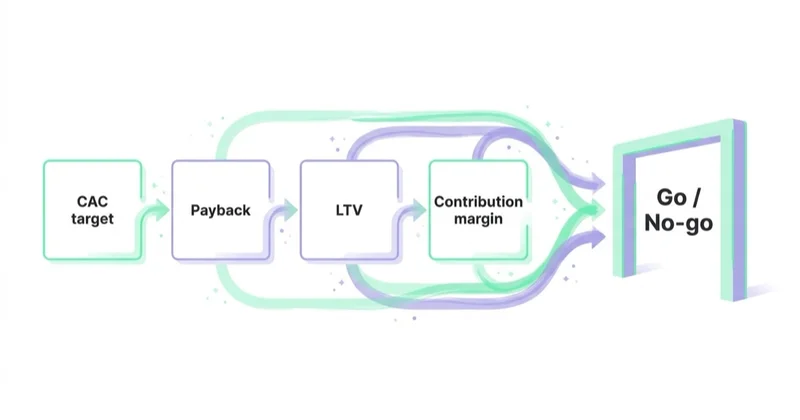
CAC = attributable acquisition costs ÷ new customers acquired
CAC payback period = CAC ÷ average monthly contribution generated by a new customer
Define what is included in acquisition costs and use the same basis across periods. Media-only CAC is useful for campaign operations but should not be presented as fully loaded CAC. Early LTV is especially uncertain; show a base, downside and upside case, then replace assumptions with observed cohorts.
For lead generation, pass qualified and converted outcomes back from the CRM where consent and platform requirements allow. Google recommends enhanced conversions for leads for offline outcomes, and from 15 June 2026 relevant uploads moved to the Data Manager API for most implementations. The technical integration matters, but the underlying business definitions matter more.
Launch is three phases, not one day
A public announcement may happen on one day; market learning does not. Use phases, with the length determined by product readiness and the buying cycle.
| Phase | Goal | Work |
|---|---|---|
| Validation | Reduce the highest-risk assumptions | interviews, prototypes, pricing conversations, pilot or early-access cohorts |
| Controlled launch | Observe the full customer journey | limited distribution, service-level monitoring, sales and onboarding feedback |
| Expansion | Increase reach where economics and delivery hold | broader channel mix, structured experiments and capacity planning |
A waitlist can indicate interest, but it is not demand until people take a meaningful step such as activating, paying, entering procurement or completing the service. Tag the source and proposition that generated each early-access contact, set expectations clearly and measure progression. For a detailed sequence, use the 90-day new-product marketing framework.
Evidence gates before budget expansion
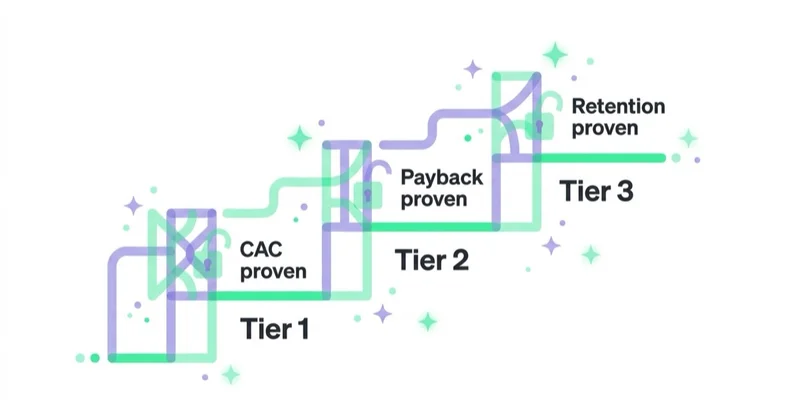
A 90-day calendar should not automatically unlock the next spend tranche. Each phase needs an evidence gate:
| Gate | Minimum evidence | Decision |
|---|---|---|
| Problem–segment | repeated, consequential problem among buyers with ability to act | continue, narrow or change segment |
| Offer–message | intended buyers understand the proposition and believe the proof | retain or revise offer and positioning |
| Journey–conversion | qualified buyers progress through sales, product or booking flow | remove friction or correct targeting |
| Delivery–retention | the company can fulfill the promise and customers reach value | repair product, onboarding or capacity |
| Economics–scale | cohort contribution and payback fit the cash and risk limits | expand, hold or stop spend |
Early evidence is not simply CTR. Teams need sales-call themes, disqualification reasons, activation, time to value, cancellation reasons, realized price and delivery quality. Scale only when the company can explain who buys, why they buy, what blocks progression and how much cash the payback period consumes.
Set stop conditions before the team becomes attached to the launch. Examples include a spend ceiling without sufficient qualified demand, repeated failure at the same activation step, unacceptable cancellation or return rates, and sales capacity below the generated lead volume. A stop is a decision to investigate and correct the constraint—not proof that the entire market or channel is permanently invalid.
Build the measurement architecture before traffic arrives
Map the journey from first eligible exposure to realized customer value. The exact events differ by motion, but the architecture should cover:
- Acquisition: source, campaign, creative and landing experience.
- Identity and consent: lawful collection, consent state and first-party identifiers where appropriate.
- Progression: signup, activation, qualification, opportunity, purchase or booking.
- Value adjustment: refund, cancellation, return, failed delivery, contract expansion or closed-lost outcome.
- Finance outcome: revenue, contribution, payback and cash collection.
Deduplicate transactions and preserve stable IDs so later adjustments do not become additional conversions. Restrict access to personal and commercial data, document retention and avoid sending sensitive fields to advertising platforms. Platform attribution supports bidding; controlled experiments, where feasible, are the stronger tool for causal incrementality. Google describes Conversion Lift as an experiment that separates treatment and control groups, but access and eligibility vary.
Glossary
- GTM strategy — the connected choices used to reach, convert, deliver value to and retain a defined market.
- ICP (ideal customer profile) — the type of customer with the problem, buying conditions and operating fit for a good outcome.
- Motion — how a customer discovers, evaluates, buys and reaches value.
- Positioning — the choice of competitive frame and differentiated value for a buyer.
- Demand creation vs capture — generating new interest versus converting existing intent.
- Activation — a product behavior that indicates the user has reached an initial value milestone; it should be validated against retention or revenue.
How Space Ads approaches go-to-market
In our GTM work, we look for the break between the commercial hypothesis and the acquisition system: an ICP without qualification rules, a proposition without proof, a channel without a defined role, or a lead event disconnected from revenue. The objective is to make those dependencies explicit before adding scale.
We translate the market, offer and motion into channel hypotheses, a measurement map and evidence gates. Initial budgets are bounded by the cost of learning and the company's cash risk; later budgets depend on qualified outcomes, realized economics and delivery capacity. This is the acquisition layer of performance marketing. When the gap is cross-functional ownership of positioning, pricing, sales, product and budget, the broader remit may fit a fractional CMO.
A practical 90-day GTM plan
| Phase | Work | Output |
|---|---|---|
| Days 1–30 | Validate problem, segment, buying process and alternatives; model economics and capacity | Assumption register, ICP rules and decision thresholds |
| Days 31–45 | Test proposition, proof, price and landing journey with intended buyers | Selected offer and documented objections |
| Days 46–60 | Implement consent, analytics, CRM stages, IDs and value feedback | Tested measurement and response workflow |
| Days 61–75 | Run a controlled launch across the few channels best suited to the motion | Qualified demand and full-journey evidence |
| Days 76–90 | Review cohorts, delivery, economics and incrementality options | Scale, revise or stop decision by segment and channel |
Stop doing / Do instead
| Stop doing | Do instead |
|---|---|
| Treating GTM as a positioning deck | Connect offer, distribution, sales, delivery and measurement |
| Copying another company's channel mix | Match channels to audience access, intent and buying motion |
| Amplifying vague positioning with spend | Sharpen positioning before scaling media |
| Treating an early LTV estimate as fact | Use scenarios, cash limits and observed cohorts |
| Optimizing to leads or signups alone | Feed qualified and realized value back into decisions |
| Treating launch as one day | Use validation, controlled launch and evidence-led expansion |
| Waiting to add measurement | Test the data and response process before media starts |
FAQ
What is a go-to-market strategy?
A go-to-market strategy is the set of choices used to reach, convert, serve and retain a defined market. It connects the customer problem and alternatives with positioning, proof, pricing, buying motion, distribution, delivery and measurement.
What are the components of a GTM strategy?
At minimum: market and ICP, problem and trigger, alternatives, positioning and proof, price and packaging, buying and delivery motion, distribution, and measurement ownership. The components must agree; for example, price affects the viable sales motion and acquisition cost.
What is a GTM motion?
A GTM motion describes how the customer discovers, evaluates, buys and reaches value. It may be product-led, sales-led, commerce-led, service-led or hybrid. The motion shapes the journey and measurement, but it does not dictate one mandatory channel mix.
Why do go-to-market strategies fail?
Failures usually have several causes: weak problem evidence, an ICP without buying ability, undifferentiated positioning, poor product experience, unsuitable pricing, disconnected distribution, insufficient delivery capacity or measurement focused on shallow events. Diagnose the constraint before buying more traffic.
How should you measure a go-to-market launch?
Set a target range for CAC, contribution and payback; track progression to activation, qualified pipeline or completed purchase; and reconcile results with CRM, product and finance data. Use platform attribution for operations and experiments where feasible to assess incremental effect.
What is the difference between demand creation and demand capture in GTM?
Demand creation helps a relevant audience recognize a problem or solution before active search. Demand capture serves people who already express intent. Many GTM plans need both, but not always at the same stage or budget. Evaluate creation with reach quality, progression and incrementality—not last-click revenue alone.
When should paid acquisition start?
Start when the team can state the audience, proposition, desired action, test budget and response process—and when the product or service can deliver the promise. Paid media may support early message testing, but broad scaling should wait for evidence that qualified customers progress and receive value.
How large should the initial paid-media budget be?
There is no universal minimum. Estimate the eligible audience, expected cost to reach it, likely conversion range, sales cycle and the number of outcomes needed for a decision. Cap the test at an affordable loss, concentrate on a small number of hypotheses and define what result leads to scale, revision or stop.
Key takeaways
- A go-to-market strategy connects the customer problem, offer, economics, buying motion, distribution, delivery and measurement.
- Paid acquisition can create reach, capture demand and accelerate learning, but it cannot compensate for a product or service that fails to deliver value.
- Select channels by audience access, intent and buying process; measure downstream qualified outcomes.
- Treat early CAC and LTV as ranges, then replace assumptions with cohort contribution and cash collection.
- Use validation, controlled launch and evidence gates before broad expansion.
Sources
- Google Ads Help — Use different values for conversions
- Google Ads Help — Value-based bidding using campaign experiments
- Google Ads Help — About Conversion Lift
- Google Ads Help — Bidding and enhanced conversions for leads updates
Continue learning
- Product marketing vs growth marketing: who owns the number?
- Product-led growth still needs paid: how PLG companies acquire
- Demand generation vs lead generation in B2B
- SaaS paid acquisition: Google and Meta for pipeline, CAC and payback
- Performance marketing built around acquisition economics
- Fractional CMO: ownership of the whole go-to-market
Continue reading
Product Marketing vs Growth Marketing: Who Owns the Number?
Product marketing usually leads market and message decisions; growth marketing leads the experiment portfolio. This guide maps decision rights, metrics and one accountable owner for the commercial target.
How to Market a New Product: A 90-Day Launch Campaign Framework
Most product launches treat launch day as the event and under-invest in the demand that makes it land. This 90-day framework runs the launch as three phases — build demand before, capture it at launch, scale what works after — with concrete actions, so the launch is an engine, not a one-day spike.
Brand Strategy vs Performance: How Brand Work Actually Shows Up in Revenue
Brand building and sales activation serve different time horizons, but neither belongs to a single channel. Learn how to set objectives, use the 60/40 finding responsibly, connect brand indicators to commercial outcomes, and measure incremental impact.