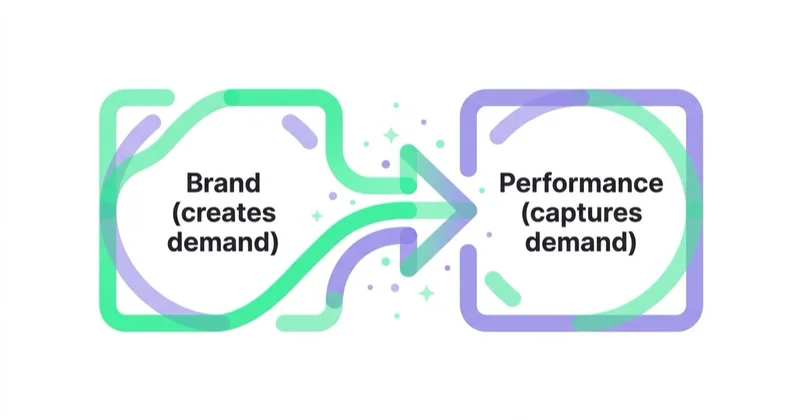
Brand strategy and performance marketing are often presented as competing budget lines. A more useful distinction is between building future demand and preference and activating people who may be ready to act now. Both need commercial objectives and measurement; they simply differ in timing, audience, and the evidence available.
This is not a clean channel split. Search can introduce an unfamiliar brand, video can drive immediate sales, and the same campaign can influence both memory and action. The planning task is to define the job, time horizon, audience, message, and measurement for each investment—then choose channels.
TL;DR
- Plan by objective and time horizon, not by agency label. Brand building and activation are complementary jobs that can use overlapping channels.
- Short-term attribution is incomplete. Last-click reporting favors touches close to conversion and cannot estimate the total causal value of earlier exposure.
- The 60/40 finding needs context. Binet and Field's IPA case analysis is an influential benchmark, not a default media split for every company.
- Brand indicators are not revenue by themselves. Awareness, consideration, mental availability, branded search, and direct traffic need to be connected to commercial outcomes.
- Correlation is not incrementality. Rising branded search alongside a campaign is useful evidence, but a holdout or well-designed model is stronger.
- Protect the measurement horizon. A short campaign report can miss delayed effects; a long-term plan can still require near-term cash and unit-economics guardrails.
The false choice, and why it's expensive
The question “brand or performance?” combines decisions that should be separate. A business needs to create or reinforce memory among future buyers, make the offer easy to find and buy, and convert current demand efficiently. The right balance depends on growth goals, cash position, category buying frequency, distribution, competition, margins, and the evidence already available.
After a budget cut, reported ROAS may rise simply because spend falls into the highest-intent, easiest-to-attribute activity. That does not prove the removed investment had no value, nor does it prove that future demand will decline. To answer that question, examine total revenue, new-customer volume, penetration, margin, branded demand, and appropriately lagged experimental or modelled results—not the surviving channel in isolation.
Future demand and current activation
Brand work can clarify positioning, build distinctive memory structures, improve recognition, and make the brand easier to recall in buying situations. Activation gives people a timely reason and a practical route to act. The first often targets a broader group over a longer period; the second often concentrates on a nearer-term opportunity.
Both can reach diminishing returns. Activation may saturate a finite pool of high-intent buyers; broad reach can also waste money if distribution, product, or proposition is weak. Growth may require better availability, a stronger offer, broader category entry points, new markets, or improved conversion—not automatically “more brand.” The connection to demand generation versus lead generation is direct.
The 60/40 heuristic (and its limits)
The widely cited 60/40 split comes from Les Binet and Peter Field's analysis of IPA Effectiveness Awards cases. Their work argued that, in aggregate, campaigns balancing long-term brand building and short-term sales activation produced stronger business effects, with roughly 60% brand and 40% activation presented as a broad optimum in the analysed data.
It is not a universal instruction for digital budget allocation. The source data consists of submitted effectiveness cases, and the appropriate balance changes with category, purchase frequency, company size, brand maturity, distribution, growth target, and definition of “brand” and “activation.” Use 60/40 to challenge an extreme short-term bias, then build the actual allocation from the business model and measurement plan.
| Brand building / future demand | Sales activation / current demand | |
|---|---|---|
| Job | Create and grow demand and preference | Capture existing intent efficiently |
| Typical time horizon | Longer, with delayed and cumulative effects | Nearer-term, with faster feedback |
| Measurement | Brand tracking, reach, lift studies, experiments, MMM, business outcomes | Incremental sales/leads, margin, experiments, attribution as a diagnostic |
| Failure mode if over-weighted | Awareness without conversion; hard to justify | Rising costs as demand pool depletes |
| Historical aggregate heuristic | ~60% | ~40% |
Why last-click can't see brand — and what can
Last-click attribution assigns credit to the final recorded interaction. It therefore cannot estimate what would have happened without earlier exposure and misses unobserved or cross-device interactions. This makes it unsuitable as the sole measure of brand investment. It also does not mean every increase in direct traffic, branded search, conversion rate, or ad quality was caused by brand activity; promotions, distribution, PR, seasonality, product changes, and competitors can move the same indicators.
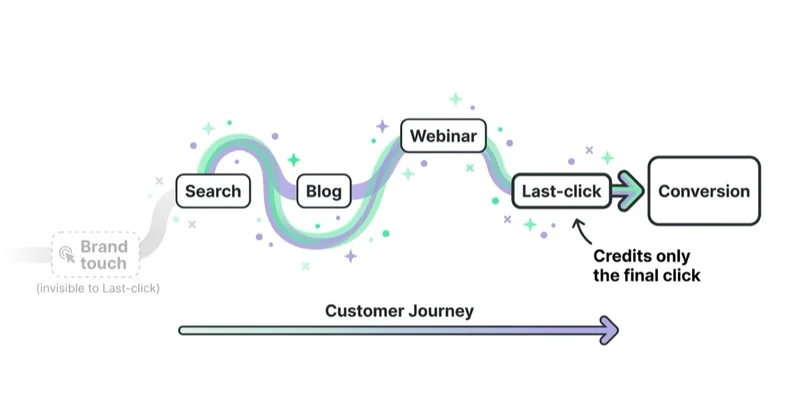
Use several layers of evidence: continuous tracking of awareness, consideration, category entry points, and distinctive assets; controlled Brand Lift, Search Lift, or Conversion Lift where eligible; geo experiments; and media mix modelling when spend history and data quality support it. Tie these to penetration, new customers, revenue, and margin. Google describes lift studies as controlled comparisons between exposed and control groups for brand, search, and conversion outcomes. This is the same measurement discipline covered in marketing attribution for executives and incrementality testing.
Glossary
- Brand building — work intended to create or reinforce memory, recognition, meaning, and preference over a longer horizon.
- Sales activation — work intended to prompt a response from a nearer-term buyer.
- 60/40 heuristic — an aggregate finding from Binet and Field's IPA case analysis, not a universal budget formula.
- Branded search — searches containing the brand name; a useful indicator influenced by many factors.
- Blended ROAS / MER — total revenue divided by total advertising or marketing spend; a business-level ratio, not a causal measure.
- Incrementality — the sales a given spend genuinely adds, measured against a holdout.
- Media-mix modelling (MMM) — statistical attribution across the whole system, not one touch.
When to weight toward which
The allocation is a judgement about the business's situation, not a fixed split:
- Early-stage, needs revenue now. Validate the product, distribution, economics, and sales motion. Brand fundamentals still matter, but broad paid reach may not be the first constraint.
- Plateaued performance, rising costs. Diagnose marginal returns, audience saturation, offer, conversion, competition, retention, and demand indicators before assigning the cause.
- Considered / high-AOV / B2B. Plan for longer buying committees and delayed outcomes, while giving sales teams useful activation and proof.
- Category leader vs challenger. Leaders invest in brand to defend mental availability; challengers need brand to enter the consideration set at all.
- Commodity or price-led category. Distinctiveness and availability can still matter, but price, distribution, and product comparability may dominate the decision.
There is no reliable diagnosis based on “flat performance” alone. The constraint may be demand, but it may also be product-market fit, distribution, inventory, pricing, tracking, creative, media saturation, retention, or sales execution. Resolving that cross-functional question is where a fractional CMO or another accountable marketing leader can add value.
How Space Ads approaches brand and performance
At Space Ads, planning starts with the commercial objective and constraint, not a predetermined brand/performance percentage. We define which audiences should remember the brand for the future, which buyers can act now, what each activity must communicate, and how the effects will be observed over the appropriate period.
The scorecard combines business outcomes, reach and frequency, brand indicators, search demand, new-customer measures, and incremental evidence where the available scale supports it. Attribution remains useful for operations, but it is not treated as proof of total causal contribution. This sits inside performance marketing run as a system and, where the whole model needs an owner, fractional CMO.
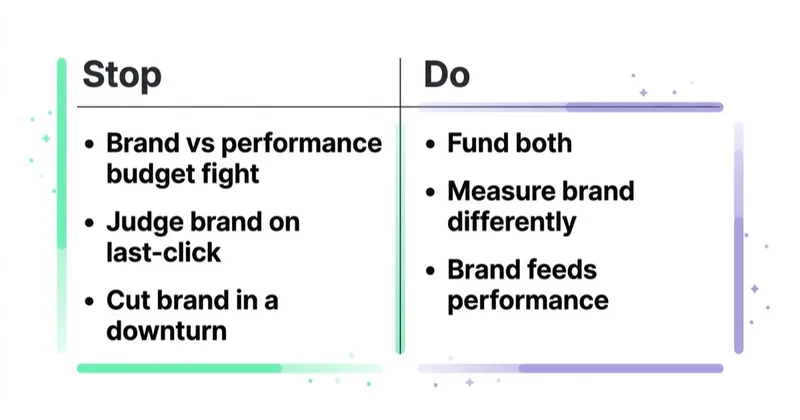
Stop doing / Do instead
| Stop doing | Do instead |
|---|---|
| Framing it as "brand or performance" | Define the future-demand and current-activation jobs together |
| Cutting brand because it shows no ROAS | Recognise last-click can't measure brand; use the right tools |
| Reading a post-cut ROAS increase as proof | Examine total revenue, margin, new customers, and lagged incremental evidence |
| Copying 60/40 into a budget spreadsheet | Use it as historical context, then model the business-specific allocation |
| Measuring brand with the performance dashboard | Use brand tracking, branded-search lift, incrementality, MMM |
| Treating the ratio as fixed | Tune it to stage, category, cycle length and position |
Common mistakes
Common mistakes include defining “brand” as any video campaign and “performance” as any search campaign, copying the 60/40 ratio without examining its source, treating branded search as causal proof, optimising attributed ROAS while total new-customer growth falls, and measuring a long-horizon objective over a few weeks. The opposite error also occurs: using “brand takes time” to protect work that has no clear audience, reach plan, learning agenda, or commercial hypothesis.
FAQ
What is the difference between brand and performance marketing?
Brand strategy defines how a business should be remembered and chosen, while brand-building activity develops memory, recognition, and preference over time. Performance marketing is managed against measurable actions and economics. The categories overlap: the same channel or campaign can influence both future preference and immediate response.
Is brand or performance marketing better?
Neither is inherently better. The right allocation follows the growth target, cash needs, category, distribution, brand maturity, marginal returns, and measurement capacity. Use the 60/40 research as a challenge to short-term bias, not as an automatic answer.
What is the 60/40 rule in marketing?
It is an aggregate conclusion associated with Les Binet and Peter Field's analysis of IPA Effectiveness Awards cases: approximately 60% long-term brand building and 40% short-term activation. It is a planning heuristic from a particular evidence base, not a universal rule for every company, market, or media budget.
Why does my ROAS improve when I cut brand spend?
The remaining spend may concentrate on the easiest-to-convert demand, so average attributed ROAS rises as volume falls. Attribution can also reassign credit after channels are removed. This result does not prove either that brand caused the previous sales or that it was waste; check total and incremental outcomes over a suitable horizon.
How do you measure the revenue impact of brand?
Use a portfolio of evidence: brand tracking, reach and frequency, controlled Brand/Search/Conversion Lift studies, geo experiments, and media mix modelling where the data supports it. Branded search, direct traffic, conversion rate, and new-customer volume are useful indicators, but they require controls for seasonality, promotions, distribution, competitors, and other causes.
Should I hire a branding agency or a performance agency?
Choose against the diagnosed problem, required capabilities, and accountability model—not the label. Ask who owns positioning, creative, media, conversion, measurement, and the connection to commercial outcomes. A plateau alone does not prove a brand problem; require the prospective partner to show its diagnosis and measurement plan.
Key takeaways
- Brand building and activation are complementary objectives, not fixed channel categories.
- Short-term attribution cannot estimate the total causal value of earlier brand exposure.
- The 60/40 split is an influential aggregate heuristic, not a default budget formula.
- Brand and search indicators need to be connected to revenue, margin, customers, and incremental evidence.
- Set the allocation from business constraints and evaluate it over the horizon in which it is expected to work.
Sources and further reading
- IPA / Les Binet & Peter Field — The Long and the Short of It (60/40)
- Google Ads Help — About lift studies
- Google Ads Help — About Brand Lift
- Ehrenberg-Bass Institute — How B2B Brands Grow (research report)
Continue learning
Continue reading

Why Is My ROAS Dropping? The Usual Suspects, in Order
A ROAS decline can come from reporting, media cost, traffic mix, conversion, order value or a changed business context. Use this diagnostic sequence to protect downside, compare mature data and isolate the real driver.
Product Marketing vs Growth Marketing: Who Owns the Number?
Product marketing usually leads market and message decisions; growth marketing leads the experiment portfolio. This guide maps decision rights, metrics and one accountable owner for the commercial target.

Marketing Attribution for Executives: Why Your Dashboards Disagree
Marketing attribution assigns conversion credit to touchpoints; it does not prove which channel caused the outcome. This guide shows executives how to use last-click, data-driven attribution, incrementality, and MMM for different decisions.