Lead form ads let people respond inside Facebook, Instagram or LinkedIn, often with profile details already filled in. Removing a page load and manual typing can increase completion, but it does not automatically make the resulting leads good or bad. Quality depends on the audience, promise, information shown before submission, questions, CRM process and the event used for optimisation.
The right objective is not maximum friction or maximum volume. It is an efficient flow of eligible, contactable people who understand what they requested and progress to a valuable business outcome. That requires one definition of a qualified lead shared by marketing and sales, reliable data transfer, an appropriate follow-up service level and feedback from the CRM.
TL;DR
- Define quality before launch. Specify eligibility, valid contact data, sales acceptance and the downstream stage that matters.
- Use the least friction that improves the decision. Extra questions can clarify fit, but they can also reduce completion without improving quality.
- Set expectations in the form. State what the person will receive, who will contact them and what happens next.
- Test CRM sync and routing end to end. A successful platform submission is not enough if fields break or no owner is assigned.
- Set a realistic response SLA. A fast acknowledgement and timely human follow-up matter, but the correct window depends on the offer and operating hours.
- Send a frequent, reliable downstream signal. Qualified-lead optimisation needs enough correctly matched events to learn.
- Choose the platform from evidence. Compare audience reach, form data, qualified-lead rate, sales progression and acquisition cost—not stereotypes.
Why form volume and business value diverge
An instant form reduces technical and typing friction. That can help an interested person respond, especially on mobile. It can also make an unclear offer easy to accept without understanding the next step. Manual typing, however, is not a reliable measure of purchase intent: a person can complete a long form and still be a poor fit, while a pre-filled lead can become a valuable customer.
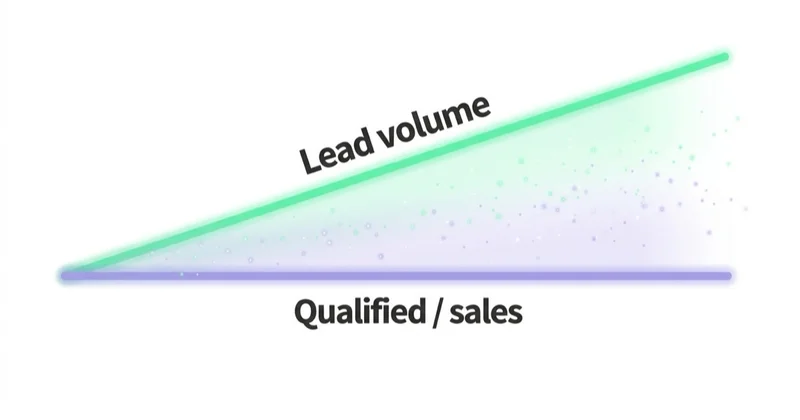
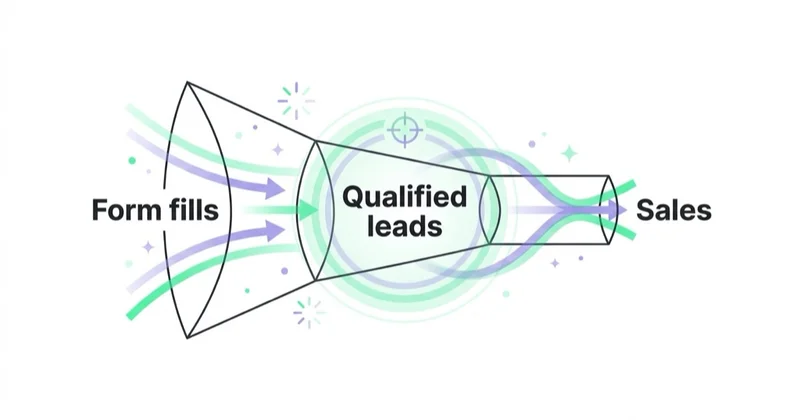
The divergence usually appears because the platform counts a submitted form, while the business needs something further downstream: a valid enquiry, eligible patient, sales-accepted lead, opportunity or completed sale. If those stages are not defined and returned to the campaign data, a low CPL can hide invalid details, poor fit, duplicate contacts or weak progression. This is the gap between the mechanics of launching lead form ads and running them as a measurable acquisition system.
Add information and commitment only when they have a job
Every additional question should serve a defined purpose: determine eligibility, route the enquiry, personalise the response or provide a useful optimisation signal. A review or confirmation step may reduce accidental submissions, but it does not guarantee commercial fit. Test it using qualified-lead and sales outcomes, not completion rate alone.
More friction commonly reduces form completion. Whether the remaining leads are better must be measured. A question that sales never uses creates cost without value; an overly direct budget question can also encourage guessing or exclude buyers before they understand the offer. Compare cost per qualified lead, opportunity and acquisition alongside the workload created for sales.
Qualify inside the form
Start with the qualification rule already used by the business. A local service may need postcode and service type. A B2B team may need company size and use case. A regulated offer may need to route people without collecting sensitive information in an advertising form. Questions should use plain, neutral language and response options that map cleanly into the CRM.
Do not assume self-reported answers are verified facts. Treat them as routing and prioritisation inputs, then validate important criteria in the next step. Collect only what is necessary, link the correct privacy notice and distinguish consent to answer an enquiry from consent to receive separate marketing. LinkedIn explicitly prohibits requesting sensitive data in Lead Gen Forms; applicable law and platform rules determine what can be collected elsewhere too.
Glossary
- Instant / lead form ad — an ad with a pre-filled form users submit without leaving the platform.
- Cost per lead (CPL) — media cost divided by recorded form submissions; it does not describe lead quality.
- Response SLA — the agreed maximum time and process for acknowledging, routing and contacting an enquiry.
- Qualifying questions — custom form questions (budget, role, timeline) that filter intent.
- CRM sync — real-time integration pushing leads from the platform into the CRM.
- Downstream conversion — a later CRM event, such as a qualified lead or sale, shared for measurement or optimisation.
Sync to the CRM instantly and follow up fast
Lead data needs a controlled route from the platform to the system where it will be handled. A native integration, approved connector or direct API can reduce manual work, but "connected" does not mean reliable. Send test leads before launch and verify field mapping, source identifiers, consent data, deduplication, owner assignment, alerts and failure handling.
The thank-you state should confirm the request and explain the next step. An automated acknowledgement can arrive immediately; the human response target should reflect the urgency promised, opening hours, lead value and team capacity. Do not promise a call in five minutes if nobody can consistently deliver it. Track time to assignment, first attempt, first contact and next-stage conversion to find the service level that works. This is the CRM-and-follow-up discipline covered in connecting ads, leads and follow-up.
Optimise to qualified leads, not cost per lead
Optimising only to form submissions asks the delivery system to find more people likely to submit. A downstream event can align optimisation more closely with business value, but it must be defined consistently, matched back to the correct lead and sent with enough frequency and acceptable delay. A closed sale may be valuable but too rare or delayed for learning; an earlier sales-accepted or qualified stage may be more usable.
Meta documents a conversion-leads performance goal for instant forms when CRM data is connected through Conversions API. LinkedIn supports qualified-lead optimisation using Conversions API or CRM Sync and recommends a minimum flow of qualified events for learning. Availability and prerequisites change, so confirm them in the current account. Audit event match quality, duplicates and stage definitions before trusting the reporting.
Report the funnel from form submit to valid contact, qualified lead, sales acceptance, opportunity and sale. Include cost, conversion rate, time and value at each stage. Platform attribution helps manage delivery; it does not by itself prove incremental impact.
Platforms differ: match the platform to the lead
LinkedIn forms can pre-fill member profile data and provide work-related fields, which can be useful for some B2B qualification. Meta can reach consumer, local, professional and business audiences across Facebook and Instagram. Neither fact determines the winner. Profile data can be incomplete or outdated, audience estimates do not guarantee qualified reach, and cost varies by market, objective, competition and creative.
Run a fair test when both platforms can reach the audience. Keep the offer and qualification definition comparable, then evaluate qualified-lead rate, cost per qualified lead, opportunity creation, sales cycle and acquired value. One platform may deliver fewer but more advanced opportunities; another may create a larger pipeline at a sustainable acquisition cost. Raw CPL cannot settle that decision.
How Space Ads approaches lead form ads
We start by agreeing the funnel definitions with sales: valid, eligible, qualified, accepted, opportunity and won. The form then asks only what is needed to set expectations, determine eligibility and route the enquiry. Before launch, test leads must arrive with the correct source, campaign, consent fields and owner, and the team needs a response SLA it can actually meet.
Once the downstream data is stable and frequent enough, we return the deepest usable event to the relevant platform and monitor match quality, duplicates and delays. Reporting shows both media metrics and CRM progression, so a fall in lead volume can be judged against opportunity value rather than celebrated or rejected in isolation. This lives in Meta Ads, LinkedIn Ads and performance marketing.
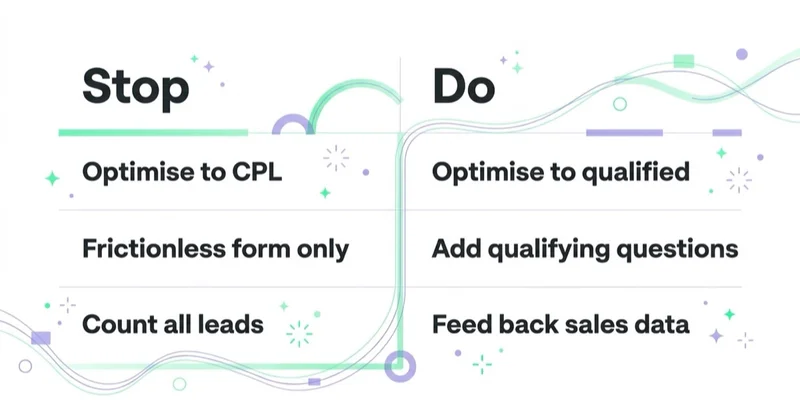
Stop doing / Do instead
| Stop doing | Do instead |
|---|---|
| Adding questions to make the form feel serious | Add a field only when it qualifies, routes or improves follow-up |
| Optimising to the lowest CPL | Track qualified-lead, opportunity and acquisition economics |
| Assuming the connector works | Test mapping, ownership, alerts, deduplication and failures |
| Promising an unrealistic instant call | Set and monitor a response SLA the team can meet |
| Sending the rarest CRM stage back | Use the deepest reliable event with enough volume and low delay |
| Choosing by platform stereotype | Compare the same qualification and sales outcomes |
| Treating a privacy link as blanket consent | Explain data use and collect purpose-specific permission where required |
Common mistakes
Common failures include an offer that attracts curiosity rather than real demand, fields that do not map into the CRM, no duplicate handling, ambiguous qualification rules, no owner, and a downstream event that arrives too late or too rarely for optimisation. Another is collecting more personal data than the request needs or using enquiry data for marketing without the appropriate notice and permission. A form submission is a hand-off point, not the final outcome.
FAQ
Why are my Facebook/Instagram lead ads producing junk leads?
Possible causes include an offer that is too broad, weak expectation-setting, audience mismatch, invalid or stale pre-filled details, accidental submissions, poor routing or an overly loose qualification definition. Break the CRM funnel down by campaign and form, listen to sales feedback with examples, and change the specific cause. Adding fields alone may only reduce volume.
How do I get higher-quality leads from lead form ads?
Define a qualified lead with sales, make the offer and next step explicit, and ask only the questions needed for eligibility or routing. Test the CRM hand-off and enforce an appropriate response SLA. When downstream events are accurate and frequent enough, send a qualified stage back through the platform's supported integration. Judge the change on pipeline and acquisition outcomes, not an assumption that fewer leads are better.
Should lead forms have more or fewer fields?
Use the minimum number needed to process and qualify the request responsibly. Extra fields generally add effort, but their effect on lead quality must be tested. Start from the business rule rather than a target count. Never request sensitive information that the platform prohibits, and avoid collecting data merely because a field is available.
How important is speed-to-lead for lead form ads?
It matters when the offer implies timely contact, but there is no universal number of minutes. Confirm the request immediately, route it correctly and set a human-response SLA based on urgency, opening hours and capacity. Measure contact and progression rates by response interval. Reliability and relevance are more valuable than an automated call that surprises the person.
What's the difference between LinkedIn and Meta lead forms?
LinkedIn can pre-fill professional profile fields and offers work-related form options. Meta runs instant forms across Facebook and Instagram and can serve consumer and business use cases. Cost and quality are not fixed by platform. Compare reachable audience, form requirements, qualified progression and acquired value for the specific offer and market.
How should I measure lead form ad performance?
Report form completion, valid-contact rate, qualification, sales acceptance, opportunity, sale, time to response and value. Calculate cost and conversion rate at each stage. Return a consistently defined downstream event when the platform supports it and volume is sufficient, while monitoring matching and duplication. Use incrementality testing where feasible rather than treating attributed conversions as proof of causation.
Key takeaways
- Form completion is not lead quality; define and measure downstream business stages.
- Add a question only when it supports eligibility, routing or a better response.
- Test CRM field mapping, ownership, consent data, deduplication and failure alerts before launch.
- Use a realistic response SLA and a downstream optimisation event with enough quality, volume and speed.
- Compare Meta and LinkedIn on qualified pipeline and acquisition value, not platform stereotypes.
Sources and further reading
- Meta for Business — Lead ads with forms and CRM feedback
- Meta Business Help Center — About Conversions API
- LinkedIn Help — Lead Gen Forms
- LinkedIn Help — Qualified leads optimisation goal
- LinkedIn Help — Lead Gen Forms privacy policy
Continue learning
Continue reading
How to Choose a Lead Generation Agency (Questions to Ask, Red Flags)
A practical framework for comparing lead generation agencies: scope, measurement, pricing, account ownership, security, contracts and the questions worth asking before you sign.
Cost Per Lead (CPL): Benchmarks, What's 'Good', and How to Set Your Target
CPL is easy to calculate and easy to misuse. Learn how to compare valid benchmarks, separate media CPL from fully loaded CPQL, and derive an affordable target from your own unit economics.
Appointment Setting vs Lead Generation: What Actually Fills the Calendar
A calendar entry is not a sales outcome. Learn where lead generation ends and appointment setting begins, how to define an accepted meeting, and how to measure the path from booking to opportunity.