“We do not need more leads; we need meetings.” The request is understandable, but it skips several decisions. Who should attend? What must be true before the meeting is accepted? Does a rescheduled or unattended call count? Who owns qualification, reminders and follow-up?
Appointment setting can move a prospect from interest to a scheduled conversation. It can also create a full calendar of poor-fit, duplicate or unattended calls when the contract rewards bookings rather than business progress.
Lead generation and appointment setting overlap, but neither is automatically a better service. This guide separates their scope, shows where quality can fail and provides a measurement framework from first response to opportunity.
TL;DR
- Lead generation creates or captures identifiable demand and may include validation and qualification. Appointment setting secures a mutually agreed time for a sales conversation. Their exact boundary must be written into the scope.
- A booking, confirmed booking, held meeting, qualified held meeting and sales-accepted opportunity are different events. Report them separately.
- Inbound, outbound and partner-sourced meetings can all be valuable or poor. Quality depends on fit, context, offer, qualification and execution—not the channel label.
- Payment per booking can reward easily scheduled calls rather than valuable ones. A contract needs acceptance rules, exclusions, replacement terms and an audit trail.
- Qualification should match the next sales action. Do not require information that is unnecessary or unrealistic before discovery.
- Outbound email, calls and social messages are subject to different laws and platform rules by jurisdiction and recipient type. A global programme needs market-specific review.
- Measure cost per qualified held meeting, opportunity creation, pipeline, wins and sales capacity—not just calendar volume.
What is appointment setting?
Appointment setting is the process of securing a mutually agreed sales meeting between an eligible prospect and the appropriate representative. It can include outreach, initial qualification, calendar routing, confirmation, reminders, rescheduling and recording the outcome.
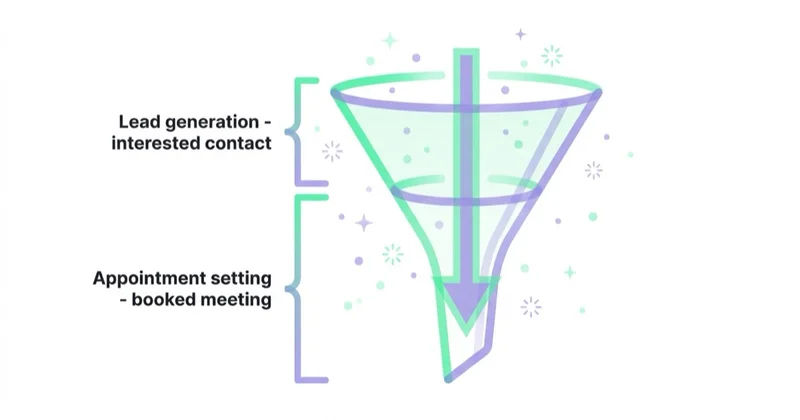
The exact deliverable varies. Some providers stop when a calendar invitation is accepted. Others remain responsible until the meeting is held or replaced. That difference materially changes the price and risk, so “appointment” should never be left undefined.
Appointment setting can begin with:
- an inbound demo or consultation request;
- a qualified lead generated by marketing;
- a product-usage signal;
- a target account selected for outbound outreach;
- a referral or event conversation;
- an existing customer expansion signal.
A cold target account is not automatically a lead just because an SDR schedules a call. Equally, a form fill is not necessarily ready for a meeting. The lifecycle must describe what is known at each stage.
What is B2B lead generation?
B2B lead generation is the system used to create, capture and identify potential demand from organisations and people relevant to an offer. It can include paid media, organic search, content, events, partnerships, referrals, product signals and compliant outbound activity.
Depending on the agreed scope, lead generation may stop at a valid enquiry or continue through MQL, qualification and CRM feedback. It is therefore too narrow to define it simply as “delivering interested contacts.” The handoff must state what the team actually receives: raw submission, validated lead, MQL, accepted lead or something else.
Appointment setting vs lead generation
| Dimension | Lead generation | Appointment setting |
|---|---|---|
| Primary job | Create or capture identifiable potential demand | Secure an agreed sales conversation |
| Possible inputs | Audiences, searches, content, events, target accounts | Enquiries, MQLs, PQLs, target accounts, referrals |
| Typical deliverable | A lead at a defined validation or qualification stage | A booked, confirmed or held meeting under written rules |
| Core operating risk | Optimising for cheap submissions with no downstream value | Optimising for calendar volume, no-shows or poor-fit attendees |
| Primary system of record | Marketing platform plus CRM/product data | CRM plus calendar and sales disposition |
| Useful unit metric | Cost per valid or qualified lead | Cost per accepted qualified held meeting |
The services can be complementary, but one does not always precede the other. A self-serve product may not need meetings. Enterprise account development may start with an outbound conversation before any marketing lead exists.
How an appointment-setting workflow should work
1. Define the eligible account and person
Specify market, company characteristics, use cases, exclusions and the roles that can meaningfully participate. “Decision-maker only” is often too simplistic: users, technical evaluators and project owners may be essential to a legitimate buying process.
2. Define the reason to meet
The offer should explain what the prospect will gain from the conversation: diagnosis, technical review, tailored demo, estimate or decision workshop. “A quick introduction” rarely justifies the interruption on its own.
3. Choose the acquisition route
- Inbound: a prospect requests contact or chooses a time after an ad, search, content, event or referral.
- Outbound: a team contacts selected accounts using channels permitted in the target market.
- Product-led: usage and account fit trigger an invitation to discuss adoption, limits or expansion.
- Partner-led: a trusted partner introduces the parties with the appropriate context and data permissions.
No route is inherently highest quality. A precisely targeted outbound conversation may outperform a broad inbound offer; a high-intent inbound request may outperform both. Compare like-for-like cohorts in the CRM.
4. Qualify only what the next step requires
Qualification may cover account fit, relevant problem, scope, role, region and timing. Budget and buying process may emerge during discovery rather than before it. An overlong pre-call interrogation can reject valid prospects; no qualification at all can overload sales.
Google Ads, for example, supports qualifying and conditional responses in selected lead-form workflows. Platform labels remain inputs: the company must still confirm whether the answer meets its own sales criteria.
5. Route and schedule
The booking system should account for territory, language, product, account ownership, representative capacity, time zone and buffer time. It also needs a fallback for unavailable owners, duplicate records and integration failures.
The prospect should see the meeting purpose, duration, participants and any preparation required before confirming. Avoid hiding an immediate sales call behind a resource download.
6. Confirm, remind and make rescheduling easy
Send accurate calendar details and proportionate reminders. Allow cancellation or rescheduling without forcing the prospect through a new qualification process. Track each outcome separately instead of repeatedly counting the same meeting.
7. Record the meeting outcome
The representative should log whether the meeting was held, who attended, whether it met the agreed criteria, the next step and any rejection reason. Without this disposition, the provider cannot distinguish a targeting problem from a scheduling, attendance or sales-execution problem.
Define the meeting lifecycle before buying the service
Use separate CRM statuses:
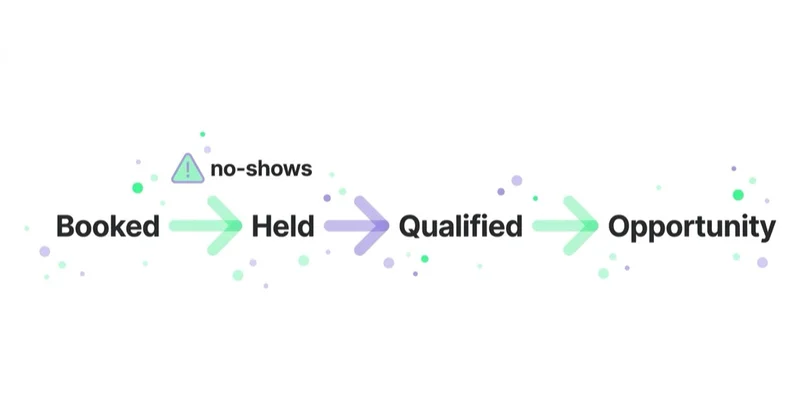
- Booked: a calendar event was created.
- Confirmed: the prospect explicitly confirmed under the agreed rule.
- Held: the required participants attended for a meaningful conversation.
- Qualified held: the meeting met the written fit and problem criteria.
- Sales accepted: the owner accepted it for follow-up.
- Opportunity created: the organisation's opportunity-entry conditions were met.
- Won or lost: the commercial process reached a recorded outcome.
Define cancellations, reschedules, duplicates, existing opportunities, competitors, students, vendors and meetings outside the target market. State the review window and evidence used to accept or reject a charge. Otherwise, both client and provider can interpret the same calendar differently.
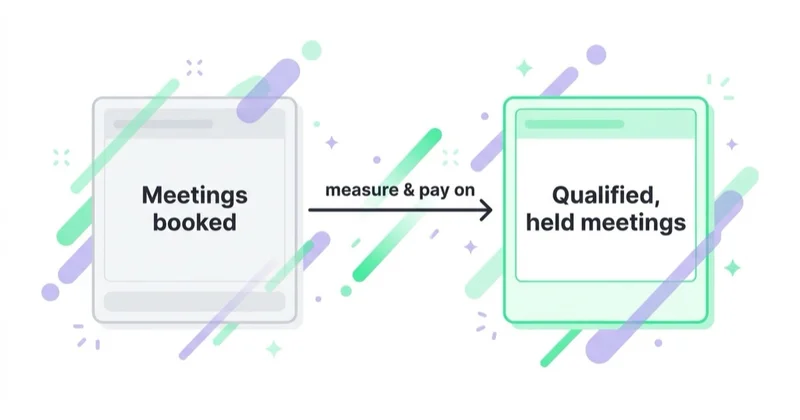
“Qualified held meeting” is a useful operating unit, but it is not automatically the correct billing unit. If the provider controls only outreach and booking while the client controls qualification criteria, availability and the conversation, a blended fee or shared incentive may allocate risk more fairly than pure pay-per-meeting.
When appointment setting fits — and when a meeting is unnecessary
Appointment setting is worth considering when:
- discovery, technical validation or multiple stakeholders require a live conversation;
- deal economics can support research, outreach, qualification and sales time;
- the organisation has a defined target market and a credible reason to meet;
- representatives have capacity and a repeatable process after the call;
- CRM outcomes can be returned to the team generating meetings.
A meeting may be unnecessary when:
- buyers can evaluate, trial and purchase successfully without assistance;
- the next useful action is an assessment, quote or product activation rather than a call;
- the company cannot yet explain who qualifies or what happens after the meeting;
- sales capacity is already constrained;
- the expected contribution cannot support the full cost of booked and unheld calls.
Lead generation is not automatically “enough” in these cases; the right next step may be self-serve conversion, nurturing or product activation rather than appointment setting.
How to price and govern an outsourced programme
Review the commercial model against what each party controls:
- fixed fee for team capacity and defined activity;
- fee per accepted lead or meeting;
- fee per qualified held meeting;
- fixed base plus a quality or opportunity component;
- project fee for building the workflow, data and messaging.
Pure pay-per-booking creates a clear unit but can encourage low-friction scheduling. Pure pay-per-opportunity may transfer sales and CRM risk to a provider that does not control discovery. Whatever the model, document qualification, replacement, duplicate, cancellation, attribution, data-access and dispute rules.
Do not evaluate a provider solely by a promised number of appointments. Ask how target accounts are sourced, how exclusions are managed, who owns sender domains and data, which jurisdictions are covered, how consent or other legal requirements are assessed, and how outcomes are audited.
How to measure it
- Confirmation rate = confirmed meetings / booked meetings.
- Held rate = held meetings / eligible booked meetings.
- Qualified-held rate = qualified held meetings / held meetings.
- Sales-acceptance rate = accepted meetings / qualified held meetings.
- Opportunity rate = opportunities / held or qualified held meetings, with the denominator stated.
- Cost per qualified held meeting = full programme cost / qualified held meetings.
- Cost per opportunity and CAC, measured after a sufficiently mature sales window.
- Pipeline and revenue, reported with the organisation's valuation and attribution rules.
Also report sample size, time period, source, segment, representative and rejection reasons. A high held rate with no opportunities indicates a different problem from a low held rate with strong post-meeting conversion.
Use acquisition cohorts. Meetings booked this month may create opportunities later, while opportunities closed this month may come from earlier bookings. Mixing the two periods can make performance look better or worse than it is.
Where volume permits, use a holdout or another credible comparison to assess incremental pipeline. Calendar and CRM attribution alone cannot prove that the meeting would not have happened without the programme.
Compliance and data responsibilities
Outbound rules differ by country, recipient type and channel. The US CAN-SPAM Act sets requirements for commercial email and opt-outs; UK PECR rules differ for corporate subscribers, sole traders and other recipients; EU member states have their own implementation alongside data-protection law. Telephone and social-platform rules add further obligations.
Do not assume that “B2B” means unrestricted outreach. Before launch, document the target jurisdictions, lawful basis or consent requirements, suppression lists, identity and opt-out process, record retention, vendor roles and platform terms. Obtain qualified legal advice for the markets in scope.
How to approach appointment setting with an agency
A professional scope should connect audience strategy, the reason to meet, acquisition, qualification, routing and CRM feedback. It should also state which parts are owned by the agency, the client, sales representatives and technology vendors.
Paid search, content, LinkedIn Ads, other paid media and compliant outbound work can support different parts of the system. The channel mix should follow the market and sales motion rather than a preset package. This is how lead generation should support appointments: by creating measurable context and learning, not merely adding names to a calendar.
Common questions
Is appointment setting better than lead generation? No. They perform different jobs and can overlap. Lead generation creates or captures potential demand; appointment setting secures a sales conversation. Some sales motions need both, while self-serve products may need no meeting at all.
What counts as a qualified appointment? A held meeting that meets the written account, participant, problem and scope criteria agreed before launch. The definition should also cover duplicates, existing opportunities, cancellations, reschedules and evidence.
Should we pay per booked or held meeting? Neither is universally best. Booked meetings are easier to verify but create attendance and quality risk. Held qualified meetings move the unit closer to value but require precise criteria and shared responsibility. A base plus quality component may fit some programmes better.
Does a meeting create an SQL or opportunity? Not automatically. A representative should verify the company's SQL or opportunity criteria and record the decision in the CRM after the conversation.
How can we reduce no-shows? Set an honest meeting purpose, route to the right person, confirm time zones, provide useful preparation, send proportionate reminders and make rescheduling easy. Then analyse no-shows by source and segment rather than assuming one cause.
Is cold B2B outreach legal? The answer depends on jurisdiction, recipient type, channel and data use. US, UK and EU rules differ. A provider should document the markets and compliance process and obtain legal review where needed.
Sources
- Microsoft Learn — Qualify and convert a lead to an opportunity
- Google Ads — Qualifying responses in lead forms
- Google Ads — CRM integration for lead-form ads
- US Federal Trade Commission — CAN-SPAM Act compliance guide
- UK Information Commissioner's Office — Business-to-business marketing
Continue learning
Continue reading
How to Choose a Lead Generation Agency (Questions to Ask, Red Flags)
A practical framework for comparing lead generation agencies: scope, measurement, pricing, account ownership, security, contracts and the questions worth asking before you sign.
Lead Scoring and Qualification: MQL vs SQL Without the Guesswork
A practical guide to MQL, SQL and lead scoring: define auditable stages, choose reliable fit and intent signals, route leads fairly, and improve the model using sales outcomes.
Cost Per Lead (CPL): Benchmarks, What's 'Good', and How to Set Your Target
CPL is easy to calculate and easy to misuse. Learn how to compare valid benchmarks, separate media CPL from fully loaded CPQL, and derive an affordable target from your own unit economics.