Choosing a lead generation agency is not simply a comparison of case-study numbers or monthly fees. You are selecting a partner to influence part of your revenue system. The right choice therefore depends on what you need the agency to own, how a lead becomes revenue in your business, and whether both sides can measure that journey reliably.
A low cost per lead can coexist with poor sales results. Equally, a high cost per lead is not proof of quality. The useful question is whether the agency can create an economically sound flow of prospects who fit your agreed criteria — and give your team the information, access and control needed to judge the result.
This guide provides a practical way to compare agencies without assuming that one channel, commercial model or type of supplier is right for every company.
In short
- Define the result, scope and division of responsibilities before comparing proposals.
- Evaluate lead quality, sales progression and acquisition economics alongside volume and cost per lead.
- Ask for evidence of the agency's method, not just client logos or an exceptional headline result.
- Make account access, data portability, intellectual property, privacy, security and exit support explicit in the contract.
- Choose a pricing model that matches what the agency can genuinely control and what your data can verify.
- Score every shortlisted agency against the same criteria. A polished pitch should not replace due diligence.
First, define what you are buying
"Lead generation agency" can describe several different services. One supplier may manage paid search and landing pages. Another may run outbound prospecting and appointment setting. A broader partner may also support positioning, creative, conversion tracking, CRM integration and reporting. Comparing these offers by fee alone produces a false comparison.
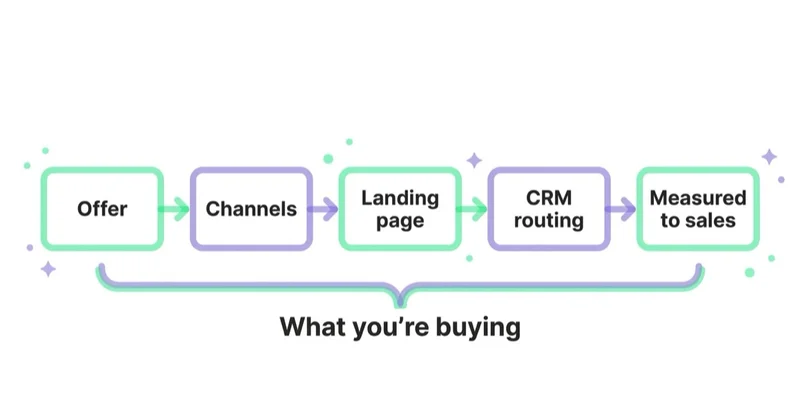
Write a short brief before contacting agencies. It should state:
- the market, offer and customer profile you want to reach;
- the countries, languages and channels in scope;
- the lead stage you want the agency to deliver, such as an enquiry, marketing-qualified lead, sales-accepted lead or booked meeting;
- your current funnel volumes and conversion rates, if reliable data exists;
- sales capacity, response process and any geographic or regulatory constraints;
- the systems the agency will need to work with;
- the target economics and the assumptions behind them;
- what your internal team will continue to own.
If you do not yet have dependable benchmarks, say so. A credible agency should separate known facts from assumptions and propose a learning plan rather than presenting an uncertain forecast as a promise.
Map responsibilities across the full lead journey
Campaign performance is affected by work on both sides. An agency can influence targeting, messages, creative, forms and media optimisation. Your team may control pricing, stock, sales follow-up, qualification and CRM discipline. Website development, analytics and compliance may be shared with other suppliers.
Agree who is responsible, accountable, consulted and informed for each important activity. At minimum, cover:
| Area | Questions to settle |
|---|---|
| Strategy and offer | Who approves the audience, proposition, incentive and claims? |
| Campaign delivery | Who builds, reviews and publishes campaigns and creative? |
| Landing experience | Who owns copy, design, development, hosting and testing? |
| Data and measurement | Who implements consent, tracking, CRM fields and offline conversion imports? |
| Lead handling | Who receives leads, how quickly, and through which routing and escalation process? |
| Qualification | Who decides whether a lead meets the definition, and how is rejection evidence recorded? |
| Reporting | Which metrics, systems and review cadence form the source of truth? |
This prevents an agency from being held responsible for activities it cannot control — and prevents important work from falling into the gap between teams.
Questions to ask before you hire one
Use the same core questions with every shortlisted supplier. Ask for written answers where the details will affect the contract.
1. How will you learn our market and challenge our assumptions?
Look for a discovery process that covers the buyer, offer, competitors, sales cycle, historical data and operational constraints. The agency does not need to agree with every premise in your brief. It should be able to explain which assumptions it will validate first and what evidence would change its approach.
2. What exactly counts as a lead and a qualified lead?
Terms such as MQL and SQL are not universal standards. Define the required fields, fit criteria, intent signals, geography, consent status and disqualifying conditions. Also specify how duplicates, existing customers, job applicants, spam, unreachable contacts and out-of-area enquiries will be treated.
The definition must be possible to audit. "A good prospect" is too subjective for reporting or performance-based billing.
3. Why are you recommending these channels?
A useful answer connects channel choice to buying behaviour, demand maturity, budget, geography and measurement — not merely to what the agency happens to sell. A specialist using one channel can be the right choice when that focus matches the brief. A multi-channel proposal is not automatically more sophisticated.
Ask what the agency would test first, what would make it stop or expand a channel, and where channel overlap could distort attribution.
4. Which assets and services are included?
Clarify the number and type of campaigns, landing pages, creative concepts, copy variants, reporting meetings and technical integrations. Ask whether production, development, translation, call tracking, media costs and third-party software are included or charged separately. The statement of work should also list exclusions and the process for approving additional work.
5. How will you connect marketing activity to sales outcomes?
The appropriate setup depends on your sales process and technology. It may involve platform conversion tracking, analytics, call tracking, CRM stages or offline conversion data. Do not demand a particular technical feature simply because it sounds advanced. Ask the agency to draw the measurement flow, identify likely gaps and state which team must implement each part.
Agree which system resolves disagreements and how data quality will be monitored. If revenue attribution is incomplete, the reporting should show that limitation rather than manufacture precision.
6. How will optimisation and reporting work?
Ask to see a representative report with sensitive data removed. It should distinguish delivery metrics from business outcomes, explain material changes and record the next decisions. Establish the reporting frequency, review format, experiment log and escalation path before work starts.
Useful reporting may include spend, reach, clicks and conversion rate, but it should progress as far down the funnel as reliable data allows: valid leads, accepted leads, opportunities, revenue and acquisition cost. The relevant depth will differ between a long B2B cycle and a high-volume consumer service.
7. Who will actually work on the account?
Meet the proposed lead, not only the salesperson. Ask about seniority, relevant skills, expected account load and who covers absences. Establish whether delivery or data processing will involve contractors, offshore teams or specialist partners, and how their work is supervised. Named experts in a pitch are meaningful only if their involvement is clear.
8. What evidence supports your approach?
A relevant case study has more than an impressive percentage. Ask for the starting point, timeframe, market, budget range, lead definition, measurement method and the agency's actual scope. Results from a comparable sales motion or acquisition model may be more useful than a logo from the same industry.
References can help, but treat them as one input. Platform credentials are also narrow signals. For example, Google Partner status indicates that an agency meets Google's programme requirements; it does not prove fit for your business or guarantee commercial results.
9. How will accounts, data and intellectual property be handled?
For advertising platforms, the client should normally retain appropriate access and be able to continue operating after the relationship ends. Google states that linking a client account to a manager account does not remove the client's access, and eligible users can unlink the account. Ask whether the agency needs owner-level privileges and why.
Not every asset follows the same ownership model. Bespoke landing-page code, editable design files, licensed stock, agency templates and third-party tools may have different rights. The contract should say what you own, what you license, what remains the agency's background intellectual property, and what will be exported or handed over on exit.
10. How do you protect personal and commercially sensitive data?
Ask what information the agency will access, where it is processed, who can access it and how access is removed. If it processes personal data on your behalf, clarify the controller–processor relationship and the required data-processing terms. Cover approved subprocessors, security controls, incident notification, retention and deletion or return of data.
Security questions should be proportionate to the access involved. An agency receiving CRM access warrants deeper due diligence than one delivering creative files only. NIST's supplier guidance provides a useful principle: assess provenance, supplier practices, resilience and dependencies instead of relying on a brand name alone.
11. What is the complete commercial model?
Request a total-cost view that separates media spend, agency fees, creative and landing-page production, tracking, software, call charges, taxes and optional work. Ask what triggers a fee change and how unused budgets or third-party commitments are handled.
Then test the incentives. A fee based on media spend may be simple but increases as spend grows. A performance fee creates stronger outcome alignment only when the outcome is clearly defined, verifiable and materially controlled by the agency. No pricing model removes the need for governance.
12. What happens if we stop working together?
Contract length alone is not a quality signal. A longer term may reflect genuine setup work or committed production; it can also create avoidable lock-in. Focus on termination rights, notice, early-exit charges, access continuity and the transition process.
Ask for a handover checklist covering accounts, permissions, data exports, campaign documentation, creative and outstanding commitments. The agreement should state which assistance is included and what additional transition support costs.
Red flags that warrant a closer look
- Results are guaranteed before discovery. A precise volume, cost or revenue promise is difficult to defend without agreed definitions, historical evidence and stated assumptions.
- Costs and incentives are unclear. You cannot compare proposals if fees, media, production and technology are blended into an unexplained number.
- The agency resists meaningful access or portability. Operational permissions may be sensible, but unexplained restrictions create continuity risk.
- Reporting stops at activity metrics despite an accessible sales signal. The agency should not ignore qualified outcomes when the necessary data can be shared lawfully and reliably.
- Case studies omit context. Large percentage gains can result from a very low baseline, a different lead definition or a selective time window.
- The proposal is generic. Replacing your logo in a standard deck is not evidence that the plan reflects your market or constraints.
- Compliance and security questions are dismissed. The answer need not be legal advice, but the agency should understand its operational responsibilities and involve appropriate specialists.
- Everything important remains verbal. Scope, definitions, fees, approvals and exit arrangements should survive beyond the sales conversation.
Google's third-party policy offers a useful minimum standard for agencies managing Google Ads: be honest about services and expected results, make costs and performance transparent, and avoid misleading claims. Apply the same expectations to every channel.
Compare pricing models in context
There is no universally best agency pricing model. Common structures include:
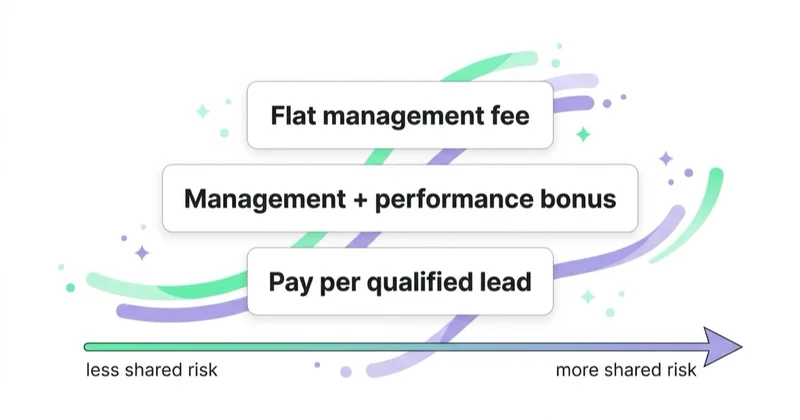
- Fixed retainer: predictable and suitable for an agreed ongoing scope, but changes need a clear process.
- Percentage of media spend: easy to calculate and able to scale with account size, although fee growth is not directly tied to better outcomes.
- Project fee: useful for defined work such as strategy, measurement implementation or landing-page production; less suited to indefinite optimisation.
- Retainer plus performance component: combines delivery coverage with an incentive, provided the baseline and outcome are robust.
- Pay per lead or qualified lead: makes unit cost visible but requires precise acceptance, duplicate and dispute rules. It can encourage volume at the expense of value if definitions are weak.
Compare expected total cost at more than one spend or volume scenario. Model the effect on cost per accepted lead and customer acquisition cost, then test those numbers against gross profit, payback requirements and sales capacity. A lower agency fee is not a saving if the arrangement produces unusable demand; a higher fee is not justified without sufficient value.
Our guide to performance-based marketing and pay-per-lead examines these trade-offs in more detail.
Use a consistent evaluation scorecard
Create the criteria before final presentations, then weight them for your situation. A regulated company may give security and compliance more weight; a new offer may prioritise research and experimentation. Useful categories include:
| Category | Evidence to compare |
|---|---|
| Strategic fit | Understanding of the buyer, offer, constraints and assumptions |
| Delivery approach | Scope, channel rationale, testing method and quality assurance |
| Measurement | Funnel definitions, data flow, attribution limits and reporting |
| Team | Named people, relevant capability, capacity and continuity |
| Commercial fit | Total cost, incentives, change control and forecast assumptions |
| Governance | Approvals, communication, issue escalation and decision cadence |
| Risk | Account access, data protection, security, IP and transition terms |
Score the written proposal and supporting evidence, not presentation style alone. Record uncertainties and conditions separately. This makes it easier to distinguish a correctable gap from a fundamental mismatch.
Consider a controlled first phase
A first phase can reduce uncertainty, but it should not be disguised free work or an unrealistic demand for instant scale. Define what both sides intend to learn, the minimum setup required, the budget at risk and the decision at the end.
A sensible sequence might cover discovery and measurement validation, initial campaigns or outreach, lead-quality review, and then a scale or stop decision. The duration should reflect traffic volume and sales-cycle length. If customers normally take months to close, do not judge the agency solely on revenue generated during a short test.
Before launch, agree a baseline, reporting source, approval turnaround, lead-feedback routine and material decision thresholds. Include qualitative evidence from sales rather than reducing the review to one dashboard metric.
Put the operating agreement in writing
The proposal explains the idea; the contract and statement of work govern delivery. Review them together and obtain legal, privacy or security advice where appropriate. Check for:
- deliverables, exclusions, dependencies and acceptance criteria;
- lead-stage definitions and rules for invalid or disputed leads;
- fees, media budgets, expenses, taxes and payment timing;
- approval responsibilities and change-control procedure;
- account permissions, reporting access and record retention;
- confidentiality, data-processing and security obligations;
- ownership and permitted use of creative, code, data and agency materials;
- subcontractor or subprocessor arrangements;
- term, notice, suspension and termination rights;
- handover obligations and charges after termination.
This clarity protects both parties. It gives the agency stable conditions in which to deliver and gives the client a concrete basis for evaluating performance.
What a strong agency evaluation should produce
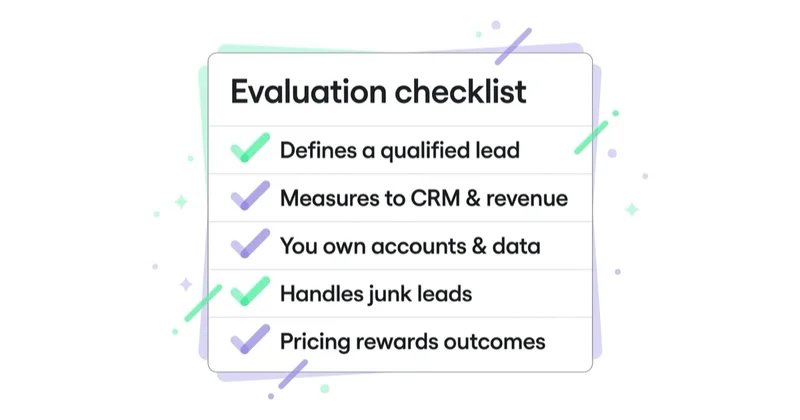
By the end of the process, you should understand what the agency proposes to do, why it chose that approach, what it needs from you, how results will be judged and what happens if the assumptions are wrong. You should also be able to identify the people responsible for delivery, the complete cost, the main risks and the practical exit route.
Space Ads supports businesses with lead generation strategy and execution. Whether you evaluate us or another supplier, use the same evidence-based questions and make the commercial decision against your own funnel economics.
Common questions
How much does a lead generation agency cost?
The fee depends on scope, markets, channels, production needs, technology and commercial model. Compare the complete cost of agency services, media, creative, landing pages and software. Then model cost per accepted lead and customer acquisition cost using realistic conversion assumptions.
Should I choose an agency that guarantees leads?
Treat any guarantee as a contractual mechanism, not proof of quality. Check the exact lead definition, volume, period, exclusions, replacement or credit rules and your own obligations. Be especially cautious when a precise result is promised before the agency has reviewed your data, offer and market.
Does the agency need experience in my exact industry?
Not always. Exact sector experience can shorten discovery and help with regulation or buyer language, but comparable sales cycles, economics and channel constraints may be equally relevant. Assess the team's reasoning and evidence rather than relying on logos alone. Consider conflicts if the agency serves direct competitors.
Should we hire a specialist or a full-service agency?
Choose according to the problem. A specialist may bring deeper channel expertise and a simpler scope. A broader agency may coordinate strategy, creative, media and measurement. The important issue is whether the proposed capabilities match your needs and integrate with the work you keep in-house.
When should lead generation stay in-house?
Keep work in-house when it is strategically sensitive, requires constant product access or can be staffed effectively at the required depth. An agency can add specialist capacity, speed or an external perspective. Hybrid arrangements are common, but they need explicit decision rights and ownership.
Sources
- Google Ads Help — Third-party policy: transparency, costs and claims
- Google Ads Help — Ownership of client accounts
- Google Ads Help — Linking a client account to a manager account
- Google — Google Partners programme
- UK Information Commissioner's Office — Contracts and liabilities between controllers and processors
- NIST — Cybersecurity Supply Chain Risk Management: Due Diligence Assessment Quick-Start Guide
Continue learning
Continue reading
Performance-Based Marketing and Pay-Per-Lead: How It Works
Pay-per-lead can align payment with a defined outcome, but it does not remove business risk. Learn how to define a billable lead, calculate a sustainable CPL, connect CRM outcomes and protect quality, data and compliance.
Cost Per Lead (CPL): Benchmarks, What's 'Good', and How to Set Your Target
CPL is easy to calculate and easy to misuse. Learn how to compare valid benchmarks, separate media CPL from fully loaded CPQL, and derive an affordable target from your own unit economics.
Appointment Setting vs Lead Generation: What Actually Fills the Calendar
A calendar entry is not a sales outcome. Learn where lead generation ends and appointment setting begins, how to define an accepted meeting, and how to measure the path from booking to opportunity.