A useful marketing calendar is not a collection of novelty days. It connects the moments that genuinely affect customer behaviour with the decisions required to serve them: offer, stock, creative, media, CRM, landing pages, tracking, customer support and fulfilment.

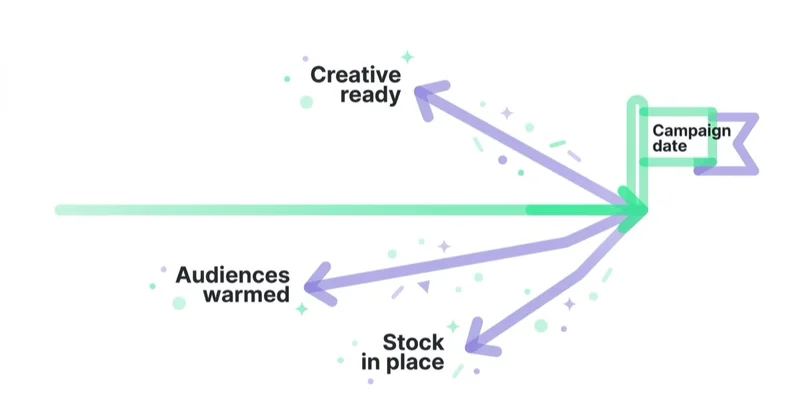
The public date is the go-live or demand date, not the project deadline. A campaign that requires imported stock, new packaging or regulated claims may need six months. A small email and paid-social refresh may need a few weeks. The correct lead time comes from dependencies, not from a universal rule that every Q4 campaign should “start in summer”.
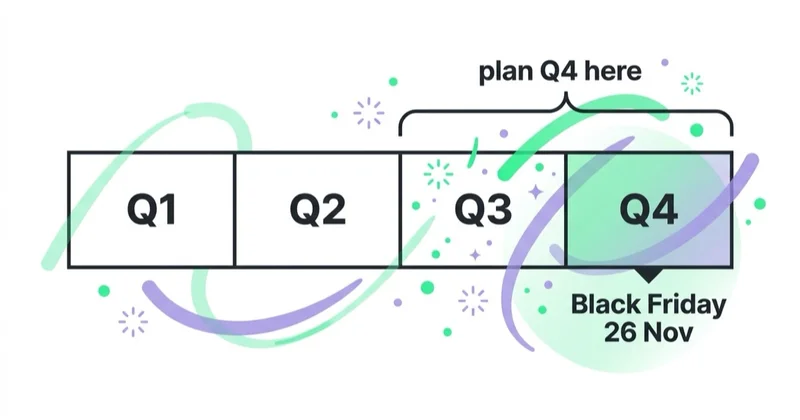
This 2027 calendar provides verified reference dates for the US and UK, marks dates that must be checked locally and gives you a backwards-planning system. Black Friday falls on Friday, 26 November 2027, after US Thanksgiving on 25 November; Cyber Monday is 29 November.
TL;DR
- Select moments from customer demand, commercial relevance and operational capacity—not from a generic social-media calendar.
- Maintain a separate calendar for each country. Public holidays, school terms, Mother's Day and fulfilment cut-offs differ by market.
- Western Easter Sunday is 28 March 2027. Black Friday is 26 November and Cyber Monday is 29 November.
- In the US, Christmas Day falls on Saturday, so the federal holiday is observed on Friday, 24 December. In England and Wales, substitute bank holidays are 27 and 28 December.
- Use four lead-time classes: strategic (16–24+ weeks), integrated (8–16), tactical (3–8) and always-on refresh (1–4). Extend them where product, legal or supply-chain work requires it.
- Plan the post-campaign period too: returns, fulfilment, reporting, creative learnings and cohort quality.
- Do not publish dates for events that have not been officially announced. Hold provisional planning windows and confirm them later.
How to use this 2027 marketing calendar
For every possible moment, answer five questions:
- Audience: does it matter to a defined customer group in this market?
- Commercial role: acquisition, repeat purchase, gifting, product launch, education or retention?
- Distinctive idea: can the brand add value without forcing a weak connection?
- Economics: can price, margin, inventory and fulfilment support the expected response?
- Execution: is there enough time and capacity to deliver the promise safely?
If a date fails these questions, it does not belong in the campaign plan. It may remain as an operational note—for example, a bank holiday that changes delivery or support hours—without becoming a promotion.
Use three layers:
- commercial calendar: launches, promotions, budgets and revenue periods;
- customer calendar: needs, gifting occasions, replenishment and buying cycles;
- operating calendar: stock arrivals, content production, approvals, platform freezes, carrier cut-offs and team availability.
The campaign calendar is where those layers meet.
Key 2027 dates: US, UK and international reference
The table is a planning shortlist, not a recommendation to run every event. Dates described as “common” are commercial conventions rather than public holidays and should be checked in the target market.
| Date in 2027 | Moment | Primary market or scope | Planning note |
|---|---|---|---|
| 1 Jan, Fri | New Year's Day | International | Review support hours, delivery and campaigns prepared in 2026 |
| 18 Jan, Mon | Martin Luther King Jr. Day | US federal holiday | Treat cultural relevance carefully; operational or values-led planning may be more appropriate than promotion |
| 14 Feb, Sun | Valentine's Day | Many markets | Delivery cut-off is earlier than the occasion; test gifting demand by category |
| 15 Feb, Mon | Washington's Birthday | US federal holiday | Often marketed as Presidents' Day; naming and retail relevance vary |
| 8 Mar, Mon | International Women's Day | International | UN observance; avoid tokenistic offers or unsupported purpose claims |
| 26 Mar, Fri | Good Friday | UK bank holiday and Christian observance | Carrier, store and support schedules may change |
| 28 Mar, Sun | Western Easter Sunday | Many Western Christian markets | Basket, travel and fulfilment effects begin before the weekend |
| 29 Mar, Mon | Easter Monday | England, Wales and other markets | Bank-holiday status differs by country |
| 22 Apr, Thu | International Mother Earth Day / Earth Day | International | Use only with credible product and operational evidence for environmental claims |
| 3 May, Mon | Early May bank holiday | UK | Confirm regional calendars and delivery schedules |
| 9 May, Sun | Mother's Day | US and several other markets | Common second-Sunday convention; not the UK date and not universal |
| 31 May, Mon | Memorial Day / Spring bank holiday | US / England and Wales | Different meaning in each market; operational and campaign treatment must be localised |
| 18 Jun, Fri | Juneteenth observed | US federal workforce | Actual anniversary is Saturday, 19 June; use culturally informed review |
| 20 Jun, Sun | Father's Day | US, UK and several markets | Common third-Sunday convention; verify locally |
| 4 Jul, Sun | Independence Day | US | Federal holiday observed Monday, 5 July; plan fulfilment and support accordingly |
| 30 Aug, Mon | Summer bank holiday | England and Wales | Scotland uses a different summer bank-holiday date |
| 6 Sep, Mon | Labor Day | US | Often affects late-summer retail and travel patterns |
| 11 Oct, Mon | Columbus Day | US federal holiday | Local names and observance vary; do not assume uniform cultural treatment |
| 31 Oct, Sun | Halloween | Several markets | Category relevance varies sharply; delivery must arrive before the weekend |
| 11 Nov, Thu | Veterans Day / Singles' Day | US / international ecommerce | These are unrelated occasions sharing a date; segment by market and context |
| 25 Nov, Thu | Thanksgiving Day | US | Official federal holiday and the anchor for the following retail weekend |
| 26 Nov, Fri | Black Friday | International retail adoption | Not a public holiday in most markets; offer and fulfilment capacity matter more than the label |
| 27 Nov, Sat | Post-Thanksgiving Saturday | US retail period | “Small Business Saturday” use may involve brand or programme rules; confirm before using protected assets |
| 29 Nov, Mon | Cyber Monday | International ecommerce adoption | Plan as part of one promotional system, not automatically a disconnected sale |
| 24 Dec, Fri | Christmas Day observed | US federal workforce | Christmas Day itself falls on Saturday |
| 25 Dec, Sat | Christmas Day | Many markets | Customer order cut-offs occur days or weeks earlier |
| 26 Dec, Sun | Boxing Day | UK and selected markets | Actual date; retail and public-holiday treatment varies |
| 27 Dec, Mon | Christmas substitute bank holiday | England and Wales | Operational closure may continue after Christmas weekend |
| 28 Dec, Tue | Boxing Day substitute bank holiday | England and Wales | Include returns, support and carrier capacity in the plan |
The US federal holiday schedule comes from the US Office of Personnel Management. UK dates in this guide use the GOV.UK calendar for England and Wales; Scotland and Northern Ireland have different dates. Western Easter is confirmed for 28 March 2027 in the US Conference of Catholic Bishops calendar.
Dates to confirm for each market
Do not copy one country's calendar into another. Confirm these categories with official local sources:
- Mother's Day and Father's Day;
- school terms, back-to-school periods and university calendars;
- public and bank holidays by country, state or region;
- tax deadlines and fiscal year ends relevant to B2B buyers;
- religious observances based on lunar calendars or local sighting;
- Orthodox Easter and other denominational calendars;
- Ramadan, Eid al-Fitr and Eid al-Adha;
- Lunar New Year, Diwali, Passover, Rosh Hashanah and Hanukkah;
- local sales periods and pricing restrictions;
- carrier collection dates and final delivery cut-offs;
- major sports, entertainment and industry events.
Some religious days begin at sunset rather than midnight. Some public holidays are observed on a substitute weekday when the actual date falls on a weekend. Store both the actual observance and any operational day off as separate fields.
Use religious and cultural moments only when the brand understands the audience and can review the work appropriately. A date being commercially popular does not make every promotional treatment suitable.
Events not yet confirmed: plan a window, not a fake date
As of 22 July 2026, some 2027 retail, platform and industry dates may not have been officially announced. Examples can include retailer deal events, individual conferences, platform product moments and local shopping festivals.
For an unconfirmed event:
- create a provisional planning window based on the organiser's usual period;
- label it TBC, not confirmed;
- assign an owner to monitor the primary source;
- avoid booking non-refundable production around an assumed date;
- update media, stock and CRM plans when the organiser confirms it.
Do not use a third-party calendar's prediction as if it were an official announcement.
2027 planning by quarter
Q1: fulfil plans made in 2026 and validate the baseline
January campaigns need to be ready before the year begins. Use Q1 to execute genuine New Year, winter or budget-reset demand and establish clean targets for the year.
Key work:
- finalise January creative and stock in Q4 2026;
- account for New Year returns and gift-card redemption;
- decide whether Valentine's Day fits the category;
- prepare Easter earlier than usual because it falls on 28 March;
- establish measurement baselines before multiple seasonal changes overlap.
For B2B, new budgets may create opportunity, but procurement and fiscal cycles differ. Map named-account and pipeline stages rather than assuming every buyer resets on 1 January.
Q2: Easter follow-through, spring demand and H2 preparation
Good Friday is 26 March, so Easter activity crosses the Q1/Q2 boundary. Returns, fulfilment and reporting continue into April.
Q2 can include Mother's Day in markets using the May date, spring bank holidays and category-specific summer preparation. It is also the decision period for H2 launches that require product, stock or major creative production.
Key work:
- close Easter reporting after the return or lead-quality window;
- localise Mother's/Father's Day rather than reusing one market's assets;
- lock Q3 launches with supply-chain dependencies;
- make the first commercial assumptions for Black Friday and Christmas;
- reserve production capacity if Q4 requires major shoots or new packaging.
Q3: back-to-school, late summer and Q4 readiness
Back-to-school dates vary across countries and school systems. Use local search, sales and school-calendar data rather than one global launch date.
Q3 is a critical Q4 production period for many retailers, but it is not the universal beginning. A complex peak programme may already be underway; a tactical promotion may not need to start until later.
Key work:
- finalise Q4 offer architecture and margin guardrails;
- confirm stock orders, allocation and replenishment contingencies;
- produce and approve core creative;
- validate feeds, promotion logic, checkout and analytics;
- decide how Black Friday, Cyber Monday and Christmas connect;
- plan service staffing, fraud controls, returns and delivery messaging.
Q4: execute, monitor capacity and preserve post-purchase quality
For many retailers Q4 is a demand peak; for other businesses it is not. Use historical weekly contribution, lead quality, capacity and cohort data to decide how much investment it deserves.
Important 2027 facts:
- Halloween is Sunday, 31 October;
- Singles' Day and US Veterans Day are Thursday, 11 November;
- Thanksgiving is Thursday, 25 November;
- Black Friday is Friday, 26 November;
- Cyber Monday is Monday, 29 November;
- Christmas Day is Saturday, 25 December;
- England and Wales have substitute bank holidays on 27 and 28 December.
Do not end the plan at checkout. Monitor promised delivery dates, cancellations, customer contacts, refunds, returns, gift-card use and the quality of newly acquired cohorts.
Choose the right campaign lead time
These are planning ranges, not service guarantees.
| Campaign class | Starting range | Typical characteristics |
|---|---|---|
| Strategic tentpole | 16–24+ weeks | Product or offer design, imported stock, major production, several markets, legal review, new technology |
| Integrated campaign | 8–16 weeks | Several channels, original creative, landing pages, CRM, feed changes and meaningful budget |
| Tactical activation | 3–8 weeks | Existing products, limited markets, modest creative adaptation and known mechanics |
| Always-on refresh | 1–4 weeks | Iteration inside an approved system with no major operational dependency |
Extend the range for regulated claims, talent contracts, physical manufacturing, localisation, accessibility review, retail partner approval or long procurement. Shorten only when dependencies are genuinely removed—not by compressing quality assurance.
Backwards-planning template
For a high-complexity moment, work backwards from the customer date:
T−24 to T−16 weeks: commercial decision
- define audience, customer need and business outcome;
- model contribution, discount, shipping and return scenarios;
- forecast stock and operational capacity;
- identify countries, channels, owners and approval risks;
- decide whether an experiment or holdout is feasible.
T−16 to T−12: proposition and measurement
- lock the offer architecture and exclusions;
- write creative and landing-page briefs;
- define conversion, margin and cohort metrics;
- reserve production, development and translation capacity;
- establish the baseline and test plan.
T−12 to T−8: production and build
- produce master creative and variants;
- build landing pages, feeds, promotion rules and CRM journeys;
- obtain legal, brand, accessibility and market approvals;
- plan customer service scripts and fulfilment contingencies.
T−8 to T−4: integration and early learning
- validate tracking, transaction values and product eligibility;
- test checkout, codes, thresholds and mobile journeys;
- launch eligible creative tests without leaking a confidential offer;
- confirm inventory, carrier capacity and budget scenarios;
- prepare rollback rules.
T−4 to T−1: launch readiness
- complete end-to-end QA in every market and currency;
- schedule media and owned-channel communication;
- verify price, feed and landing-page consistency;
- confirm escalation owners and monitoring thresholds;
- freeze avoidable high-risk changes.
T0 to T+2 weeks: execution and follow-through
- monitor contribution, capacity, errors and customer experience;
- adjust within pre-agreed guardrails;
- preserve control groups where used;
- reconcile orders, cancellations and returns;
- document creative, offer and audience learnings.
Not every campaign needs every step. The template makes dependencies visible so the team can remove them deliberately rather than discover them during launch.
Build the calendar around economics
For each campaign, store:
- target audience and market;
- baseline demand and forecast;
- list price, promotion and stacking rules;
- unit contribution before and after the offer;
- inventory and capacity limit;
- media and production budget;
- primary outcome and guardrail metrics;
- return, cancellation or sales-quality window;
- owner, approver and escalation path;
- go/no-go and rollback criteria.
A seasonal campaign can increase revenue while reducing contribution through discounting, expensive delivery, overtime, returns or low-quality acquisition. The calendar should therefore show commercial guardrails, not just content deadlines.
See how to plan a marketing budget and ecommerce promotions without killing margin for the connected economics.
Ecommerce and B2B need different calendars
Ecommerce
Prioritise customer delivery dates, stock, promotional rules, feeds, checkout capacity, fraud, support and returns. The “event date” may be less important than the final date on which a product can arrive for gifting or use.
B2B and services
Map:
- buyer fiscal years and budget release;
- procurement and security-review duration;
- relevant conferences and submission deadlines;
- regulatory or reporting milestones;
- contract renewal periods;
- product releases and implementation capacity;
- quarter-end pressure without sacrificing lead quality.
For a conference, the event start is not the campaign deadline. Speaking submissions, meeting outreach, travel, account research and post-event follow-up each require their own milestones.
How Space Ads approaches annual planning
We build the calendar from demand, economics and delivery dependencies. The working sequence is:
- map historical demand and customer cycles by market;
- add verified holidays, events and operational closures;
- select moments with a clear commercial or customer role;
- classify each campaign by lead time and risk;
- plan stock, creative, media, CRM, measurement and fulfilment together;
- assign decision owners and guardrails;
- review outcomes after returns or lead-quality data mature;
- carry forward evidence, not assumptions.
A marketing audit can pressure-test measurement, dependencies and readiness. Ongoing performance marketing then operates within the calendar while preserving always-on learning and commercial control.
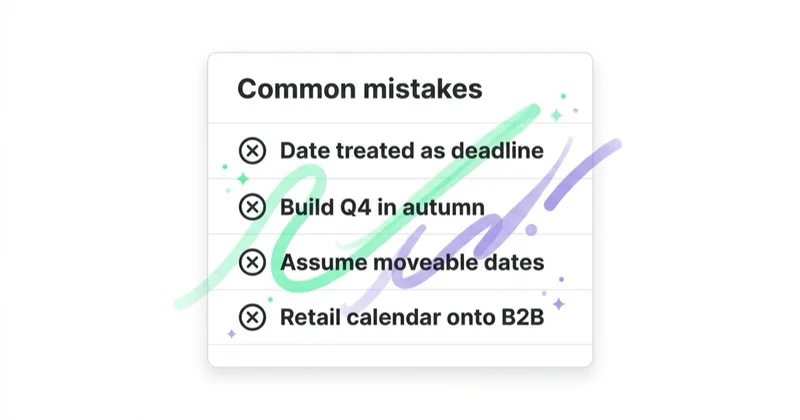
Common mistakes
| Mistake | Better approach |
|---|---|
| Copying hundreds of novelty days | Select moments with customer and commercial relevance |
| Treating the public date as the deadline | Back-plan every dependency from the customer need date |
| Using one global calendar | Maintain country and region variants |
| Assuming Q4 is the peak for every business | Use historical demand, contribution and capacity |
| Publishing predicted event dates as confirmed | Mark TBC and monitor the primary organiser |
| Planning media without stock and fulfilment | Use one integrated commercial and operating plan |
| Ending analysis at revenue | Include margin, cancellations, returns and cohort quality |
| Replacing always-on activity with tentpoles | Layer selected peaks onto a stable learning system |
FAQ
When is Black Friday 2027?
Black Friday is Friday, 26 November 2027. US Thanksgiving is Thursday, 25 November, and Cyber Monday is 29 November. The required planning start depends on stock, creative, markets, technology and approvals; a complex programme may need 16–24 weeks or more.
When is Easter 2027?
Western Easter Sunday is 28 March 2027. Good Friday is 26 March and Easter Monday is 29 March. Public-holiday status and Orthodox Easter dates differ by market and tradition, so verify the local calendar used by customers, carriers and staff.
When should I start planning Christmas 2027 campaigns?
Start from the last customer delivery date, then work backwards through carrier cut-offs, stock arrival, production, approvals and testing. A product-led international campaign may begin in Q2; an adaptation of an established campaign may begin much later. Complexity determines the date.
What are the UK Christmas bank holidays in 2027?
Christmas Day falls on Saturday, 25 December, and Boxing Day on Sunday, 26 December. In England and Wales, the substitute bank holidays are Monday, 27 December and Tuesday, 28 December. Scotland and Northern Ireland should be checked separately on GOV.UK.
What US holiday dates affect Q4 2027?
Veterans Day is Thursday, 11 November; Thanksgiving is Thursday, 25 November; Christmas Day is Saturday, 25 December and is observed federally on Friday, 24 December. Business opening and delivery schedules can differ from the federal calendar.
How far in advance should a marketing campaign be planned?
As a starting framework, allow 16–24+ weeks for strategic tentpoles, 8–16 for integrated campaigns, 3–8 for tactical activations and 1–4 for always-on refreshes. Extend for product, supply-chain, legal, localisation or development dependencies.
Does every brand need a Black Friday campaign?
No. Participate only if the customer proposition, margin, stock, fulfilment and brand strategy support it. Alternatives include maintaining standard pricing, offering a service benefit, focusing on selected inventory or choosing a different moment. Fear of missing out is not a commercial model.
How should a B2B marketing calendar differ?
It should prioritise fiscal and procurement cycles, conferences, regulatory milestones, renewals, product launches and sales capacity. Retail holidays belong only where they affect the audience. The same backwards-planning discipline applies, but the milestones and outcome window are different.
Key takeaways
- Use verified, market-specific dates and label unconfirmed events as TBC.
- Black Friday 2027 is 26 November; Western Easter is 28 March.
- Choose campaigns by customer relevance, economics and capacity.
- Set lead time from dependencies rather than a generic seasonal rule.
- Plan media, creative, stock, CRM, measurement and fulfilment as one system.
- Evaluate the full outcome after cancellations, returns or lead quality mature.
Sources and further reading
- US Office of Personnel Management — 2027 federal holiday schedule
- GOV.UK — UK bank holidays, including 2027 dates by country
- US Conference of Catholic Bishops — 2027 liturgical calendar
- United Nations — International Women's Day and International Mother Earth Day
Continue learning
Continue reading

The Ecommerce Marketing Calendar for 2026 (Plan the Year, Not the Week)
A useful ecommerce calendar connects verified market dates to inventory, creative, media, CRM, fulfilment, and measurement deadlines. Use this 2026 framework to select relevant moments, plan backwards, and protect contribution margin.

Loyalty Programs for Ecommerce and DTC: What Actually Works
An ecommerce loyalty program works only when it changes customer behaviour profitably. Compare points, tiers, cashback and paid membership, model the reward economics and measure incrementality without member-selection bias.
Free Shipping Strategy for Online Stores (Threshold, Margin, When)
Free shipping can improve the offer, but only when the additional contribution it generates exceeds the delivery subsidy. Learn how to choose a model, calculate a threshold and test the impact on profit rather than AOV alone.