An ecommerce marketing calendar connects commercial dates with the work required to serve customers well: demand analysis, inventory, pricing, creative, media, CRM, site changes, fulfilment, customer support, and measurement. A list of holidays is not a strategy. Each market and category needs its own calendar, verified against local dates, delivery capacity, and historical customer behavior.
This guide provides confirmed 2026 anchors for US and UK planning plus a framework for working backwards. Dates such as Mother's Day, bank holidays, school terms, religious observances, and shipping cutoffs vary by country or region; verify every market before publishing an offer.
TL;DR
- Select moments from evidence. Use historical sales, search demand, customer research, category seasonality, and operational constraints.
- Plan backwards from the customer promise. Inventory and delivery cutoffs often precede media and creative deadlines.
- Q4 is important for many consumer categories, not all businesses. Do not let a generic retail calendar override the brand's actual demand pattern.
- Earlier reach can support later demand, but it is not automatically cheaper or incremental. Define the role and measurement of pre-peak activity.
- Model contribution, not revenue alone. Include discounts, media, fulfilment surcharges, returns, payment fees, and support.
- Prepare the measurement before launch. Promotion codes, clean event tracking, holdouts where practical, and an annotated calendar improve the post-event read.
Why a calendar beats reacting
Peak periods compress decisions across teams. A campaign can be ready while the product is out of stock, a discount code fails, the landing page shows the wrong terms, or the promised delivery date is no longer achievable. Planning reduces these avoidable failures and gives legal, finance, operations, service, and media teams the same source of truth.
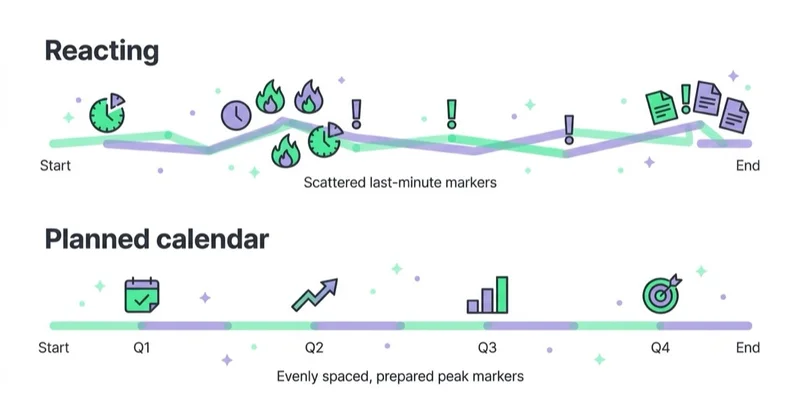
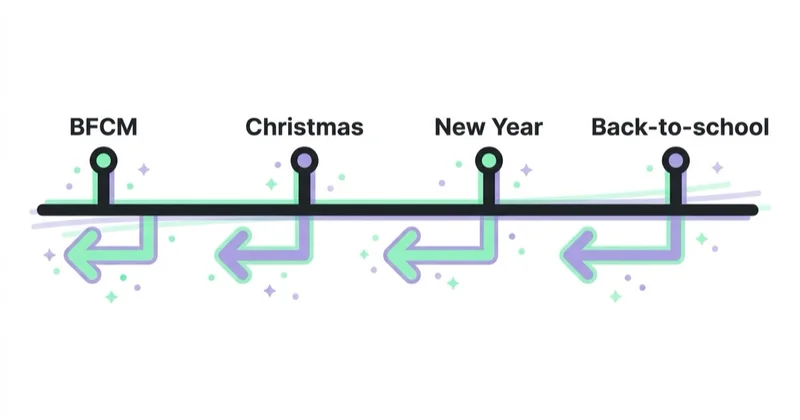
For each moment, work backwards through six gates: customer delivery date, fulfilment and stock lock, site and promotion QA, asset approval, production, and commercial decision. Add owners and contingency dates. A late asset may be recoverable; late inventory or inaccurate delivery promises are not.
Pick your moments — not every holiday is yours
The first planning step is deciding which commercial moments actually matter for your brand, because trying to activate around every retail holiday spreads budget and attention thin. A supplements brand cares about New Year (resolutions) and back-to-routine periods; a gifting brand lives on Valentine's, Mother's Day and December; a fashion brand plans around seasonal collection drops and end-of-season sales; a B2B ecommerce seller may ignore consumer holidays entirely and plan around fiscal and industry cycles.
Many consumer retailers plan around the Black Friday–Cyber Monday period and December gifting, but categories also have product launches, weather shifts, cultural events, pay cycles, and replenishment patterns. Choose a manageable set of priority moments and define what the brand will not activate. The number is a capacity decision, not a universal three-to-five rule.
The 2026 anchor moments (adapt to your category)
| 2026 date or period | Moment | Market note | Suggested planning start |
|---|---|---|---|
| 1 January | New Year's Day | Fixed date; category relevance varies | Prior November–December |
| 14 February | Valentine's Day | Fixed date; Saturday in 2026 | December–early January |
| 15 March | Mother's Day / Mothering Sunday | UK; the US date is 10 May | January for UK; March for US |
| 3–6 April | Good Friday, Easter Sunday, Easter Monday | Easter Sunday is 5 April; public holidays vary by country | January–February |
| 21 June | Father's Day | US and UK in 2026; market customs vary | April |
| July–September | Summer sale and back-to-school windows | School calendars and climate differ by region | 8–12 weeks before local demand |
| 31 October | Halloween | Category- and market-dependent | August–September |
| 11 November | Singles' Day | Strongest in selected markets and cross-border retail | August–September |
| 27 November | Black Friday | Day after US Thanksgiving on 26 November | Commercial plan in Q2–Q3; production in Q3 |
| 30 November | Cyber Monday | Monday after US Thanksgiving | Plan with the Black Friday period |
| 25–28 December | Christmas and UK Boxing Day period | Christmas is 25 December; UK Boxing Day substitute bank holiday is 28 December | Inventory and carrier plan in Q3; campaigns in Q4 |
The US Treasury confirms Thanksgiving on Thursday, 26 November 2026, which places Black Friday on 27 November and Cyber Monday on 30 November. GOV.UK lists Good Friday on 3 April, Easter Monday on 6 April, Christmas Day on 25 December, and the Boxing Day substitute bank holiday on 28 December for England and Wales. Check other countries, UK nations, religious calendars, local school terms, and carrier schedules separately.
Give pre-peak activity a specific job
Pre-peak media may build awareness, collect permissioned email or SMS sign-ups, test messages, introduce products, or capture early purchases. Assign one job and suitable measurement to each phase. Do not assume that retargeting pools are free demand or that everyone in them is incremental; many people would return without another ad.
Run prospecting early enough to observe conversion delay, verify creative and landing pages, and establish a baseline. During the peak, allocate budget by marginal incremental return rather than automatically concentrating on retargeting and branded search, which often receive credit for demand created elsewhere. The relationship between longer- and shorter-horizon activity is covered in brand strategy vs performance.
Glossary
- Marketing calendar — a year-ahead plan of commercial moments and the work that precedes each.
- Anchor moment — a peak that materially moves your revenue (e.g. Q4 for most ecommerce).
- Pre-peak activity — media, CRM, content, merchandising, and testing conducted before the main buying window for a defined purpose.
- Peak auction pressure — a possible change in media cost when advertiser demand and inventory conditions shift; verify it in the account rather than assuming it.
- Delivery cutoff — the last order time at which the business and carrier can support a promised arrival date.
- Margin-led promotion — a discount planned against margin, not reacted to competitors.
Protect margin through discount season
Before approving a promotion, calculate expected units, average selling price, product margin, media cost, payment fees, fulfilment, returns, support, and the cost of gifts or free shipping. Define eligibility, stacking, exclusions, stock limits, code behavior, start and end time, timezone, and the landing page. Only use genuine scarcity and verifiable deadlines.
Google Merchant Center requires promotions to add value, be clear, meet redemption requirements, and comply with local policies. Submitted effective dates and timezone should match the live site. Segmenting can improve economics, but it should respect consent, fairness, and operational capability. Read MER and blended efficiency alongside contribution and incremental profit rather than celebrating gross peak revenue alone.
Don't forget post-peak and off-season
A peak calendar also needs post-purchase service, returns, reviews, replenishment where appropriate, and a measured second-purchase plan. Do not rush gift buyers or customers with unresolved issues into another sale. Quieter periods can support product research, creative testing, data quality, site improvement, and retention work; auction costs are not guaranteed to be lower.
Compare peak cohorts with normal cohorts at the same lifecycle age and on contribution, not just repeat revenue. Gift-heavy or discount-heavy buyers may behave differently, so do not apply a normal replenishment assumption without evidence. See customer retention marketing.
How Space Ads approaches the calendar
At Space Ads, the annual calendar starts with market-level demand and the commercial plan, then assigns owners and deadlines across stock, pricing, creative, media, CRM, site, analytics, fulfilment, and support. Each priority moment has a base case, upside case, risk limits, and a fallback if stock or delivery capacity changes.
Media phases have explicit jobs and measurement. Promotions are evaluated on contribution and incremental effect where the data permits, while the calendar records changes that would otherwise distort a before-and-after comparison. This lives in performance marketing, with the seasonal deep dive in the Black Friday timeline.
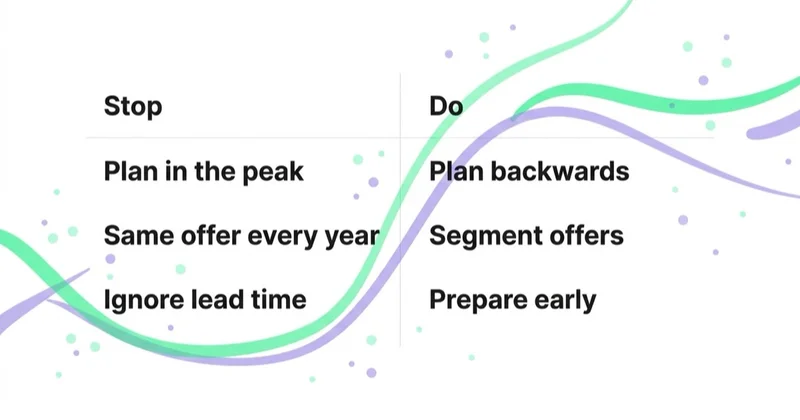
Stop doing / Do instead
| Stop doing | Do instead |
|---|---|
| Planning a few weeks ahead | Plan the year backwards from anchor moments |
| Activating every retail holiday | Prioritise the moments supported by evidence and team capacity |
| Starting planning when the campaign should launch | Work back from delivery, stock, QA, production, and approval deadlines |
| Discounting as a reflex to competitors | Plan promotions on margin, in advance |
| Chasing peak revenue at any cost | Read blended; a huge unprofitable peak isn't a win |
| Treating the calendar as all peaks | Plan post-peak retention and off-season demand-building |
Common mistakes
Common errors include copying another market's dates, omitting delivery and stock cutoffs, planning media without customer support, using unsupported scarcity, failing to QA promotion stacking, and measuring revenue without margin or holdouts. Another is assuming peak CPMs, warm audiences, or Q4 importance without checking the account and category.
FAQ
What should an ecommerce marketing calendar include?
Include the market and verified date, business objective, audience, offer, forecast, stock, delivery cutoff, owners, creative and media deadlines, CRM, landing page, tracking, QA, support plan, risk limits, and post-event analysis. Add only moments supported by category and customer evidence.
When should I start planning for Black Friday and Q4?
Set the commercial plan in Q2 or Q3 when inventory, production, and fulfilment require it. Creative production and campaign testing commonly belong in Q3 or early Q4. The exact lead time follows the supply chain and approval process; it is not determined by media alone.
Why do ad costs spike during peak periods?
Auction costs can rise when advertiser demand increases relative to available impressions, but the size and timing vary by market, audience, placement, and objective. Compare the account's CPM, reach, conversion rate, and marginal cost with prior comparable periods. Do not assume retargeting is cheaper or more incremental merely because its attributed ROAS is higher.
How do I protect margin during the discount season?
Plan promotions in advance on margin rather than reacting to competitors. Model the margin impact before committing, segment offers (deeper discounts for lapsing customers or overstock, lighter or none for products that sell anyway), and hold the line where a discount isn't needed to convert. Reading blended efficiency rather than chasing peak revenue at any cost keeps a big Black Friday from being a loss-making one.
Should I activate around every holiday?
No. Select moments from historical demand, customer relevance, category fit, operational capacity, and testable opportunity. The right number depends on the team's capacity and the business—not a universal quota.
What should I do after a peak period?
Prioritise fulfilment, service, returns, feedback, and appropriate post-purchase guidance. Then compare the cohort's contribution and repeat behavior with normal cohorts. Use replenishment or second-purchase messages only when product need, timing, and permission support them.
Key takeaways
- A marketing calendar's value is planning the year backwards from revenue-moving moments, not listing holidays.
- Choose moments from category and customer evidence, then verify dates for every market.
- Work backwards from stock and delivery promises through QA, production, approval, and launch.
- Give pre-peak media a defined job; do not assume retargeting or attributed ROAS proves incrementality.
- Plan promotions on contribution margin and operational capacity, not gross revenue.
- Prepare fulfilment, service, measurement, and cohort analysis as carefully as the campaign.
Sources and further reading
- US Department of the Treasury — 2026 federal holiday notice confirming Thanksgiving
- GOV.UK — Official UK bank holiday dates
- Google Merchant Center Help — Promotions policies
- Google Merchant Center Help — Promotion effective dates
Continue learning
Continue reading
Marketing Calendar 2027: Plan the Year Around Lead Times, Not Dates
Build a practical 2027 marketing calendar with verified US and UK dates, market-specific checks and realistic lead times. Use the planning framework to align campaigns, stock, creative, tracking and fulfilment.

Lead Generation for Online Courses and Education Providers
Education lead generation must connect an honest promise with learner fit, enrolment and course starts—not just form volume. Learn how to design the journey, evidence claims and measure each intake.
How to Choose a Performance Marketing Agency
Choose a performance marketing agency with a defined brief, evidence-based scorecard and clear commercial safeguards. This guide covers team evaluation, measurement, account access, fees, contracts and handover.