
Mobile game advertising and app user acquisition are not web PPC with an app-store link. The unit of growth is not a click. It is an install that turns into a retained user, a first purchase, a subscription, ad revenue or another in-app outcome that can pay back the spend.
That changes the operating model. Google App campaigns and Meta app promotion campaigns automate much of the targeting, placement selection and bid execution. The work shifts to four inputs: the events passed back to the ad platforms, the creative system that feeds them, the attribution setup that makes results readable, and the commercial model used to decide whether growth is actually profitable.
TL;DR
- App user acquisition is event-led. Installs matter only as the first step toward retention, purchase, subscription, ad revenue or another in-app value signal.
- Google App campaigns are asset-driven. Google can serve app ads across Search, Google Play, YouTube, Discover and the Google Display Network from the text, image, video and HTML5 assets supplied to the campaign.
- Meta app promotion should be consolidated around signal quality. Advantage+ style app campaigns reduce manual targeting work, so the main controllable inputs are the app event, operating-system split, budget and creative pool.
- iOS and Android should be managed as different measurement environments. iOS relies on SKAdNetwork and AdAttributionKit postbacks; Android can use the Google Play Install Referrer and platform-level conversion data.
- Creative testing is not optional. Once targeting and bidding are automated, new concepts, angles and formats become the main lever left to improve install quality and cost.
- CPI is a diagnostic, not the goal. The business question is payback: D1 retention, D7/D30 ROAS, subscription activation, purchase rate and lifetime value.
Why app UA behaves differently from web PPC
Web paid media usually starts with a click, a landing page and a conversion event in a browser. App UA starts with a store visit, an install, first open, onboarding, permission prompts and post-install behaviour. The conversion happens after the app is downloaded, which means the ad platform must learn from in-app events rather than a simple page-view-to-purchase path.

The second difference is privacy. On iOS, deterministic user-level attribution is limited by App Tracking Transparency, SKAdNetwork and AdAttributionKit. Apple can return aggregated postbacks with delayed and conditional data, not the full path a performance marketer expects from a browser pixel. That does not make iOS unmeasurable. It means the conversion-value schema, event selection and reporting cadence have to be designed before spend scales.
The third difference is control. Search campaigns still allow keyword and query work. Many app campaigns do not. Google and Meta decide much of the matching, placement and creative assembly. The quality of the input determines the quality of the output: clean events, enough conversion volume, disciplined targets and a steady creative pipeline.
| Dimension | Web PPC | Mobile game and app UA |
|---|---|---|
| First paid action | Click or site visit | Store visit, install and first open |
| Main conversion path | Landing page to lead or purchase | Install to retained in-app behaviour |
| Primary early metric | CPA or ROAS | CPI, activation, retention and early ROAS |
| Mature metric | Profit, LTV, ROAS | D7/D30 ROAS, payback and LTV |
| iOS attribution | Consent-based web tagging and modelling | SKAdNetwork and AdAttributionKit postbacks |
| Main control surface | Keywords, audiences, bids, landing pages | Events, creative, OS/geography structure and targets |
If the team is still aligning on paid-media vocabulary, the PPC fundamentals guide is the web-side primer this article assumes.
What has to be in place before spend scales
The expensive mistakes in app UA usually happen before launch. A campaign can be technically live while the business still cannot tell which users are valuable.
Start with the measurement stack. The app needs a reliable SDK setup, app events mapped to the business model and a mobile measurement partner or equivalent attribution layer where channel-reported installs can be reconciled. Google App campaigns may also rely on Firebase or Google Play codeless conversion sources, especially when value bidding is used. Meta needs app events that can distinguish low-intent installs from users who complete onboarding, purchase or subscribe.
Then define the event ladder. A mobile game might move from first open to tutorial complete, level 5 reached, first purchase, ad revenue and D7 ROAS. A subscription app might move from install to registration, trial start, activated trial, paid subscription and retained subscriber. The ladder should contain events that happen often enough to train on and are close enough to value to improve economics.
Finally, set the commercial model. CPI is useful only if it is tied to retention and payback. For a game, the decision may be based on D0, D1, D7 and D30 revenue curves. For a subscription app, it may be trial-to-paid conversion, churn and payback month. Without that model, the team ends up buying cheap installs that look good in the ad account and weak in the product data.
Google App campaigns: objectives, assets and signal density
Google App campaigns promote apps across Google's largest properties, including Search, Google Play, YouTube, Discover and the Google Display Network. The campaign is built from a small set of business inputs: app, locations, languages, budget, bid strategy and assets. Google then tests asset combinations and serves them across eligible inventory.
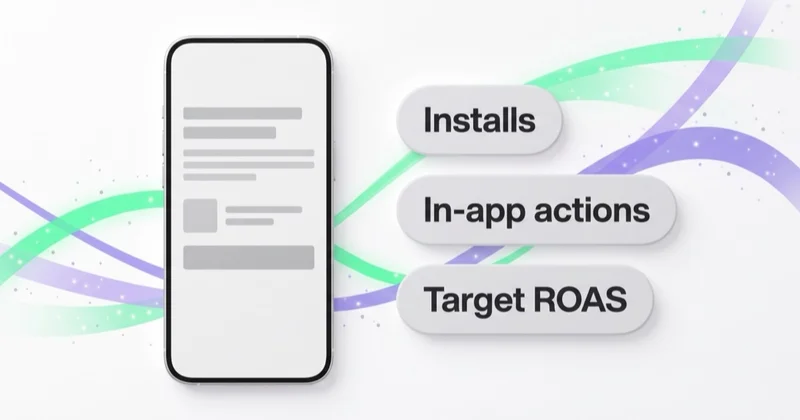
That design makes the objective choice important. App campaigns can support installs, engagement and pre-registration. For acquisition, the usual sequence is:
| Stage | Campaign emphasis | What it is for | Main risk |
|---|---|---|---|
| Cold start | Installs or maximize conversions for installs | Build volume and learn which markets and creative concepts can attract users | Optimising too long for installs with no quality filter |
| Early quality | In-app action bidding | Train toward registration, tutorial completion, trial start or first purchase | Choosing an event that fires too rarely |
| Mature value | Target ROAS or maximize conversion value | Optimise toward revenue or value-bearing events | Moving to value bidding before value data is stable |
Google's Target ROAS guidance for App campaigns is deliberately conservative: confirm that conversion pings are firing, use Firebase or Google Play codeless conversion sources where required, start with Maximize Conversions or Target CPA for a new app, and move to Target ROAS after stable volume, typically 30 or more conversions in 30 days. When migrating from Target CPA, Google also points to 3 to 4 weeks of historical conversion value data.
The practical implication is simple: do not ask the algorithm to optimise for revenue before the app produces enough revenue signal. Start with the densest useful event, then move down the funnel as volume supports it. The same logic applies to Performance Max: automated campaigns need clean objectives more than manual interference.
Asset coverage matters as much as bidding. Google can use text, images, videos, app-store assets and HTML5 where relevant. Weak creative coverage restricts where ads can serve and limits what the system can test. For mobile games, that means gameplay-first video, short hooks, store-aligned visuals, portrait and landscape variants, and enough concept diversity to avoid learning from one narrow idea.
Meta app promotion: consolidate, then feed the machine
Meta app promotion campaigns use the app, event signal, budget, placements and creative assets to find people likely to install or take in-app actions. Advantage+ App Campaigns reduce manual setup by automating more of the targeting, placement and creative optimisation that older structures handled through many ad sets.
That does not mean the campaign can be left alone. The account still needs a clean structure:
- Separate iOS and Android in planning and reporting, because attribution and optimisation constraints differ by operating system.
- Keep acquisition separate from re-engagement where the audience, event and expected economics differ.
- Avoid unnecessary fragmentation by country, language or audience when it starves campaigns of learning volume.
- Align the optimisation event with the current data stage: installs first when there is no post-install volume, then activation or purchase once events are dense enough.
- Feed enough creative concepts for the system to find new pockets of demand.
The temptation is to compensate for automation with more targeting layers. In app UA that usually makes the signal thinner. Better work is to improve the app event, clean up attribution, test stronger creative concepts and evaluate cohorts by value rather than campaign-reported CPI.
If the team already runs e-commerce on Meta, the mechanics will feel familiar to Advantage+ Shopping, but the economics are different. App campaigns do not end at purchase on a website. They have to connect install cost to retention, monetisation and lifetime value.
The measurement layer: MMP, SKAN, AdAttributionKit and Play Install Referrer
Measurement is the foundation of app UA. Without a reliable attribution layer, Google, Meta, the app store and the product analytics stack can each report a different version of the same install. A mobile measurement partner such as AppsFlyer, Adjust, Branch or Singular is commonly used to deduplicate installs, manage network integrations, support SKAN reporting and reconcile channel data with product events.
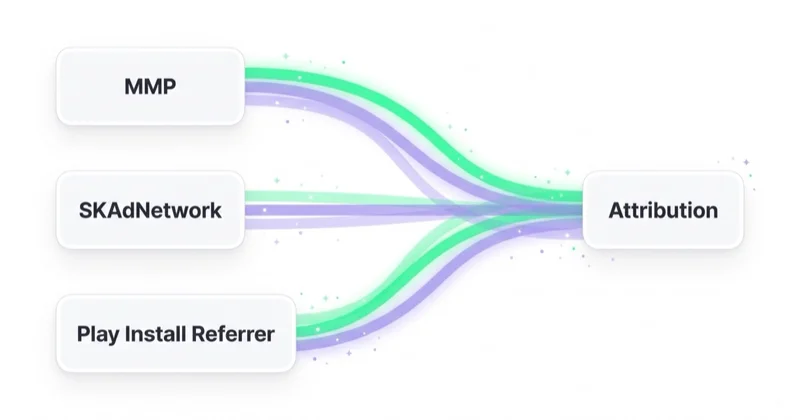
The core concepts:
- App event taxonomy: the agreed list of in-app events, parameters and revenue values used by ad platforms and analytics.
- Mobile measurement partner: the attribution layer that receives app SDK events, works with ad networks and helps deduplicate channel claims.
- SKAdNetwork: Apple's privacy-preserving install attribution framework for iOS campaigns.
- AdAttributionKit: Apple's newer attribution framework that builds on SKAdNetwork, supports multiple ad formats and can measure installs and re-engagement while limiting data in postbacks.
- Conversion-value schema: the mapping from early in-app behaviour to values Apple can send back in postbacks when privacy thresholds allow it.
- Google Play Install Referrer: the Android API that can retrieve referral content from Google Play, including the referrer URL, click timestamp, install timestamp and app version at first install.
Apple's own documentation is clear about the trade-off. AdAttributionKit can attribute installs without tracking individual users across apps, supports click-through and view-through attribution, and can send postbacks within 24 to 48 hours after launch. Some fields, including conversion values, are conditional and may be null when privacy thresholds are not met. Apple also states that AdAttributionKit does not require the AppTrackingTransparency prompt by itself, but any separate tracking or access to the advertising identifier still requires permission.
For marketers, that means two things. First, iOS reporting has to be read in cohorts and windows, not minute-by-minute dashboards. Second, the conversion-value schema has to encode the early behaviours that actually predict value. "Every event we can think of" is not a strategy. The schema should prioritise events that answer decisions: did the user finish onboarding, reach a meaningful game milestone, start a trial, purchase, subscribe or generate early revenue?
Creative testing is the remaining performance lever
When campaign controls are automated, creative becomes the main variable the team still controls at speed. The strongest UA teams do not treat creative as a quarterly asset drop. They run a testing system.
That system starts with concepts, not variants. A resized video, a different end card and a new colour grade are not three strategic tests. Stronger tests compare distinct reasons to install: gameplay loop, problem-solution, progress fantasy, social proof, competition, speed of reward, character, offer, seasonal moment or product utility. Once a concept works, then variants are worth producing.
For mobile games, the creative should show the real game loop quickly. Misleading gameplay can produce cheap installs and weak retention, which damages the payback model. For utility and subscription apps, the creative should make the outcome specific enough to attract the right user, then align with the app-store page so the click-to-install transition does not break intent.
A practical cadence:
- Maintain a backlog of concepts, not only finished assets.
- Launch enough new concepts every week to avoid relying on one winner.
- Separate concept tests from production polish tests.
- Track creative by concept, hook, format, operating system, market and monetisation outcome.
- Retire fatigued winners, but preserve the learning so the next batch is not a reset.
This is close to the logic behind dynamic creative on Facebook and Instagram: supply useful components, let the platform test combinations, then turn the observed winners into the next creative brief.
Events and metrics that actually guide decisions
App UA reporting should move from activity to economics as quickly as the data allows.
| Metric | What it tells you | How to use it |
|---|---|---|
| CPI | Cost to acquire an install | Diagnose channel and creative efficiency, but never judge alone |
| First open rate | Whether installs turn into app launches | Detect store, tracking or install-quality problems |
| Activation event | Whether users reach the first meaningful milestone | Choose better optimisation events than install alone |
| D1/D7 retention | Whether users come back | Separate low-quality installs from users with real intent |
| Trial start or first purchase | Whether value begins | Move bidding closer to monetisation |
| D7/D30 ROAS | Early payback curve | Decide whether to scale, hold or cut spend |
| LTV by cohort | Long-term value | Set allowable CPI or CPA by market, OS and creative concept |
The most common measurement failure is judging app campaigns on a blended CPI target. That target hides the real questions: which market produces retained users, which operating system pays back, which creative concept attracts purchasers instead of installers, and which event is dense enough to optimise against without drifting away from value.
Budgeting and learning: give algorithms stable inputs
App campaigns do not respond well to constant resets. Google's Target ROAS guidance recommends evaluating trends over a 14 to 30 day window, allowing for conversion lag, avoiding major changes more than once every 1 to 2 weeks, and keeping target adjustments within a measured range rather than forcing large swings.
The operating principle is broader than Google. If a campaign changes budget, event, geography, creative mix and target at the same time, the team learns almost nothing. A better launch plan isolates decisions:
- Start with the most important operating-system and geography splits.
- Use an event that has enough volume to train.
- Hold budgets and targets steady long enough to read cohort behaviour.
- Add creative concepts before adding campaign fragments.
- Move the optimisation event closer to revenue only when the event is frequent and stable.
- Read scale decisions against payback, not only platform-reported efficiency.
This is where app UA becomes more financial than tactical. The campaign manager should know the allowable CPI or CPA by market, operating system and monetisation model. Without that, even a "good" campaign can scale unprofitable users.
How Space Ads approaches app UA
At Space Ads, app UA sits inside performance strategy, not as a generic traffic service. We focus on the part that decides whether spend can scale responsibly: Google App campaigns, Meta app promotion, event laddering, creative testing and measurement reconciliation.
The working model is deliberately narrow:
- Define the commercial target: payback window, revenue event, subscription economics or game monetisation curve.
- Audit the event setup before campaigns are judged.
- Separate iOS and Android reporting because the attribution environments are different.
- Build a creative testing cadence around concepts and in-app value, not only polished assets.
- Reconcile channel numbers with the measurement layer and product data.
- Move from install volume to event and value bidding only when the data supports it.
There is a boundary. Hardcore ad monetisation, waterfall setup, mediation bidding and in-game ad-inventory optimisation are separate specialisms. Paid acquisition can drive users into that economy, but it should not pretend to replace the monetisation work itself. For Google and Meta acquisition, the starting point is Google Ads management and Meta Ads management.
A practical 90-day operating plan
| Phase | What to do | What to avoid |
|---|---|---|
| Days 1-15 | Audit SDKs, MMP, Firebase or app events, SKAN settings and revenue parameters | Launching campaigns before post-install events are reliable |
| Days 16-30 | Launch by OS and priority markets with install or early event optimisation | Splitting into too many small campaigns |
| Days 31-60 | Graduate to activation, trial, purchase or other dense value-proxy events | Jumping to Target ROAS before conversion value is stable |
| Days 61-90 | Expand winning geographies, creative concepts and value bidding where supported | Scaling based on CPI without retention or payback |
The plan is not about waiting three months to make decisions. It is about sequencing decisions so each one has evidence behind it. In a mature account, this cycle compresses. In a new app, skipping it usually creates a reporting system that looks busy and teaches very little.
FAQ
What is mobile game advertising?
Mobile game advertising is paid user acquisition for games, usually through channels such as Google App campaigns, Meta app promotion, TikTok, ad networks and cross-promotion. The goal is not just installs. The goal is users who retain, spend, subscribe, generate ad revenue or contribute to the game's monetisation model.
What are Google App campaigns?
Google App campaigns are automated campaigns for promoting apps across Google properties such as Search, Google Play, YouTube, Discover and the Google Display Network. The advertiser provides campaign settings and assets, while Google tests combinations and optimises toward the chosen objective.
What is Meta Advantage+ App Campaigns?
Meta Advantage+ App Campaigns are Meta's more automated app-promotion setup. They reduce manual audience and placement work, using the app, event, budget and creative assets to optimise delivery. The strategic work remains in event selection, OS planning, creative testing and measurement.
Do I need an MMP for app user acquisition?
For meaningful spend, usually yes. An MMP helps reconcile installs and events across networks, app stores and analytics tools. Without that layer, each platform can claim credit differently, making it hard to judge which campaigns produce retained and paying users.
How do SKAdNetwork and AdAttributionKit affect iOS campaigns?
They make iOS attribution more aggregated, delayed and conditional than Android or web attribution. Marketers have to read postbacks in reporting windows, design conversion-value schemas around early value indicators and accept that some fields may be null when privacy thresholds are not met.
What is a good CPI for a mobile game?
There is no universal CPI. A useful CPI depends on platform, country, genre, monetisation model, retention and payback. A higher CPI can be profitable when D7 or D30 revenue supports it, while a low CPI can be wasteful if users do not return.
When should an app campaign move to Target ROAS?
Only when revenue or conversion value is reliable enough for the campaign to learn. Google's guidance for App campaigns points to stable volume, typically 30 or more conversions in 30 days, and historical conversion value data when migrating from Target CPA. Moving earlier often reduces learning quality.
In short
- App user acquisition is built around post-install value, not clicks.
- Google App campaigns need clean objectives, asset depth and enough conversion volume before value bidding.
- Meta app promotion needs strong app events, disciplined OS planning and a steady creative testing system.
- iOS attribution should be managed through SKAdNetwork and AdAttributionKit realities, not compared directly to web pixels.
- CPI is useful only when tied to retention, D7/D30 ROAS, LTV and payback.
Sources
- Google Ads Help - About App campaigns
- Google Ads Help - About bidding in App campaigns
- Google Ads Help - Set a recommended initial Target ROAS for your App campaigns
- Meta for Business - Advantage+ App Campaigns
- Apple Developer - Measuring ad performance with AdAttributionKit
- Android Developers - Google Play Install Referrer
Continue learning
- Performance Max campaigns: what to know and how to create them
- Meta Advantage+: what it is and how it works after the changes
- Dynamic creative on Facebook and Instagram
- Incrementality testing: geo experiments with Meta, Google and Meridian
- Managing Meta ads at scale: native tools vs an AI workspace
- Google Ads management and Meta Ads management
Continue reading

Gemini Ad Formats: When the Ad Is Generated, Not Written
Google is testing and announcing Gemini-powered ad experiences across AI Mode and Search. Learn what each format does, what remains uncertain and how to prepare data, content and measurement.

Google Ads Experiments: Testing That Produces a Decision
A useful Google Ads experiment starts with a decision, an effect worth detecting and enough statistical power. Learn how to choose the test, split, metric and interpretation.

Google Ads Account Suspended: Why It Happens and What to Do
A Google Ads suspension requires evidence, not panic. Learn how suspension differs from a hold or pause, what the strike system covers and how to diagnose and appeal safely.


































