Managing Facebook and Meta ads at scale means running paid campaigns across Facebook and Instagram — often for many accounts — without doing everything by hand inside Meta Ads Manager. The native panel is powerful and free, and it's where the spend actually lives. A Meta ads management tool sits on top of it for the work the panel isn't built for: operating several accounts to one standard, auditing continuously, reconciled reporting, and the newer layer of AI that reads accounts and proposes changes. After Advantage+ and Andromeda automated much of the delivery, the human job shifted from manual levers to judgement, signal quality and creative — which is exactly where good tooling now adds leverage.
TL;DR
- Meta Ads Manager runs the auction; management tools are the layer on top. The native panel is deep on one account; tools exist for cross-account scale and consistency.
- Advantage+ and Andromeda moved the levers. Manual bid and budget micro-management gave way to feeding the system clean signals and strong creative.
- Judge at the right altitude. Under Andromeda, per-ad CPA is misleading; performance is an ad-set/campaign-level question now.
- Creative is the main variable. With delivery automated, the creative volume and angle rotation you feed the system is the biggest lever left.
- Signal quality decides outcomes. Pixel, the Conversions API and clean event data shape what Advantage+ can learn.
- Scale is an operations problem. Many accounts need one standard, continuous auditing and reconciled reporting — the same pattern as any channel.
- AI workspaces are the new layer. Audit and act across Meta accounts through chat, with limits and an audit trail.
This post focuses on Meta. For the cross-platform picture, see the pillar on ad management software and the agency multi-account workflow.
A quick glossary
- Meta Ads Manager — Meta's native interface for creating and managing Facebook and Instagram campaigns. See what it is and how to use it.
- Advantage+ — Meta's automation suite (audiences, placements, and Advantage+ Shopping campaigns) that hands delivery decisions to the system. See how it works after the changes.
- Andromeda — Meta's machine-learning retrieval layer that selects which ads to show; it reshaped how budget distributes across ads. See the Andromeda guide.
- Conversions API (CAPI) — server-side event sending that improves signal quality beyond the browser pixel.
- Creative fatigue — declining performance as an audience sees the same creative too often; managed by angle rotation, not just frequency caps.
- Business Manager — Meta's account-and-asset organization layer, the equivalent backbone to Google's MCC for managing multiple accounts.
What the native panel does well — and where it stops
Meta Ads Manager is genuinely good at what it's for: building campaigns, configuring Advantage+, managing creative, and analyzing one account in depth. For a single brand run by one team, it's often all you need, and a management tool would be overhead.
Where it stops is the same place every native panel stops: it's built to manage one account deeply, not many accounts consistently. An agency running Facebook and Instagram for fifteen clients, or an in-house team running Meta alongside Google and TikTok, hits the same friction described in the ad management software pillar — the work grows faster than the hours, and consistency slips before strategy does. The case for a Meta ads management tool isn't that the panel is weak; it's that operating Meta at scale, or as one channel among several, is a different job.
How automation changed the Meta job: Advantage+ and Andromeda
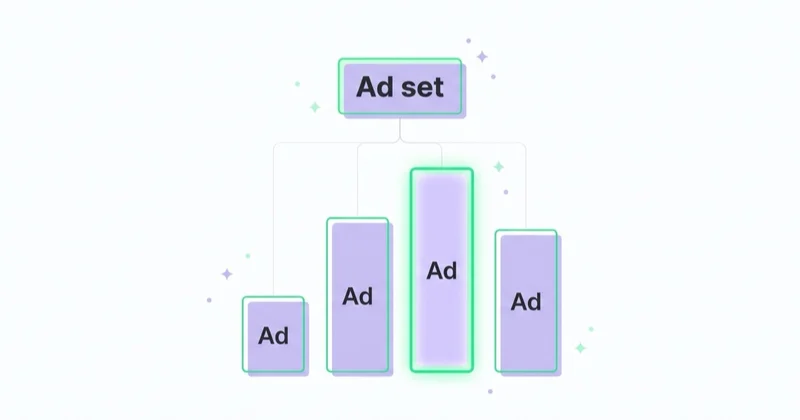
The biggest shift in managing Meta ads is that the manual levers mostly moved inside the system. Advantage+ automates audiences, placements and, in shopping campaigns, much of the structure. Andromeda — Meta's retrieval layer — decides which ads actually get shown, and it concentrates budget on what it predicts will perform.
Two practical consequences follow, and they matter more than any tool choice:
Judge at the right altitude. Under Andromeda, budget distribution across ads is deliberately uneven — one or two ads in an ad set often take the majority of spend. Evaluating an individual ad by its isolated CPA leads to wrong decisions; performance is an ad-set and campaign-level question now. Pausing the "expensive" ad frequently hurts the set.
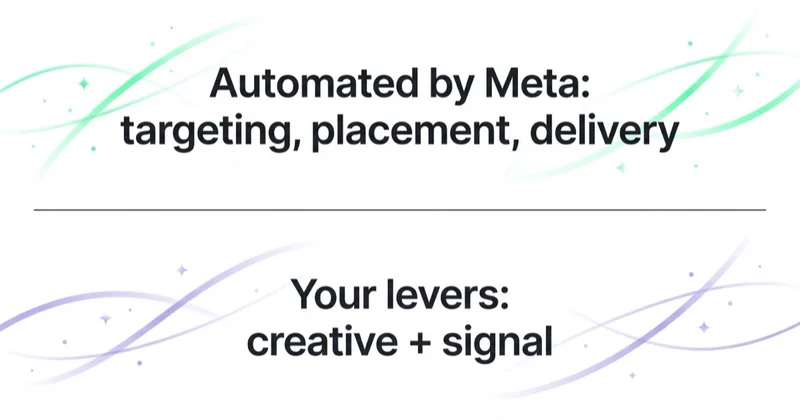
The levers that remain are creative and signal. With delivery automated, the things still firmly in your control are the creative you feed the system — volume, angles, formats — and the quality of the conversion signal via Pixel and CAPI. That's where management effort should concentrate, not on manual bid tweaks the system no longer wants.
| Before automation | After Advantage+ / Andromeda |
|---|---|
| Manual audience building | Feed signals; let the system find the audience |
| Per-ad CPA optimization | Judge at ad-set / campaign level |
| Manual bid and placement control | Clean value signals + creative volume |
| Creative as one input among many | Creative as the primary lever |
Managing Meta at scale: the operations layer
Once you're running Meta across many accounts, the management problems are the familiar ones, and the solutions mirror any channel:
- One standard across accounts — structure, naming, event setup and CAPI configured the same way everywhere.
- Continuous auditing — catching a broken pixel, a disapproved ad, or a creative that's fatigued before the client does. A periodic Facebook ads audit becomes a continuous one at scale.
- Reconciled reporting — Meta-reported ROAS reconciled against GA4, because platform-reported and business numbers diverge (see the reporting guide).
- Creative pipeline — enough new angles to keep the system fed, rotated before fatigue, tracked by what's actually working.
What we see managing Meta across a portfolio
Across the accounts we run — and roughly 500+ creative tests a month across the portfolio — the single most common mistake we see imported from the pre-automation era is fighting Andromeda's budget distribution. A specialist sees one ad taking 70% of the spend and three ads starved, assumes something's broken, and starts pausing or rebalancing by hand. Almost always that makes the ad set worse, because the uneven distribution was the system working as intended. The accounts that perform are the ones where the team accepts the altitude shift — judging at ad-set level, feeding creative volume, keeping the signal clean — and stops trying to micromanage levers Meta moved inside the box. The leverage now is creative and measurement discipline, not manual delivery control.
A 30-day plan to get Meta management under control
- Week 1 — fix the signal. Audit Pixel and Conversions API setup, event quality and deduplication. Everything Advantage+ does depends on this.
- Week 2 — fix the altitude. Review how performance is being judged. If decisions are being made on per-ad CPA, move them to ad-set/campaign level and document the rule.
- Week 3 — build the creative pipeline. Establish a cadence of new angles and a way to track which are working, so the system stays fed.
- Week 4 — scale the routine. For multiple accounts, put auditing and reconciled reporting on a fixed cadence so a broken pixel or fatigued creative gets caught everywhere, not just where someone looked.
Stop doing / do instead
| Stop doing | Do instead |
|---|---|
| Judging ads by isolated per-ad CPA | Evaluate at ad-set / campaign level under Andromeda |
| Rebalancing budget away from the "expensive" ad | Let the system distribute; feed it more creative |
| Treating the browser Pixel as enough | Add CAPI and deduplicate for signal quality |
| Manual audience micro-targeting | Feed clean signals; let Advantage+ find the audience |
| Checking accounts ad hoc | Continuous auditing across every account |
| Reporting Meta-claimed ROAS as truth | Reconcile against GA4; report the blended number |
Where Space Ads OS fits
Space Ads OS runs Meta alongside Google, TikTok and GA4 in one workspace, which matters because Meta is rarely the only channel a brand runs. Practically, the daily audit watches pixel and CAPI health, creative fatigue and disapprovals across every Meta account at once, and surfaces the exceptions instead of waiting for someone to open each Business Manager. Reporting comes out reconciled against GA4 — so the Meta-reported ROAS isn't taken at face value — and changes run through limits, a preview and a logged reason.
It's deliberately built so the team keeps the judgement that Meta's automation made more important, not less: which creative to push, where the signal is weak, what the altitude shift means for a given account. The system handles the tireless part — watching every account, every day. If Meta is one of several channels you run at scale, that's the gap it closes; you can see how it works here.
FAQ
What is a Meta ads management tool?
A Meta ads management tool is software that helps run Facebook and Instagram advertising on top of Meta Ads Manager, usually across multiple accounts. It connects through Meta's API to help with auditing, reporting, creative tracking and (in newer tools) proposing and applying changes. The native panel is deep on a single account; the tool's value is managing several accounts consistently, or Meta as one channel among several.
Is Meta Ads Manager enough on its own?
For a single brand managed by one team, Meta Ads Manager is often enough — it's powerful and free. The case for a management tool appears when you run Meta across many accounts, or alongside Google and TikTok, where operating one panel deeply doesn't address the cross-account consistency and reconciled reporting that scale requires.
How do you manage Facebook ads after Advantage+ and Andromeda?
The job shifted from manual levers to judgement and inputs. Because Andromeda distributes budget unevenly across ads by design, you judge performance at the ad-set and campaign level rather than per ad, and you concentrate effort on the two things still in your control: feeding clean conversion signals (Pixel plus Conversions API) and supplying enough fresh creative for the system to test.
Can Facebook ads be automated safely?
Much of Facebook delivery is already automated by Advantage+ and Andromeda. Third-party automation on top — rules or AI that change accounts — can be safe when it works within limits, previews each change, and keeps a log. As with any channel, the risk rises when automation can act across many accounts at once, so guardrails and a human approving consequential changes are essential.
Why don't Meta-reported conversions match GA4?
Meta attributes conversions on its own model and window, and only sees Meta touchpoints, so its reported numbers diverge from a neutral source like GA4 — often substantially. This isn't a fault to hide; it's why reporting should reconcile against GA4 and lead with the blended, business-mapped number rather than Meta's self-reported ROAS.
What's the biggest mistake managing Meta ads at scale?
The most common one is importing pre-automation habits — especially fighting Andromeda's uneven budget distribution by rebalancing away from the ad taking most of the spend. That usually hurts the ad set. The second is neglecting signal quality: without solid Pixel and CAPI setup, Advantage+ has poor data to learn from, and no amount of management fixes that.
In short
- Meta Ads Manager runs the auction; management tools add cross-account scale, auditing and reconciled reporting.
- Advantage+ and Andromeda moved the levers — judge at ad-set level, not per ad.
- Creative volume and signal quality (Pixel + CAPI) are the main levers left to the manager.
- At scale, Meta is an operations problem: one standard, continuous auditing, reconciled reporting.
- The biggest mistake is fighting the system's budget distribution by hand.
- AI workspaces add the tireless coverage; the judgement automation made more important stays with the team.
Sources and further reading
- Meta Business Help — About Ads Manager
- Meta Business Help — About Advantage+ shopping campaigns
- Meta for Developers — Conversions API
- Space Ads — Meta Andromeda: what it is and how to adapt
- Space Ads — Ad management software in 2026
Continue learning
Continue reading
Scaling Meta Ads Without Killing ROAS
Scaling Meta ads is a commercial decision, not a promise to preserve the same ROAS at a higher spend. Learn how to set a profitable ceiling, diagnose constraints and increase budget through controlled tests.
Meta Advantage+ vs Manual Campaigns: When to Trust the Automation
Meta Advantage+ can automate audience expansion, placements and budget allocation, while manual settings preserve selected controls. This guide explains what each label actually means and how to test the right configuration for a business goal.
Facebook, Instagram & TikTok Ads for Fashion Brands: Creative, Catalogs and Targeting
Use this as a paid-social operating map for apparel and footwear, not a channel overview. It shows how catalogue quality, platform-specific creative, creator-style ads, retargeting and return-adjusted measurement fit together when Meta and TikTok do most of the targeting for you.