Property developer marketing coordinates demand for a defined scheme or portfolio with changing availability, prices, construction milestones and sales capacity. Off-plan campaigns add another responsibility: visuals, specifications, completion expectations and "from" prices must accurately represent what a buyer can obtain, with material qualifications presented clearly.

The plan is not simply a funnel designed to generate as many leads as possible. It must support fair access to housing, comply with local property and advertising rules, keep inventory information current and connect media to reservations, contracts and completions. This guide is a strategic framework, not legal or financial advice; requirements vary by country and project.
TL;DR
- Start with the inventory and sales plan. Map unit type, release phase, current availability, price, margin, audience eligibility and sales capacity.
- Check housing-ad and property rules by market. Targeting, lead questions, price claims, deposits and off-plan promotion may be restricted.
- Pre-launch registration is optional. Use it only when promotion is permitted, the value exchange is clear and the team can communicate what registration does—and does not—provide.
- Choose channels from demand evidence. Search, property portals, partnerships, social, video, email and offline media can play different roles.
- Qualify consistently and lawfully. Ask only what advances the buyer's request; do not use protected characteristics or proxies to restrict access.
- Keep claims synchronised with reality. Availability, prices, incentives, specifications, imagery and timelines need owners and review dates.
- Measure the full sales path. Enquiry, contact, viewing, reservation, exchange or contract, cancellation and completion all matter.
Why a development is a different marketing problem
Finite inventory changes the campaign as units are released, reserved, returned or sold. Demand for a studio does not automatically transfer to a family home, and a blended cost per lead can hide an oversupplied unit type. Marketing therefore needs a live inventory view and a feedback loop with sales rather than a fixed creative plan that runs until completion.
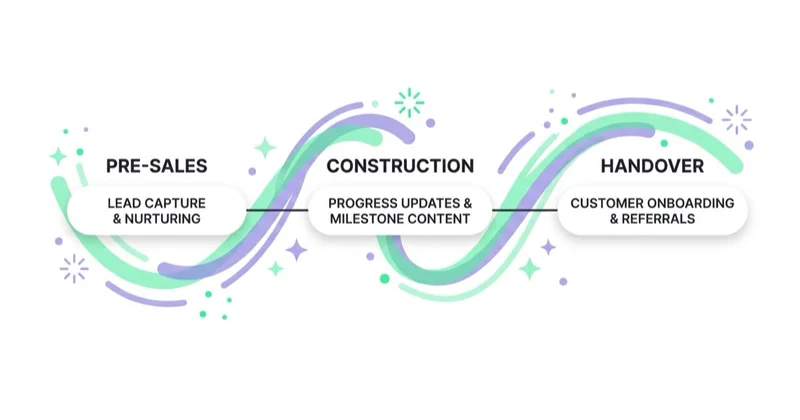
The commercial goal also has several dimensions: sales velocity, achieved price, incentive cost, cancellation risk, cash timing and margin. "Sell out quickly" is not always optimal if discounts destroy value, while a high lead volume is not useful if it overwhelms the sales team or targets unavailable stock. The model differs from an agent's service acquisition, discussed in estate agent marketing, although developers and agents can share channels and sales processes.
Decide whether a pre-launch phase has a clear job
A pre-launch phase can test proposition, gather permitted registrations and prepare sales operations before a wider release. It is useful only when the project can be promoted lawfully, the launch timetable is credible and the team has meaningful information to send. A registration should not be described as a reservation, guaranteed allocation or "priority access" unless that is genuinely how the process works.
Define the pre-launch value exchange in plain language: what information the person will receive, when, whether units or prices are confirmed, and how to withdraw from marketing. Keep speculative imagery clearly identified and qualifications adjacent to the claim they modify. In the UK, for example, CAP guidance says an off-plan image that includes optional upgrades can be used in defined circumstances only when the "from" price and a prominent adjacent qualification explain the extra cost. Other markets have their own rules.
Measure pre-launch registrations by valid consent, reachable contact, stated interest and later progression—not by list size alone. For general launch planning, see the 90-day product launch framework.
The paid-media mix
Build the mix from where eligible buyers research and how the project is sold:
- Search can capture active location, development and unit-type demand. Search-term quality and sufficient local demand determine its role.
- Property portals and listing partners can provide comparison traffic and established category demand, subject to commercial terms and data access.
- Paid social and video can explain location, design and lifestyle, but housing-ad targeting rules may restrict audience selection.
- Display, video and Performance Max can extend reach where eligible, though channel-level transparency and lead quality need review.
- Email and CRM follow-up can support consented prospects with meaningful project updates, availability and viewing information.
Retargeting is not automatically required and may be restricted by platform policy, consent or local law. Housing campaigns in the US and Canada, for example, face audience restrictions on Google; Meta also applies special housing-ad controls in applicable markets. Avoid using age, gender, postcode, family status or indirect proxies to restrict an opportunity where prohibited. Platform settings do not replace fair-housing and anti-discrimination duties.
Glossary
- Off-plan — selling units before or during construction, from plans rather than finished properties.
- Pre-launch registration — a request to receive project information before general release; it is not automatically an allocation or reservation.
- Reservation — a project- and jurisdiction-specific stage that may involve a fee or deposit; it is not the same as exchange, contract or completion.
- Sales window — the defined period over which the development must sell.
- Long-cycle nurture — email/CRM communication sustaining interest over a months-long decision.
- Sales-accepted enquiry — a valid request that meets documented, lawful criteria and is ready for the agreed sales process.
Qualify consistently and follow up usefully
Start with information needed to answer the request: unit type, preferred contact route, intended timing or whether the person wants a viewing. Financial qualification should follow an approved, consistent process and should not be confused with ad targeting. Questions, routing and sales prioritisation must comply with applicable housing, consumer, privacy and anti-discrimination requirements.
Follow-up should help the person make a considered decision: accurate availability, floor plans, specification, total price and charges, viewing options, construction updates and material changes. Scarcity, incentives and deadlines must be genuine and current. Separate the service communication needed to answer an enquiry from optional ongoing marketing, and honour channel preferences and withdrawal.
In the CRM, preserve campaign and creative source without allowing it to determine access to stock. Track response time, viewing, unit interest, reservation, contract or exchange, cancellation reason and completion. Report by release phase and unit type so the team can shift spend toward actual inventory needs.
How Space Ads approaches developer marketing
We begin with the project truth sheet: released units, prices and mandatory charges, approved visuals, specification, completion assumptions, incentives, reservation process, sales capacity, claim owners and expiry dates. The media plan can then reflect live stock rather than a generic development message.
Channels are assigned a job and a measurement level. CRM stages are agreed with sales, test leads validate routing, and inventory changes trigger creative and landing-page review. If customer data or downstream conversions are shared with an ad platform, the team documents the collection source, disclosure, consent where required, uploader and retention under the platform's customer-data policy. This lives in performance marketing and a broader marketing audit.
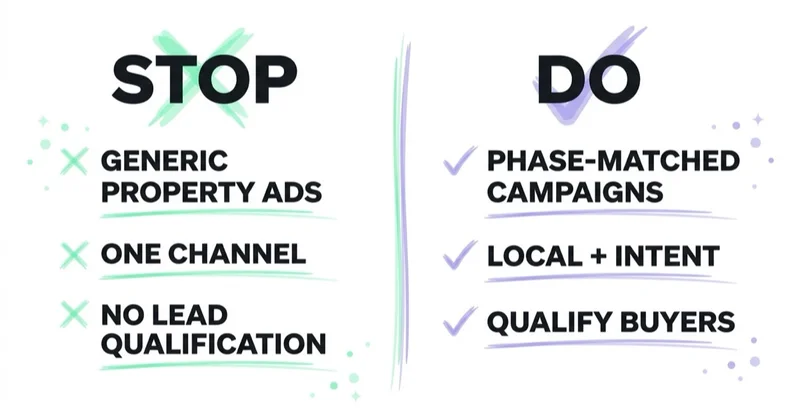
Stop doing / Do instead
| Stop doing | Do instead |
|---|---|
| Launching claims before project approval | Create an approved truth sheet with owners and expiry dates |
| Calling registration "priority" without a real process | Explain exactly what registration provides |
| Using demographic proxies to narrow housing access | Apply lawful, consistent audience and qualification rules |
| Leaving sold units and old prices in ads | Synchronise media, site, portals and CRM with current inventory |
| Measuring only leads or reservations | Track contract, cancellation, completion, achieved price and margin |
| Uploading buyer data by default | Meet platform policy, privacy law and consent requirements first |
FAQ
How is property developer marketing different from estate agent marketing?
A developer usually markets a defined scheme or release with changing inventory, construction and price information, while an agent may market vendor acquisition, individual listings or the development on the owner's behalf. The roles can overlap, but development marketing needs particularly close coordination between approved claims, live stock, release phases and the sales process.
How do you market an off-plan development?
Confirm that off-plan promotion is permitted and approve the project facts, imagery, pricing qualifications and reservation language. A transparent registration phase can then gather consented interest where useful. Choose search, portals, social, video, email and offline channels from local demand and policy. Keep availability current and measure progression through viewing, reservation, contract and completion.
Why is a pre-launch registration list important?
It can provide early demand evidence, test messaging and create a permissioned audience for approved launch information. It is not mandatory and a large list does not guarantee sales. The form must explain what registration provides, and any claims about priority, scarcity, prices or launch dates must be accurate.
How should developer marketing be measured?
Track valid enquiries, contact, viewings, reservations, contracts or exchange, cancellations and completions by unit type and release phase. Add achieved price, incentive cost, sales velocity and contribution. Attribution is useful for operations but does not prove causality; use experiments where feasible. Share customer or conversion data with platforms only after satisfying policy and legal requirements.
Which channels work best for selling a development?
There is no universal best mix. Search may capture active demand; property portals provide category browsing; social and video can introduce the scheme; partnerships, email and offline media may matter in a local market. Housing-ad rules can restrict targeting and retargeting. Allocate budget from demand evidence, lead progression, inventory need and incremental sales—not channel stereotypes.
Key takeaways
- Development marketing connects live inventory, approved claims, release phases, media and sales capacity.
- Pre-launch registration is useful only with a lawful promotion, clear value exchange and accurate language.
- Housing and privacy rules shape targeting, lead questions, CRM use and downstream data sharing.
- Keep prices, incentives, imagery, availability and timelines synchronised across every channel.
- Measure the journey through completion, cancellations, achieved price and margin—not leads alone.
Sources and further reading
- Google Ads Policy — Personalised advertising restrictions for housing
- Meta — Ads fairness and housing audience controls
- UK ASA/CAP — Advertising new-build and off-plan homes
- Google Ads Help — Customer data policies
Continue learning
Continue reading

Marketing for Financial Services: Compliant Campaigns in a Restricted Category
Financial-services campaigns must satisfy the law in each target market and a separate set of platform rules. This guide explains Google's July 2026 EEA verification expansion, approval workflows, disclosures, measurement and the controls needed to scale without treating compliance as a final check.

Consumer Lending and BNPL Marketing: Rules and Channels
Consumer lending and BNPL marketing requires clear information about the obligation, costs and terms. Campaigns should be judged by originated-loan quality — not application volume.

Wealth Management and Investment Firm Marketing
Investment firm marketing requires clear communication of risk, costs and past performance. Success is a client who fits the service and retains assets — not simply a lead or account opening.