Real estate agent marketing is not one campaign for "more leads." A buyer inquiry, tenant inquiry, seller valuation request, landlord lead, investor inquiry and commercial property lead have different economics. A buyer lead can create showings and pipeline. A seller lead can become a listing, which can then create inventory, portal visibility, buyer demand and commission potential. Treating every inquiry as the same conversion usually pushes budget toward the easiest form rather than the business outcome the brokerage actually needs.
A more useful real estate marketing system separates buyer demand from seller acquisition, uses portals without making them the only source, builds owned visibility through Google, Meta, SEO and CRM, and measures each source through listing appointments, signed agreements, closings and commission value.
This guide focuses on real estate agents and brokerages. Developer marketing is a separate model because inventory, financing, reservations and project-stage demand behave differently.
TL;DR
- Buyer and seller leads are different funnels. Buyer inquiries may be more numerous; seller inquiries can be strategically important because they may become listings. The relative value depends on the brokerage model and close rates.
- CPL is not the main metric. Better metrics are cost per valuation, listing appointment, signed listing agreement, closing and commission value.
- Search exposes explicit queries. Terms such as "real estate agent [city]," "sell my house [area]" and valuation searches can reveal a specific need, although the lead still requires qualification.
- Meta can support seller discovery and education. Valuation guides, local market updates and seller checklists give people a more useful reason to engage than an unsubstantiated "top agent" claim.
- Housing-ad compliance matters. Meta and Google restrict some housing-related targeting and require advertisers to comply with non-discrimination rules and local law.
- CRM response quality is part of marketing. Lead source, contact attempt, appointment, listing agreement, offer, closing and commission should all be tracked.
Why real estate marketing is difficult
Real estate is high-value but low-frequency. Most people buy, sell or rent property only occasionally, so the marketing system has to build trust before the moment of intent and respond quickly when that intent appears.
There are three main difficulties.
First, buyer and seller demand are asymmetric. Buyer inquiries can be easier to generate, especially around attractive listings. Seller inquiries are harder because the owner must trust an agent with a high-value asset, pricing advice, negotiation and process control.
Second, portals can dominate the buyer journey. They are useful for listing exposure, but they also control ranking, package pricing and the buyer relationship. A brokerage that depends only on portals has less control over pipeline resilience.
Third, downstream lead quality is difficult to evaluate without CRM data. A form submission can be a casual showing request, a seller valuation, a duplicate portal lead, an out-of-market inquiry, an investor, a landlord or the start of an exclusive listing. The advertising platform will not see later appointments, agreements and closings unless those outcomes are measured and, where appropriate, sent back in a permitted form.
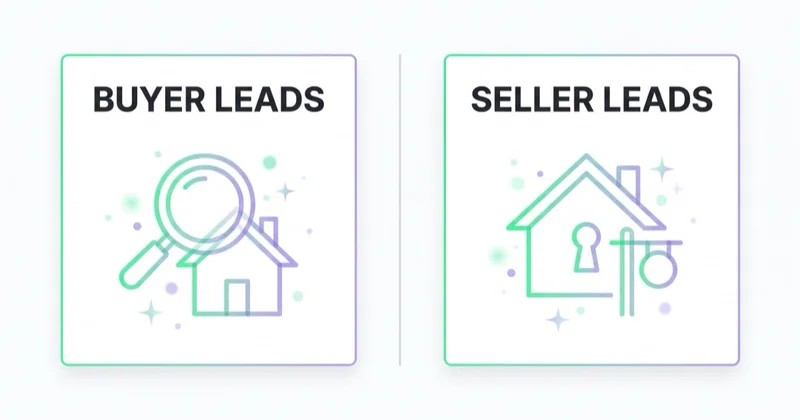
Buyer leads vs seller leads
The budget should start with the business objective.
| Area | Buyer leads | Seller leads |
|---|---|---|
| Main intent | specific property, neighborhood, homes for sale | valuation, selling process, agent comparison |
| Potential value | showing, buyer representation, database growth | listing appointment, signed listing, inventory and commission potential |
| Volume pattern | may be higher around attractive inventory | may be lower because the trust and timing threshold is higher |
| Follow-up | fast routing, property fit, financing readiness | trust, valuation, local proof, appointment setting |
| Main risk | many contacts for the same property and low readiness | longer trust cycle and more comparison |
| Better metric | qualified showing, buyer agreement, closing | valuation, listing appointment, signed agreement, closing |
Both can matter. Buyer campaigns can help move inventory and build a database. Seller campaigns can build future inventory and local authority. The mistake is letting one lead type dominate reporting simply because its form is easier to generate. Budget should follow qualified appointments, agreements and closings, with buyer and seller economics reported separately.
Channel roles: Google, Meta, portals, SEO and CRM
Each channel should have a specific job.
| Channel | Best role | Main risk |
|---|---|---|
| Google Search | explicit seller, local agent, valuation and brand queries | broad housing queries and unqualified information searches |
| Local Services Ads | eligible real estate service demand in supported markets | availability, verification, profile quality and lead handling constraints |
| Meta Ads | seller education, valuation offers, local market content, retargeting where compliant | weak qualification and housing targeting constraints |
| Portals | listing exposure and buyer inquiries | dependency on platform pricing and duplicate buyer leads |
| Google Business Profile | local trust, reviews, Maps visibility | incomplete data and weak review response |
| SEO and content | durable local authority and seller education | thin neighborhood pages and generic advice |
| CRM and email | nurturing owners, buyers, investors and past clients | no status discipline or source attribution |
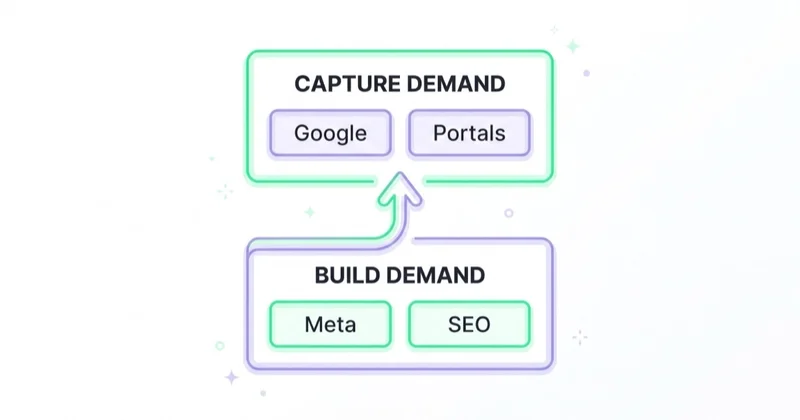
A healthy system can use portals for listing exposure, Google for explicit queries, Meta for discovery and education, SEO for durable local visibility, and CRM for permission-based nurture, repeat and referral activity. The mix should reflect the brokerage's market, inventory and measured close rates.
Google Ads for real estate agents
Google Search should be structured by intent. A person searching for "homes for sale [area]" is not the same as a person searching for "sell my house [area]" or "real estate agent near me."
Useful campaign themes include:
- seller and valuation intent: sell my house, home valuation, property valuation, listing agent, selling apartment or house by area;
- local agent intent: real estate agent [city], real estate broker [neighborhood], listing agent [area];
- property type: apartments, houses, land, commercial, luxury, rentals, investment property;
- buyer intent: homes for sale, condos for sale, open houses, neighborhood-specific inventory;
- brand and reputation: brokerage name, agent name, reviews, phone number;
- landlord and rental management: only where the business offers those services.
Search traffic should land on pages that match the intent. A seller valuation query needs a seller page, valuation process and local proof. A buyer property query needs inventory, showing request path and financing or readiness qualification. A luxury listing campaign needs different proof than a rental inquiry.
The negative keyword process is important because real estate queries attract taxes, templates, legal questions, jobs, courses, property management support, landlord tenant disputes, DIY sale advice and general market research. Some of those topics are useful for SEO, but they may be too broad for paid Search.
Meta Ads and housing-ad compliance
Meta can be useful for seller education, valuation lead magnets, neighborhood updates, open house promotion, permission-based database growth and agent reputation. Creative grounded in specific, supportable local knowledge is generally more useful than broad superiority claims.
Useful angles include:
- neighborhood market update;
- seller preparation checklist;
- pricing mistakes owners make before listing;
- valuation consultation or estimate request;
- guide to preparing a property for sale;
- case-style explanation of marketing process;
- open house or listing creative;
- agent introduction and local proof.
Housing-related ads need compliance review. Meta's campaign-creation guidance requires advertisers to choose the applicable Special Ad Category for ads related to housing, employment or financial products and services. The options and delivery restrictions should be checked in the current account and target market rather than copied from an old regional checklist. Google restricts the use of age, gender, parental or marital status and ZIP-code targeting for housing ads in the United States and Canada. Its policy explicitly includes real estate agents, brokers and services that enable the sale or rental of homes.
In practice, safer campaign design relies on the offer, content, permitted geography, query context, landing-page quality and CRM response instead of excluding people based on protected or sensitive characteristics. US Department of Housing and Urban Development guidance makes clear that fair-housing risk can arise from targeting inputs, ad delivery, creative and the destination page. Copy, images, forms and follow-up should therefore avoid expressing a preference, limitation or exclusion based on protected characteristics.
Portals and owned pipeline
Portals can be valuable because many buyers start with inventory search. They are not a full marketing strategy by themselves.
Portal strengths:
- immediate exposure for listings;
- high buyer traffic;
- property-level inquiry flow;
- visibility in competitive neighborhoods.
Portal risks:
- pricing and package dependency;
- duplicate or low-readiness buyer leads;
- limited ownership of the relationship;
- weaker seller acquisition unless supported by the agent's own brand;
- reporting that stops before appointment or closing quality.
Owned pipeline assets are different: website, SEO, Google Ads account, Meta account, email database, CRM, local content, reviews, referrals and remarketing where allowed. The more those assets grow, the less fragile the business becomes when portal pricing or visibility changes.
Seller lead generation
Seller campaigns often need strong trust signals because an owner is not just asking for a brochure. They are evaluating whether the agent can price, present, negotiate and manage a major transaction.
A seller lead page should include:
- local market experience;
- valuation process;
- steps from preparation to closing;
- example marketing plan;
- property types and neighborhoods served;
- reviews and proof;
- agent credentials and brokerage details;
- commission or fee explanation where appropriate;
- what happens after the valuation request;
- form fields that qualify property type, location, timeline and motivation.
Meta lead forms can work when the form helps route the inquiry and the follow-up process is reliable. Short forms reduce friction but may provide too little context; additional questions can improve routing but may also suppress valid inquiries. Test the trade-off using appointment and listing outcomes rather than assuming that form length determines quality. Collect only data needed for the stated next step, provide appropriate privacy and consent information, and move sensitive transaction details to a suitable workflow. Facebook lead ads should be judged by appointment and listing outcomes, not by form cost alone.
Google Business Profile and local SEO
Local visibility supports both paid and organic conversion. Google describes local ranking as based mainly on relevance, distance and prominence. For real estate agents and brokerages, the profile should help both search engines and prospects understand the business.
Key elements:
- correct business category and service area;
- accurate phone number and website;
- current hours;
- real office or service-area setup that follows platform rules;
- photos of team, office, listings and local presence;
- review generation and response process;
- services and specialties where available;
- consistent name, address and phone details across the web.
SEO should answer questions owners and buyers ask before contacting an agent:
- home valuation in a city or neighborhood;
- how to sell a house locally;
- commission and agency agreement explanations;
- neighborhood market pages;
- property preparation checklist;
- selling inherited property or downsizing guidance where appropriate;
- buyer guides by area and property type;
- local market updates based on real data and clear methodology.
Thin neighborhood pages with only swapped location names are weak. Better pages explain property types, transport, amenities, pricing context, days-on-market patterns, local constraints and common owner questions using attributable, current data. In markets governed by fair-housing rules, wording, imagery and any discussion of local services or schools should be reviewed to avoid steering or implying who belongs in an area.
Landing pages for buyers and sellers
Buyer pages and seller pages need different conversion paths.
Seller pages should focus on:
- valuation or consultation;
- agent process;
- proof of local experience;
- property preparation;
- marketing plan;
- commission transparency;
- CRM follow-up expectations.
Buyer pages should focus on:
- relevant inventory;
- showing request path;
- financing readiness or mortgage partner handoff where appropriate;
- neighborhood fit;
- saved search or alert signup;
- agent availability;
- next-step clarity.
The landing page guide covers the general principles. In real estate, separating the conversion path by lead type is a sensible early test when buyer and seller inquiries currently share one generic page.
CRM measurement: from lead to commission
Real estate PPC cannot be managed well if every form is the same conversion. The CRM should send quality stages back into reporting.
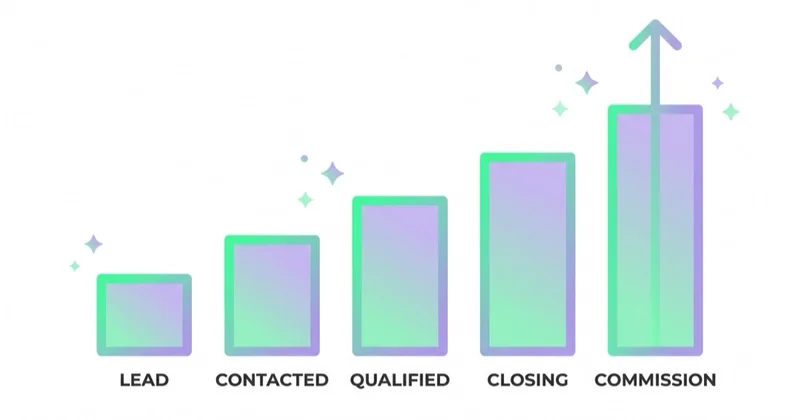
Useful stages:
- New lead.
- Contacted.
- Qualified buyer, seller, landlord or tenant.
- Appointment booked.
- Valuation completed or showing completed.
- Listing agreement signed or buyer agreement signed.
- Listing published or property search active.
- Offer, reservation or negotiation.
- Closing.
- Gross commission income or value proxy.
Google Ads offline conversion imports can connect later offline outcomes back to the click or call that started the path, where the advertiser has an appropriate legal basis, consent where required and a permitted configuration. This matters because a seller lead may take weeks or months to become a listing, and a buyer may close after multiple touchpoints. Send only the minimum permitted identifiers and stage or value data; do not upload contracts, property documents, free-text notes or other unnecessary personal information.
Call tracking is useful when phone calls drive appointments. Reports should separate branded and non-branded demand, buyer and seller intent, portal and owned sources, and first-time versus repeat or referral contacts.
Sphere of influence and referrals
Paid media should not replace relationship marketing. In real estate, past clients, local partners, mortgage professionals, attorneys, accountants, builders, investors and neighborhood contacts may produce high-trust opportunities.
The marketing system should support sphere of influence through:
- CRM segmentation;
- market updates;
- home-value check-ins;
- useful local content;
- review requests after successful transactions;
- referral partner nurture;
- permission-based past-client check-ins tied to relevant service milestones or stated preferences;
- open house and community invitations.
Paid campaigns can create new demand, but referrals and repeat business often close with less friction because trust already exists.
How a Space Ads engagement can be structured
A real estate acquisition engagement can start by separating buyer, seller, landlord, tenant, investor and commercial inquiries in campaign and CRM reporting. This makes it possible to see whether a source produced appointments, signed agreements, listings and closings instead of stopping at a blended cost per lead.
The work can start with the business objective: listings, buyer representation, rentals, commercial, premium property, investors or property management. Google Search, Meta, portals, SEO and CRM can then be mapped to distinct roles and stages. Platform-policy checks can form part of campaign work, while legal and fair-housing approval remains with the brokerage and its qualified advisers. The exact scope for landing pages, call tracking, CRM integration, offline conversion imports and lead routing should be agreed before implementation.
When a brokerage wants to know whether paid media is building listings or only filling the CRM with low-readiness inquiries, a marketing audit is the right entry point. Ongoing acquisition and measurement sit under performance marketing, with execution across Google Ads, Meta Ads, SEO and CRM.
30-day action plan
- Define growth priority: sellers, buyers, rentals, commercial, premium, investors or property management.
- Split campaigns, landing pages and conversion actions by lead type.
- Review housing-ad policy, Special Ad Category requirements and non-discrimination language.
- Build seller pages around valuation, process, local proof and appointment setting.
- Build buyer pages around inventory, showing requests and readiness qualification.
- Audit Google Business Profile, reviews, photos, categories and local consistency.
- Add negative keywords for jobs, courses, templates, broad legal/tax topics and unsupported locations.
- Connect CRM stages to campaign source, lead type and commission outcome.
- Separate portal, Google, Meta, organic, referral and database reporting.
- Hold weekly lead-quality reviews between marketing and agents.
Common mistakes
| Mistake | Better approach |
|---|---|
| Measuring only cost per lead | Measure valuation, appointment, agreement, closing and commission |
| Mixing buyers and sellers in one campaign | Separate intent, budget, page and CRM status |
| Relying only on portals | Build owned Google, Meta, SEO, CRM and referral assets |
| Generic "top agent" claims | Use local proof, process and relevant seller or buyer guidance |
| Ignoring housing ad rules | Review targeting, creative and landing pages for compliance |
| Weak CRM discipline | Track lead type, source, contact attempts, appointment and outcome |
| Thin local SEO pages | Build real neighborhood and seller guidance with local context |
| Slow follow-up | Route leads with clear ownership and response SLAs |
FAQ
What is real estate agent marketing?
Real estate agent marketing is the system used to generate and convert buyer, seller, landlord, tenant, investor or commercial property leads. It includes Google Ads, Meta Ads, portals, SEO, Google Business Profile, CRM, referrals, landing pages and reporting from lead to closing.
Should real estate agents focus on buyer or seller leads?
Most agents need both, but the business objective should be explicit. Buyer leads support showings and database growth. Seller leads can become listings, which create inventory, visibility and commission control. Campaigns should separate the two rather than optimizing to one blended lead cost.
Are Meta ads useful for real estate lead generation?
They can be useful for seller education, valuation requests, local market updates, listing promotion and permission-based database growth. Results depend on the offer, market, creative, form and follow-up. Housing-ad rules must be followed, including the applicable Special Ad Category and non-discriminatory targeting, creative and landing pages.
Are property portals enough for real estate marketing?
Portals are useful for listing exposure and buyer demand, but they are not a complete strategy. Owned assets such as the website, CRM, reviews, SEO, advertising accounts and referral relationships create more control over measurement, audience relationships and pipeline development.
What should a seller landing page include?
A seller page should explain valuation, local expertise, process, marketing plan, commission or fee expectations where appropriate, proof, reviews, neighborhoods served and the next step after the form. It should qualify property type, location and timeline.
How should real estate marketing be measured?
The strongest reporting tracks lead type, contacted status, appointment, valuation, signed agreement, listing, offer, closing and commission value. Cost per lead is secondary because many leads never become transactions.
In short
Real estate agent marketing performs best when buyer leads, seller leads, portals, owned campaigns, local SEO and CRM are managed as distinct parts of one system. The goal is not the cheapest form. The goal is more qualified appointments, signed agreements, listings, closings and commission.
Search queries can reveal explicit intent. Meta can support discovery and education when used within housing-ad rules. Portals support inventory exposure. CRM shows which source creates real business. That feedback loop is what turns lead generation into pipeline.
Need help connecting media activity to appointments, agreements and closings? Explore the Space Ads lead generation service. Campaign, landing-page, tracking and CRM responsibilities are defined for each engagement; legal, licensing and fair-housing approval remains with the advertiser and its advisers.
Sources
- Google Ads Policy Help - Restricted targeting in personalized advertising
- Meta Transparency Center - Advertising Standards
- Meta Help Center - Create ad campaigns in Meta Ads Manager
- US Department of Housing and Urban Development - Guidance on advertising through digital platforms
- Google Business Profile Help - Improve local ranking on Google
- Google Ads Help - Offline conversion imports
- Google Local Services Help - Getting started with Local Services Ads
Continue learning
- Mortgage lead generation: Google and Meta for loan officers
- Facebook lead ads: what they are and how to launch instant forms
- Call tracking for PPC and lead generation
- Google Ads for local businesses, home services and contractors
- Negative keywords in Google Ads: cut wasted spend
- Google Ads Smart Bidding: tCPA, tROAS and Maximize Conversions
Continue reading

Language School Marketing: Two Businesses, One Building
Language schools often combine consumer enrolment and corporate training. Market them as separate buying journeys, then connect campaigns to attendance, enrolment, group contribution and continuation.

Driving School Marketing: Selling Instructor Hours, Not Courses
A practical system for growing a driving school around real instructor capacity: local demand, transparent lesson offers, compliant proof, responsive booking and completed-pupil value.

Bike Shop Marketing: The Workshop Pays the Rent
A practical marketing system for bike retailers and workshops: model capacity and contribution, capture local service demand, promote in-stock bikes, and turn first visits into lasting customer relationships.