Margin-based conversion value in Google Ads makes sense when gross revenue is not the value the business actually wants to maximise. If a store sends full order revenue into Google Ads, value-based bidding will optimise toward full order revenue. It will not automatically know that a $900 product has weak margin while a $250 product creates more profit.
This is one of the most important ecommerce measurement decisions because Shopping and Performance Max often rely on value-based bidding. If the conversion value is wrong, the campaign can look strong in the platform while shifting budget toward products that do not support profitable growth.
TL;DR
- Value-based bidding optimises toward the conversion value the store reports.
- If the value is gross revenue, Google Ads optimises toward gross revenue.
- For stores with different product margins, a better signal may be gross margin, estimated profit or value after discounts and returns.
- Not every store should start with margin value immediately. Purchase tracking, currency, order ID and product data need to be stable first.
- Margin-based value works best with custom labels, return adjustments and product segmentation.
- After changing conversion value, old revenue ROAS and new margin ROAS should not be compared without context.
Why gross revenue can be the wrong signal
Gross revenue is easy to pass: a customer buys for $500, so Google Ads receives $500. The problem starts when products have different margins, discounts, fulfilment costs, payment fees and return rates.

Example:
| Product | Price | Gross margin | Returns | What revenue bidding sees |
|---|---|---|---|---|
| Premium jacket | $900 | 25% | 30% | very high value |
| Accessory | $250 | 65% | 5% | lower value |
| Outlet product | $400 | 12% | 20% | mid-level value |
If the system only receives revenue, the jacket is the highest-value product. If the store looks at margin after returns, the accessory may be the better media decision.
What Google Ads does with conversion value
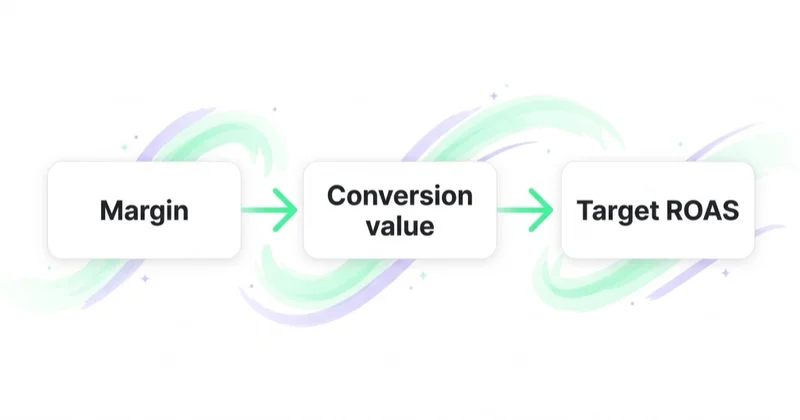
Google Ads supports transaction-specific conversion values, meaning different conversions can pass different values. With Maximize conversion value or Target ROAS, Google uses the reported value to set bids and seek higher-value conversions. Google also notes that the advertiser defines the value to maximise, such as sales revenue or profit margins.
That makes conversion value a strategic input, not only a tag parameter. The question is: what should the campaign consider more valuable?
Conversion value models
| Model | What Google Ads receives | When it fits | Risk |
|---|---|---|---|
| Gross revenue | full order value | simple store with similar margins | campaign scales revenue, not profit |
| Revenue after discounts | value after codes and promotions | promotion-heavy store | still ignores cost of goods |
| Gross margin | revenue minus product cost | store knows SKU-level cost | requires cost data quality |
| Value after returns | adjusted value after refunds | high-return categories | adjustments arrive with delay |
| Blended model | estimated margin plus labels and adjustments | larger catalogue with mixed economics | needs clear methodology |
The model does not need to be fully precise on day one. A reasonable margin estimate can be more useful than exact gross revenue if it better reflects product differences.
When margin-based value makes sense
Consider this model when:
- products have very different margins;
- some categories have high return rates;
- ROAS looks good but profit is weak;
- budget moves toward sale or outlet products;
- the store has cost data by SKU or category;
- Performance Max scales the wrong catalogue segment;
- the team wants campaigns to optimise toward profit, not revenue alone.
It is especially relevant for larger catalogues, fashion, footwear, beauty, electronics, home decor, seasonal products and categories with uneven profitability.
When not to start with margin value
Some stores need to fix measurement basics first:
- purchase value is not tracked correctly;
- currency is wrong or inconsistent;
- transactions are duplicated;
- order ID is missing;
- Merchant Center has disapproved products;
- product identifiers are unstable;
- cost data is incomplete or outdated;
- conversion volume is too low for a major value change.
In that case, start with correct revenue, margin labels and segment reporting. Move conversion value closer to margin after the data layer is trustworthy.
Implementation workflow
- Define the margin metric. Gross margin, margin after discount, contribution after shipping or another agreed measure.
- Choose the cost source. ERP, ecommerce platform, PIM, cost table or feed tool.
- Calculate order value. A cart may contain products with different margins.
- Pass the value to Google Ads. Use the tag, data layer, server-side setup or import process.
- Keep order ID. It supports return adjustments and duplicate control.
- Label products.
margin_high,margin_midandmargin_lowmake campaign reporting clearer. - Test in stages. Start with reporting, then selected campaigns, then wider bidding use.
Changing conversion value changes the meaning of ROAS. Revenue ROAS and margin ROAS are different metrics. Expect different target levels.
Margin and Target ROAS
If conversion value is revenue, a 500% Target ROAS means five dollars of revenue for one dollar of ad spend. If conversion value is margin, the same 500% means five dollars of margin for one dollar of ad spend. That is a very different profitability threshold.
After switching to margin value, targets need to be recalculated. A campaign may show lower nominal ROAS and still be healthier for the business. This is where teams need to stop comparing old and new dashboards without context.
How margin, labels and returns work together
The strongest setup usually has three layers:
| Layer | Function |
|---|---|
| Margin-based conversion value | gives bidding a better value signal |
| Custom labels | allow reporting and filtering by margin, season and risk |
| Conversion adjustments | update value after returns, cancellations and partial refunds |
These layers do not replace each other. Margin says what a product can earn. Labels help manage the catalogue. Adjustments update what happened after purchase.
How we approach it at Space Ads
At Space Ads, we start by checking what conversion value Google Ads receives and whether it matches what the business wants to scale. We analyse margin structure, returns, discounts, shipping costs, categories, bestsellers, outlet products and feed quality. Only then do we recommend margin value, blended value or a first step focused on reporting.
For ecommerce Google Ads management, this connects directly to custom labels in Google Shopping, returns and conversion adjustments, Performance Max vs Standard Shopping and the value model in Shopify Google Shopping and Performance Max for DTC. The goal is not a prettier report. It is budget moving toward products that fund growth.
Common mistakes
| Mistake | Result | Better decision |
|---|---|---|
| Sending revenue when margins vary widely | campaigns scale products that may not be profitable | margin value, labels or segmentation |
| Changing value across the whole account overnight | bidding receives a major signal shock | staged test and learning period |
| Keeping old ROAS targets | results are judged incorrectly | recalculate targets for the new value |
| Using outdated cost data | bidding optimises toward false margin | recurring cost updates |
| Ignoring returns | margin remains overstated | conversion adjustments or conservative value |
FAQ
Can Google Ads optimise toward margin?
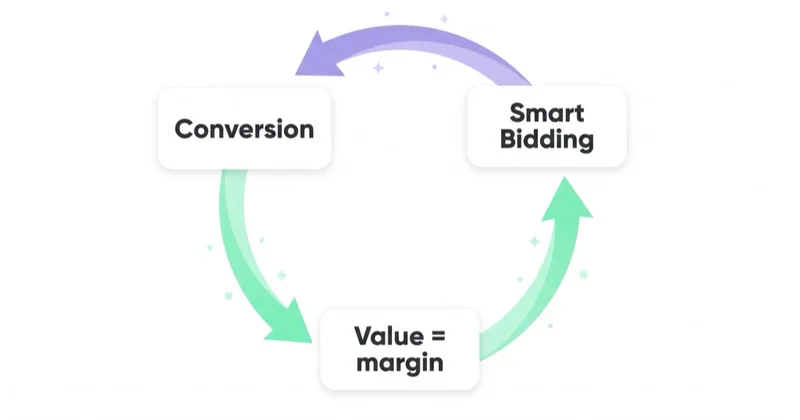
Yes, if margin or a value close to margin is passed as conversion value. Google Ads optimises toward the value it receives.
Should every product send exact margin?
It depends on data quality. If SKU-level cost is reliable, exact margin can work. If data is weaker, start with margin tiers or estimated values.
Does margin value replace return adjustments?
No. Margin describes product economics at purchase. Conversion adjustments update the order value when the order is returned or changed.
Will ROAS drop after switching to margin?
Nominally, often yes, because conversion value is lower than gross revenue. That does not automatically mean performance is worse. The metric now measures a different value.
Where should a small store start?
Start with correct revenue tracking, order ID and margin labels. Full margin-based value is worth implementing when cost data is reliable enough.
Key takeaway
Margin-based conversion value matters when gross revenue sends campaigns in the wrong direction. Google Ads does not know product economics unless the store passes them. A value closer to margin, supported by labels and return adjustments, helps Shopping and Performance Max optimise toward products that actually earn.
If campaigns generate revenue but not enough profit, our Google Ads team can connect conversion value, product feed and margin-based segmentation.
Sources and further reading
Continue reading

Returns and Conversion Adjustments in Google Ads for Ecommerce
Returns, cancellations and partial refunds change the real value of ecommerce orders after the purchase. If Google Ads only sees gross revenue from the conversion day, campaigns can optimise toward products that look efficient before returns but weak after them.

Free Shipping Strategy for Online Stores (Threshold, Margin, When)
Free shipping can improve the offer, but only when the additional contribution it generates exceeds the delivery subsidy. Learn how to choose a model, calculate a threshold and test the impact on profit rather than AOV alone.

Performance Max Campaigns: What to Know and How to Create Them
Performance Max is a goal-based Google Ads campaign type powered by Google AI, but its results depend on inputs: conversion quality, values, assets, feeds, landing pages and business rules. This guide explains when to use PMax, how to structure ecommerce and lead generation campaigns, and how to measure performance beyond one blended ROAS number.