Value-based bidding for lead generation changes the question an advertising platform is asked to solve. Instead of “Which clicks are most likely to produce a form submission?”, it asks “Which clicks are most likely to produce valuable business outcomes?”
That distinction matters. The easiest person to persuade to complete a form is not necessarily someone sales can qualify, serve or close. If the advertising account receives only form submissions, automated bidding cannot see the difference. It can reduce cost per lead while pipeline quality deteriorates.
Closing the loop from CRM gives the platform a later and more useful signal: qualified lead, accepted opportunity, signed contract or realised value. The technical connection is important, but the hardest decisions come first—choosing a reliable stage, defining value and preventing the same commercial outcome from being counted several times.
TL;DR
- Automated bidding optimises towards the primary conversion actions and values it receives. Cheap leads are a rational outcome when form fills are the only signal.
- Offline conversion measurement links later CRM outcomes to the original ad interaction using click identifiers and, for enhanced conversions for leads, consented first-party data.
- Choose one primary stage that predicts business value, occurs often enough and is recorded consistently. Keep other milestones secondary for observation unless the design explicitly prevents double counting.
- Use actual contribution where it is available promptly. Otherwise use a documented proxy based on historical stage-to-sale probability and expected value.
- Upload events regularly, deduplicate them and monitor match rate, delay and errors. A technically “running” integration can still deliver poor training data.
- Since 15 June 2026, the Data Manager API is the primary API for new Google Ads offline-conversion integrations. Existing allowlisted Google Ads API implementations can continue while migrating.
- Move from volume bidding to value bidding in stages. First stabilise the new conversion goal; then accumulate values; only then change the bidding strategy.
Why lead volume and business value diverge
Google Ads does not know your ideal customer profile, sales capacity or gross margin unless the measurement design expresses them. A lead form conversion says only that someone submitted the form.
Common examples of hidden variation include:
- an enterprise enquiry versus a very small account;
- a prospect inside versus outside the service area;
- a decision-maker versus a student doing research;
- an eligible applicant versus someone who cannot buy the product;
- a high-margin service versus a low-margin request;
- a duplicate, spam submission or existing customer support request.
If each event has the same conversion value, value-based bidding has no meaningful value differences to learn from. The account may report a strong cost per lead while sales rejects most of the volume. This is not primarily a bidding failure. It is a mismatch between the business objective and the conversion signal.
What value-based bidding means in Google Ads
Google defines value-based bidding as the use of Smart Bidding to maximise conversion value, either within a budget or against a target return on ad spend. In lead generation, the value can be an actual economic outcome or a proxy such as a lead score, provided that different leads genuinely receive different values.
This differs from conversion-volume strategies:
| Objective | What the system tries to maximise | Suitable when |
|---|---|---|
| Maximise conversions / Target CPA | Number of selected primary conversions | The conversions are sufficiently similar in business value |
| Maximise conversion value / Target ROAS | Sum of the values assigned to selected primary conversions | Values differ and represent the business objective reliably |
Target ROAS is not automatically more sophisticated or more profitable. It faithfully pursues the values supplied. If those values are arbitrary, duplicated or based on gross revenue when margins vary, automation scales the measurement error.
How the CRM loop works
A reliable implementation connects four layers:
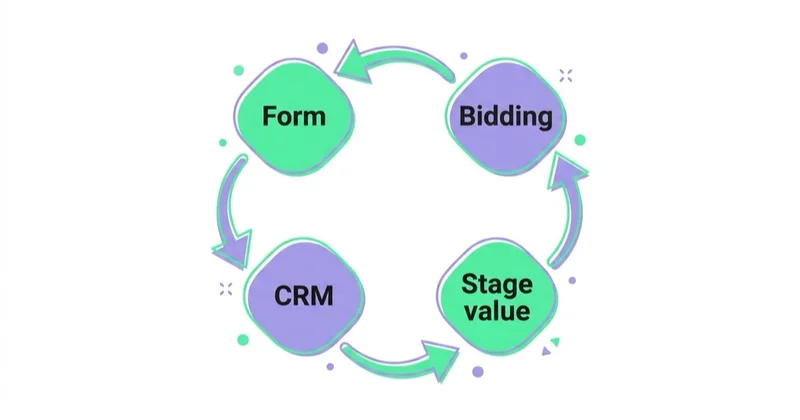
- Ad interaction: a visitor arrives with an eligible advertising identifier, such as GCLID, GBRAID or WBRAID.
- Lead capture: the identifier and permitted first-party information are stored with a unique lead ID.
- CRM outcome: sales records qualification, opportunity and revenue events using consistent stage definitions and timestamps.
- Platform import: an eligible downstream event is sent back with its conversion action, time, value, currency and identifiers.
Enhanced conversions for leads supplements offline measurement with hashed first-party information such as email, phone number or address. It does not make click identifiers irrelevant. Google recommends including GCLID whenever it is available, together with user-provided data, because the combination can improve matching and durability.
Use an order or event ID to control duplicates and to support later adjustments. Store the raw marketing identifier separately from changing CRM fields; otherwise a form rebuild, integration update or record merge can break attribution history.
Which CRM stage should be the primary conversion?
The best stage balances four properties:
- Relevance: it predicts revenue, contribution or another real business outcome.
- Volume: it happens often enough for evaluation and automated bidding.
- Speed: it is returned soon enough to influence decisions.
- Consistency: the organisation records it using one operational definition.
| Stage | Business relevance | Typical volume | Typical delay | Main risk |
|---|---|---|---|---|
| Form submitted | Low | High | Immediate | Optimises towards easy rather than valuable leads |
| Marketing-qualified lead | Moderate | Medium-high | Hours or days | Scoring may reward engagement rather than purchase fit |
| Sales-accepted or qualified lead | Good | Medium | Days | Depends on consistent sales review |
| Opportunity | Strong | Lower | Days or weeks | Pipeline definitions can vary by salesperson |
| Closed-won | Highest | Lowest | Weeks or months | Too sparse and delayed for some accounts |
Google recommends choosing a single stage in the lead-to-sale journey for value-based bid optimisation. If the final sale arrives too late, an earlier qualified-lead goal may be more usable.
The word “single” matters. Importing form, qualified lead, opportunity and sale as four primary actions can make one customer appear to be four independent successes. Keep diagnostic stages as secondary actions so they remain visible in “All conversions”, or design mutually exclusive conversion actions and values with care.
Do not promote a CRM stage to primary merely because it has enough volume. Audit a sample of records with sales. If “qualified” means “salesperson opened the record” in one team and “budget, authority, need and timing confirmed” in another, it is not a stable optimisation target.
How to assign lead values
There are three defensible levels of value maturity.
1. Actual contribution or customer value
Use realised or forecast contribution—not automatically contract value—when deal margins vary materially. For a subscription or repeat-purchase business, an approved customer-value model may be more useful than first-order revenue, provided its assumptions are monitored.
This is the closest signal to the business objective but often arrives late. It works best when deal volume is sufficient and sales outcomes return within the platform's usable conversion cycle.
2. Stage-weighted expected value
When a qualified stage arrives earlier, derive a proxy from historical cohorts:
Expected value of a qualified lead = probability of becoming a customer × expected contribution per customer
Suppose qualified leads in one service line close at 20%, and an average new customer generates £4,000 of expected contribution. A starting proxy is £800. If another segment closes at 8% with £2,000 contribution, its expected value is £160. Sending both as “1 lead” hides a fivefold difference.
Use cohorts mature enough to contain final outcomes. Recalculate on a defined schedule rather than reacting to every week of noise. Segment only where differences are material and sample sizes support them.
3. Evidence-based lead score
If revenue data is immature, use an operational score based on explicit fit and intent signals. Exclude sensitive attributes and variables that introduce unlawful discrimination. Back-test whether higher scores actually correspond to higher close rates or contribution.
A score that sales likes but that does not predict an outcome is not value. It is an opinion encoded as a number.
What not to include in a proxy model
Avoid signals that are unavailable at conversion time, reveal the future outcome, or merely repeat the platform's own delivery decision. These create leakage and misleading performance.
Also separate value from sales-team capacity. If a region temporarily cannot answer calls, fix routing or restrict spend operationally; do not permanently teach the model that otherwise good customers have low value.
Document:
- the business outcome the value approximates;
- source tables and cohort dates;
- included costs and time horizon;
- segment rules and fallbacks;
- owner and recalculation frequency;
- acceptable difference between predicted and realised value.
That documentation turns a clever spreadsheet into a governable measurement product.
The 2026 Data Manager API change
On 15 June 2026, the Google Ads API stopped accepting new adopters of offline conversion imports, including enhanced conversions for leads. Google made the Data Manager API the primary API for these use cases.
The change is more precise than “all uploads moved overnight”:
- developer tokens that had not adopted these imports—or had not uploaded offline conversions between December 2025 and May 2026—receive
CUSTOMER_NOT_ALLOWLISTED_FOR_THIS_FEATUREwhen they callConversionUploadService.UploadClickConversions; - previously active, allowlisted implementations can continue using the Google Ads API while they integrate with Data Manager API;
- new API integrations should use Data Manager API;
- UI uploads, Data Manager connections and supported CRM integrations may follow different implementation paths from a custom API build.
When migrating, note that Data Manager API has a different account model, error model and quota structure. In particular, its operating account must be the Google Ads conversion customer that owns the conversion action. Do not treat migration as a simple endpoint replacement; validate account ownership, destinations, consent fields, identifiers and diagnostics.
Implementation plan: from CRM audit to live bidding
Step 1: define the commercial outcome
Agree whether campaigns should maximise qualified pipeline, expected contribution, first-year contribution or another outcome. Give every selected CRM stage an unambiguous entry and exit rule.
Step 2: audit data quality before integration
Measure stage completion, duplicate records, invalid contact data, time-zone consistency, missing values and how often closed records are later reopened. Review whether the CRM value represents revenue, recurring contract value, margin or manual guesswork.
Step 3: design identity and consent
Capture eligible ad identifiers on the landing page and preserve them on the lead. Configure enhanced conversions for leads using customer data collected and processed in line with applicable law, platform terms and the user's consent choices. Hashing personal data is a security measure, not a replacement for a lawful basis or transparent notice.
Send only necessary fields. Do not place sensitive personal information in event names, order IDs, URLs or custom variables.
Step 4: create the downstream conversion action
Use a clear name such as “Sales-qualified lead” or “Closed customer”. Configure counting, attribution and value settings intentionally. Keep form submissions and intermediate milestones secondary while validating the new action.
Step 5: upload frequently and idempotently
Google recommends daily offline uploads. Send events when they become available rather than holding a weekly or monthly batch. Use stable event identifiers and idempotent processing so retries do not create duplicate conversions.
Google's current guidance recommends conversion delays shorter than seven days where possible. If no data arrives within seven days of a click—or the complete feed is delayed beyond that point—the initial value-bidding ramp-up can take much longer. This is a reason to select a reliable earlier stage, not to fabricate an early sale.
Step 6: validate before using the signal for bidding
Check:
- accepted, rejected and pending event counts;
- unmatched events and identifier coverage;
- median and percentile upload delay;
- duplicate and missing-value rates;
- values and currencies against CRM totals;
- conversion dates and time zones;
- sample records from click through CRM to import;
- whether consent choices are being respected.
A dashboard that says “integration successful” is insufficient if half the eligible leads never match or values are shifted into the wrong currency.
Step 7: transition the bidding objective safely
Google recommends moving to the desired conversion goal before moving to value bidding. A practical sequence is:
- import the new stage as secondary and validate it;
- make it the campaign's primary goal and initially optimise for its count;
- pass values consistently for at least three weeks or one to two conversion cycles, whichever is longer;
- switch to Maximise conversion value without an aggressive target;
- introduce a Target ROAS only after the value model and delivery stabilise.
Use campaign experiments where available and keep other major changes limited during the transition. A sudden switch of goal, value model, bid strategy, budget and landing page leaves no interpretable result.
Adjustments, cancellations and changed deal values
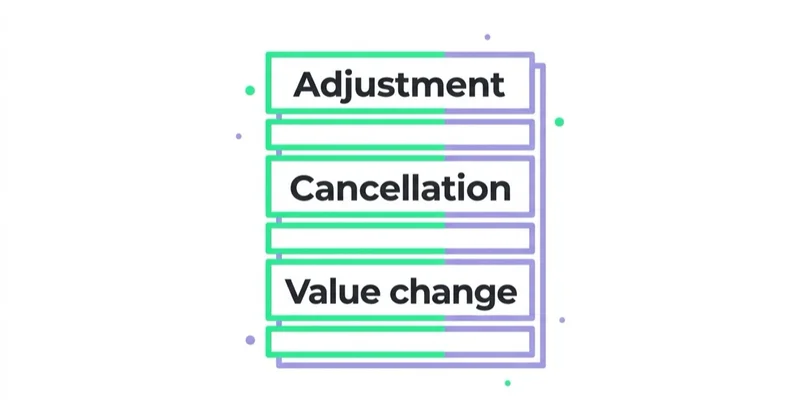
CRM outcomes can change. A deal may be cancelled, partially refunded or expanded. Google Ads conversion adjustments can restate a value or retract a conversion, subject to product and timing limits. Build adjustment logic alongside the initial import rather than treating the first upload as permanent truth.
Use the same order ID and conversion action conventions consistently. Test retractions carefully: platform rules may prevent later changes to a retracted conversion. Keep the CRM or warehouse as the commercial source of truth even when an old outcome can no longer be adjusted inside the ad platform.
Monitoring that prevents silent failure
The integration needs an owner and service-level expectations. Monitor daily:
- number and value of eligible CRM events;
- number accepted by the destination;
- match and error rates by identifier type;
- event delay;
- sudden shifts in stage mix or average value;
- the difference between platform-imported value and warehouse totals;
- schema, form and CRM-field changes.
Alert on absence as well as error. A renamed field may produce no events without generating an obvious campaign warning. Keep a runbook for credential expiry, API changes, consent-mode changes and backfills.
The Space Ads operating approach
For lead-generation accounts, we treat CRM feedback as part of campaign architecture rather than a reporting add-on:
- map the lead-to-revenue process with sales and finance;
- identify the earliest reliable stage connected to commercial value;
- audit identifiers, consent and CRM hygiene;
- build and reconcile the offline feed;
- validate the goal as secondary before exposing bidding to it;
- transition the primary goal and bidding strategy in controlled steps;
- review predicted versus realised value by mature cohort.
Where a company's process differs, the implementation should follow its actual sales cycle rather than forcing a generic MQL–SQL–opportunity template onto it. The objective is a signal that both sales and marketing recognise as economically meaningful.
Common mistakes
| Mistake | Better practice |
|---|---|
| Treat every form fill as equal | Return a reliable downstream stage and differentiated values |
| Import every funnel stage as primary | Choose one biddable stage; keep supporting events secondary |
| Use contract revenue where margins vary | Use expected contribution or another finance-approved value |
| Replace GCLID with email matching | Send click identifiers and permitted user-provided data together when available |
| Backfill a large history and immediately switch bidding | Establish a consistent live feed and transition goals in stages |
| Judge performance before cohorts mature | Compare mature lead and revenue cohorts with a clear data cutoff |
| Monitor only API errors | Reconcile event counts, values, match quality and delay |
| Let sales stages drift | Maintain definitions, ownership and CRM quality checks |
FAQ
What is value-based bidding for lead generation?
It is automated bidding that tries to maximise the values assigned to lead outcomes rather than simply their count. Values can represent actual economic results or validated proxies, but they must reflect meaningful differences between leads.
What is an offline conversion import?
It sends an outcome recorded outside the website—such as a qualified lead or closed deal—from the CRM or data warehouse back to the advertising platform and connects it to an eligible earlier ad interaction.
Do enhanced conversions for leads replace GCLID?
No. They supplement conversion matching with hashed, consented first-party customer data. Google recommends continuing to send GCLID whenever available, together with user-provided data, to maximise measurement coverage.
Which lead stage should Google Ads optimise towards?
Choose the earliest stage that strongly predicts business value, occurs with usable frequency and is applied consistently. Closed-won is ideal only when it produces sufficient, timely data. For many companies, a rigorously defined sales-qualified lead is more practical.
How many conversions does Target ROAS need?
Google's Search and Shopping guidance says Target ROAS should have at least 15 conversions in the previous 30 days at conversion-tracking level, but that is a minimum rather than a guarantee of stable performance. Value distribution, delay, campaign type and data quality also matter.
Can several CRM stages be imported?
Yes, and doing so is useful for diagnostics. Usually only one stage should be the primary bidding goal. Set the others to secondary unless the measurement design ensures that values are incremental and the same customer outcome is not counted repeatedly.
How long does the transition take?
At least the time required for the chosen sales stage to occur, return to Google and pass through a learning period. Google recommends supplying values for three weeks or one to two conversion cycles—whichever is longer—before activating value-based bidding. Long and irregular delays extend evaluation time.
Key takeaways
- Lead generation improves when the campaign objective reflects accepted business value, not just form volume.
- The CRM stage must be relevant, frequent, prompt and consistently recorded.
- Enhanced conversions for leads add first-party matching; they do not eliminate the value of click identifiers.
- One primary downstream stage avoids teaching the bidder to count one customer several times.
- A documented expected-value proxy can be more useful than sparse, months-late revenue.
- Data Manager API is the primary route for new custom integrations after the June 2026 Google Ads API restriction.
- Reconciliation, diagnostics and staged bidding migration are as important as the upload itself.
How Space Ads connects measurement, media and sales outcomes is described on our lead generation page. For the broader system around CRM ownership and follow-up, read CRM and marketing automation.
Sources and further reading
- About value-based bidding for Search and Shopping — Google Ads Help
- Configure enhanced conversions for leads — Google Ads Help
- Changes to offline click conversion import support — Google Ads Developer Blog
- Upgrade from Google Ads API to Data Manager API — Google for Developers
- How to adjust conversions — Google Ads Help
- Margin-based conversion value in Google Ads
Continue reading

The Webinar Funnel: From Ad to Sale
A webinar does not create pipeline because people registered. Learn how to design the offer, attendance, live experience, follow-up and measurement as one conversion system.
How to Choose a Lead Generation Agency (Questions to Ask, Red Flags)
A practical framework for comparing lead generation agencies: scope, measurement, pricing, account ownership, security, contracts and the questions worth asking before you sign.
Cost Per Lead (CPL): Benchmarks, What's 'Good', and How to Set Your Target
CPL is easy to calculate and easy to misuse. Learn how to compare valid benchmarks, separate media CPL from fully loaded CPQL, and derive an affordable target from your own unit economics.