A webinar funnel is not an advert, a form and a live presentation connected by email. It is one conversion system: the promise attracts a defined audience, the registration experience sets expectations, the reminder sequence protects attendance, the session creates understanding and trust, and the follow-up turns relevant intent into a useful next step.
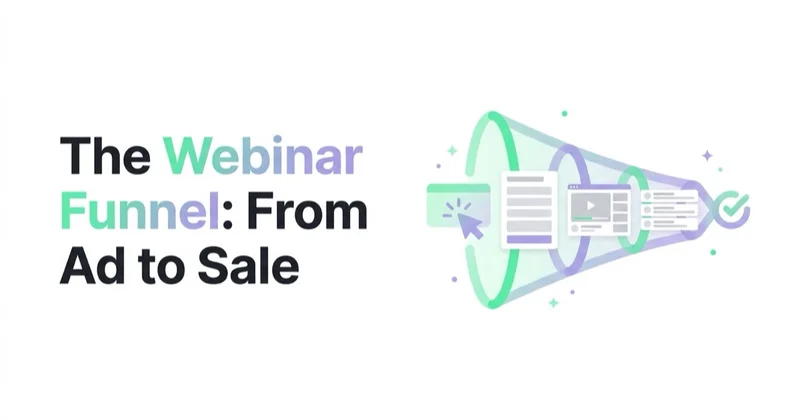
Most disappointing webinars are not simply “bad webinars”. They have a broken handoff. Marketing celebrates registrations that sales cannot qualify. The speaker delivers a valuable lecture with no commercial bridge. A replay is sent to everyone, but nobody can tell who watched it. The platform reports leads while the CRM contains no source or campaign data.
This guide shows how to plan the complete journey from ad to revenue without turning an educational event into a disguised sales pitch.
TL;DR
- Start with a specific audience, costly problem and useful outcome. “Join our webinar” is a format, not an offer.
- Design the funnel backwards from the next commercial step and the information sales needs to act on it.
- Registration cost is useful for diagnosing media and landing pages, but the business case depends on qualified attendance, pipeline and revenue.
- Attendance improves when the session is timely, the promise is accurate, calendar entry is easy and reminders deliver value—not when reminders merely become more frequent.
- The live session needs an early payoff, structured interaction, evidence and a clear transition from education to action.
- Segment follow-up by behaviour and fit: attended, highly engaged, left early, registered but absent, watched replay and requested contact.
- Treat the replay as a separate experience with editing, chapters, captions, transcript and its own conversion path.
- Obtain and record the permissions required for marketing communication. An event confirmation is not blanket consent for indefinite promotion.
The webinar funnel from ad to sale
| Stage | User decision | Primary diagnostic | Business risk |
|---|---|---|---|
| Ad or invitation | “Is this relevant to me?” | Qualified click or visit | Broad promise attracts the wrong audience |
| Registration page | “Is the value worth my details and time?” | Registration rate | Form friction or unclear outcome |
| Pre-event sequence | “Will I still prioritise this?” | Registration-to-attendance rate | Commitment fades or expectations drift |
| Live session | “Is this credible and useful?” | Qualified attendance and engagement | Content fails to deliver the promise |
| Offer or next step | “Is further action worthwhile?” | CTA response by fit segment | Abrupt or vague commercial transition |
| Follow-up | “Should I act now, later or not at all?” | Qualified conversation and opportunity rate | One generic sequence ignores intent |
| Sales process | “Can this provider solve my case?” | Opportunity, win rate and value | Context is lost at the handoff |
Each metric answers a different question. A low registration rate does not automatically mean the form is too long; the topic or audience may be wrong. Low attendance may reflect a distant event date or misleading promise. Strong attendance with weak pipeline may be perfectly acceptable for a customer-education programme—or a sign that a demand-generation event attracted learners rather than buyers.
Define the job before judging the funnel.
Step 1: choose a problem worth attending for
People do not reserve calendar time for broad subject areas. They reserve it for a result, decision or risk that feels current.
Weak: “The future of B2B marketing.”
Stronger: “How to replace form-fill reporting with qualified pipeline in Google Ads.”
The stronger proposition communicates:
- who should attend;
- the problem being solved;
- the practical outcome;
- the level of depth;
- why this session is credible now.
Topic selection should use sales-call questions, search demand, customer research, product adoption barriers and commercial priorities. Avoid selecting a topic solely because a speaker wants to discuss it.
Choose the audience narrowly enough to make the examples useful. A finance director and a paid-search specialist may share a business objective, but they need different language, evidence and next steps. If both must attend, explicitly design separate takeaways for each.
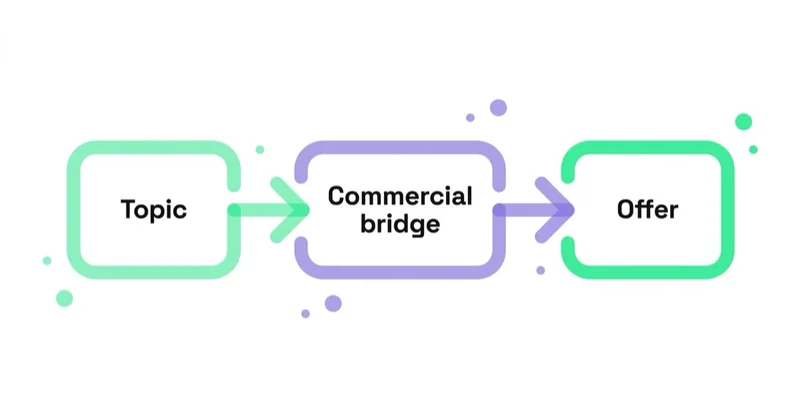
Step 2: define the commercial bridge before writing the deck
Work backwards from what a suitable attendee should do next. Possible steps include:
- request a diagnostic or audit;
- book a scoped consultation;
- start a trial or product assessment;
- receive a benchmark or implementation worksheet;
- ask for an account-specific review;
- join a nurture track for a future purchase window.
The next step should be a logical continuation of the webinar, not a sudden change of subject. If the session teaches how to audit measurement quality, an offer to review the attendee's measurement architecture is coherent. “Book a demo” without explaining what the conversation will resolve is not.
Agree with sales:
- what qualifies someone for direct outreach;
- which questions the form can reasonably ask;
- who owns each response segment;
- response-time expectations;
- what context appears on the CRM record;
- when a registrant belongs in nurture rather than sales.
This prevents the common post-event scramble in which every attendee is treated as a hot lead.
Step 3: build an ad that qualifies as well as attracts
The job of the ad is not to maximise curiosity at any cost. It should help the intended person recognise themselves and allow the wrong person to opt out.
Useful components include:
- a recognisable problem or decision;
- the audience or maturity level;
- two or three concrete learning outcomes;
- date, time, time zone and format for a live event;
- speaker credibility relevant to the topic;
- whether a recording will be available;
- a clear statement that registration is required.
Test distinct angles—not cosmetic rewrites of the same headline. One ad may lead with a costly problem, another with a framework, and another with an expert's evidence. Keep the registration page promise aligned with the winning angle so the visitor does not have to reinterpret the offer after clicking.
Channels should follow the audience. Search can capture explicit problem demand; LinkedIn can target professional context; customer email can activate known relationships; partner promotion can add trusted reach; Meta, YouTube and other channels may create or retarget consideration. The mix depends on the market and measurement—not on a universal “webinar channel”.
Step 4: make the registration page answer the decision
A high-quality registration page should make five things clear near the top:
- Who the webinar is for.
- What the attendee will be able to understand or do afterwards.
- When it happens and how long it lasts.
- Who is teaching and why their experience is relevant.
- What happens after registration, including replay availability where applicable.
Then support the decision with:
- agenda and concrete takeaways;
- examples of what is and is not covered;
- speaker evidence, not a generic biography;
- accessibility and caption information;
- privacy notice and communication choices;
- an appropriately short form;
- answers to practical objections in an FAQ.
Every extra field has a cost. Ask for information that changes routing, content or sales qualification. If company size will not affect the experience, collecting it may add friction without value. Progressive profiling or post-registration questions can capture more context later.
Do not preselect marketing consent or bundle it ambiguously with event access. Explain what registrants will receive as part of administering the webinar and provide the choices required for any broader promotional communication.
Step 5: engineer the registration-to-attendance journey
Registration is a future intention competing with a changing calendar. Protect it with useful, proportionate communication.
A practical live-event sequence can include:
- immediately: confirmation, calendar links, joining instructions and a concise promise recap;
- several days before: a useful preparatory resource or question that makes the session more relevant;
- one day before: time, time zone, agenda, accessibility and joining details;
- shortly before: direct join link and start time;
- at start, if appropriate: a final “we are live” message.
Cadence should reflect how far ahead people register. Someone registering 20 minutes before the event does not need five automated reminders. Use logic that suppresses obsolete messages and honours unsubscribes and consent choices.
Add-to-calendar links should contain the correct time zone, duration, join route and reminder. Test daylight-saving transitions and mobile calendar behaviour. A broken or generic calendar entry silently harms attendance.
Use the waiting period to deepen relevance, not repeat “don't forget”. Ask attendees to submit a question, choose a challenge in a one-click poll or bring a specific data point. The answers improve the session and reveal audience needs.
Live, on-demand or hybrid?
Live webinar
Best when real-time questions, discussion, demonstration or a scheduled decision point creates value. Live attendance adds urgency and gives speakers behavioural context. It also imposes time-zone and availability constraints.
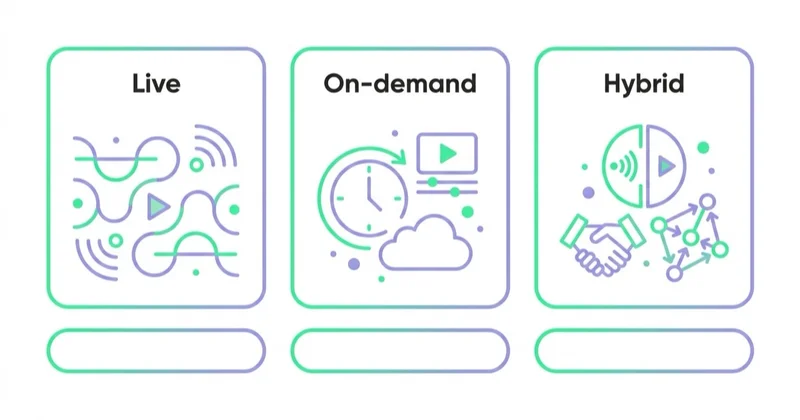
On-demand webinar
Best when the topic is evergreen, the audience spans time zones or a prospect needs education at their own pace. It removes the shared moment and live interaction but can be integrated into always-on acquisition.
Live followed by on-demand
Often the most useful design: the live event produces interaction and a launch moment; an edited replay serves non-attendees and future demand. The two experiences should not be identical by accident. Remove dead air and time-sensitive housekeeping from the replay, add chapters and provide a persistent CTA.
Evergreen does not mean permanent. Add a visible review date and update or retire recordings when products, regulations, prices or platform interfaces change.
Step 6: design a session that earns the next step
A practical structure is:
- Opening: restate the outcome, audience and agenda; explain how questions will work.
- Early payoff: deliver a useful insight or diagnosis quickly rather than spending ten minutes on biographies.
- Framework: give the audience a way to understand and organise the problem.
- Application: show examples, trade-offs, failure modes and decisions.
- Interaction: use questions, polls or scenarios where the response changes the discussion.
- Summary: consolidate the actions an attendee can take independently.
- Commercial bridge: explain who may need help, what the next step includes and who it is not for.
- Q&A and close: answer relevant questions and repeat how to access resources or follow up.
Education and conversion are not opposites. A useful session demonstrates competence and helps the audience diagnose whether they can solve the issue alone. The sales transition becomes credible when it offers implementation, customisation or risk reduction beyond what a general webinar can provide.
Do not manufacture urgency or pretend every attendee needs a call. A premium agency position is strengthened by qualification and restraint.
Accessibility is part of production quality
Plan accessibility before invitations go out. Depending on the audience, applicable standards and legal obligations, this can include:
- accurate live captions;
- keyboard-accessible registration and webinar controls;
- sufficient colour contrast and readable slides;
- verbal explanation of important charts and visual demonstrations;
- accessible copies of slides or resources;
- edited captions for the recording;
- transcript and chapter navigation;
- a route to request accommodations.
W3C guidance notes that automatic captions commonly require correction. Live and prerecorded video have different WCAG considerations. Accessibility should be assessed for the organisation and jurisdiction rather than reduced to switching on automatic transcription.
Step 7: follow up by behaviour, fit and declared intent
Prepare follow-up before the event so relevant messages can be sent promptly. Do not equate speed with sending a hard sales pitch to everyone.
Attended and requested contact
Route immediately with the session context, submitted question, company details and requested next step. Confirm the request and set a clear expectation for response.
Attended and highly engaged
Send the promised resources, a concise summary and the relevant next step. Sales outreach is appropriate when the attendee meets agreed qualification rules—not merely because they stayed until the end.
Attended but left early
Offer the replay at the point they missed, key takeaways and a low-friction way to ask a question. Early departure can mean a poor content match, a schedule conflict or a technical issue; it is not a reliable lack-of-interest signal on its own.
Registered but absent
Lead with the recording, summary and resources. Give them a way to indicate whether the topic remains relevant. Avoid copy that shames them for missing the event.
Watched the replay
Use watch and CTA behaviour only where measurement and privacy choices permit it. A replay viewer who reaches the relevant section or requests a resource may deserve different nurture from someone who never starts the video.
Not commercially ready
Offer genuinely useful related content and a controllable subscription preference. Suppress sales sequences where fit or timing is wrong.
Event emails and marketing permission are not identical
Confirmation, join details and material service updates may be necessary to deliver the event someone requested. Promotional follow-up is a separate purpose and can be subject to electronic marketing rules.
Requirements differ by jurisdiction, recipient and relationship. For example, UK ICO guidance explains that electronic mail marketing to individuals generally requires consent or a qualifying existing-customer “soft opt-in”, while rules for corporate subscribers differ. Sole traders and some partnerships are treated like individuals. Identity must not be concealed, and marketing messages need a valid opt-out route.
Use qualified legal advice for the markets in scope. Operationally, store consent source, wording, timestamp and channel; synchronise suppression lists; and make unsubscribe choices apply across webinar and CRM tools. This article is not legal advice.
Step 8: connect engagement with CRM and revenue
Create one event and field map before launch:
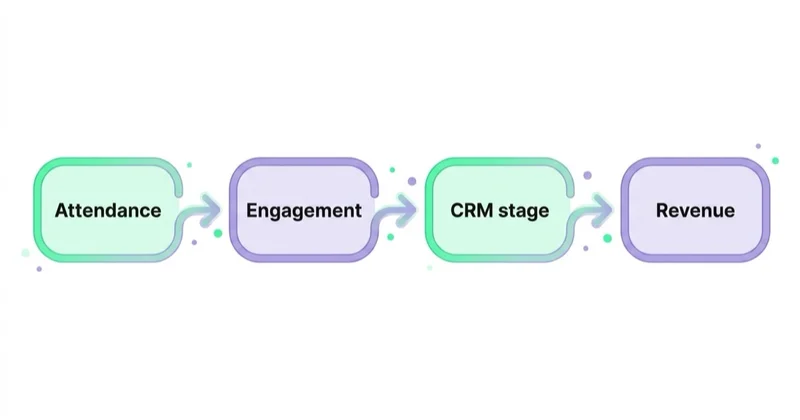
- campaign, source, medium and creative;
- registration ID and contact ID;
- registration timestamp;
- live attendance, join and leave times;
- poll, question and CTA actions;
- replay access and meaningful engagement, where permitted;
- qualification status and owner;
- meeting, opportunity, value and outcome;
- consent and communication preferences.
Avoid treating watch duration as lead score without validation. Someone can leave a webinar running in another tab. Combine behaviour with declared need, account fit and sales evidence.
Import qualified or revenue outcomes back to eligible advertising platforms when the sales cycle and privacy basis support it. Our guide to value-based bidding and offline conversion import explains the measurement architecture.
Metrics for each layer of the funnel
Acquisition
- qualified reach and click-through rate;
- landing-page view cost;
- registration rate and cost per registration;
- registration quality by source and creative.
Attendance and content
- show-up rate by registration lead time and source;
- live attendance count and qualified-attendee rate;
- join-time and watch-duration distribution;
- drop-off by content section;
- questions, polls and CTA response;
- technical failure rate.
Follow-up and sales
- replay start and meaningful-watch rate;
- response and booked-conversation rate by segment;
- sales-accepted lead rate;
- opportunity rate, pipeline value and win rate;
- contribution or revenue by mature registration cohort;
- cost per qualified conversation, opportunity and customer;
Cost per registration is not a vanity metric when used to diagnose media efficiency. It becomes misleading when treated as the final business result. A narrower promise may increase registration cost while improving attendance, qualification and customer acquisition economics.
Analyse cohorts only after enough time for the sales cycle to mature. A webinar held last week and one held three months ago do not have equal opportunity to produce revenue.
How Space Ads approaches webinar funnels
Our operating framework treats media, automation and sales feedback as one system:
- research the audience problem and define the webinar's job;
- agree qualification and the next step with sales;
- map acquisition, event and CRM data before launch;
- build aligned ads, landing page and pre-event sequence;
- prepare behaviour-based follow-up and routing in advance;
- quality-assure tracking, consent, calendars and accessibility;
- optimise against qualified downstream outcomes, not registration volume alone;
- turn strong live content into an edited, maintained on-demand asset.
This framework is adapted to the organisation's sales cycle, technology and legal requirements. It avoids promising a universal benchmark where audience, price point and event purpose differ.
Common mistakes
| Mistake | Better practice |
|---|---|
| Choose a broad topic to maximise registrations | Solve a specific problem for a defined audience |
| Write the deck before defining the next step | Design backwards from audience outcome and sales handoff |
| Ask for every CRM field on the form | Collect only data that changes the experience or routing |
| Send reminders that add no value | Reinforce the promise, calendar and preparation |
| Begin with a long company introduction | Deliver an early payoff and establish relevance quickly |
| Treat every attendee as sales-ready | Segment by fit, behaviour and explicit intent |
| Upload the raw live recording | Edit, chapter, caption and maintain a replay experience |
| Bundle event access with indefinite marketing | Separate purposes and record valid communication choices |
| Report only registration cost | Connect cohorts to qualified pipeline, customers and value |
FAQ
What is a webinar funnel?
It is the connected journey from promotion and registration through attendance or replay, engagement, follow-up, sales qualification and revenue. The systems and handoffs between those stages determine whether the webinar creates commercial value.
What is a good webinar attendance rate?
There is no reliable universal number. Attendance varies with audience, topic, registration lead time, time zone, brand relationship and whether replay availability reduces urgency. Compare like-for-like cohorts and diagnose changes by source and days between registration and event.
How can a business increase webinar attendance?
Improve the relevance and accuracy of the promise, reduce unnecessary delay, make calendar entry reliable and send useful reminders at decision moments. Segment reminder logic by registration time and verify time zones and join links.
Should a webinar be live or on demand?
Choose live when interaction and a shared moment add value; choose on demand for evergreen, time-zone-independent education. Many programmes benefit from a live event followed by a separately edited replay.
How quickly should webinar follow-up be sent?
Send promised resources and requested contact promptly, often the same day. The sequence should already be prepared, but its content and timing should vary by attendance, engagement, qualification and communication permission.
Should sales contact everyone who attended?
No. Attendance signals topic interest, not necessarily purchase intent. Direct outreach should follow agreed fit and intent criteria. Other attendees belong in a useful nurture path or receive only the materials they requested.
How should webinar ROI be calculated?
Compare the complete programme cost—including media, production, speakers, technology and sales effort—with attributable or incremental contribution from sufficiently mature cohorts. Track intermediate economics such as cost per qualified attendee, opportunity and customer to locate where value is created or lost.
Key takeaways
- A webinar funnel succeeds through aligned handoffs, not registration volume alone.
- The topic, audience and commercial next step should be defined before creative production.
- Attendance communication must protect the commitment and respect consent choices.
- The session should deliver independent value and make the next step a logical continuation.
- Behaviour-based follow-up is more useful than one broadcast to every registrant.
- Accessible live delivery and an edited replay increase both quality and reach.
- CRM-connected cohort reporting turns the event from content activity into a measurable acquisition system.
Learn how Space Ads connects these stages on our marketing automation and lead generation pages.
Sources and further reading
Continue reading
Value-Based Bidding for Lead Gen: Closing the Loop from CRM
A form submission tells Google Ads that a lead exists—not whether sales accepted it or revenue followed. Learn how to return CRM outcomes and values without corrupting the bidding signal.
How to Choose a Lead Generation Agency (Questions to Ask, Red Flags)
A practical framework for comparing lead generation agencies: scope, measurement, pricing, account ownership, security, contracts and the questions worth asking before you sign.
Cost Per Lead (CPL): Benchmarks, What's 'Good', and How to Set Your Target
CPL is easy to calculate and easy to misuse. Learn how to compare valid benchmarks, separate media CPL from fully loaded CPQL, and derive an affordable target from your own unit economics.