Google Discovery campaigns should now be understood as the predecessor of Demand Gen campaigns. If someone asks how to launch Discovery Ads today, the practical answer is to create a Demand Gen campaign in Google Ads. Demand Gen is Google's visual, feed and video-oriented campaign type for building demand across surfaces such as YouTube, Discover, Gmail and, depending on campaign settings and ongoing Google changes, additional Google inventory.
Discovery Ads are still important as a search term and legacy concept because many advertisers remember the older campaign type. But operationally, new planning should focus on Demand Gen: audience strategy, creative assets, product feeds, Smart Bidding, conversion measurement and the role the campaign plays alongside Search, Shopping and Performance Max.
TL;DR
- Discovery campaigns are a legacy Google Ads concept. Demand Gen is the current campaign type to plan around.
- Demand Gen is not Search. It reaches users before or outside an active search query, using visual and video assets.
- Typical surfaces include YouTube, YouTube Shorts, Discover and Gmail. Google continues to evolve inventory and has announced broader movement of Display-style activity into Demand Gen.
- Creative quality matters more than in classic Search. Images, video, headlines, product context and landing page continuity are central.
- Demand Gen can support prospecting, remarketing, product discovery, content promotion and mid-funnel conversion.
- It should complement Search, Shopping and Performance Max, not replace them blindly.
- Measurement needs patience. Demand-building campaigns can influence later searches, remarketing and assisted conversions.
What Discovery campaigns were
Discovery campaigns were a Google Ads campaign type designed to reach users across discovery-oriented surfaces such as Google Discover, Gmail and YouTube placements. The idea was to show visually rich ads to users while they browsed, watched or explored content, rather than only when they typed a search query.
The core concept was valuable:
- reach people before they search directly;
- use visual ads to create interest;
- show ads in feed-like environments;
- support prospecting and remarketing;
- promote products, offers, content or services in a more visual way.
Google developed that direction into Demand Gen campaigns. That is why modern guidance should translate the old Discovery question into a Demand Gen strategy.
What Demand Gen is
Demand Gen is a Google Ads campaign type built to generate interest and drive action with visual and video creative across Google's more immersive surfaces.
It can be used for:
- sales;
- website traffic;
- product and brand consideration;
- lead generation;
- remarketing;
- product discovery;
- content promotion;
- new customer acquisition;
- customer re-engagement.
Demand Gen is closer to paid social and video advertising than to classic keyword Search. The user may not be actively typing a buying query. The ad has to earn attention quickly.
Discovery Ads vs Demand Gen
| Area | Discovery campaigns | Demand Gen campaigns |
|---|---|---|
| Status | Legacy / predecessor concept | Current Google Ads campaign type |
| Main role | Visual discovery and demand creation | Demand creation, visual/video reach and conversion |
| Surfaces | Discover, Gmail, YouTube-related inventory | YouTube, Discover, Gmail and evolving visual inventory |
| Creative | Image-led, feed-style assets | Image, video, carousel and product feed-oriented assets |
| Audience strategy | Audiences and automation | Audiences, optimized targeting, lookalike segments and first-party data |
| Measurement | Mid-funnel and conversion impact | Demand generation, conversion, product and assisted impact |
The old name still helps explain the intent. The new campaign type is what matters operationally.
Why the terminology matters in 2026
Google has been consolidating more visual and action-oriented formats into Demand Gen. Video action campaigns have been upgraded into Demand Gen, and Google announced on May 26, 2026 that Display Ads have a new home in Demand Gen. That makes Demand Gen increasingly important as the place where Google Ads handles visual demand creation across more inventory.
For advertisers, this means older mental models can break:
- "Discovery" is no longer the main operational term.
- "Video action" is no longer a separate planning island in many accounts.
- "Display" activity is moving closer to Demand Gen thinking.
- Creative and audience quality matter more.
- Measurement must account for a wider visual journey.
The practical question is not "should Discovery campaigns be used?" It is "what role should Demand Gen play in the account?"
Where Demand Gen fits in the funnel
Demand Gen is usually strongest at the top and middle of the funnel, with some conversion use cases when data, creative and offer quality are strong.
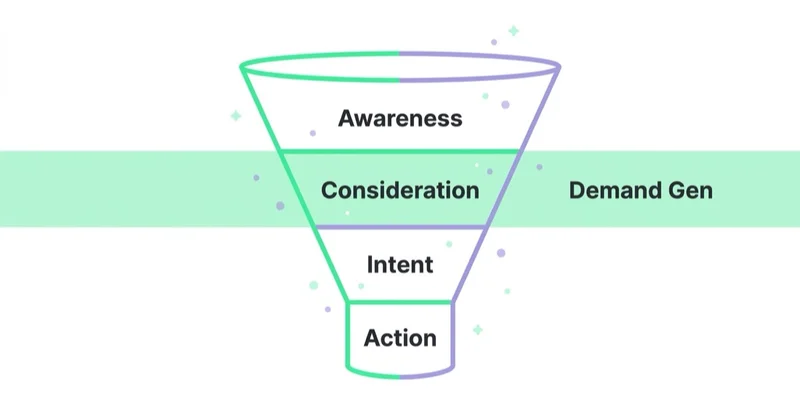
Top of funnel
Use Demand Gen to introduce:
- a new brand;
- a product category;
- a seasonal collection;
- a use case;
- a campaign message;
- a content asset;
- a new service.
Middle of funnel
Use Demand Gen to nurture:
- site visitors;
- product viewers;
- YouTube engagers;
- customer lists;
- lookalike audiences;
- people comparing options.
Bottom of funnel
Demand Gen can drive conversions, but it usually should not be judged in the same way as high-intent Search. It works best when tracking, creative, audience signals and landing pages are strong.
Demand Gen vs Search
Search captures active intent. Demand Gen creates or strengthens demand.
| Area | Search | Demand Gen |
|---|---|---|
| User intent | User types a query | User browses, watches or discovers |
| Main input | Keywords, ads, landing page | Creative, audiences, feeds, signals |
| Best for | Existing demand | Creating and expanding demand |
| Creative role | Text-heavy | Visual and video-heavy |
| Evaluation | Often direct conversion and CPA | Conversion, assisted impact and new demand |
Search is usually closer to the buying decision. Demand Gen can expand the pool of people who later search, return or convert through other campaigns.
Demand Gen vs Performance Max
Demand Gen and Performance Max are not the same.
| Area | Demand Gen | Performance Max |
|---|---|---|
| Main role | Visual demand creation and engagement | Automated performance across Google inventory |
| Creative control | More visible creative/audience planning | Broader automation and asset groups |
| Audience use | Strong role for audience themes and lookalikes | Audience signals guide automation |
| Ecommerce role | Product discovery, prospecting and remarketing | Shopping-led scale and cross-channel performance |
| Best when | Creative story and audience hypothesis matter | Conversion volume and feed/asset automation matter |
In many accounts, Demand Gen supports Performance Max by creating awareness, engagement and product interest before users convert later.
Read Performance Max Campaigns: What to Know and How to Create Them for the wider automation context.
When to use Demand Gen
Demand Gen is worth testing when:
- the product or service benefits from images or video;
- the brand needs demand beyond existing search volume;
- the category is visual or lifestyle-driven;
- there is strong first-party audience data;
- remarketing lists are large enough;
- creative assets are available;
- the landing page tells a clear story;
- the store or offer can handle mid-funnel traffic;
- Search and Shopping are already limited by demand or competition.
Examples:
- launching a new fashion collection;
- promoting a beauty routine;
- showing software use cases;
- remarketing to cart abandoners;
- promoting a lead magnet;
- re-engaging previous buyers;
- introducing a new service category;
- using customer lists to find similar users.
When Demand Gen may be a poor fit
Be careful when:
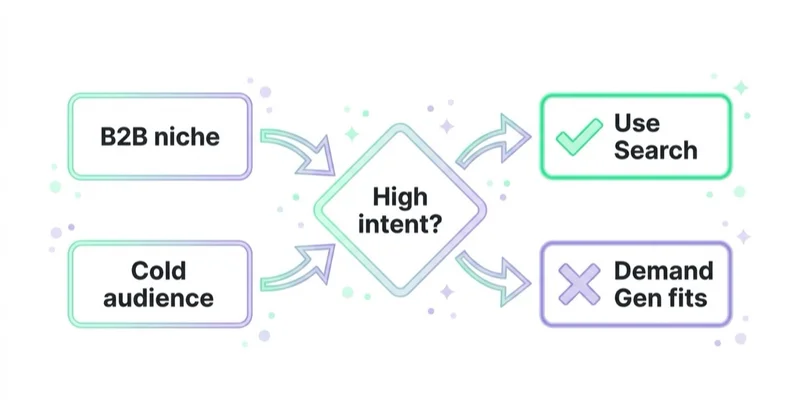
- there is no strong creative;
- conversion tracking is weak;
- the offer needs urgent high-intent search only;
- the budget is too small for learning;
- the landing page is generic;
- the product requires long education but the creative does not explain it;
- the business expects Search-like CPA immediately;
- there is no way to evaluate assisted impact.
Demand Gen is not a magic campaign type. Weak creative, weak measurement and weak offers usually produce weak results.
Campaign setup: practical steps
1. Choose the goal
Google's campaign creation flow supports goals such as sales, website traffic, product and brand consideration or creating a campaign without a goal's guidance.
Choose based on the real business objective, not on what sounds broad.
2. Define audience strategy
Audience strategy may include:
- first-party customer lists;
- website visitors;
- cart abandoners;
- YouTube engagers;
- custom segments;
- in-market or affinity-style themes;
- lookalike segments;
- optimized targeting.
Separate audiences only when they need different creative, bid targets or measurement. Over-segmentation can reduce learning volume.
3. Prepare creative assets
Demand Gen needs strong visual inputs.
Prepare:
- short videos;
- vertical video for Shorts-style environments;
- square and landscape images;
- lifestyle imagery;
- product imagery;
- logo assets;
- headlines;
- descriptions;
- calls to action;
- carousel concepts;
- product feed assets where relevant.
Google's own best practices emphasise creative diversity, Ad Strength and using image and video together where possible.
4. Build landing pages
The landing page should match the creative promise.
If the ad introduces a product collection, the landing page should show that collection. If the ad promotes a guide, the page should deliver the guide. If the ad uses a product feed, product pages should be accurate and mobile-ready.
5. Set bidding and budget
Demand Gen can use conversion-oriented bidding, but the campaign needs enough data to learn.
Google's campaign creation guidance recommends allowing around 50 conversion events before making bidding changes. Its best-practice guidance also highlights sufficient budget for target CPA and target ROAS strategies.
Do not change bidding every day because early results feel uneven. Learning volatility is normal.
6. Review and launch
Before launch:
- check final URLs;
- check policy approval;
- test conversion tracking;
- verify product feed if used;
- confirm audiences;
- confirm budget;
- check location and language settings;
- check creative quality on mobile;
- document the test hypothesis.
Creative strategy
Demand Gen creative should be native to visual discovery.
Strong creative usually:
- shows the product or outcome quickly;
- uses a clear first frame;
- explains the value proposition fast;
- matches the platform format;
- includes brand cues early;
- uses mobile-safe text;
- has a clear CTA;
- avoids tiny text on images;
- shows real use cases;
- tests multiple angles.
Weak creative often:
- looks like a generic banner;
- hides the product;
- uses stock imagery;
- depends on too much text;
- has no clear audience;
- sends users to a mismatched landing page;
- copies social creative without adapting it.
Demand Gen should borrow the best lessons from paid social while respecting Google's placements and user context.
Ecommerce use cases
For ecommerce, Demand Gen can support:
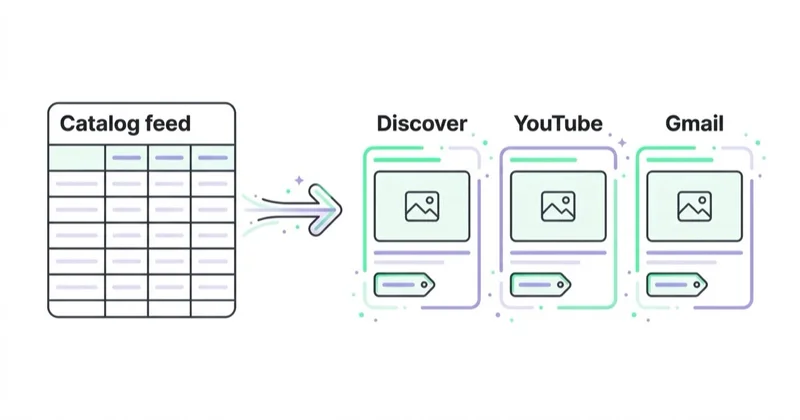
- new collection launches;
- product discovery;
- seasonal promotions;
- visual categories;
- repeat purchase campaigns;
- remarketing;
- cart abandonment;
- product feed campaigns;
- customer list reactivation;
- mid-funnel education.
It should not replace a clean product feed, Shopping campaigns or Performance Max. Product titles, images, prices, availability and landing pages still matter.
For feed foundations, read What Is Google Merchant Center and How to Manage It? and How to Write a Product Description That Sells and What It Must Include.
Lead generation use cases
For lead generation, Demand Gen can promote:
- demo requests;
- webinars;
- reports;
- consultations;
- calculators;
- case studies;
- free audits;
- comparison guides.
The risk is lead quality. A campaign can generate cheap leads that do not become opportunities. Measure lead status, qualification and pipeline, not only form submissions.
How to measure Demand Gen
Measure based on role.
For direct response:
- conversions;
- conversion value;
- CPA;
- ROAS;
- lead quality;
- revenue;
- new customer share.
For mid-funnel:
- engaged sessions;
- product views;
- add-to-cart rate;
- assisted conversions;
- remarketing audience growth;
- branded search lift;
- return visits;
- YouTube engagement;
- view-through or impression-assisted trends where appropriate.
For creative:
- asset performance labels;
- CTR;
- view metrics;
- conversion by creative theme;
- landing page behavior;
- audience-level performance.
Avoid judging a demand-building campaign only on last-click revenue after a few days.
How we approach this at Space Ads
We run this as Demand Gen now, the successor to Discovery, and use it to reach people before they start searching rather than to harvest demand that already exists. Strong, native creative and good audience signals do the heavy lifting here: they decide who the system puts the ad in front of. The real difference is in how it's judged. Held to the same yardstick as Search — last-click cost — Demand Gen almost always looks weak, simply because it works earlier in the journey. We read its assisted impact and whether sales actually rose, not just the final click; otherwise it's easy to kill a campaign that was quietly driving results everywhere else.
Common mistakes
| Mistake | Why it hurts | Better approach |
|---|---|---|
| Treating Demand Gen like Search | Wrong expectations and creative | Plan for visual discovery |
| Using weak banners | Low attention | Use product, outcome and native visual assets |
| No video | Limits storytelling potential | Test short vertical and square video |
| No conversion QA | Algorithm optimises on bad signals | Test events before launch |
| Changing bids too early | Learning resets or noise increases | Wait for enough data |
| Tiny audience splits | Low learning volume | Consolidate where possible |
| Generic landing page | Message mismatch | Match ad promise to page |
| Ignoring product feed quality | Ecommerce performance suffers | Fix Merchant Center data |
| Measuring only last click | Underestimates demand creation | Include assisted and delayed impact |
Demand Gen checklist
Before launching:
- The role of the campaign is clear.
- Search, Shopping and Performance Max roles are understood.
- Conversion tracking is tested.
- Value tracking is configured where relevant.
- Audiences are meaningful.
- First-party data is prepared if available.
- Creative includes images and video where possible.
- Product feed is clean if used.
- Landing pages match creative.
- Budget is sufficient for learning.
- Reporting includes delayed and assisted impact.
- The test will run long enough to be meaningful.
FAQ
Do Google Discovery campaigns still exist?
Discovery campaigns should be treated as a legacy concept. For new planning, use Demand Gen campaigns in Google Ads.
Is Demand Gen the same as Discovery Ads?
Demand Gen evolved from and replaced the older Discovery campaign concept, but it is broader and more central to Google's visual and video demand-generation strategy.
Where do Demand Gen ads appear?
Demand Gen can appear across surfaces such as YouTube, Discover and Gmail, with inventory depending on settings and Google's evolving campaign coverage.
Is Demand Gen good for ecommerce?
Yes, especially for visual products, launches, product discovery, remarketing and customer reactivation. It should work alongside Merchant Center, Shopping and Performance Max rather than replacing them.
Is Demand Gen good for B2B?
It can be, especially for education, lead magnets, webinars, case studies and remarketing. Lead quality must be measured beyond simple form volume.
Should Demand Gen replace Search?
No. Search captures active intent. Demand Gen creates or strengthens demand. The two roles are different.
How long should a Demand Gen test run?
The campaign should run long enough to leave the learning phase and gather meaningful conversion or engagement data. Google's guidance often references around 50 conversions before major bidding changes.
What is the biggest Demand Gen mistake?
The biggest mistake is launching with weak creative and judging the campaign like Search. Demand Gen needs visual storytelling, clear audiences, strong landing pages and realistic measurement.
Conclusion
Discovery campaigns are now best understood as the historical foundation for Demand Gen. The modern campaign strategy should focus on Demand Gen: visual creative, audience signals, product feeds, bidding, landing page continuity and measurement across the customer journey.
Demand Gen is not a direct replacement for Search or Shopping. It is a way to create and nurture demand across Google's visual surfaces. Used well, it can expand reach, build product interest and support later conversions. Used poorly, it becomes expensive display-style traffic with weak intent.
The difference is preparation: strong creative, clean measurement, clear role in the account and enough patience to evaluate the campaign properly.
We run Discovery and Demand Gen as part of a broader strategy within Google Ads campaigns — from creative to audiences.
Sources and further reading
- Google Ads Help: About Demand Gen campaigns
- Google Ads Help: Create a Demand Gen campaign
- Google Ads Help: Best practices for high-performing Demand Gen campaigns
- Google Ads Help: Video action campaigns are being upgraded to Demand Gen
- Google Blog: Google Display Ads has a new home in Demand Gen
- Google Ads: Demand Gen campaigns
Continue learning
- What Is a Demand Gen Campaign in Google Ads and How to Launch One
- Performance Max Campaigns: What to Know and How to Create Them
- What Is Google Merchant Center and How to Manage It?
- What Are Responsive Search Ads in Google Ads?
- What Is a Google Ads Audit and How to Do It?
- How to Use Google Data Studio (Looker Studio)
Continue reading
Margin-Based Conversion Value in Google Ads: When Ecommerce Should Use It
If Google Ads receives gross revenue as conversion value, value-based bidding optimises toward gross revenue. For ecommerce stores with different product margins, a value closer to gross margin or contribution margin can give Shopping and Performance Max a better signal.
Returns and Conversion Adjustments in Google Ads for Ecommerce
Returns, cancellations and partial refunds change the real value of ecommerce orders after the purchase. If Google Ads only sees gross revenue from the conversion day, campaigns can optimise toward products that look efficient before returns but weak after them.
How to Use Google Shopping Campaigns Effectively?
Google Shopping performance depends on Merchant Center health, feed quality, campaign structure, margin, stock, landing pages and measurement, not bidding alone. This guide explains how to use Shopping, Standard Shopping and Performance Max so product budget follows profitable demand rather than the whole catalogue equally.